Amit Sharma, Gesa Praetorius, Reto Weber, Scott N MacKinnon, Bjørn Sætrevik (2025). From ship to shore: Understanding Cognitive Challenges in Remote Pilotage Operations. In: Advances in Human Factors of Transportation. AHFE Open Access, vol. 186, pp. 601–610. https://doi.org/10.54941/ahfe1006550
Pilotage is one of the foremost safety measures provided by coastal states to ensure safe and efficient movement of vessels to ports. Pilotage is conducted by experienced navigators with expert knowledge of the local navigational landscape and traffic flows. Traditionally, pilots board a vessel and remain physically co-located with the ship’s bridge team throughout the operations. In recent years, several research projects have explored the possibility of remote pilotage, where the pilot can perform the same functions while being located on shore. These developments are largely driven by the technological advances enabling novel modes of communication and information exchange. In this study, we report findings from six semi-structured interviews with pilots who are being trained in remote pilotage operations in a Scandinavian port. The results highlight cognitive challenges that the participants experience as pilotage operations are reimagined to be conducted from a shore station. While this study is focused on pilotage, the identified challenges also highlight potential risks for and may inform the design of remote vessel control, e.g. for maritime autonomous surface ships.
Pilotage refers to the phase of navigation where a vessel is navigating in close vicinity of the shoreline, going either inbound to the port or outbound to open waters (Sharma et al., 2019). These tasks are undertaken jointly by the ship’s bridge team along with an experienced navigator, who is knowledgeable about the navigation process for the port of call – often referred to as the “pilot”. While the captain remains responsible for the safe conduct of the ship, in practice their manoeuvring to an extent relies on the advice of the pilot.
Pilotage is considered as a safety-critical operation both because it concerns navigation in restricted waters, and as it requires a pilot to physically embark or disembark while the vessel is underway. Several incidents in recent years
(Safety4Sea, 2024; BBC, 2023; CruiseMapper, 2023) show that the transfer to and from the pilot boat is risky.
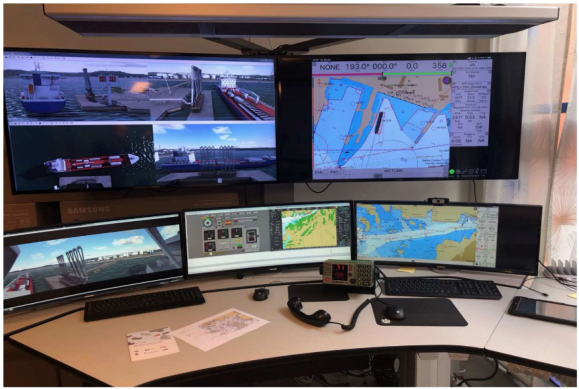
Due to the above-mentioned operational challenges and because of the novel technological affordances, the concept of “remote pilotage”(or “shore- based pilotage”) is gaining increased interest (Ujkani et al., 2024; Heikkila et al., 2024). The concept of remote pilotage, however, is not new in the maritime industry. Early efforts to remotely guide the vessels during coastal phases of navigation can be dated back to 1960s when a combination of VHF radio communication and radar images were utilized (Lahtinen et al., 2020). In the subsequent years, remote pilotage was adopted in certain geographical regions to various degrees, depending on the overall acceptance of the practice and the availability of technological solutions. Figure 1 below provides an example of workstation for remote pilotage.
Figure 1: An example of remote pilotage workstation.
Bruno and Lützhöft (2009) described pilotage in terms of maintaining control in a complex socio-technical system with human and technological artefacts. Since the remote pilotage operation will invariably result in the situation where the control will be split between ship and shore, they implied that it could be a less effective mode of maintaining control over the vessel trajectory. They further argued that challenge to maintain control over the vessel in remote pilotage can be resolved by four principal ways: (1) Providing extra information to a ship’s bridge team, (2) Restrictions on the types of ships that can avail this service, (3) Improved feedback to the shore-based pilot and (4) Standardization of procedures and communications.
In this regard, it is particularly important to understand the human factors challenges for the pilots who will be involved in remote operations from shore as compared to onboard ships. The transfer of pilot’s location from ship to shore, while addressing the some of the issues related to conventional pilotage, also requires taking into account new set of tasks for
From Ship to Shore: Understanding Cognitive Challenges in Remote Pilotage Operations 603
the remote pilot. Being removed from the physical presence on ship would mean that the information obtained by the pilots is indirect and often limited. This could interfere with the pilot’s ability to anticipate several variables related to ship’s immediate environment and develop their “ship sense” (Prison et al., 2013). Furthermore, communication and coordination are also important aspects of exerting control and exchanging relevant navigation information between the pilot and the bridge team. Gralak (2010) argued that remote pilotage situation could lead to a more than average level of communication occurring during manoeuvring phase, thereby increasing probability of miscommunication and errors. The work profile of pilots involved will be markedly different in the scenario of remote pilotage. The skillset requirements, information needs, and operational procedures, therefore, will also differ significantly. Porathe (2021) has discussed the general challenges regarding keeping the remote operators in the loop during navigation operations and the need to prevent deskilling in the long term.
Understanding the human factors challenges could further aid the efforts of all the maritime stakeholders in making remote pilotage viable both in terms of safety performance and optimum use of technology. The present paper contributes to a small but growing set of studies conducted recently which discussed various human factors challenges with respect to adaption of remote pilotage as perceived by the pilots themselves (Lahtinen et al., 2020; Salonen et al., 2020; Berlin and Praetorius, 2023). Specifically, in the present paper we focus on the cognitive challenges that may arise when pilotage operations are reimagined to be conducted from shore in contrast to the pilots being physically co-located at the ship’s bridge.
METHOD
This study explored the feasibility of remote pilotage in a Scandinavian port, by examining necessary investment in infrastructure, technological solutions and training of pilots for the new roles. A total of 6 experienced pilots were interviewed employing a semi-structured format.
Participants The age of participants ranged from 40 to 59 years with the mean age being 50 years (SD = 7.5). The total experience in years of the participants ranged from 19 to 35 years with the mean total experience as 29.1 years (SD = 5.8). The experience as a pilot of the participants ranged from 4 to 20 years with the mean experience of as 11.6 years (SD = 7.1). The participants were recruited based on their qualifications as remote pilot in training. The sample was a small but highly specialized group. The prefix of Remote Pilot (RP) 1–6 are used as annotation within the result section.
Semi-Structured Interviews The interviews were conducted as a part of an ongoing research project with the broader aim of evaluating the feasibility of enabling remote pilotage for the port in question. The data collection took place between September and November 2024.
The principle of informed consent was followed while conducting the interviews and all the respondents received an information letter describing their details, project objectives and how their data will be stored and processed by the researchers. The respondents were asked certain demographic questions before the interview. With respect to the actual interview questions, the respondents were asked regarding the overall structure of their tasks, the role of experience, situational awareness, decision making strategies and other related themes related to their cognitive processes.
The participants highlighted several cognitive challenges that arise in the work as remote pilot. Some of the emergent cognitive challenges as mentioned by the remote pilots were – challenges related to perception of information, communication, monitoring and regulating their performance. Each of these factors are further described in the sections below.
Perception The most evident challenge when considering the scenario of remote pilotage in contrast to conventional pilotage is the lack of physical co-location of the pilot with the ship’s bridge team. It therefore raises apprehension regarding the accuracy and quality of information and navigation parameters for the remote pilots. One of the predicaments in such situation for remote pilots is the difficulty to evaluate the quality of information they are receiving, as they are unable to visually confirm the same from their remote stations. This issue was raised by several of the respondents.
“There are two different ways, either the data is right, and I am doing something wrong, or [it is a situation] where there is an error in the data.” (RP1) The remote pilots also mentioned challenges with respect to the data not being perfectly synchronized or having a time-lag, when presented in the shore station. This could create challenges in decision making.
“If you have an increase in the wind, you immediately notice it if you’re [on board], but it will take, you some time to understand that what happened if you’re not [on board].” (RP5)
From Ship to Shore: Understanding Cognitive Challenges in Remote Pilotage Operations 605
Remote pilot 3 remarked that in contrast to being located on board, being on shore meant that the pilots are reliant on only the readouts from a set of screens available to them.
“You don’t have your normal senses like vision, hearing and perception of the surroundings. You are completely reliant on technical two-dimensional screen or whatever.” (RP3) Some of the remote pilots remarked that they would like to see an exact replica of the information that was presented to the members of the bridge team – at least with respect to the readouts from the bridge equipment, even if direct visual confirmation is not possible.
“I would like to be able to see the same monitor that the ship has in real time on my screen, so, I would like to see their charts, I would like to see their radar, I would like to see the engine panel, I would like to see the rudder indicator and the rate of turn, I would like to see what they see, and of course that could be done in different ways.” (RP6) Communication
Another aspect of remote operation which emerged during the interviews with the remote pilots was challenges related to communication with the ship. Their approach to communication in remote pilotage scenarios, while building on their conventional pilotage experience, also differed with the added consideration of safety and precaution margins required.
“If you have lots of ships at the same spot, then you need to make clear some kind of strategy with several parties involved, you have to make a priority list, who to speak to first.” (RP1) RP 1 further emphasized that his approach is to always think ahead and have multiple contingency plans available which will also be the case in remote pilotage scenarios.
“We are not talking about right or wrong in this situation, we are just talking about doing this safe, and have a plan B, maybe even a plan C.” (RP1) RP 5 similarly remarked about having good communication with other vessels in the traffic environment to avoid complications.
“To improve safety of pilotage operation, you have to have good communication with other ships. What could be a challenge for the remote pilot is to know which one is relevant.” (RP5) Similarly, RP 6 explained that he likes to proactively contact the ships he is advising in case of perceived scenario development or conflicting information being received on his end:
“When I see that something might be off, I talk to the captain or the officer on watch and say that my system is sending me this is this really correct and if they say yes, that is correct, then I can take action.” (RP6)
However, he also argued that there should be a balance in the number of times a pilot has to communicate with the ship they are advising.
“There is a sweet spot, you need to be in good level with the communication, not too much, not too little.” (RP6) Monitoring and Regulation
A challenge for remote pilots in shore-based pilotage scenario is also to monitor the navigation progress from afar, with relatively limited information at their disposal coupled with the need to perpetually make sense of the traffic scenarios unfolding. The remote pilots mentioned a variety of ways they employ to cater for the same.
“I use various kinds of checkpoints, for example, when doing a longer turn to determine if we are turning fast enough or too slow. And by using these checkpoints, I can see that we turned too late, or we turned too early, then I need to change the turn rate to end up in the correct position at the end of the turn.” (RP3) The RP 2 argued that one has to continuously monitor the progress of the task and compare with the agreed plan.
“I think that you are self-monitoring all the time more or less. You want to be in a specific spot that you have in your head.” He went on to add: “It is a continuous process of self-assessments.” (RP2) RP 5 stated that he tries to make a mental note in the beginning of the pilotage as to how the ship and its equipment are influencing manoeuvring because he will need to correspondingly adapt to deliver safe performance.
“If I can see that one ship is hard to steer, for instance, then I got clue that the rudder might be very small and there will be problem to manoeuvre later on. I guess that will be hard to understand, if you’re [a shore-based pilot].” (RP5) RP 6 stated that the act of guiding the ship from shore can lead to narrow tunnel vision, which might be posing operational challenges for the pilot and could be something difficult to manage.
“You are only focused on specific data; this is creating difficulty and it’s challenging, because it can take focus off different things.” (RP6) He continued on to mention that with such an arrangement, it could sometimes feel to be under-utilized as an operator:
“As [a shore-based] pilot we are looking at that number every five seconds and so it’s a big difference in the self-monitoring; I am looking at screen and so and I don’t feel that my experiences and my knowledge as a pilot is working at full length, I am not using my whole set of skills.” (RP6)
DISCUSSION
The aim of this study has been to explore the cognitive challenges that may arise when moving a pilot from ship to shore. The results indicate that
From Ship to Shore: Understanding Cognitive Challenges in Remote Pilotage Operations 607
the physical move also creates a novel role for the pilot in the bridge-team which leads to the need to redefine and reinvent current work strategies. The experienced pilots in this study highlighted the increased dependence on information sources, the increased need to monitor and increased need to compensate for “lost” senses through novel strategies and work tasks.
The fundamental premise for using remote pilotage in maritime navigation is that it should be equally safe or safer than conventional pilotage (Hadley, 1999). The relocation of pilot to the shore station eliminates some of the risks related to transporting and boarding the pilot. However, it may introduce other operational challenges in terms of perception of information, communication, traffic resolution and meaningful engagement for the pilots..
The advances in technology, business model demands, and logistical considerations have been the primary driving force for the possibility of remote pilotage (Lahtinen et al., 2020). However, as can be seen in this study, it could still fall short of providing a substitution to the physical presence of a conventional pilot. This can be attributed to the fact that the remote pilots are not able to immediately perceive the changes in ship’s parameters such as speed, heading, rate of turn, as well as the impact of weather elements. Piloting changes from being proactive to a reactive task, where the pilots are depending on feedback from the bridge-team to double-check and confirm the information that is available to them.
The pilots also indicated that to a certain degree, these problems could be minimized if the required information is replicated with similar interfaces at their end and with minimum time lag. The presence of a pilot on board the ship’s bridge, in addition to facilitating the pilotage operations, also provides a measure of redundancy in the bridge team as they can independently verify the ship’s parameters. To mitigate the risk of losing this level of redundancy during pilotage, the availability of information to the shore-based pilots should adequately be enhanced in quality and reliability.
In addition to not being able to perceive the ship’s parameters and other related information immediately, the other challenge is that the remote pilots are also not able to communicate with the ship’s bridge team to the same degree as being physically co-located with them. The remote pilots mentioned that to address this, they plan and prioritize the information exchange they would like to have with the vessels. The advent of fifth generation of wireless technology (5G) has presented new modes of oral communication during pilotage, in addition to Very High Frequency (VHF) radio channels. Additional measures such as prior route information exchange using decision support systems and the use of Portable Pilot Unit (PPU) can further facilitate the planning process (Westin and Lundberg, 2025). The challenges related to communication can therefore be mitigated to a certain extent when considering the remote pilotage scenarios.
The transition from a very active role on board the ship, to a relatively passive role on a shore station was also mentioned by the pilots as an aspect requiring further consideration. In addition to technological or design solutions to supply the remote pilots with information and mechanisms to meaningfully engage their attention, organizational solutions such as
alternating the shifts as conventional pilot and remote pilot roles could prevent loss of skills and local expertise.
The expertise of pilotage is built through on the job knowledge and experience over an extended period of time (Berlin and Praetorius, 2023). A possible reason for cognitively demanding nature of remote pilotage can therefore be attributed to the fact that, while information might still be replicated at the shore end, clearly outlined work strategies and experience specific for the role are still under development. Furthermore, the information which is available to the remote pilots also needs to be reliable, as it is being perceived indirectly.
All ports have different characteristics in geography, infrastructure and economic activities. The decision to use remote pilotage as a solution will certainly depend upon various and often interdependent factors specific to each port. However, the human factors challenges remain mostly similar in each case, where it is planned to split the control and decision-making aspects between the ship’s bridge and a shore control station.
Although the findings from the study are related to remote pilotage operations, the cognitive challenges described in the study will also be similar for Remote Operation Centre (ROC) operators of autonomous or semi- autonomous ships. The ROC operator will have similar issues related to lack of physical co-location with the ship’s bridge team, indirect communication modes and remodelled work tasks with dominant periods of relatively less activity. The findings from this study are therefore also relevant for functions of the ROC operators and challenges they might encounter.
One of the limitations of the current study is that the data collection had relatively few participants. However, at the time of data collection, the sample represented the entire population of the qualified remote pilots for the particular port. The limitations related to qualitative nature of the investigation and subjective process of data analysis and interpretation should also be acknowledged. Therefore, the results should be viewed in limited context, and we should avoid over-generalizing from the findings. Further analysis of the data transcripts is ongoing, and it is expected that a cognitive demands table will emerge as an output which can further aid in analysing the remote pilotage operations. The preliminary results were utilized in understanding some of the emergent cognitive challenges mentioned by the pilots when undertaking remote pilotage operations.
CONCLUSION
In the era of increased digitalization and automation of maritime navigation, remote pilotage operation is presented as one possible solution allow the pilot for advising the vessels through a shore control station, thereby reducing the need for them to have a physical presence on the ships bridge itself. The present study contributed to this discourse by selecting a Scandinavian port as a relevant case. The interviews of experienced pilots who are being trained for the role of remote pilots, attempted to bring forward their perspective, concerns and reflections about remote pilotage operations at large. The preliminary results suggest that while remote pilotage can mitigate the risks
From Ship to Shore: Understanding Cognitive Challenges in Remote Pilotage Operations 609
related to physical exposure to hazardous conditions for the pilots, the remote operations present them with certain novel and additional challenges. The challenges related to perception of relevant ships parameters and other elements, the need for proactive communication and concerns regarding performance regulation and monitoring at shore station were listed. Future research is being directed to formulate a cognitive demands table which can in turn assist in devising required interfaces and areas where additional training could be targeted for ensuring optimal performance and safe outcomes.
ACKNOWLEDGMENT
The authors would like to thank the participants in the study for their participation and insights. We would also like to acknowledge support from the project – Navigation support from shore (Navigationsstöd från land - TRV2021/11826) led by the Swedish Maritime Administration. The first author would like to acknowledge support from the Shaping European Research Leaders for Marine Sustainability (SEAS) program under the European Union’s Horizon 2020 Framework for Research and Innovation, with the Marie Skłodowska-Curie agreement No. 101034309.
REFERENCES
BBC. (2023). Pilot dies after falling into Humber. Retrieved from: https:// www.bbc.com/news/uk-england-humber-64223424. Berlin, C., Praetorius, G. (2023). Applied Cognitive Task Analysis (ACTA) of Marine Piloting in a Swedish Context. Proceedings of the 14th International Conference on Applied Human Factors and Ergonomics and the Affiliated Conferences, San Francisco, USA. Vol. 95, pp. 709–718. Bruno, K., Lützhöft, M. (2009). Shore-based pilotage: Pilot or autopilot? Piloting as
a control problem. The Journal of Navigation, Vol. 62. No. 3. pp. 427–437. doi: https://doi.org/10.1017/S0373463309005335. CruiseMapper. (2023). Nagasaki Port pilot dies on Diamond Princess ship. Retrieved from: https://www.cruisemapper.com/news/11803-nagasaki-port-pilot- dies-diamond-princess-ship. Gralak, R. (2010). Analysis of methods for communication the navigational informations in the Remote Pilotage System. Zeszyty Naukowe Akademii Morskiej w Szczecinie, Vol. 20 No. 92. pp. 25–32. Hadley, M. (1999). Issues in remote pilotage. The Journal of Navigation, Vol. 52.
No. 1. pp. 1–10. Heikkilä, M., Himmanen, H., Soininen, O., Sonninen, S., Heikkilä, J. (2024).
Navigating the future: Developing smart fairways for enhanced maritime safety and efficiency. Journal of Marine Science and Engineering, Vol. 12. No. 2. p. 324. Lahtinen, J., Banda, O. A. V., Kujala, P., Hirdaris, S. (2020). Remote piloting in an intelligent fairway: A paradigm for future pilotage. Safety Science, Vol. 130. p. 104889. https://doi.org/10.1016/j.ssci.2020.104889 Prison, J., Dahlman, J., Lundh, M. (2013). Ship sense—striving for harmony in ship
manoeuvring. WMU Journal of Maritime Affairs, Vol. 12. pp. 115–127. Porathe, T. (2021). Human-automation interaction for autonomous ships: Decision support for remote operators. TransNav: International Journal on Marine Navigation and Safety of Sea Transportation. Vol. 15. No. 3.
Sharma, A., Nazir, S., Ernstsen, J. (2019). Situation awareness information requirements for maritime navigation: A goal-directed task analysis. Safety Science, Vol. 120. pp. 745–752. https://doi.org/10.1016/j.ssci.2019.07.034 Safety4Sea. (2024). Maritime pilot loses life after falling into Bosphorus. Retrieved from: https://safety4sea.com/maritime-pilot-loses-life-after-falling-into- bosphorus/. Salonen, T., Wahlström, M., Karvonen, H. (2020). Designing a remote-pilotage
system: work styles to be considered. In 8th Transport Research Arena, TRA 2020-Conference Cancelled. Finnish Transport Agency (pp. 235–236). Tunçel, A. L., Akyuz, E., Arslan, O. (2023). Quantitative risk analysis for operational transfer processes of maritime pilots. Maritime Policy & Management. Vol. 50. No. 3. pp 375–389. https://doi.org/10.1080/03088839.2023.2162345 Ujkani, A., Hohnrath, P., Grundmann, R., Burmeister, H. C. (2024). Enhancing
Maritime Navigation with Mixed Reality: Assessing Remote Pilotage Concepts and Technologies by In Situ Testing. Journal of Marine Science and Engineering, Vol. 12. No. 7. p. 1084. Westin, C., Lundberg, J. (2025). A survey on Swedish maritime pilots’ trust, training, understanding, and use of the portable pilot unit’s predictor automation. Cognition, Technology & Work, pp. 1–21.
LISTED IN THE AHFE DIGITAL BOOKSTORE CATALOGUE
Explore the complete digital volume
Advances in Human Factors of Transportation
Read this individual research paper free through the original publisher, or explore the full digital proceedings book.
ISBN 978-1-964867-62-5
Explore this ISBN in the AHFE Bookstore ↗Listed in the July 2026 bookstore catalogue; search by ISBN to confirm current availability · Digital book purchase optional