Cecilia Berlin, Gesa Praetorius (2023). Applied Cognitive Task Analysis (ACTA) of marine piloting in a Swedish Context. In: Human Factors in Transportation. AHFE Open Access, vol. 95, pp. 709–718. https://doi.org/10.54941/ahfe1003856
1 Chalmers University of Technology, Department of Industrial and Materials Science, Division of Design and Human Factors, Hörsalsvägen 5, 41296 Göteborg, Sweden ↗
2 Swedish National Road and Transport Institute (VTI), Olaus Magnus väg 35, 581 95 Linköping, Sweden ↗
Modern-day marine pilots are a competent and experienced workforce. They are highly skilled navigators that support the merchant fleet in transiting through challenging sea areas and rivers, as well as in the navigation in and out of ports. In this study, Applied Cognitive Task Analysis (ACTA) was used to pursue a deeper understanding of expertise and tacit or procedural knowledge that experts rely on and exhibit, mostly in safety-critical situations. ACTA is a structured interview method, which relies on three distinct phases: a task diagram, a knowledge audit and a simulation interview. In this article, results from the first two interview steps are presented to show the intricate complexity of pilotage and building blocks of expertise within marine pilotage. A total of eight experienced pilots from two different port areas in Sweden were interviewed. The results show that there are large differences in how pilotage is conducted in the two areas with regards to both tasks, knowledge and understanding of the service as such. Further, despite recognizing maneuvering as cognitively demanding, the pilots emphasized social skills and learning on the job as key elements of expertise. Conclusions drawn from the ACTA structure highlight the mentally and socially complex task that piloting is, and that the pilots use great discernment and acuity when processing verbal and non-verbal input, as well as physical human and vessel movements.
Marine pilotage is one of the foremost safety measures within maritime tran- sportation. Marine pilotage is carried out by marine pilots in areas that are challenging to navigate in, such as port approaches or other sensitive sea areas (National Research Council, 1994). Pilots usually are experienced navigators who support the bridge-team of a vessel with their local expertise, and ease the communication flow between shore-based services such as Vessel Traf- fic Services (VTS), linesmen or tugboats (Darbra et al., 2007). In Sweden, pilotage is offered by the Swedish Maritime Administration, which employs 230 marine pilots who offer nautical expertise and detailed knowledge of local circumstances to ensure a safe and expedient passage in Swedish waters (Swedish Maritime Administration, 2023).
While pilotage’s and marine pilots’ contribution to safety within maritime operations have been the focus of several studies throughout the past deca- des (e.g. Darbra et al., 2007; Bruno and Lützhöft, 2009; Lahtinen et al., 2020), only a limited number of studies have explored task design, know- ledge and expertise in this domain (e.g. Orlandi, Brooks and Bowles, 2015; Butler, Read and Salmon, 2022). Therefore, little is known about what cha- racterizes expertise and expert knowledge within this domain. This study contributes to the current body of knowledge by utilizing an adapted version of the Applied Cognitive Task Analysis (ACTA) framework (Militello et al., 1997; Militello and Hutton, 1998) to pursue a deeper understanding of what types of cognitive skills marine pilots rely on and exhibit when solving tasks, mostly in safety-critical situations. While, to the best of our knowledge, the application of ACTA within maritime settings has been rare so far (e.g. Brodje et al., 2013), we believe that this structured approach can shed light on the complexity of everyday work and help to identify what characterizes exper- tise in marine pilotage. Within this article, we will focus only on the results obtained during stages one (task diagram) and two (knowledge audit) of the ACTA, due to limitations of paper length.
METHODOLOGY
This study has utilized an adapted version of the Applied Cognitive Task Analysis (ACTA) framework (Militello et al., 1997; Militello and Hutton, 1998) to explore everyday work of marine pilots. The ACTA method, deve- loped in the late 1990s, can be described as a structured interview approach to identify cognitively demanding aspects of subject matter expert (SME) work within high-risk domains, such as firefighting or nursing. Rooted in the fra- mework of naturalistic decision making (NDM), the method explores critical decisions and the use of information within dynamic environments with the aim to provide input into design and training.
ACTA is split into three data collection stages and one analytical stage. The first stage (task diagram) aims to establish an overall, high-level description of the task at hand; the second (knowledge audit) explores specific sub-tasks that the participant considers particularly mentally demanding, probing spe- cific behaviors that are associated with expertise; the third stage (simulation interview) takes the participant through a simulated task (in this case, maneu- vering to berth) in several steps, inquiring about what course of action they would take based on available information, and introducing situations that require intentional decision-making. This last data collection stage was sup- ported in this study by mediating objects (i.e. visual aids such as printed sea charts, visual scene renderings from a simulator, and a model boat) to focus the discussion. The analysis of the structured interview is carried out in the fourth phase, called the Cognitive Demands Table (Militello et al., 1997).
After a pilot interview with an experienced maritime simulator instructor and former pilot was held, the authors found that purely using the ACTA guide as a linear manuscript for probing each stage and situation in turn was quite cumbersome, repetitive and time-consuming. The pilot interviewee also questioned the applicability of some particular probing questions, since
Applied Cognitive Task Analysis (ACTA) of Marine Piloting in a Swedish Context 711
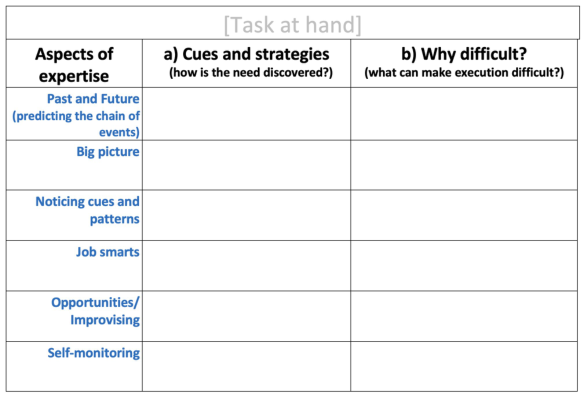
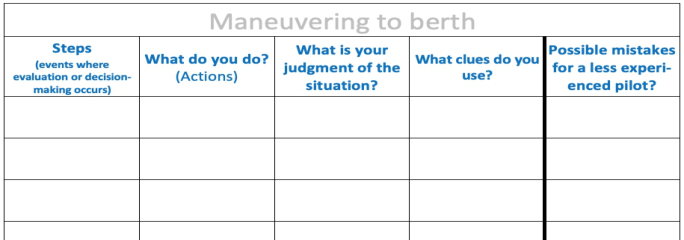
most piloting assignments are not standardized in execution. To address these issues, the authors produced a complementary visual template in the form of a matrix on paper for the Knowledge Audit (Figure 1) and the Simulation Interview (Figure 2), to guide the interviewee towards discussing the cognitive skills in question, without requiring them to do so in a linear order.
A total of eight experienced marine pilots were individually interviewed (see Table 1). Four worked at a large industrial and commercial port on Swe- den’s west coast, area 1 (with container, ro-ro, car, passenger and oil and energy terminals), while the other four worked at a smaller commercial port on the east coast, area 2 (container and ro-ro terminals).
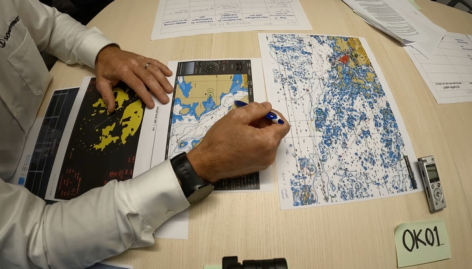
The interviews took between 52 minutes to 1 hour 42 minutes and were audio recorded for Phases 1, 2 and 3, while the third stage (the Simulation Interview) was also video-recorded in a way that only showed the parti- cipant’s hands from above pointing to the visual mediating objects in the simulation sequence (Figure 3). The interviews were conducted in Swedish,
Figure 1: Visual matrix of the knowledge audit stage (translated from Swedish) used as a mediating object in this study.Figure 2: Visual matrix of the simulation interview stage (translated from Swedish) used as a mediating object in this study.
712 Berlin and Praetorius
Table 1. Sample information of interviewees.
Table available in the original PDF paper.
Location Gender Age range Years of seafaring experience
Years of pilotage experience Area 1 3M, 1F 41 – 58 10 – 27 4 – 25 Area 2 3M, 1F 43 – 45 10 – 25 1 – 14
Figure 3: Example of video documentation in the simulation interview stage.
as this was the pilots’ working language. All interviews were transcribed ver- batim, and a consolidation of the data was carried out using the 4th ACTA phase, the Cognitive Demands Table.
ANALYSIS AND RESULTS In the following sections, the interviewed pilots will be referred to as SMEs (subject matter experts).
Task Diagram: Pilotage in Area 1
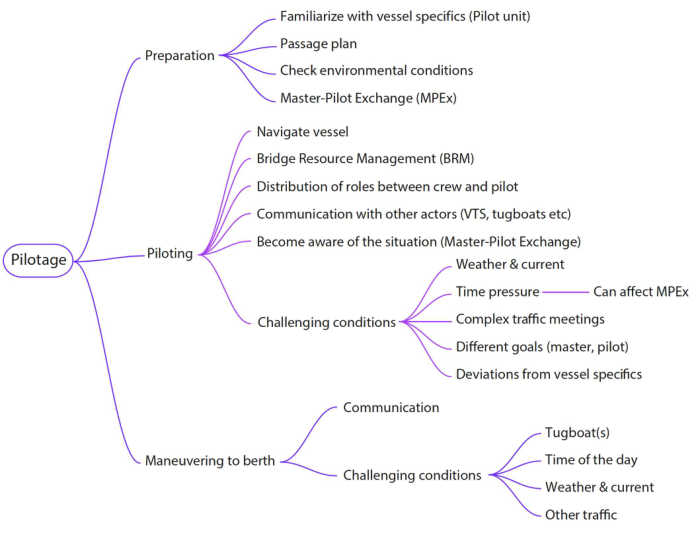
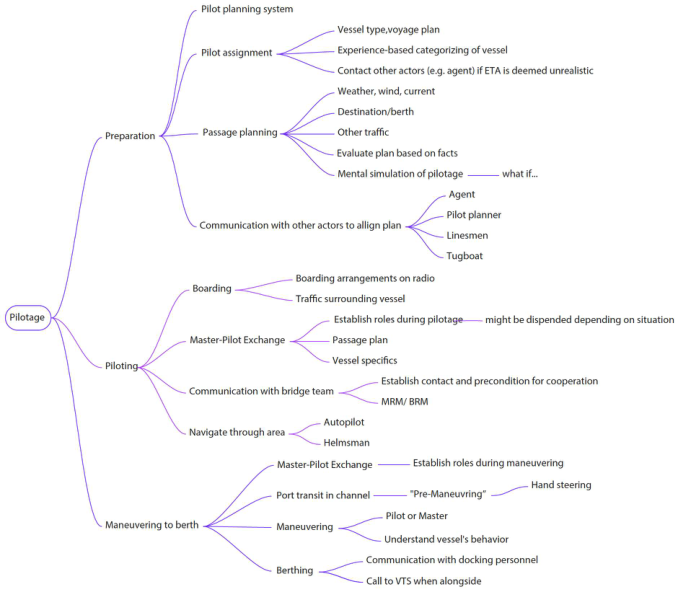
Figure 4 presents an overview of the tasks and related aspects of piloting a vessel within area 1. The figure is compiled from the respondents’ task diagrams and reflects all tasks and aspects mentioned. There was a large degree of agreement among the area 1 pilots with regards to the mental model of there being three different phases of a pilotage; Preparation, Piloting and Maneuvering to berth.
The preparation phase starts during the transit from port to the vessel. The pilot familiarizes him- or herself with the vessel specifics, checks the current environmental conditions, such as wind and weather forecast, and prepares a passage plan for the voyage. The preparation phase ends in a Master-Pilot Exchange (MPEx) after the pilot has boarded.
During the piloting, which can be seen as the transit into the port area, the pilot and bridge team navigate the vessel jointly. Tools associated with Bridge Resource Management (BRM), such as closed loop communication, are used to maintain situation awareness and enable joint decision making. It is important to maintain a clear distribution of roles among the team mem- bers. This distribution is established during the MPEx. During the piloting,
Applied Cognitive Task Analysis (ACTA) of Marine Piloting in a Swedish Context 713
Figure 4: Task overview for pilotage in area 1.
communication among the team onboard and with other actors, such as the VTS, other traffic or potential tugboats, may also take place.
The SMEs emphasize several conditions that may increase the complexity and thus pose a challenge during the piloting phase. These conditions include time pressure, complex traffic meetings, deviations and deficiencies of the vessel being piloted, the state of the crew (in terms of well-being), as well as heavy winds, currents, and weather.
The last phase of the pilotage is the maneuvering from entering the port area to the assigned berth. This phase requires an increased amount of com- munication both within the bridge team and with other actors, such as the VTS or the linesmen. Several conditions may pose additional challenges, such as the use of tugboats, weather conditions, other traffic in and out of the port, as well as the time of the day.
Task Diagram: Pilotage in Area 2 Pilot area 2 is a larger pilot area with a longer transit period into port. Thus, although the pilotage can be split into the same three phases as pilotage in area 1, the tasks and associated aspects differ (Figure 5).
The preparation phase is started by receiving the pilot assignment through the designated pilot planning system (which pilots can access through a mobile device such as a smartphone). One expert also mentions that they check the planning system regularly, but in the other three cases SMEs iden- tified the assignment as the starting point. Once the assignment is received,
714 Berlin and Praetorius
Figure 5: Task overview for pilotage in area 2.
the pilots use their previous experience to categorize the vessel type and its potential requirements and challenges, as well as prepare a voyage plan. If certain facts in the assignment are identified as not possible to adhere to, such as an unrealistic Estimated Time of Arrival (ETA) in port, the pilot also acts as coordinator and communicates with other involved parties, such as the agent in port, the pilot planner, linesmen, and tugboat operator(s) to align the planning. Further, during the preparation phase the passage planning for the pilotage is conducted, and previously made plans are revised and updated based on available facts, such as other expected traffic in the area, destina- tion for the specific vessel, weather, wind and current. One pilot mentions using mental simulation and ‘what if’-thinking to explore potential risks and evaluate whether the plan is feasible.
The piloting through the area is characterized by transit navigation through the area, i.e. the bridge team uses mostly an autopilot (with some exceptions including hand steering with the help of a helmsman). The piloting phase is started by making boarding arrangements on the radio and boarding the vessel. After boarding, the MPex takes place during which the role of pilot and master during the pilotage are established, as well as the passage plan and vessel specifics. Like in area 1, communicating with the vessel’s crew is seen as an important part of the pilot’s work. Establishing a good contact with the bridge team is mentioned as a precondition for successful cooperation during the voyage.
Applied Cognitive Task Analysis (ACTA) of Marine Piloting in a Swedish Context 715
The last phase of the pilotage is the maneuvering to berth, which includes both transit through the port channel, the maneuvering to berth and actual berthing. Since area 2 is a larger area and characterized by a longer transit period, this last phase is initiated through another MPEx to agree upon who will maneuver the vessel to the berth (master or pilot) and agree upon the specific arrangements for the operation.
KNOWLEDGE AUDIT In the knowledge audit phase, six out of eight pilots identified maneuve- ring as the most cognitively demanding task when conducting a pilotage. One respondent chose to focus on a specific situation dealing with a machine failure, and another on the preparation, or pre-maneuvering, phase.
Maneuvering is considered cognitively demanding as it requires an intri- cate mixture of skills that are technical (such as understanding the vessel movements and impacts of weather and currents) and non-technical (such as communication, decision making and establishing leadership in the team) throughout the task execution. The SMEs emphasize the need to be flexible in the light of sudden changes in the operational conditions, and emphasize the complexity of their everyday work, as no pilotage is alike.
Past and Future (Predicting Chain of Events) and Big Picture Pilots are experienced navigators and have served within the merchant fleet several years before being eligible to join the pilot organization. However, transitioning from a navigator into a pilot role is challenging, as the former is familiar with a specific vessel, while the latter needs to be an expert advisor for a large variety of vessel types in a determined sea area, where every piece of information, such as water depths, buoys, fairways etc. needs to be learned by heart. The SMEs within this study highlight that expertise is built through experience, rather than through being a good navigator. It is important to build a repertoire of vessel types, weather conditions, and social interactions with different crews to be able to quickly adapt to the conditions during a specific pilotage, and to be able to predict potential outcomes, developments and identify risks. Thus, building one’s own knowledge and experience base is essential to become an expert pilot, and sets novices and experts apart within the domain.
While pilots go through an extensive training period, the SMEs emphasize that learning on the job is the key, i.e. both during the time as trainee where an experienced pilot acts as advisor and supervisor, as well as continuously during the work where every new situation a pilot faces becomes part of their knowledge base.
Job Smarts, Routines, Planning and Improvising The SMEs highlight the importance of planning and conceiving several alter- nate plans as a precondition for being able to adapt and act quickly when the circumstances for the operation change. Planning normally occurs in the preparation phase where generic plans from a pilot’s knowledge base are ada- pted to the anticipated operation. For this, vessel type, weather conditions,
716 Berlin and Praetorius
flag state and whether a specific vessel has been piloted before are essential indicators for whether a plan need to be changed. Unless the weather con- ditions are bad, i.e. strong winds or currents, most pilotages are considered routine operations, although with a large complexity in everyday work that requires the pilot to keep in mind many factors beyond their control.
The SMEs had difficulties to name specific job smarts or situations where a need to improvise occurs, mainly because they emphasized that there is always at least one backup plan prepared. Further, job smarts are rather seen as processes and strategies that are learned in the intera- ction with other pilots. This type of interpersonal and informal learning can be identified as a safety-increasing measure and essential to building expertise.
Cues and Self-Monitoring The SMEs mentioned visual cues as important for the maneuvering and to determine whether a pilotage is proceeding according to plan, or if chan- ges and adaptions are needed. Visual cues can both be information available in the pilot tablet, the bridge system or in the external environment. Further, verbalizing the passage plan during the MPEx also allows for self-monitoring and monitoring of the bridge team during the pilotage. If an open commu- nication is established, the procedure of the operation can be monitored and challenged by both bridge team and pilot alike.
One of the SMEs specifically stressed that the difference between novi- ces and expert pilots lies in the ability to anticipate deviations and make changes and adjustments ahead of time, while novices, with less experience, are prone to use corrective actions and become reactive, which often affects the quality of the outcome more. Thus, it can be concluded that the abi- lity to self-monitor and regulate is a facet of expertise built through work experience.
Further, despite the emphasis on the maneuvering as being cognitively demanding, this SME reasoned to a large extent about the importance of social interactions and cues provided in the social environment onboard. Social aspects include finding one’s role in the bridge team during the ope- ration and establishing a clear communication among the team members to coordinate the work. Maritime resource management (MRM), which is also referred to as Bridge Resource Management (BRM) by the experts, provides tools and a mindset that can help to support the pilot during the work.
It is emphasized that the ability to take on different roles in the team as well as the ability to communicate clearly and establish leadership are impor- tant to support the safe conduct of the operation. Roles mentioned by the SMEs range from being a support to the bridge team and mainly monitoring their actions, to actively taking control within the navigation by providing instructions to the helmsman and master. Signs of stress, incomplete commu- nication or mismatches between what is communicated and what is done, can be used as cues to change one’s behavior and adapt to the needs to the crew.
Applied Cognitive Task Analysis (ACTA) of Marine Piloting in a Swedish Context 717
DISCUSSION
In comparison to “traditional” studies utilizing ACTA to provide input into training or technology design, this study has tried to explore aspects of expertise in everyday work that involves great adaptability to changing circumstances.
The results show the importance of operational experience and knowledge transfer through interpersonal and informal learning as key components to becoming an expert pilot. Unfortunately, since this type of learning occurs informally, many important lessons might only be shared among a limited group of individuals. It also makes it difficult to draw practical conclusions about how to improve formalized pilot training and education.
While the educational and professional backgrounds as navigator are pre- conditions, the actual pilotage expertise is built on the job as the individual creates a knowledge and experience base, which can be used to during the preparation phase of a pilotage and enables quick adaptions and the ability to foresee potential needs for corrections.
This study also identified certain difficulties with using the ACTA pro- bes on a type of profession that, for all its planning ahead and protocols, is unpredictable in many micro-perspectives and constantly shifting in response to weather, vessel peculiarities and the state of the crew (in a social sense). In contrast to other professions that have been extensively studied with ACTA before, the safety-criticality of pilotage is not event-based, but rather depen- dent on constant monitoring and adaptability to shifting conditions. Pilots were sometimes not sure how to fit certain probes to the “right way” to carry out pilotage, nor were they sure whether to call any behaviour a “job smart” or “trick of the trade” as no two pilotage situations are alike, even within the same port.
CONCLUSION
Conclusions drawn from the ACTA’s first two stages highlight the men- tally and socially complex task that piloting is, and that the pilots use great discernment and acuity when processing verbal as well as non-verbal input, alongside human as well as non-human movements (the latter coming from the vessel and surrounding bodies of air and water).
ACKNOWLEDGMENT
This study was part of the project “Evaluation of eye-tracking as support in simulator training for maritime pilots” (TRV2019/117837), funded by the Swedish Transport Administration. The authors would like to ackno- wledge and thank the eight pilots who participated, and Johanna Larsson for substantial help with the data collection.
REFERENCES
Brodje, A. et al. (2013) ‘Exploring non-technical miscommunication in vessel traffic service operation’, Cognition, Technology and Work, 15(3), pp. 347–357. Available at: https://doi.org/10.1007/S10111-012-0236-5/FIGURES/2.
718 Berlin and Praetorius
Bruno, K. and Lützhöft, M. (2009) ‘Shore-based pilotage: Pilot or autopilot? Piloting as a control problem’, Journal of Navigation, 62(3). Butler, G. L., Read, G. J. M. and Salmon, P. M. (2022) ‘Understanding the syste-
mic influences on maritime pilot decision-making’, Applied Ergonomics, 104, p. 103827. Available at: https://doi.org/https://doi.org/10.1016/j.apergo.2022. 103827. Darbra, R. M. et al. (2007) ‘Safety culture and hazard risk perception of Australian and New Zealand maritime pilots’, Marine Policy, 31(6), pp. 736–745. Lahtinen, J. et al. (2020) ‘Remote piloting in an intelligent fairway – A paradigm for
future pilotage’, Safety Science, 130, p. 104889. Available at: https://doi.org/https: //doi.org/10.1016/j.ssci.2020.104889. Militello, L. G. et al. (1997) Applied Cognitive Task Analysis (ACTA) Methodology, Navy Personnel Research and Development Center. San Diego. Militello, L. G. and Hutton, R. J. B. (1998) ‘Applied cognitive task analysis
(ACTA): A practitioner’s toolkit for understanding cognitive task demands’, Ergonomics, 41(11), pp. 1618–1641. Available at: https://doi.org/10.1080/ 001401398186108. National Research Council (1994) Minding the Helm: Marine Navigation and Piloting, Minding the Helm. The National Academies Press. Orlandi, L., Brooks, B. and Bowles, M. (2015) ‘A Comparison of Marine Pilots’
Planning and Manoeuvring Skills: Uncovering Mental Models to Assess Shiph- andling and Explore Expertise’, The Journal of Navigation. 2015/04/17, 68(5), pp. 897–914. Available at: https://doi.org/DOI: 10.1017/S0373463315000260. Swedish Maritime Administration (2023) Lotsning. Available at: https://www.sjofar tsverket.se/sv/tjanster/lotsning/ (Accessed: 22 February 2023).
LISTED IN THE AHFE DIGITAL BOOKSTORE CATALOGUE
Explore the complete digital volume
Human Factors in Transportation
Read this individual research paper free through the original publisher, or explore the full digital proceedings book.
ISBN 978-1-958651-71-1
Explore this ISBN in the AHFE Bookstore ↗Listed in the July 2026 bookstore catalogue; search by ISBN to confirm current availability · Digital book purchase optional