Mourad Zoubir, Marthe Gruner, Benjamin Schwarz, Jan Heidinger, Hans-christian Jetter, Thomas Franke (2023). Charting the Course: Human Factors Research for Shipping Energy-Efficient Operations. In: Application of Emerging Technologies. AHFE Open Access, vol. 115, pp. 403–412. https://doi.org/10.54941/ahfe1004338
To achieve climate objectives, it is essential to close "energy efficiency gaps"—the discrepancies between potential and actual energy savings. While much research in the maritime sector has focused on policy and onshore influences, it is unclear to what extent research is overlooking the potential of onboard human factors to mitigate climate impact. This study addresses this gap through a systematic literature review of the results sections of 17 journal articles on maritime human factors. Using Thematic Analysis, we generate 12 themes, with the most prominent being stakeholders, knowledge, and technical implementation. These themes provide insights into onshore influences, seafarers' expertise, as well as examples of the usage and limitations of implemented systems. Conversely, underrepresented themes such as learning, system properties, and safety referring to how seafarers acquire knowledge, specific design guidelines for onboard technology, or how to overcome the goal conflict of energy efficiency and safety. Our findings underline that key areas in this field have been studied disparately, and that a complete picture is necessary to close the energy efficiency gap here and in other sectors.
In 2018, shipping was responsible for 3% of global carbon emissions, a figure that could grow by 50% by 2050 without industry-specific strate- gies (International Maritime Organization (IMO), 2021). The volatility of energy costs, which can account for up to 70% of a ship’s operating costs (Rehmatulla and Smith, 2015), propels operators towards reducing fuel con- sumption, resulting in both economic and environmental advantages. The IMO introduced regulations, including the MARPOL Annex VI (IMO, 2011), to further environmental sustainability and meet climate objectives, imple- menting operational measures such as the Ship Energy Efficiency Carbon Intensity Indicator (CII) further evaluates large vessels’ efficiency based on CO2 emissions per cargo-carrying capacity and nautical mile (IMO, 2018). Yet, the anticipated reduction in shipping emissions is still unachieved, lead- ing to “energy efficiency gaps”, disparities between current or expected
energy consumption and optimal energy usage (Acciaro et al., 2013; Jaffe and Stavins, 1994; Johnson and Andersson, 2016).
Although operational measures like slow steaming, weather routing, trim optimisation, hull and propeller maintenance, conserving auxiliary engines, and using energy-efficient appliances exist (Balcombe et al., 2019; Faber et al., 2011), they can conflict with interests of stakeholders onboard as well as onshore. For example, turning off onboard auxiliary engines, considered operationally unnecessary, might oppose a captain’s safety concerns about backup generators (Ballou, 2013). This further demonstrates that barriers to energy efficiency, usually associated with economic and organizational elements within shipping companies (Poulsen et al., 2022; e.g., Rehmatulla and Smith, 2015), also include ships’ crews having to make decisions in the complex and uncertain scenario of shipping operations (Zoubir et al., 2023).
One method to overcome this barrier is the development of technical sys- tems, especially decision support systems. Previous work in this direction examines the implementation of new navigational tools from a sociotechni- cal perspective (Man et al., 2018; e.g., Viktorelius and Lundh, 2019). Yet, as the authors themselves suggest, there still remains potential in research with a focus on specific design implications and best practices, or in expanding on these findings from within e.g., a user-centered design process in the sense of ISO 9241–210 (ISO, 2019, p. 92) aiming for integrated, concrete (i.e., non-theoretical) solutions.
The objective of this paper is to present a systematic analysis of the cur- rent literature on maritime human factors concerning energy efficiency which involve ship crews, the analysis of the results of these papers and in the discussion derive key points for a research agenda.
METHOD
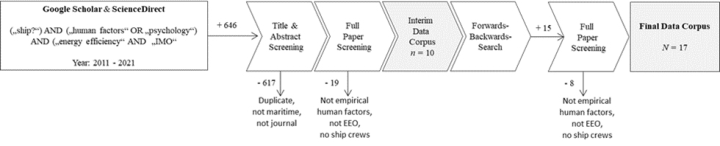
To conduct the systematic review, we included a structured and exhaustive literature search of previous papers in the research area via Google Scholar and ScienceDirect, as well as a forward-backward search. The search term for the systematic literature search followed the PICo scheme (Stern et al., 2014), which suggests terms for population, interest and context. Population was defined by the term “ship” as the most common term for the working environment and was a root word for further inflections (e.g. shipping). Our Interest was with the experience and behavior of seafarers, which is covered by the fields of “Human Factor OR Psychology”. The Context was defined in the search by the term “Energy Efficiency AND IMO”, as any applicable maritime research would cite IMO regulation (e.g., the Ship Energy Effi- ciency Management Plan). The search covered the period from 2011 to 2021. The beginning of the period in 2011 served to limit the search to publica- tions only after the announcement of the MARPOL Annex VI (IMO, 2011) which extended energy efficiency regulations for new and existing ships. See Figure 1 for an overview of the literature search and Table 1 for a full list of all papers included.
We applied Thematic Analysis (TA) to analyze the results from the perspec- tive of energy efficiency. TA was chosen due to its flexibility and ability to
Charting the Course: Human Factors Research for Shipping Energy-Efficient Operations 405
explore heterogeneous data in detail (Braun and Clarke, 2006). A distinction was made between the data corpus (entire publications) and the data set for the analysis, which refers only to results. The data set was coded inductively, and on a semantic level of overt meaning, as we were interested in the explicit report of results. Coding was carried out with the aid of MAXQDA 2018 (Verbi, 2017) and consisted of the six phases as defined by Braun & Clarke (2006). Coding and theme creation was conducted iteratively with two of the authors (MZ and MG) who had previous experience, and with two student researchers. To ensure clarity, only text segments based on generated results of the researchers were coded (references to other research results were not coded to avoid double coding). Units of meaning (e.g. result, evidence or paraphrasing) were coded together to avoid redundancy.
Figure 1: Procedure of the systematic literature search.Table 1. Final list of papers included for analysis.
Table available in the original PDF paper.
Reference Paper Title Banks et al. (2014) Seafarers’ current awareness, knowledge, motivation and ideas towards low carbon energy efficient operations Be¸sikçi et al. (2021) Determining the awareness and knowledge of officers towards ship energy efficiency measures Dewan et al. (2018) Barriers for adoption of energy efficiency operational measures in shipping industry Hammander et al. (2015) How do you measure Green Culture in shipping? The search for a tool through interviews with Swedish seafarers Hansen et al. (2020) Making shipping more carbon-friendly? Exploring ship energy efficiency management plans in legislation and practice Jensen et al. (2018) Energy-efficient operational training in a ship bridge simulator Johnson et al. (2014) Barriers to improving energy efficiency in short sea shipping: an action research case study Johnson & Andersson (2016) Barriers to energy efficiency in shipping Lützen et al. (2017) Energy efficiency of working vessels – A framework Man et al. (2018) Maritime energy efficiency in a sociotechnical system: A collaborative learning synergy via mediating technologies Man et al. (2020) From ethnographic research to big data analytics – A case of maritime energy-efficiency optimization Poulson & Sampson (2019) ‘Swinging on the anchor’: The difficulties in achieving greenhouse gas abatement in shipping via virtual arrival Rasmussen et al. (2018) Energy efficiency at sea: Knowledge, communication, and situational awareness at offshore oil supply and wind turbine vessels Viktorelius & Lundh (2019) Energy efficiency at sea: An activity theoretical perspective on operational energy efficiency in maritime transport Viktorelius (2020) Adoption and use of energy-monitoring technology in ship officers’ communities of practice Viktorelius et al. (2021) Automation and the imbrication of human and material agency: A sociomaterial perspective Von Knorring (2019) Energy audits in shipping companies
RESULTS
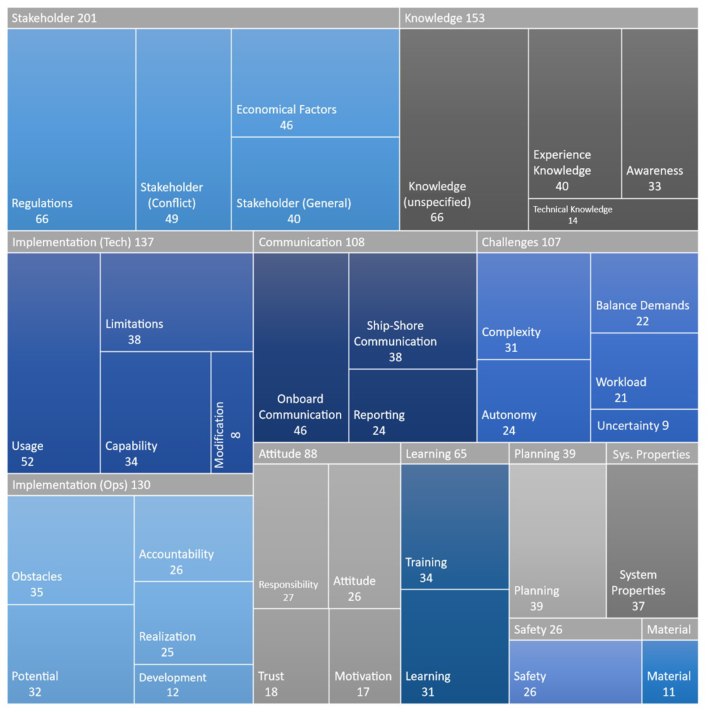
After analysing the results of 17 papers from the perspective of energy effi- ciency, 696 text segments were assigned to a total of 35 codes (with multiple assignments possible N = 1102), which in turn were assigned to twelve overarching themes. The following section describes each theme, its sub- themes and gives examples, while Figure 2 gives an overview and displays proportion.
Most often, codes were assigned to the theme of stakeholders (n = 201), describing results applicable to onshore actors such as charterters, shipping companies, port authorities or other non-ship organizations. This theme included results pertaining to regulations (e.g., the SEEMP or EEOI), eco- nomic factors (e.g., principal agent problems between onshore parties, i.e. owners and charterers), or conflicts of interest between onshore and onboard motivation for EEO. In the latter, e.g. Hammmander et al. (2015) describes the conflict between a ship’s motivation to replace a hydraulic hose, which was an environmental issue, but conflicted with onshore budgeting priorities.
Knowledge (n = 153) was explored in different forms, either as technical knowledge (e.g., understanding of onboard systems and their interactions), experience knowledge (i.e., information resulting from previous experiences while on the job), awareness (e.g., to what extent seafarers were conscious of the environmental impact of shipping or their role in EEO) or knowl- edge without specification. In contrast, learning was not often coded as a result (n = 65), and was either generalized learning or referred to formalized training, e.g. computer based training or as part of programs initiated by the shipping company. Of note is the overlap of codes on experience knowledge and learning, which underlines how seafarers’ experience is shared with new crew members (e.g., Hansen et al., 2020). The implementation of technology (n = 137) or operations (n = 130) were often reported in the results, either as the objectives of the papers were the observation of such implementa- tions, or seafarers reported on measures after the fact. Both themes included a subtheme on 1) benefits, such as seafarers realizing they can improve energy usage through better maneuvers without compromising punctuality (Viktore- lius, 2020), 2) hindrances, such as mismatches between perceived complexity of a task and crews’ willingness to invest time (Viktorelius and Lundh, 2019), or 3) consequences for future iterations such as the setting of clearly defined goals and the monitoring of these by a designated seafarer (Hansen et al., 2020). The theme communications (n = 108) discussed two primary forms. Firstly, onboard information was communicated formally (e.g. during safety meetings) or informally (between officers e.g. in the mess). Secondly, between onboard and onshore stakeholders, which, in regard to EEO, ranged from close collaborations with e.g., via an environmental manager (Vik- torelius, 2020) or to one-sided, with e.g., ships submitting requests but not receiving responses (Hammander et al., 2015). Another form of note is that of reporting (e.g. noon-reports), which was used e.g. to report fuel consumption “to prove that speed demands are met” (Hansen et al., 2020, p. 7).
Charting the Course: Human Factors Research for Shipping Energy-Efficient Operations 407
Key challenges in regard to EEO included 1) task complexity, such as with analysis of large amounts of data (Viktorelius and Lundh, 2019), 2) balanc- ing different goals, such as safety, economy, efficiency and environmental concerns (Hansen et al., 2020), 3) maintaining autonomy from employers, such as not wanting to be constantly monitored (Viktorelius, 2020), 4) uncer- tainty, e.g. regarding destinations, or 5) high levels of workload or fatigue, especially on smaller vessels (Poulsen and Sampson, 2019).
Results on seafarers’ attitude (n = 88) often included descriptions of their stance on EEO, often as a concern for the environment, which was repeatedly coded as a motivator alongside a wish to have a good corporate relation- ship with external stakeholders. Stakeholders were also mentioned in the subtheme responsibility, which included segments reporting some seafarers rejecting personal responsibility, e.g. by blaming timetables set by external stakeholders (Viktorelius and Lundh, 2019).
Finally, we generated themes without subthemes. Planning (n = 39) referred to the process of how EEO were carried out or could be improved upon, e.g. by the bridge consulting with the engine department (Man et al., 2018). System properties (n = 37) described results specifically addressing elements of technical systems or interfaces, e.g. that the display of consump- tion rates and total fuel consumption were not useful for self-evaluation or navigational DSS (Man et al., 2018). Safety (n = 26) described this aspect beyond being a challenge, as was the case with the learning curve of offi- cers who were previously fixated on safety but eventually found a balance between it and managing energy efficiency (Jensen et al., 2018). Lastly, the physical theme of material (n = 11) covered e.g. the spare parts used to maintain vessel machinery and their availability (Banks et al., 2014).
DISCUSSION
We conducted a systematic literature review of 17 papers of maritime human factors in energy efficient operations with a focus on ship crews. The gener- ated results of these papers were analyzed with Thematic Analysis. Based on the number of codes assigned to the inductive themes, we found a large num- ber of results on stakeholders, knowledge and implementation of technical systems and operations, while there is potentially a research gap regarding learning, system properties, and safety. Our findings underline that key areas in this field have been studied disparately, and that a complete picture - espe- cially of complementary subjects - is necessary to close the energy efficiency gap here and other sectors. Insofar we propose two central research needs.
Increase Knowledge With Low-Workload On-The-Fly Training Firstly, there is a discrepancy between research on seafarers’ knowledge and how this knowledge is to be acquired. Previous research has shown that missing knowledge is a hinderance to crew implementing energy-efficient operations, and conversely, crew members with more technical training do not perceive knowledge as such a barrier (Zoubir et al., 2023). Similarly, e.g. Jensen et al. (2018), show that seafarers reflecting on their use of technical
tools (thereby gaining experience knowledge) can reduce the fuel consump- tion of a vessel by 10%. At the same time, workload is a key challenge, with seafarers’ calculating the likelihood of technical or operational implementa- tion as a trade-off of fuel saving against how much time and effort would be required (Viktorelius, 2020). By integrating these findings, we propose that one key research need is to understand how seafarers can learn on the job without increasing workload.
Figure 2: Overview of themes developed from the thematic analysis of the results of human factors research in EEO involving seafarers. Numbers indicate the count of segments with that code assigned.
One step towards this goal has been conducted by Man et al. (2018) which explores the possibilities of collaborative learning synergy with the use of mediating technologies. On the basis of qualitative research, this work iden- tifies possible applications, such as the sharing of information and expertise between bridge and engine crews, or post-journey performance evaluations. As a next step, we postulate the need for quantitative user research which implements such features into a tool and assess usability and user experience metrics, especially workload, measured in a standardized way e.g. with tools
Charting the Course: Human Factors Research for Shipping Energy-Efficient Operations 409
such as the NASA-TLX (Hart and Staveland, 1988). This would allow for the comparison across applications and thereby the identification of features with the best trade-off between workload and achieved learning.
Support Seafarers’ Balancing of Goal Conflicts With Transparency Secondly, goal conflicts with stakeholders economic interests are well doc- umented (e.g., Poulsen et al., 2022; Poulsen and Sampson, 2019), and it is still unclear how seafarer’s can balance these. Furthermore, it is also unclear to what extent this balancing can similarly be applied to other prohibitive conflicts such as safety (or vice versa). Finally, as above, it is critical that any balancing does not require further workload, or even serves to reduce work- load. We therefore propose that the second key research need is to understand how goal conflicts can be balanced or resolved onboard.
One part of this goal is the calibration of perceived conflicts. For exam- ple, Jensen et al. (2018) showed that in a ship simulator, although initially wary due to safety concerns, after experience and reflection workshops, sea- farers found balance between safety and energy efficiency. This effect could be supported by visualizing goal conflicts. For example, restraints defined within charterer contracts (e.g., minimum speed requirements etc.) could be considered by routing tools. Another part of this goal could be to increase transparency to other stakeholders by keeping them in the loop, e.g., by hav- ing decision support systems generate exports to be included with the daily noon reports for ship stake holders. All-in-all the research above strongly sug- gests that without support seafarers will err to the side of caution when faced with subjective uncertainty and miss opportunities to save carbon emissions.
Limitations While our study contributes insights into this field, we acknowledge limi- tations to our findings. Firstly, the quality of the studies included in the review varied in terms of methodology and rigor. Furthermore, less repre- sented themes may be due to a bias in the existing literature rather than a true reflection of their importance in the field (e.g., “safety” being over- whelmingly important yet well-known and self-explanatory, in comparison to novel “stakeholder conflicts”). These aspects should be considered when interpreting the aggregated code counts. Secondly, the use of Thematic Anal- ysis, while advantageous for summarizing diverse findings, could introduce interpretive bias. Themes are constructed categories by the authors and may not capture the complexity of the individual studies.
CONCLUSION
The results of our systematic review of human factors literature of energy effi- ciency in shipping revealed a wide breadth of research highlighting challenges in the maritime sector. On this strong basis, we identified potential research gaps, such as regarding learning, safety, system properties. Going forward, we suggest two approaches for the research agenda in this field: 1) under- standing how seafarers can acquire knowledge on energy-efficient operations on-the-fly, to implement them autonomously and effective onboard, and
2) understanding how goal-conflicts can be balanced onboard, by increas- ing transparency and thereby reduce seafarers’ uncertainty. Both approaches must take workload into account or risk being overlooked by seafarers already operating under high workload conditions. To achieve this, we sug- gest an increase of quantitative user research in this field, which utilizes concrete system features and evaluates these with standardized tools to allow for comparisons and allow for concrete design guidelines for future technical systems.
ACKNOWLEDGMENT
This research has been funded by the Federal Ministry for Economic Affairs and Climate Action of Germany in the project MariData.HEI (Maritime Research Programme, grant number 03SX528H). This article has benefited from the contributions of our team of research assistants, especially T. Hem- mie, S. Peper, N. Beiler and H. Ritter, as well as of our thesis students, especially L. Heptner.
AUTHOR CONTRIBUTIONS Mourad Zoubir: Conceptualization, Methodology, Investigation, Formal Analysis, Writing (original draft, review and editing). Marthe Gruner: Methodology, Investigation and Formal Analysis. Benjamin Schwarz: Writ- ing (review and editing). Jan Heidinger: Writing (review and editing) Hans- Christian Jetter: Writing (review and editing), Project Administration, Super- vision. Thomas Franke: Funding acquisition, Project Administration, Writing (review and editing), Supervision.
REFERENCES
Acciaro, M., Hoffmann, P., Eide, M., 2013. The energy efficiency gap in maritime transport. Journal of Shipping and Ocean Engineering 3. Balcombe, P., Brierley, J., Lewis, C., Skatvedt, L., Speirs, J., Hawkes, A.,
Staffell, I., 2019. How to decarbonise international shipping: Options for fuels, technologies and policies. Energy Conversion and Management 182, 72–88. https://doi.org/10.1016/J.ENCONMAN.2018.12.080 Ballou, P. J., 2013. Ship Energy Efficiency Management Requires a Total Solution Approach. Marine Technology Society Journal 47, 83–95. https://doi.org/ 10.4031/MTSJ.47.1.5 Banks, C., Turan, O., Incecik, A., Lazakis, I., Lu, R., 2014. Seafarers’ Current Aware-
ness, Knowledge, Motivation and Ideas towards Low Carbon-Energy Efficient Operations. Journal of Shipping and Ocean Engineering 4, 93–109. Be¸sikçi, E. B., Solmaz, M. S., Jurdana, I., 2021. Determining the awareness and knowledge of officers towards ship energy efficiency measures. Pomorstvo 35, 327–340. https://doi.org/10.31217/p.35.2.15 Braun, V., Clarke, V., 2006. Using thematic analysis in psychology. Qualitative
Research in Psychology 3, 77–101. https://doi.org/10.1191/1478088706qp063oa Dewan, M. H., Yaakob, O., Suzana, A., 2018. Barriers for adoption of energy efficiency operational measures in shipping industry. WMU Journal of Maritime Affairs 17, 169–193. https://doi.org/10.1007/s13437-018-0138-3
Charting the Course: Human Factors Research for Shipping Energy-Efficient Operations 411
Faber, J., Wang, H., Nelissen, D., Russell, B., St Amand, D., 2011. Marginal abatement costs and cost effectiveness of energy-efficiency measures. London: Institute of Marine Engineering. Science, and Technology 2207. Hammander, M., Karlsson, P., Österman, C., Hult, C., 2015. How Do You Mea-
sure Green Culture in Shipping? The Search for a Tool Through Interviews with Swedish Seafarers. TransNav 9, 501–509. https://doi.org/10.12716/1001.09.04. 06 Hansen, E. K., Rasmussen, H. B., Lützen, M., 2020. Making shipping more carbonfriendly? Exploring ship energy efficiency management plans in legislation and practice. Energy Research & Social Science 65, 101459. https://doi.org/10.1016/ j.erss.2020.101459 Hart, S. G., Staveland, L. E., 1988. Development of NASA-TLX (Task Load Index):
Results of empirical and theoretical research, in: Advances in Psychology. Elsevier, pp. 139–183. https://doi.org/10.1016/s0166-4115(08)62386-9 IMO, 2021. Fourth IMO GHG Study 2020. International Maritime Organization, London, UK. IMO, 2018. Initial IMO Strategy on Reduction of GHG Emissions from Ships
(Resolution MEPC.304(72)). IMO, 2011. MARPOL Annex VI, Amendment 19. IMO, London. ISO, 2019. Ergonomics of human-system interaction — Part 210: Human-centred design for interactive systems. Jaffe, A. B., Stavins, R. N., 1994. The energy-efficiency gap: What does it mean?
Energy Policy 22, 804–810. https://doi.org/10.1016/0301-4215(94)90138-4 Jensen, S., Lützen, M., Mikkelsen, L. L., Rasmussen, H. B., Pedersen, P. V., Schamby, P., 2018. Energy-efficient operational training in a ship bridge simu- lator. Journal of Cleaner Production 171, 175–183. https://doi.org/10.1016/j.jcle pro.2017.10.026 Johnson, H., Andersson, K., 2016. Barriers to energy efficiency in shipping. WMU
Journal of Maritime Affairs 15, 79–96. https://doi.org/10.1007/s13437-014- 0071-z Johnson, H., Johansson, M., Andersson, K., 2014. Barriers to improving energy efficiency in short sea shipping: an action research case study. Journal of Cleaner Production 66, 317–327. https://doi.org/10.1016/j.jclepro.2013.10.046 Lützen, M., Mikkelsen, L. L., Jensen, S., Rasmussen, H. B., 2017. Energy efficiency
of working vessels – A framework. Journal of Cleaner Production 143, 90–99. https://doi.org/10.1016/j.jclepro.2016.12.146 Man, Y., Lundh, M., MacKinnon, S., 2018. Maritime Energy Efficiency in a Sociotechnical System: A Collaborative Learning Synergy via Mediating Tech- nologies. TransNav 12, 239–250. https://doi.org/10.12716/1001.12.02.03 Man, Y., Sturm, T., Lundh, M., MacKinnon, S. N., 2020. From Ethnographic
Research to Big Data Analytics—A Case of Maritime Energy-Efficiency Optimiza- tion. Applied Sciences 10, 2134. https://doi.org/10.3390/app10062134 Poulsen, R. T., Sampson, H., 2019. ‘Swinging on the anchor’: The difficulties in achieving greenhouse gas abatement in shipping via virtual arrival. Transportation Research Part D: Transport and Environment 73, 230–244. https://doi.org/10. 1016/j.trd.2019.07.007 Poulsen, R. T., Viktorelius, M., Varvne, H., Rasmussen, H. B., von Knorring, H.,
2022. Energy efficiency in ship operations - Exploring voyage decisions and decision-makers. Transportation Research Part D: Transport and Environment 102, 103120. https://doi.org/10.1016/j.trd.2021.103120
Rasmussen, H. B., Lützen, M., Jensen, S., 2018. Energy efficiency at sea: Knowledge, communication, and situational awareness at offshore oil supply and wind turbine vessels. Energy Research & Social Science 44, 50–60. https://doi.org/10.1016/j.er ss.2018.04.039 Rehmatulla, N., Smith, T., 2015. Barriers to energy efficient and low carbon ship-
ping. Ocean Engineering 110, 102–112. https://doi.org/10.1016/j.oceaneng.2015. 09.030 Stern, C., Jordan, Z., McArthur, A., 2014. Developing the Review Question and Inclusion Criteria. AJN, American Journal of Nursing 114, 53–56. https://doi.org/10.1097/01. NAJ.0000445689.67800.86 Verbi, S., 2017. MAXQDA, software for qualitative data analysis. Sozialforschung
GmbH. Viktorelius, M., 2020. Adoption and use of energy-monitoring technology in ship officers’ communities of practice. Cognition, Technology & Work 22, 459–471. https://doi.org/10.1007/s10111-019-00578-z Viktorelius, M., Lundh, M., 2019. Energy efficiency at sea: An activity theoret-
ical perspective on operational energy efficiency in maritime transport. Energy Research & Social Science 52, 1–9. https://doi.org/10.1016/j.erss.2019.01.021 Viktorelius, M., MacKinnon, S. N., Lundh, M., 2021. Automation and the imbrication of human and material agency: A sociomaterial perspective. International Journal of Human-Computer Studies 145, 102538. https://doi.org/10.1016/j.ijhc s.2020.102538 von Knorring, H., 2019. Energy audits in shipping companies. Transportation
Research Part A: Policy and Practice 125, 35–55. https://doi.org/10.1016/j.tra. 2019.04.017 Zoubir, M., Gruner, M., Franke, T., 2023. “We go fast - It’s their fuel”: Understanding energy efficiency operations on ships and marine vessels. Energy Research & Social Science 97, 102992. https://doi.org/10.1016/j.erss.2023.102992
LISTED IN THE AHFE DIGITAL BOOKSTORE CATALOGUE
Explore the complete digital volume
Application of Emerging Technologies
Read this individual research paper free through the original publisher, or explore the full digital proceedings book.
ISBN 978-1-958651-91-9
Explore this ISBN in the AHFE Bookstore ↗Listed in the July 2026 bookstore catalogue; search by ISBN to confirm current availability · Digital book purchase optional