Markus Gödker, Vivien Moll, Thomas Franke (2024). Feeling comfortable? Exploring the relation between personality, competence, and range interaction in electric vehicles. In: Advances in Human Factors of Transportation. AHFE Open Access, vol. 148, pp. 297–306. https://doi.org/10.54941/ahfe1005220
As electric vehicles (EVs) become increasingly prevalent, understanding drivers' interactions with range and their charging behavior is crucial for supporting optimal system design and adoption. The present study investigates the link of technology-related driver characteristics, such as affinity for technology interaction (ATI), to range interaction and charging behavior and explores how driving experience with EVs impacts drivers’ comfortable range. Two online surveys (NS1 = 205, NS2 = 57) were conducted, focusing on range interaction and charging behavior. Results revealed that drivers with higher ATI tend to have higher comfortable range values, and this relationship is mediated by subjective range competence (SRC). Additionally, drivers who base their charging decisions on their preferred charge level are likely to have already experienced lower displayed remaining range values, suggesting potentially more efficient battery utilization. These findings suggest the importance of considering personality variables and charging behavior patterns in promoting efficient EV usage. Moreover, we found that most drivers in our sample mainly charge at home, and there is still a large proportion of drivers who do little to no public charging. Strategies focusing on enhancing drivers' SRC and addressing individual differences, particularly in technology-related variables, could help to better cope with situations involving range stress and bridge the gap between technical and comfortable range.
Driving electric vehicles (EVs) entails dealing with range as a resource, par- ticularly for long trips, where charging planning uncertainties, suboptimal charging infrastructure, or a generally smaller battery size or slower maxi- mum charging speed (in favor of lower manufacturing costs and/or overall balance of CO2 emissions) can create challenges for drivers. These challenges could potentially heighten experienced range stress and, consequently, can influence drivers’ willingness to adopt EVs as a sustainable transportation solution (Adnan et al., 2017; Bühler et al., 2014; Neubauer & Wood, 2014; Rezvani et al., 2015).
Research has revealed that factors such as remaining range, charging speed level, parking time, trip time, trip kilometers, time available until the next trip,
and charging fees (Morrissey et al., 2016; Jabeen et al., 2013; Sun et al., 2015; Wang et al., 2021; Zoepf et al., 2013) impact charging decisions and thus range interaction. Beyond environmental and technical vehicle-related fac- tors, personal characteristics, such as personality variables related to action styles (i.e., behavioral styles in goal-directed interaction with systems) and stress resistance (e.g., Franke et al., 2012), can influence how individuals manage potential range stress and make charging decisions. To bridge the gap between the technically possible range with a given EV model and the individual range that drivers obtain and utilize, understanding the effect of inter-individual factors is crucial. Understanding these dynamics could help to optimize energy efficiency, range use, and subjective experience of EV drivers.
Franke and Krems (2013b) showed that, as it might be expected, charging decisions are motivated by the objective level of remaining range but also by the available range that users subjectively feel comfortable with while driving (i.e., users’ preferred range safety buffer). According to the adaptive con- trol of range resources model (Franke et al., 2012; Franke & Krems, 2013a; Labeye et al., 2013), the comfortable range describes the range that the driver utilizes with an optimal user experience, which means without range stress or range anxiety. It is influenced by various factors, such as the availabil- ity of coping strategies, the possibility of in-between-charging, energy-saving driving behavior, or subjective range competence (SRC). More specifically, drivers with a high SRC also have a higher comfortable range, so positive belief in one’s ability to regulate range and mentally model (range and) range- influencing factors has been proposed to be positively linked to enhanced range appraisal and comfortable range. According to previous research, range utilization and SRC are not only linked to comfortable range (Franke et al., 2012; Franke et al., 2015) but also to the amount of experience in driving EVs (Franke et al., 2012; Franke et al., 2015; Rauh et al., 2015; Wikström et al., 2014). What is more, certain personality variables are related to individual differences in evaluating energy dynamics and in battery usage patterns (Moll & Franke, 2021; Franke & Krems, 2013a; Franke et al., 2012). For instance, control beliefs and ambiguity tolerance have been found to have moderate stress-buffering effects in terms of comfortable range. Drivers with a high need for cognition (NfC; Cacioppo & Petty, 1982) require less practice to improve range utilization, and high NfC is generally correlated with better complex task performance (Coutinho et al., 2005; Pichelmann et al., 2013).
The objective of the present research was to focus on more technology- related personality factors, such as affinity for technology interaction (ATI; Franke et al., 2019), which can be understood as a domain-specific con- ceptualization of NfC. High ATI is associated with more actively exploring technical systems and may be linked to better judgments of energy efficiency (Moll & Franke, 2021). Thus, affinity for technology interaction might con- ceptually be closely linked to range utilization and comfort and, therefore, could provide valuable explanatory value. Similarly, we also look at the indi- vidual user-battery interaction style (UBIS), as it has been shown that it is related to range utilization (Franke & Krems, 2013b).
Feeling Comfortable? Exploring the Relation Between Personality, Competence 299
In summary, understanding the factors that contribute to different charg- ing patterns can help develop strategies for efficient utilization of the electric mobility system (i.e. charging systems vs. vehicles with their given techni- cal range), ultimately reducing the need for drivers to actively deal with range situation (i.e. experience range-related workload) and ultimately avoid- ing range stress and promoting efficient use of EVs. Building upon previous findings, the present research investigates with a larger sample of actual EV drivers and EV-interested drivers (a) general user interactions with their EV’s range, (b) the link of technology-related personality variables, such as ATI, to range interaction and charging behavior, and (c) the extent to which driving experience with EVs is related to comfortable range.
METHOD
We conducted two online surveys (S1 and S2), one (NS1 = 205) focusing on the range interaction while driving and another (NS2 = 57) focusing on the charging behavior. In S1, we recruited participants through social media and from the audience of a talk on electric mobility for the interested public. For S2, we recruited participants through a mailing list, social media, and word- of-mouth referrals. The average age of participants was MS1 = 41.4 years (SDS1 = 11.8) and MS2 = 42.0 years (SDS2 = 12.4). Most respondents were male (81.0 % in S1 and 77.2% in S2). To focus on participants having expe- rience with actual vehicle technologies and relevant coping behaviors, it was important for us to know whether the participants had regular EV driving experience and experienced critical range events (instead of total EV driving experience). More than half of all respondents (56.1% in S1 and 93.0% in S2) drove or had driven EVs regularly (i.e. minimum once a month - regularly or at least for six months in the past). Some participants (14.6% in S1 and 7.0% in S2) drove EVs only occasionally, and in S1, almost a third (29.4%) had no prior EV experience, while S2 exclusively included participants with prior experience. Additionally, 77.9% (S1) and 84.2% (S2) of the EV-experienced participants had already covered a daily distance of at least 150 km at least once with an EV. Regarding the longest daily distance traveled with an EV ever, the mean scores were MS1 = 421 km (SDS1 = 323 km) and MS2 = 486 km (SDS2 = 335 km). In S2, 26.3% of participants charged their vehicles almost exclusively at home (at least 90% of all charging events), while 28.1% utilized public charging stations for at least half of their charging events, and 71.9% relied mostly on both home and public charging (at least 90% of their charging events). Notably, a significant portion of S2 (40.4%) seldom used public charging stations at all (a maximum of 10% of all charging processes). Furthermore, participants typically initiated charging when their remaining charge level dropped below one-third, with a mean score of MS2 = 27.8% for the remaining charge level at the start of charging (rangeS2 = 3% – 79%). The mean remaining range was MS2 = 79.8 km (rangeS2 = 2 km – 400 km). Addi- tionally, participants tended to prioritize the remaining range in kilometers over the remaining charge level in percentage, as indicated by a mean score of MS2 = 2.84 (SDS2 = 1.39) on a response scale of 1 (range) to 5 (charge level), with lower values indicating a preference for range and higher values
for charge level, and 3.00 signifying equal consideration for both aspects. Regarding charging frequency, participants were asked to imagine driving 40 km per day and thus 1200 km per month. Based on this scenario, participants would charge their EV approximately 5 times per 100 km technical range in a 30-day period (MS2 = 4.26, SDS2 = 6.66). Transferring this result to a typ- ical technical range, for example, 325 km, would mean a charging frequency of approximately 14 times within these 30 days.
Measures We assessed variables concerning range-critical driving experience (e.g., low- est displayed remaining range so far, longest daily trip distance), psychologi- cal ranges, SRC (Franke et al., 2012) and ATI (Franke et al., 2019) in the first survey, and UBIS (Franke & Krems, 2013b) as well as need for cognition (NfC, Bless et al., 1994; Cacioppo & Petty, 1982) in the second survey.
Participants assessed their skills in dealing with range (SRC, Franke et al., 2012) by indicating their level of agreement with six items (e.g., ‘I can accu- rately estimate the influence of various factors on the range of my battery electric car’) on a 6-point Likert scale, ranging from “completely disagree” (coded as 1) to “completely agree”(coded as 6), with higher values indicating high SRC. ATI (Franke et al., 2019) describes whether a person approaches or rather avoids more intensive interaction with technology and can be consid- ered as an important personal resource for successful technology interaction. Participants were asked to indicate their level of agreement with the state- ments on a 6-point Likert scale from “completely disagree” (coded as 1) to “completely agree” (coded as 6), with higher values indicating higher affinity for technology. Regarding UBIS, participants assessed their typical charging behavior by indicating their level of agreement on a 6-point Likert scale (from 1 = “completely disagree” to 6 = “completely agree”) with eight items (e.g., ‘I typically charged when the state of charge fell to a certain level’). Lower UBIS scores indicate that drivers charge their devices (including EVs) in a more regular manner, rather habit-based and more independent of the charge level (e.g., whenever possible, every night, etc.). In contrast, higher UBIS scores indicate UBIS charging patterns depending on subjectively preferred charge levels. Finally, participants rated their individual “tendency to engage in and enjoy thinking”(p. 130, Cacioppo & Petty, 1982) through the German 16-item version of the NfC scale (Bless et al., 1994; Cacioppo & Petty, 1982) by answering on a 7-point Likert scale (from −3 = “completely inaccurate” to 3 = “completely accurate”).
Franke et al. (2012, 2015) introduced the concept of psychological range, including different psychological range levels. We assessed the displayed per- formant range (= determined by the driver’s typical driving behavior) and the comfortable range (= performant range - individual safety buffer, represent- ing the range that drivers actually use with optimal user experience). In S1, we administered in total 4 questions regarding comfortable range and safety buffer and composed them to an index of comfortable range (Franke and Krems, 2013b; Franke et al., 2015). The participants were asked for (a) their minimum range safety buffer (MinBuff, ‘Which range buffer do you set for
Feeling Comfortable? Exploring the Relation Between Personality, Competence 301
yourself below which you would not be willing to drive the EV anymore, except in exceptional circumstances?’), (b) their proportional range safety buffer (PropBuff, ‘In general, I want to have a safety buffer of x % in the bat- tery - that is: What percentage should the displayed range be above the total trip distance?’) and (c and d) their comfortable trip distance (ComfDist100 and ComfDist50, ‘If the EV shows a range of 100 km (50 km), I would still feel good about driving a total distance of up to x km’). An exploratory factor analysis was conducted with all variables standardized and inverted where necessary. In the final principal component analysis (varimax rotation was used), Kaiser’s criterion and the scree plot provided empirical justification for keeping one factor (eigenvalue > 1). All variables had acceptable component loadings ≥0.40 (ComfDist50 = 0.85, ComfDist100 = 0.83, MinBuff = 0.44, PropBuff = 0.40). Hence, the final index of comfortable range, which is the mean value of the z-standardized (and inverted) variables, represents higher comfortable ranges and lower safety buffer demands.
RESULTS
As some survey questions required certain preconditions, e.g., driving experi- ence, the sample sizes differed between measures. We, therefore, indicate the sample size N in each case. Tables 1 and 2 report the descriptive statistics for our measures in S1 and S2. The internal consistency of the scales was high (Cronbach’s α ≥.80), except for UBIS.
Table 1. Descriptive statistics of technology-related personality variables.
Table available in the original PDF paper.
Variable Sample N M (SD) Range α SRC S1 145 4.39 (0.66) 2.3 −6.0 .82 ATI S1 205 4.75 (0.76) 1.7 −6.0 .89 UBIS S2 57 4.00 (0.69) 2.1 −5.6 .55 NfC S2 57 0.96 (0.73) −0.9 −2.4 .80
Note. α = Cronbach’s α. The response format for the NfC questionnaire ranges from −3 to +3 and is, thus, different from the other response formats (1 to 6).
Table 2. Descriptive statistics of range-related measures.
Table available in the original PDF paper.
Variable NS1 MS1 (SDS1) NS2 MS2 (SDS2) Performant range (km) 128 340 (104) 57 355 (123) Comfortable range (km) 117 269 (91) 57 278 (106) Longest EV trip distance (km) 143 421.1 (322.0) 57 486.0 (335.0) Lowest remaining range (km) 131 26.49 (43.86) 57 20.44 (27.37) Safety buffer (km) 57 29.04 (23.61) Index of comfortable range (z-stand.) 205 0.00 (1.0)
We computed Pearson correlations between the variables of each survey to provide a comprehensive overview of the data, enhancing our understand- ing of and identifying relationships. In the first sample (Table 3), higher ATI (p < .001) and SRC (p = .007) were correlated with a higher comfortable
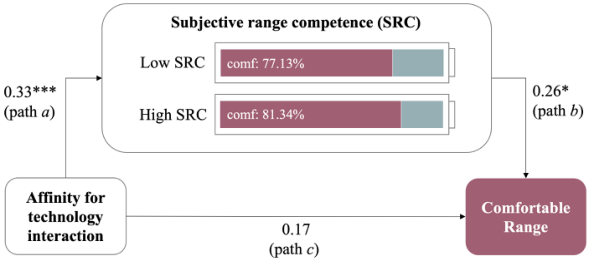
range index. Moreover, a high level of SRC was associated with a higher longest daily route (p < .001) and a higher ATI (p < .001). A simple media- tion analysis was performed to analyze whether ATI predicted comfortable range and whether the direct path would be mediated by SRC.
Mediation analysis was performed using the R package “mediate” (Tingley et al., 2014) and interpreted the results following Zhao et al. (2010). Bootstrapping with 5000 samples was employed to compute inferential statis- tics. An effect of ATI on comfortable range (total effect) was observed, F(1,143) = 4.989, c = 0.26, p = .027. And ATI predicted the mediator (SRC) significantly, F(1,143) = 17.61, a = 0.33, p < .001. After entering the mediator into the model, only SRC predicted comfortable range signif- icantly, F(2,142) = 4.812, b = 0.26, p = .035. Thus, we found that the relationship between ATI and comfortable range was fully mediated by SRC, indirect effect ab = 0.09, p = .050 (due to rounding, the exact p-value is < .050). The average direct effect of ATI on comfortable range (c’ = 0.17) was no longer significant, p = .147. Thus, there was an indirect-only mediation (see Zhao et al., 2010).
Table 3. Sample 1 - Pearson correlations.
Table available in the original PDF paper.
Variable N 1 2 3 4
1. Index of comfortable range (z-standardized) 205 2. ATI 205 .35*** 3. SRC 145 .22** .33*** 4. Longest EV trip distance 143 .20* .14 .34*** 5. Lowest remaining range 131 −.15 −.05 −.18* −.09 Note. * p < .050, ** p < .010, *** p < .001.
Figure 1: Mediation analysis and competence-dependent comfortable range (comf) in % of displayed performant range (***p < .001, *p < .050).
In S2 (Table 4), UBIS was significantly correlated (p < .008) with the lowest remaining range, meaning that the higher UBIS (rather charging depending on subjectively preferred charge level), the lower the lowest remaining range ever displayed in the EV. There were no other significant relationships.
Feeling Comfortable? Exploring the Relation Between Personality, Competence 303
Table 4. Sample 2 - Pearson correlations.
Table available in the original PDF paper.
Variable 1 2 3 4
1. Safety buffer (in km) 2. UBIS .09 3. NfC .14 −.08 4. Longest trip distance .25 .18 .06 5. Lowest remaining range .06 −.35** .08 −.23 Note. **p < .010. N = 57.
DISCUSSION
Summary and Implications In S1, our findings indicate that SRC mediated the relationship between ATI and comfortable range. It must be considered that the indirect effect has become only narrowly significant. In line with prior research indicating ben- efits in learning and performance associated with high NfC (Coutinho et al., 2005; Pichelmann et al., 2013), as well as reduced biases in energy efficiency estimations linked to higher ATI (Moll & Franke, 2021), we hypothesize that higher ATI results in more elaborate interactions with the EVs. These, in turn, increase range competence, i.e., the ability to cope with limited EV range resources. In conclusion, this implies that individuals may need a smaller range safety buffer in order to avoid feeling stressed while driving. Here, further research is necessary to test this assumption. In terms of practical implications, improving communication strategies, acceptance interventions, and enhancing experiences in critical range-related situations could help bridge the gap between technical and comfortable ranges. Our studies pro- vide important insights in this context and underline this promising lever. Thus, further research could focus on motivational methods and enhanced competence acquisition while considering the role of inter-individual differ- ences. The role of ATI seems significant, particularly for individuals with low ATI, who may benefit from enhanced support in acquiring SRC. Further research is needed to test the hypothesis that technology-related personality variables influence how drivers experience EV range, potentially reducing the need for a larger safety buffer. It must be taken into account that the aver- age ATI in the present sample (MS1 = 4.75) was higher than the average of of a quota sample assumed to represent the general population in Germany (M = 3.61; Franke et al., 2019).
In S2, drivers who rather made their charging decision based on the charge level (high UBIS) were more likely to have experienced a lower displayed remaining range. Thus, they utilize the battery capacity to a bigger extent. This is consistent with previous findings showing a positive relation between UBIS and range utilization (Franke & Krems, 2013b). Regarding charging habits, a significant portion of drivers scarcely utilize public charging stations. This indicates there are still significant obstacles to overcome, highlighting the ongoing need to make the charging infrastructure more appealing and/or usable.
Limitations Regarding S2, the results are based on a small sample (NS2 = 57) and dif- fer with regard to the higher sample size of S1 (NS1 = 205). This should be regarded in the interpretation of the results. Given its exploratory nature in identifying potential personality factors related to charging behavior and range interaction, we interpret the presented results as indicative. Further research with larger samples is warranted. Additionally, the reliability of UBIS was low in this sample, limiting the interpretability of the results. Enhanced reliability and clearer insights into both the dimensional structure and the impact of UBIS on charging behavior could be achieved through a larger sample size. Nevertheless, it is also plausible to argue that the increased tech- nical ranges of modern EVs might render the traditional two-dimensional structure of charging behavior obsolete, thus contributing to the diminished reliability of the UBIS scale.
CONCLUSION
In the present research, two online surveys with actual and experienced EV drivers were conducted to provide insight into what factors contribute to a higher comfortable range, ultimately leading to less range stress experience. We could show that technology-related personality variables and EV experi- ence are linked to range interaction and comfortable range. Practically, this implies that enhancing experiences in critical range-related situations could help bridge the gap between technical and comfortable ranges. Also, differ- ent charging styles were found to be related to range utilization. We view the results of this study as an exploratory, indicative, and directional advance- ment in the investigation of EV drivers’ interaction with range, charging behavior, and its multifaceted influences. In addition to necessary targeted methods for acquiring range competence, further research could shed light on the underlying reasons and factors driving the rather limited usage of public charging stations.
ACKNOWLEDGMENT
This research was funded by the Gesellschaft für Energie- und Klimaschutz Schleswig-Holstein GmbH (EKSH) under the name “ECO.SHARE”, project number 8/12-60. The authors would like to thank Hannah Bruns for her contribution to the success of this research.
REFERENCES
Adnan, N. et al. (2017) ‘A comprehensive review on theoretical framework-based electric vehicle consumer adoption research: Electric vehicle consumer adop- tion research’, International Journal of Energy Research, 41(3), pp. 317–335. Available at: https://doi.org/10.1002/er.3640. Bless, H. et al. (1994) ‘Need for Cognition: Eine Skala zur Erfassung von Engagement
und Freude bei Denkaufgaben’, Zeitschrift für Sozialpsychologie [Preprint]. Bühler, F. et al. (2014) ‘Is EV experience related to EV acceptance? Results from a German field study’, Transportation Research Part F: Traffic Psychology and Behaviour, 25, pp. 34–49. Available at: https://doi.org/10.1016/j.trf.2014.05.002.
Feeling Comfortable? Exploring the Relation Between Personality, Competence 305
Cacioppo, J. T. and Petty, R. E. (1982) ‘The need for cognition’, Journal of Personality and Social Psychology, 42(1), pp. 116–131. Available at: https://doi.org/10.1037/ 0022-3514.42.1.116. Coutinho, S. et al. (2005) ‘Metacognition, need for cognition and use of explanations
during ongoing learning and problem solving’, Learning and Individual Differ- ences, 15(4), pp. 321–337. Available at: https://doi.org/10.1016/j.lindif.2005.06. 001. Davidson, R. and MacKinnon, J. G. (1993) Estimation and inference in econometrics.
New York: Oxford University Press. Franke, T. et al. (2012) ‘Experiencing Range in an Electric Vehicle: Understanding Psychological Barriers’, Applied Psychology, 61(3), pp. 368–391. Available at: https://doi.org/10.1111/j.1464-0597.2011.00474.x. Franke, T. et al. (2015) ‘Range comfort zone of electric vehicle users – concept and
assessment’, IET Intelligent Transport Systems, 9(7), pp. 740–745. Available at: https://doi.org/10.1049/iet-its.2014.0169. Franke, T., Attig, C. and Wessel, D. (2019) ‘A Personal Resource for Technology Interaction: Development and Validation of the Affinity for Technology Interac- tion (ATI) Scale’, International Journal of Human–Computer Interaction, 35(6), pp. 456–467. Available at: https://doi.org/10.1080/10447318.2018.1456150. Franke, T. and Krems, J. F. (2013a) ‘Interacting with limited mobility resources: Psy-
chological range levels in electric vehicle use’, Transportation Research Part A: Policy and Practice, 48, pp. 109–122. Available at: https://doi.org/10.1016/j.tra. 2012.10.010. Franke, T. and Krems, J. F. (2013b) ‘Understanding charging behaviour of electric vehicle users’, Transportation Research Part F: Traffic Psychology and Behaviour, 21, pp. 75–89. Available at: https://doi.org/10.1016/j.trf.2013.09.002. Jabeen, F. et al. (2013) ‘Electric vehicle battery charging behaviour: findings from
a driver survey’, in Australasian Transport Research Forum (ATRF). Brisbane, Queensland, Australia. Labeye, E. et al. (2013) ‘Daily use of an electric vehicle: behavioural changes and potential for ITS support’, IET Intelligent Transport Systems, 7(2), pp. 210–214. Available at: https://doi.org/10.1049/iet-its.2012.0155. Moll, V. E. and Franke, T. (2021) ‘Biased energy efficiency perception based on
instantaneous consumption displays – Indication for heuristic energy information processing’, Applied Ergonomics, 94, p. 103399. Available at: https://doi.org/10. 1016/j.apergo.2021.103399. Morrissey, P., Weldon, P. and O’Mahony, M. (2016) ‘Future standard and fast charging infrastructure planning: An analysis of electric vehicle charging behaviour’, Energy Policy, 89, pp. 257–270. Available at: https://doi.org/10.1016/j.enpol. 2015.12.001. Neubauer, J. and Wood, E. (2014) ‘The impact of range anxiety and home, work-
place, and public charging infrastructure on simulated battery electric vehicle lifetime utility’, Journal of Power Sources, 257, pp. 12–20. Available at: https: //doi.org/10.1016/j.jpowsour.2014.01.075. Pichelmann, S., Franke, T. and Krems, J. F. (2013) ‘The Timeframe of Adaptation to Electric Vehicle Range’, in M. Kurosu (ed.) Human-Computer Interaction. Applications and Services. Berlin, Heidelberg: Springer Berlin Heidelberg (Lec- ture Notes in Computer Science), pp. 612–620. Available at: https://doi.org/10. 1007/978-3-642-39262-7_69. Rauh, N., Franke, T. and Krems, J. F. (2015) ‘Understanding the Impact of Electric
Vehicle Driving Experience on Range Anxiety’, Human Factors: The Journal of the Human Factors and Ergonomics Society, 57(1), pp. 177–187. Available at: https://doi.org/10.1177/0018720814546372.
Rezvani, Z., Jansson, J. and Bodin, J. (2015) ‘Advances in consumer electric vehicle adoption research: A review and research agenda’, Transportation Research Part D: Transport and Environment, 34, pp. 122–136. Available at: https://doi.org/10. 1016/j.trd.2014.10.010. Sun, X.-H., Yamamoto, T. and Morikawa, T. (2015) ‘Charge timing choice behavior
of battery electric vehicle users’, Transportation Research Part D: Transport and Environment, 37, pp. 97–107. Available at: https://doi.org/10.1016/j.trd.2015. 04.007. Tingley, D. et al. (2014) ‘mediation: R Package for Causal Mediation Analysis’, Journal of Statistical Software, 59(5). Available at: https://doi.org/10.18637/jss.v059. i05. Wang, Y., Yao, E. and Pan, L. (2021) ‘Electric vehicle drivers’ charging behavior anal-
ysis considering heterogeneity and satisfaction’, Journal of Cleaner Production, 286, p. 124982. Available at: https://doi.org/10.1016/j.jclepro.2020.124982. Wikström, M., Hansson, L. and Alvfors, P. (2014) ‘Socio-technical experiences from electric vehicle utilisation in commercial fleets’, Applied Energy, 123, pp. 82–93. Available at: https://doi.org/10.1016/j.apenergy.2014.02.051. Zhao, X., Lynch, J. G. and Chen, Q. (2010) ‘Reconsidering Baron and Kenny: Myths
and Truths about Mediation Analysis’, Journal of Consumer Research, 37(2), pp. 197–206. Available at: https://doi.org/10.1086/651257. Zoepf, S. et al. (2013) ‘Charging Choices and Fuel Displacement in a Large-Scale Demonstration of Plug-In Hybrid Electric Vehicles’, Transportation Research Record: Journal of the Transportation Research Board, 2385(1), pp. 1–10. Available at: https://doi.org/10.3141/2385-01.
LISTED IN THE AHFE DIGITAL BOOKSTORE CATALOGUE
Explore the complete digital volume
Advances in Human Factors of Transportation
Read this individual research paper free through the original publisher, or explore the full digital proceedings book.
ISBN 978-1-964867-24-3
Explore this ISBN in the AHFE Bookstore ↗Listed in the July 2026 bookstore catalogue; search by ISBN to confirm current availability · Digital book purchase optional