Sanaz Bakhshi Nia, Ruilin Zhu, Wei Li (2026). Navigating Digital Transformation: Strategic Alliances as Digital Catalysts for Corporate Digital Entrepreneurship in China’s Electric Vehicle Transition. In: The Human Side of Service Engineering. AHFE Open Access, vol. 221, pp. 69–76. https://doi.org/10.54941/ahfe1007710
Publisher statistics will load when you open Metrics.
AHFE OPEN ACCESS OPEN ACCESS CONFERENCE PROCEEDINGS PAPER
Navigating Digital Transformation: Strategic Alliances as Digital Catalysts for Corporate Digital Entrepreneurship in China’s Electric Vehicle Transition
The global automotive industry is undergoing a profound and rapid digital transformation, driven by electrification (EVs), autonomous driving, and connected services. This represents a foundational shift away from traditional manufacturing and toward a model focused on Intelligent, Broadband, and Integrated Services (IBIS), where digital competence defines market leadership. This shift demands that large traditional manufacturers engage in sustained Corporate Digital Entrepreneurship (CDE). Firms must leverage dynamic capabilities to secure competitive advantage, especially within the specific and fast-moving context of the Chinese market. In this highly- evolving environment, competitiveness is determined not just by producing electric vehicles, but by the continuous entrepreneurial creation of new digital value streams within the corporation. Yet legacy automakers confront a major obstacle of entrenched organizational inertia combined with the urgent need to develop new digital competencies. This tension mirrors the classic trade-off between exploitation and exploration.Existing research tends to address this problem via two distinct pathways. The first relies on internal structural ambidexterity: established firms build independent exploratory capabilities (EC) to drive internal digital transformation. The second emphasizes external resource acquisition through Strategic Alliances (SAs), enabling access to required digital assets. However, both approaches present limitations: the internal one is slow and resource-intensive, while the purely external path often leads to temporary resource exchange without permanent organizational learning. In short, neither pathway fully captures how SAs can go beyond resource provision, functioning instead as catalysts that embed long-term CDE within a legacy firm.This ongoing study investigates how large traditional automakers can leverage strategically framed alliances as a Digital Catalyst to foster and internalize exploratory capabilities (EC), enabling sustainable CDE. We propose the SA-to-EC Catalyst Model, arguing that alliances act as intermediaries bridging resource gaps and triggering systematic internal transformation by formalizing knowledge transfer and imposing new digital performance metrics on the parent company, thereby preserving competitive relevance in a fast-evolving digital market.The research employs a holistic qualitative single-case design, examining a leading Chinese automaker transitioning from traditional internal-combustion-engine (ICE) production to a dedicated EV platform. The case selection is justified by the firm’s historically strong market position, which makes its organizational inertia a pronounced challenge, and its recent formation of a landmark joint venture with a pure-play tech company. The longitudinal observation spans five years (2018–2023), capturing the formative period of digital capability development. Data are triangulated via 30 semi-structured interviews with executives and managers in R&D, strategy, and operations; extensive archival analysis of internal documents, annual reports, and digital platform launch materials; and direct observation of the firm’s digital product development journey. Analysis proceeds via process tracing, mapping how the SA governance structure triggers cultural and structural change and leads to sustained CDE.Early findings indicate that the alliance; structured as a joint venture; functions as a “digital sandbox,” externalizing risk while offering managerial and technical templates that accelerate internal learning. This research contributes to digital-strategy scholarship by providing a process-oriented lens on how external partnerships evolve beyond resource exchanges to become deep capability catalysts. Specifically, it advances CDE literature by shifting the focus from internal organizational structures to external strategic mechanisms as the engine of entrepreneurial renewal. Practically, it offers a validated strategic framework for legacy firms in high-velocity sectors, such as automotive, to overcome digital inertia via alliances and achieve genuine CDE. It also aligns with evidence linking digital transformation to improved firm-level performance under supportive corporate cultures.
The global automotive industry is undergoing one of the most profound transformations in its history. Electrification, autonomous driving technologies, and connected vehicle services are reshaping not only vehicles themselves but also the underlying logic of value creation. Traditional automotive models, long centered on mechanical engineering excellence, incremental technological improvement, and scale-based production, are increasingly being displaced by digitally mediated ecosystems in which software, data analytics, and platform integration determine competitive advantage. Within this emerging paradigm, success is no longer derived solely from hardware performance but from the ability to orchestrate Intelligent, Broadband, and Integrated Services (IBIS) across vehicles, platforms, and users (Chen et al., 2024).
As digital transformation becomes increasingly prominent, incumbent enterprises across industries face mounting pressure to adapt while Received February 6, 2026; Revised April 21, 2026; Accepted May 7, 2026; Available online July 20, 2026
sustaining ongoing operations. Unlike digital-native firms, incumbents must pursue digital innovation within established organizational structures, legacy technologies, and capital-intensive systems. One strategic response to this challenge is Corporate Digital Entrepreneurship (CDE), defined as entrepreneurial activities within established firms aimed at creating, recombining, and scaling digital value propositions. In practice, CDE can take multiple forms, including the development of software-enabled services, the creation of digital platforms, the deployment of over-the-air (OTA) updates, and the integration of data-driven customer solutions into existing product offerings (Nambisan et al., 2019).
This transformation places unprecedented pressure on incumbent automotive manufacturers. Unlike digital-native entrants, legacy firms must pursue radical innovation while simultaneously maintaining operational continuity within capital-intensive production systems. Digital transformation is therefore not a one-off technological upgrade, but an ongoing organizational process that requires sustained entrepreneurial activity within established firms.
Prior research has examined CDE primarily through lenses such as digital transformation strategies, dynamic capabilities, and organizational learning (Chen et al., 2024; Froehlich et al., 2024). However, despite these advances, less is known about how incumbents overcome internal inertia and capability constraints during CDE, particularly in high-velocity, technology-intensive environments. Specifically, the mechanisms through which firms develop and internalize exploratory capabilities that support sustained CDE remain underexplored.
China represents a particularly critical context for examining CDE. Rapid Electric Vehicle (EV) adoption, extensive government support, and the entry of agile cross-sector competitors have fundamentally altered competitive dynamics. Technology firms have significantly compressed traditional automotive development cycles, replacing multi-year timelines with much shorter, software-driven development and iteration cycles that challenge incumbent manufacturers (Teece, 2019). Policy initiatives, including investments in 5G and vehicle-to-everything (V2X) infrastructure, production and purchase subsidies, and preferential license plate policies, have created a high-velocity market environment in which incumbents must compete simultaneously with domestic startups and global players (Teece, 2019; Li et al., 2025). Dynamic capabilities theory provides a useful lens for understanding how incumbents respond to such environments. Firms must continuously sense emerging opportunities, seize them through resource reallocation, and reconfigure organizational assets to sustain competitiveness (Teece, 2019). However, automotive incumbents often struggle to develop these capabilities internally. Decades of success in Internal Combustion Engine (ICE) production have entrenched routines, performance metrics, and governance structures that prioritize exploitation over exploration.
To address this gap, this study proposes strategic alliances (SAs) as a conceptual lens for understanding how incumbents enact CDE under conditions of digital inertia. Beyond access to complementary resources,
Navigating Digital Transformation: Strategic Alliances as Digital Catalysts for Corporate 71 alliances create organizational spaces in which exploratory capabilities (ECs) can be developed, tested, and internalized. Through collaboration with technology-oriented partners, incumbent firms can experiment with new managerial logics, digital processes, and learning routines in semi-protected environments, enabling sustained CDE despite entrenched organizational constraints.
Automotive manufacturers are adopted not as the research focus per se, but as a contextual case through which CDE processes can be examined. The automotive industry, particularly during the transition to electric vehicles, offers a suitable empirical setting due to its capital intensity, technological complexity, and heightened uncertainty.
The remainder of the paper is structured as follows. Section 2 reviews the relevant literature. Section 3 outlines the research methodology. Section 4 presents the expected outcomes and implications of the study.
LITERATURE REVIEW
Corporate entrepreneurship has long been recognized as a mechanism for organizational renewal. With the diffusion of digital technologies, entrepreneurial activity within established firms increasingly takes digital forms, giving rise to Corporate Digital Entrepreneurship (CDE). CDE is commonly associated with continuous experimentation, software-enabled value propositions, platform-based business models, and the recombination of digital and physical resources to create new sources of value (Chen et al., 2024; Froehlich et al., 2024). Prior work further emphasizes that CDE is closely tied to the broader organizational process of digital transformation, where firms must develop new capabilities and governance arrangements to generate and scale digital value (Froehlich et al., 2024; Vial, 2019).
Empirically, existing CDE and digital entrepreneurship research has been developed across multiple sectors. Studies frequently examine settings where digital innovation can be pursued through relatively modular initiatives such as financial services and platform-based contexts (e.g., fintech and data-driven services), knowledge-intensive services, and technology-oriented ecosystems, where experimentation cycles are fast and iteration costs are comparatively low (Nambisan et al., 2019; Vial, 2019). Research in manufacturing has often emphasized industrial digitalization, digitally enabled services, and platform integration, highlighting how firms restructure processes and offerings through digital technologies (Vial, 2019). Collectively, these studies have advanced strong insights into digital business model innovation, ecosystem participation, and the role of dynamic capabilities in enabling incumbents to pursue entrepreneurial digital initiatives (Chen et al., 2024; Froehlich et al., 2024; Vial, 2019). However, this literature is comparatively thinner in capital-intensive incumbent industries where digital entrepreneurship is tightly coupled with legacy technologies, safety-critical systems, and deeply institutionalized routines. In such contexts, firms often experience digital inertia, a form of rigidity where prior success in hardware-centric production constrains the recognition, experimentation, and scaling of software-driven value creation
(Haskamp et al., 2021). Organizational structures and efficiency-oriented metrics can act as “corporate antibodies,” resisting digital initiatives that threaten established performance logics (Haskamp et al., 2021). In addition, engineering-dominated cultures may undervalue software expertise and slow the adoption of software-first routines that are central to sustaining CDE (Froehlich et al., 2024; Liu et al., 2023).
This limitation points to both a content gap and a theoretical gap. From a content perspective, there is limited understanding of how CDE unfolds when experimentation is expensive and failure is highly consequential. From a theoretical perspective, while existing work clarifies what forms CDE may take and why dynamic capabilities matter, fewer studies explain the mechanisms through which exploratory routines and capabilities are developed and internalized in legacy organizations facing inertia and strong constraints (Chen et al., 2024; Froehlich et al., 2024; Haskamp et al., 2021). In particular, how incumbents create organizational conditions that allow exploratory capabilities to be learned, transferred, embedded, and sustained remains underexplored.
Against this backdrop, automotive manufacturers (AM) represent an informative and challenging context for CDE research. The automotive sector, especially during the transition to electric vehicles, combines high capital intensity, complex production systems, stringent safety requirements, and accelerating digital pressures (Teece, 2019). These features make AM a “hard case” where sustaining CDE requires not only adopting digital technologies but also overcoming inertia and building exploratory capabilities under tight constraints. Studying CDE in this context therefore offers an opportunity to deepen current understanding of how incumbents renew themselves through digital entrepreneurship when internal capability development is difficult and organizational change is strongly path-dependent (Teece, 2019; Haskamp et al., 2021).
Organizational ambidexterity, the ability to balance exploitation and exploration, is a widely proposed response to incumbent inertia (O’Reilly and Tushman, 2013). Structural ambidexterity, such as establishing innovation labs or autonomous digital units, provides space for experimentation but often results in an isolation paradox, whereby innovations remain confined to peripheral units and fail to diffuse into core operations.
This limitation gives rise to an exploratory capability (EC) gap, reflecting a firm’s constrained ability to experiment, learn, and adapt under uncertainty. In the automotive industry, developing ECs internally is particularly challenging due to high failure costs, complex production systems, and stringent safety requirements. From a theoretical perspective, while ambidexterity research explains how exploratory activities are enabled, it offers limited insight into how exploratory capabilities are transferred, embedded, and sustained across legacy organizations. Prior research on organizational learning and dynamic capabilities emphasizes that capability development is cumulative and path-dependent (Zollo and Winter, 2002), yet the mechanisms through which exploratory routines diffuse into core organizational structures remain insufficiently understood. This theoretical gap motivates the present
Navigating Digital Transformation: Strategic Alliances as Digital Catalysts for Corporate 73 study. This gap suggests the need to examine organizational mechanisms that enable exploratory capabilities to move beyond isolated units and become embedded within core organizational routines.
Strategic alliances have traditionally been examined through a resource- based lens, emphasizing access to complementary assets and knowledge transfer (He et al., 2020). In high-velocity digital markets, alliances also function as organizational catalysts that accelerate capability internalization. Partnerships with technology-oriented firms expose incumbents not only to technical expertise but also to agile development routines, novel governance practices, and digital performance metrics (Jiang and Zhu, 2023).
By creating semi-autonomous organizational spaces, alliances allow new routines to be tested, failures to be contained, and learning to be formalized. Conceptually, this catalytic role mirrors a chemical catalyst: the alliance lowers the “activation energy” required for incumbents to overcome inertia and internalize exploratory capabilities that might otherwise remain inaccessible.
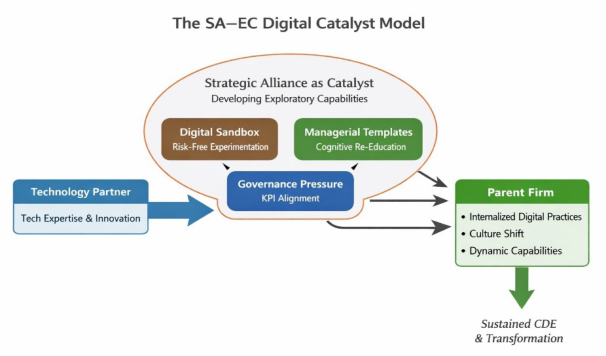
Figure 1 presents the Strategic Alliance–Exploratory Capability (SA–EC) Digital Catalyst Framework. The framework identifies three mechanisms—digital sandboxing, managerial templating, and governance pressure—through which strategic alliances facilitate the development and internalization of exploratory capabilities.
The framework addresses a theoretical gap by explaining how exploratory capabilities diffuse into core organizational routines, thereby complementing ambidexterity and dynamic capabilities perspectives and enabling sustained CDE in high-velocity, digitalized environments.
Figure 1: Strategic alliance–exploratory capability digital catalyst framework.
METHODOLOGY
This study adopts an in-depth qualitative, single-case research design employing process tracing to examine how SAs act as catalysts for CDE within a leading Chinese automotive firm. Single-case qualitative designs are particularly suitable for theory development and the examination of complex organizational processes (George and Bennett, 2005; Eisenhardt, 1989). The unit of analysis is organizational routines and managerial processes. Process tracing enables a detailed within-case examination of causal mechanisms, capturing the sequential transfer and internalization of ECs (George and Bennett, 2005; Beach and Pedersen, 2019).
Data was collected through methodological triangulation to enhance analytical rigor (Eisenhardt, 1989; Yin, 2018). Over thirty semi-structured interviews were conducted with executives and middle managers across research and development, strategy, and operations, with particular emphasis on boundary-spanning roles linking alliance units and the parent firm. In addition, more than one hundred archival documents including strategic roadmaps, governance agreements, and internal innovation plans were analyzed. Site visits to co-located research and software development centers provided direct observation of interactions between hardware and software teams.
Data analysis followed a systematic, multi-stage coding process commonly used in qualitative research (Strauss and Corbin, 1998; Miles et al., 2014; Gioia et al., 2013). Open coding identified recurring references to learning, adaptation, resistance, and friction. Axial coding organized these observations around digital sandboxing, managerial templating, and governance pressure. Selective coding integrated these categories into a process model tracing the internalization of exploratory routines.
EXPECTED OUTCOMES This study is expected to generate several interrelated outcomes that advance understanding of Corporate Digital Entrepreneurship (CDE) in incumbent firms undergoing digital transformation. By positioning strategic alliances as an extension of CDE, the study conceptualizes alliances not as independent strategic choices, but as organizational arrangements through which digital entrepreneurial activities can be enacted, experimented with, and sustained beyond firm boundaries. This framing emphasizes CDE as an ongoing process of opportunity creation, learning, and capability development rather than a set of isolated digital initiatives (Chen et al., 2024; Nambisan et al., 2019).
From a theoretical perspective, the study is expected to contribute to the CDE literature by explicating how exploratory capabilities are developed and internalized in incumbent organizations facing digital inertia. While prior research highlights the importance of digital transformation strategies and dynamic capabilities for enabling CDE (Chen et al., 2024; Froehlich et al., 2024; Vial, 2019), it provides more limited insight into the mechanisms through which exploratory routines move beyond peripheral initiatives and become embedded within core organizational structures. The proposed
Navigating Digital Transformation: Strategic Alliances as Digital Catalysts for Corporate 75 framework suggests that CDE can be enacted through alliance-based arrangements that create semi-autonomous spaces for experimentation while remaining connected to the parent firm’s strategic intent.
By identifying digital sandboxing, managerial templating, and governance alignment as key mechanisms, the study complements existing organizational ambidexterity and dynamic capabilities perspectives. Ambidexterity research explains how exploration and exploitation can coexist (O’Reilly and Tushman, 2013), and dynamic capabilities theory emphasizes sensing, seizing, and reconfiguring in turbulent environments (Teece, 2019). This study extends these perspectives by showing how CDE is operationalized over time, through concrete organizational mechanisms that facilitate the diffusion and internalization of exploratory capabilities within legacy firms. In doing so, it contributes to a more process-oriented and micro-founded understanding of CDE in capital-intensive contexts.
From a practical perspective, the study is expected to offer guidance for incumbent firms seeking to sustain CDE under conditions of high uncertainty. The findings suggest that strategic alliances can be leveraged as intentional vehicles of corporate digital entrepreneurship, rather than being treated solely as channels for technology acquisition or market access (He et al., 2020). By using alliances as digital sandboxes, firms can externalize risk and experiment with software-driven innovations without disrupting core operations. Managerial templating enables the transfer of agile routines and software-first mindsets into legacy units, while alliance-level digital performance indicators help realign governance and incentive systems toward digital value creation.
These insights are particularly relevant in the context of China’s electric vehicle transition, where incumbents face intense pressure from digitally native competitors and rapidly evolving technological standards (Teece, 2019; Li et al., 2025). By framing alliances as extensions of CDE, the study suggests that incumbents can pursue continuous digital entrepreneurship while maintaining operational stability and avoiding premature, large- scale organizational restructuring. More broadly, the findings highlight the importance of designing alliances not only for resource complementarity, but also for organizational learning and capability building, which are central to sustaining CDE over time.
REFERENCES
Beach, D., & Pedersen, R. B. (2019). Process-Tracing Methods (2nd ed.). University of Michigan Press. Chen, H., Popaitoon, S., & Mumi, A. (2024). Investigating corporate entrepreneurship
strategy through digital transformation: A dynamic capabilities perspective. Journal of Innovation and Entrepreneurship, 14, 95. Eisenhardt, K. M. (1989). Building theories from case study research. Academy of Management Review, 14(4), 532–550. Froehlich, C., Reinhart, L., Schreiber, D., & Eberle, L. (2024). Dynamic capabilities for
digital transformation in an enterprise business. Benchmarking: An International Journal, 32(2).
George, A. L., & Bennett, A. (2005). Case Studies and Theory Development in the Social Sciences. MIT Press. Gioia, D. A., Corley, K. G., & Hamilton, A. L. (2013). Seeking qualitative rigor in
inductive research: Notes on the Gioia methodology. Organizational Research Methods, 16(1), 15–31. Haskamp, T., Dremel, C., Marx, C., & Ubernickel, F. (2021). Understanding inertia in digital transformation. Proceedings of the 42nd International Conference on Information Systems (ICIS 2021). He, Q., Meadows, M., Angwin, D., Gomes, E., & Child, J. (2020). Strategic alliance
research in the era of digital transformation. British Journal of Management, 31(3), 589–617. Jiang, N., & Zhu, R. (2023). Navigating digital transformation challenges in China’s manufacturing towns. Proceedings of the International Conference on Entrepreneurship and Business (ICEB). Li, Y., Chen, Y., Wang, J., Zhou, Y., & Wang, C. (2025). Digital platform capability
and innovation ambidexterity: The mediating role of strategic flexibility. Journal Business Research, 186, 114971. Liu, Q., Wan, H., & Yu, H. (2023). Digital transformation and corporate performance.
Academic Journal of Management and Social Sciences, 3(1), 90–106. Miles, M. B., Huberman, A. M., & Saldaña, J. (2014). Qualitative Data Analysis (3rd ed.). Sage. Nambisan, S., Wright, M., & Feldman, M. (2019). The digital transformation of
innovation and entrepreneurship. Research Policy, 48(8), 103773. O’Reilly, C. A., & Tushman, M. L. (2013). Organizational ambidexterity: Past, present, and future. Academy of Management Perspectives, 27(4), 324–338. Strauss, A., & Corbin, J. (1998). Basics of Qualitative Research (2nd ed.). Sage. Teece, D. J. (2019). China and the reshaping of the auto industry: A dynamic
capabilities perspective. Management and Organization Review, 15(1), 11–40. Vial, G. (2019). Understanding digital transformation: A review and a research agenda. MIS Quarterly, 43(1), 223–252. Yin, R. K. (2018). Case Study Research and Applications (6th ed.). Sage. Zollo, M., & Winter, S. G. (2002). Deliberate learning and the evolution of dynamic
Read this individual research paper free through the original publisher, or explore the full digital proceedings book.
ISBN 978-1-964867-97-7
Explore this ISBN in the AHFE Bookstore ↗Listed in the July 2026 bookstore catalogue; search by ISBN to confirm current availability · Digital book purchase optional