Natacha Silva, Maria José Palma Lampreia Dos Santos (2023). Impact of China-Pakistan Economic Investment on Volatility of Stock Exchanges in Pakistan and Shanghai. In: Human Factors in Management and Leadership. AHFE Open Access, vol. 92, pp. 49–54. https://doi.org/10.54941/ahfe1003733
This paper aims to analyse the impact of the China-Pakistan Economic Corridor (CPEC) on the volatility of the Pakistan Stock Exchange and Shanghai Stock Exchanges, namely, to analyse the pre and post impact of China investments in Pakistan in the energy sector on the stock exchanges of the respective countries. The methods used include an econometric analysis, namely, the GARCH model, and univariate statistical analysis, from 4th January 2010 to 2nd January 2019. The results present a significant difference in volatilities of the pre and post returns of both indices. Stock prices increased post-CPEC announcement in Pakistan, and there was a growth in the stock market. However, the mean return post-CPEC announcement is lower than Pre-announcement tenure, combined with higher volatility. This shows investor under confidence due to secrecy and non-transparent deals done under CPEC. Face to these results, we recommend a more transparent process in CPEC.
Globalization and strategic partnerships between different countries, each with competitive advantages, mark the advent of every country worldw- ide. China and Pakistan (PK) are examples of this economic agreement since 1951.
This increasing commercial and Foreigner Direct Investment (FDI) and investment relations have resulted in One belt and One Road route con- necting different countries and 63% of the Gross National Product across countries (Fonseca et al., 2017). The massive FDI from China in PK should be evaluated and analyzed, which is this paper’s main aim.
The present paper aims to analyze the impact of the China-Pakistan Economic Corridor (CPEC) on the volatility of the Pakistan Stock Exchange and Shanghai Stock Exchanges. Namely, to analyze the pre and post-impact of China’s investments in Pakistan in the energy sector on the stock exchanges of the respective countries.
In the context of Pakistan (PK), the China-Pakistan Economic Corridor (CPEC) represents the involvement of most stakeholders, and the associa- ted long-term benefits for both nations have reinforced strategic importance. Initial investments expected to be made under this regional cooperation pact are over US$62 billion.
Some proposed projects include improving communication channels, energy cooperation, agricultural reforms, and human resource development, among other FDI (Bilal et al., 2022).
Nowadays, China has played an intense role in developing a global eco- nomy, which has significantly taken world trade to unprecedented levels (Ali, Gang, & Raza, 2016). The China- Pakistan Economic Corridor (CPEC) is part of China’s vision for a ‘One Belt, One Road, forming interconne- ctions between landlocked countries and building strong ties with neigh- boring countries for its strategic trade purposes (Wang, 2016). Through CPEC, China will build a 3000 km network of ports, terminals, roads, railways, and oil & gas pipelines extending its way from the coastal area of Gwadar city to the historic city of Kashgar in northwestern China (Bader, 2015).
The location of Pakistan is the most significant advantage of the country. Global powers have shown interest in the country to gain connections with the rest of the region and attain their economic interests (Shaikh, Ji, & Fan, 2016). CPEC is undoubtedly a global opportunity for Pakistan as it will link Pakistan to different countries and provide economic and financial support. Thus, the market might be down in the future as the market will move upward in the sectors linked with CPEC, such as Cement, Steel, Automobile, Banks, Etc. It is the right time to invest money in Pakistan Stock Exchange in the following sectors.
The policymakers’ recommendations can be to work on the smooth com- pletion of CPEC projects and not let the internal and external problems faced by the country impact this opportunity project. Likewise, all provi- nces and stakeholders within the country and the mega-project should benefit the country’s national interest. The project should be run transparently to attract more investors, and the project should benefit the people in general by creating new employment opportunities and social well-being.
CPEC is a golden opportunity for both countries to combine their strengths on the economic and financial fronts in the emergent South Asian region (Javaid & Javaid, 2016).
Stock prices fluctuate forever, and stock may be reasonably priced at one point, overpriced at another, and under-priced in the next period. It can be explained that the market has both speculators and investors. For instance, if good news circulates in the market for a company, the stock price incre- ases. The speculator hopes for the prices to further increases and thus takes a long position causing the prices to increase further. The investor, however, knows the intrinsic value of the stock and starts to sell orders to settle for a profit, leading to lower prices (Vveinhardt, Streimikiene, Rizwan, Ahmad, & Rehman, 2016).
Impact of China-Pakistan Economic Investment on Volatility of Stock Exchanges 51
The stock markets in emerging markets are impacted by local and glo- bal news and significant events. The periods of volatility are often linked to macroeconomic factors, company fundamentals, or politics. There are peri- ods when this volatility from intrinsic values might be more significant than in other periods. Majorly these large fluctuations are because of major eco- nomic events such as the oil crises or stock market disturbances. Time series models can help predict the variability of returns. One of the most succes- sful ones is the GARCH model. Also, the GARCH model can capture the time-varying variability of returns over long periods. (Franses & Dijk, 1996).
In CPEC’s various economic initiatives, the development and dynamization of industry and the energy sector stand out. These issues are being addressed through the formation of special economic zones. It is an excellent opportu- nity to design and evaluate financial policies that can gradually help achieve the global SDGs.
Nowadays, China has played an intense role in developing a global eco- nomy, which has significantly taken world trade to unprecedented levels (Ali, Gang, & Raza, 2016). The advent of the 21st century has marked the begin- ning of economic globalization and strategic partnerships between different countries due to diplomatic talks. Gone are the days when governments were involved in wars and engulfed in themselves, isolated from the rest of the world. Today, countries have realized that it is mandatory to form economi- cal, defense, and industrial partnerships to fulfill their interests. China and Pakistan are examples of such strategic alliances that have enjoyed a bro- therly relationship for about half-century. Since 1951, Pakistan has been a vital part of Chinese foreign policy. The Sino-Pakistan agreement (1963) was the founding stone of this relationship between the two neighboring coun- tries, which has grown positively over the years. (Hartpence, 2011). The China- Pakistan Economic Corridor (CPEC) is part of China’s vision for a ‘One Belt, One Road,’ forming interconnections between landlocked coun- tries and building strong ties with neighboring countries for its strategic trade purposes (Ali, Gang, & Raza, 2016). Through CPEC, China will build a 3000 km network of ports, terminals, roads, railways, and oil & gas pipe- lines extending its way from the coastal area of Gwadar city to the historic city of Kashgar in northwestern China (Dos-Santos, 2017). Kumar (2017) performed exemplary work in evaluating the relationship between the two countries and determining the impact of CPEC on trade, investment, energy, and infrastructure. She concluded that infrastructural development in Paki- stan, sponsored and initiated by China in the shape of Gwadar Port and others, has proven to be strategically very important for both countries. This partnership will continue to grow in the future because of the mutual inte- rest of both countries in economic support to Pakistan and China’s trade access to new markets. The China-Pakistan Economic Corridor represents a significant part of FDI. It represents a new era of connectivity and integra- tion for Pakistan-China as it will transform the region’s economic growth and the well-being of the Pakistani people. Acceptance of the CPEC project is linked to perceived benefits, including business opportunities and regio- nal growth (Anwar et al., 2022). The literature also mentions that the local population’s perspectives on quality of life, greater economic possibilities,
52 Jesus-Silva and Dos-Santos
and poverty reduction have changed due to CPEC projects (Anwar et al., 2022). Alternative trade and energy channels and easy access to the Middle East, Africa, and Europe are designed to benefit these countries.
Thus, CPEC is a multifaceted project that provides China with the shortest access to the 21st century Maritime Silk Road in the Indian Ocean and deve- lops, connects, and integrates Asian regional economies and markets (Anwar et al., 2022).
METHODOLOGY
Information and data come from the World Bank database (2020) from February 2011 to February 2010.
The variables include the total average stock returns of PSX-100 and the Shanghai Stock Exchange Composite Index.
The methods include univariate analysis and an econometric model, accor- ding to Dos-Santos (2019). It also analyzes the volatility of time-series data before and after the announcement of CPEC. E-views Program did Econometric Analysis.
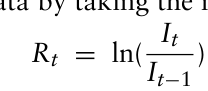
The indices’ stock returns, PSX-100 and SHCOMP, are calculated from the stock markets’ daily data by taking the natural log. It is expressed as:
)
Equation reproduced from the original PDF.
Where: Rt: Stock returns at time t It: Stock Market Index at time t It-1: Stock market index at time first lag of time t.
RESULTS AND DISCUSSION
Results confirm that the CPEC positively impacted PSX-100 prices as expe- cted, which increased prices. This trend was accomplished by higher volatility. The descriptive results also present the same trend. On the other hand, the Shanghai Stock exchange has negative returns. Inferential analysis was done to see if the indices’ volatility in different tenures is equal. The findings show a significant difference in volatilities of the pre and post-returns of both indices.
The two hypotheses regarding the absence of ARCH and GARCH effects were also rejected. Moreover, the fourth hypothesis is also rejected since the three-time series observed mean reversion indicated by the Unit Root Test and the sum of coefficients α and β, less than 1. The results aligned with the previous literature (Dos-Santos & Henriques, 2019) KSE-100 had the highest volatility and mean reversion, followed by LSE-25 and ISE-10.
The paper exhibits limitations due to the scope of the study. The data includes four years before and after the announcement of the CPEC pro- ject. Nevertheless, most projects associated with CPEC have yet to be started and will require time to develop; thus, it will take time for the impact to be reflected in stock markets in the future. The results do not com- pare pre and post-returns and mainly focus on stock market volatility and ignore other asset markets. The study covers three stock market indices of
Impact of China-Pakistan Economic Investment on Volatility of Stock Exchanges 53
PSX-100 and SHCOMP. Indeed, the econometric model itself has some limi- tations. The model only considers the impact of the magnitude of shocks (positive/negative news results) on stock returns and not its trend.
CPEC is undoubtedly a global opportunity for Pakistan as it will link Paki- stan to different countries and provide economic and financial support. Thus, the market might be down in the future as the market will move upward in the sectors linked with CPEC, such as industries of cement, steel, automobile, services, banks, Etc.
The results also present a significant difference in volatilities of the pre and post-returns of both indices. Stock prices increased post-CPEC annou- ncement in Pakistan, and there was a growth in the stock market. However, the mean return post-CPEC announcement is lower than Pre-announcement tenure, combined with higher volatility. It shows investors’ underconfidence due to secrecy and non-transparent deals done under CPEC. Face to these results, we recommend a more transparent process in CPEC. That should motivate new investors to invest and introduce new FDI in PK.
CONCLUSION
The paper presents the volatility and its characteristics before and after the CPEC announcement on PSX and Shanghai Stock Exchange. The results pre- sent a significant difference in volatilities of the pre and post-returns of both indices.
The results also confirm that the stock prices increased post-CPEC annou- ncement in Pakistan, and there was a growth in the stock market, in general, and in PK, in particular. However, the mean return post-CPEC announcement is lower than Pre-announcement tenure, combined with higher volatility, representing the investors’ reliability under CPEC.
The policymakers’ recommendations can be to work on the future com- pletion of CPEC projects and not let the internal and external problems faced by the country impact this opportunity project. Likewise, all provi- nces and stakeholders within the country and the mega-project should benefit the country’s national interest. The project should be run transparently to attract more investors, and the project should benefit the people in general by creating new employment opportunities and social well-being.
ACKNOWLEDGEMENT
This work was supported by the UIDB/05105/2020 Program Contract, funded by national funds through the FCT I.P.
REFERENCES
Ali, W., Gang, L., & Raza, M. (2016). China-Pakistan Economic Corridor: Current Developments and Future Prospect for Regional Integration. International Journal of Research, 3(10), 210–222. Anwar, S. U., Wuyi, Z., Ali Shah, S. Z., Ullah, Q., Amir, S. M., & Syed, A. (2022). The
resilient economic impact of CPEC and future of MNCs: Evidence from Pakistan. Frontiers in Environmental Science, p. 10, 1161.
54 Jesus-Silva and Dos-Santos
Bader, L. (2015). China’s 6 magical economic corridors. Retreived from http://them arketmogul.com/chinas-6-magical-economiccorridors/. Bilal, M., Ali, M. K., Qazi, U., Hussain, S., Jahanzaib, M., & Wasim, A. (2022). A
multifaceted evaluation of hybrid energy policies: The case of sustainable alter- natives in Special Economic Zones of the China-Pakistan Economic Corridor (CPEC). Sustainable Energy Technologies and Assessments, 52, 101958. Dos Santos, M. J. P. L. (2017). As principais tipologias de explorações agrícolas na União Europeia. RAMA: Revista Agronegócio e Meio Ambiente, 10(2), 273–290. Dos Santos, M. J. P. L., & Henriques, P. D. D. S. (2019). Melhoramento da eficiência e
gestão das explorações de bovinos de carne em Portugal. Revista em Agronegócio e Meio Ambiente, 921–934. Fonseca, A. M., Diz, H., & Dos Santos, M. J. P. L. (2016). O crowdfunding as a way to finance investigative journalism in Portugal. Palabra Clave, 19, 893–918. Javaid, U., & Javaid, R. (2016). Strengthening geo-strategic bond of Pakistan
and China through geo-economic configuration. Pakistan Economic and Social Review, 54(1), 123–142. Vveinhardt, J., Streimikiene, D., Rizwan, A. R., Ahmad, N., & Rehman, A.
(2016). Mean reversion: an investigation from Karachi stock exchange sectors. Technological and Economic Development of Economy, 22(4), 493–511.
LISTED IN THE AHFE DIGITAL BOOKSTORE CATALOGUE
Explore the complete digital volume
Human Factors in Management and Leadership
Read this individual research paper free through the original publisher, or explore the full digital proceedings book.
ISBN 978-1-958651-68-1
Explore this ISBN in the AHFE Bookstore ↗Listed in the July 2026 bookstore catalogue; search by ISBN to confirm current availability · Digital book purchase optional