Yong He, Xi Zhang, Qianchen Guo, Jiangtao Du (2022). A Survey of the Association between Perceived Environmental Qualities and Students’ Satisfaction in Chinese High Schools. In: Human Factors in Architecture, Sustainable Urban Planning and Infrastructure. AHFE Open Access, vol. 58, pp. 117–124. https://doi.org/10.54941/ahfe1002341
This article presented an online survey of how perceived environmental qualities affect Chinese students’ satisfaction in urban high schools. Key findings were as follows: 1) There was an association between students’ satisfaction and classroom environmental qualities including perceived qualities of facilities, furniture and wall decoration, indoor climate, indoor plant, and window view. 2) However, social capital and being away can fully mediate the effects of window view and indoor plants, while effects of perceived qualities (facilities, furniture and wall decoration) and indoor climate can be just partially mediated by them.
Recently increasing attention has been paid to the adolescent mental health problem, especially in developing countries (WHO, 2018). In Chinese urban high schools, it has been exposed that the academic stress was the major mental problem among students, which occurs with the higher pressure to pass the national university entry exam (Luo et al., 2020). As high sch- ool students spend a substantial amount of time on studying indoors, their mental health and satisfaction can be significantly affected by the environ- mental conditions of classrooms (Maxwell, 2016). Some physical aspects of classroom environment have been broadly investigated, including thermal, lighting, acoustic, and air quality (Maxwell, 2016). In addition, the impact of classroom architectural features on students’ mental performance was stu- died, such as seating location, windows, furniture, and facilities (Maxwell, 2016; Shernoff et al., 2017). However, proofs that how perceived environ- mental qualities take effect on students’ satisfaction in current Chinese high schools are limited.
The present study aimed to conduct an online survey to explore the effects of perceived classroom environmental qualities on students’ satisfaction in urban high schools and try to find out proper strategies to improve their mental wellbeing through the solutions of environmental design.
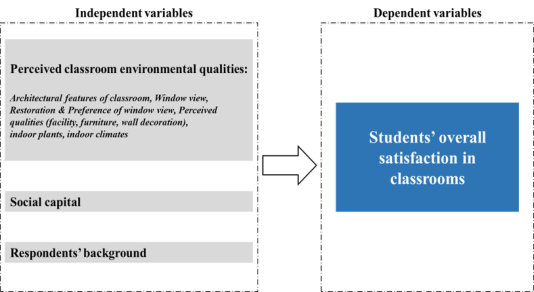
METHODS AND MATERIALS Several methods and materials were applied to implement this study as fol- lows. Survey method: Online survey was applied using Sojump (Chinese: 问 卷星). Period: September 2020 — July 2021. Respondents: Current students studying in urban high schools in China. A total of 1221 responses was ori- ginally received and only 1204 responses (64% female) were proved as valid. Their main ages ranged from 15 to 18 and the years of study were from 1 to 3. In addition, their locations include Shanghai (60.63%) and other cities (39.37%) in China. Tables 1 & 2 summarizes respondents’ demogra- phic characteristics. Research design: Figure 1 shows the independent and dependent variables of the survey questionnaire. The independent variables included architectural features of classroom (building height, floors, win- dow size, etc.), perceived qualities of facilities, furniture, and wall decoration (Brittin et al., 2017), availability of indoor plants (Bringslimark et al., 2009), window views (Li & Sullivan, 2016), preference for window view, restora- tion of window view (Being away and Fascination) (Kaplan, 2001), indoor climates (thermal, lighting, acoustic and air quality) (De Giuli et al., 2012), and social capital (Maxwell, 2016). The dependent variable was the students’ overall satisfaction in their classrooms.
Data analysis: The multiple-mediator approach was used in the analysis of survey data (Preacher & Hayes, 2008). The process adopted the recom- mendation regarding bootstrap estimation of the indirect effects. That means if bootstrap confidence interval (CI) does not include zero, the indirect effe- cts can be considered statistically significant. Analysis was completed using IBM SPSS Statistics 27 software and PROCESS macro for SPSS published by Hayes (accessible https://www.processmacro.org/index.html).
Table 1. Characteristics of respondents in this survey.
Table available in the original PDF paper.
Respondents % Gender Female 64 Male 36 Age 15 16 16 40 17 27 18 14 Other 3 Year of study 1 30 2 50 3 20
A Survey of the Association between Perceived Environmental Qualities 119
Table 2. Characteristics of environmental conditions in classroom surveyed.
Table available in the original PDF paper.
Classroom environmental conditions % Window size Large 42 Medium 55 Small 3 Window view Nature view 55 City view 41 Others 4 Indoor plant No plant 40 A bit 47 Some 11 Many 2 Total floors of building ≤3 11 4-6 69 ≥7 20 The floor of the classroom ≤3 62 4-6 36 ≥7 2
Figure 1: The design of survey questionnaire: independent and dependent variables.
RESULTS
Description: Respondents and Classroom Environmental Conditions Descriptive statistics for both respondents and classroom environmental condition in this analysis are shown in Table 1 & Table 2, respectively.
According to Table 1, 64% of respondents were female students, whilst 40% of respondents were at 16 years old. There were 50% of students who were at the year 2. In Table 2, most classroom buildings had 4-6 floors (69%). A considerable number of classrooms (63%) were found located at lower floors (<3). Most respondents’ classrooms had a medium/large window size (97%) and the nature view of window (55%).
Table 3. Descriptive statistics and correlation matrix for 9 main variables.
Correlation Analysis A correlation analysis was conducted in terms of 9 variables, as shown in Table 3.
There were significant correlations between the overall satisfaction and other eight variables (window view, indoor plant, be away, fascination, etc.). Similarly, strong bivariate correlations were found between those variables. Only the window view has negative correlation with the overall satisfaction.
Effect of Perceived Environmental Qualities on Overall Satisfaction Window view, perceived qualities, indoor plant and indoor climate were hypothesized to be the individual predictor for the overall satisfaction, while being away, fascination, view preference and social capital were tested as mediators. Characteristics of respondents and other conditions were control- led for in the mediating analyses. The indirect effect (95% bias-corrected CI) was tested via INDIRECT procedure (5000 bootstrapped samples).
In Table 4, Model 1 indicated that the predicting role of window view for overall satisfaction was significant (p<0.01). According to Model 2, the direct effect of window view on satisfaction was insignificant (p>0.05), while effects of being away and social capital were significant (p<0.01). Full media- ting effects were found for being away (−0.0908 −0.0342) and social capital (−0.1390 −0.0234), with the window view as the predictor.
Table 5 shows that the effect of perceived qualities of facilities, furniture, and wall decoration was significant in Model 1 (p<0.01). For Model 2, the direct effect of window view on satisfaction decreased, but still presented as significant (p<0.01). In addition, effects of being away and social capital on satisfaction were significant (p<0.01). The analysis showed that there were partial mediating effects of being away (0.0392 0.1139) and social capital
A Survey of the Association between Perceived Environmental Qualities 121
Table 4. Effect of window view on overall satisfaction (multiple regression analysis).
Table available in the original PDF paper.
Predictors Model1 Model2
B SE B SE Gender −0.1533** 0.0584 −0.0317 0.0405 Age 0.0265 0.0352 0.0323 0.0243 Year of study −0.0568 0.0511 −0.0901* 0.0353 Student numbers −0.0077** 0.0026 −0.0039* 0.0018 Building floors 0.0274 0.0296 0.0074 0.0207 Floor of classroom −0.0255 0.0253 −0.0239 0.0174 Window size −0.2692** 0.0511 −0.1012** 0.0232 Window view −0.2035** 0.0491 −0.0557 0.0343 Being away 0.1796** 0.0224 Fascination 0.0065 0.0207 View preference 0.0242 0.0231 Social capital 0.7289** 0.0265
*. p<0.05, **. p<0.01.
Table 5. Effect of perceived qualities (facilities, furniture, and wall decoration) on overall satisfaction (multiple regression analysis).
Table available in the original PDF paper.
Predictors Model1 Model2
B SE B SE Gender −0.0860 0.0453 −0.0277 0.0380 Age 0.0299 0.0273 0.0336 0.0228 Year of study −0.0636 0.0395 −0.0810** 0.0330 Student numbers −0.0030 0.0020 −0.0025 0.0017 Building floors 0.0351 0.0230 0.0109 0.0194 Floor of classroom −0.0356 0.0195 −0.0273 0.0163 Window size −0.0388 0.0404 −0.0327 0.0338 Perceived qualities 0.7327** 0.0256 0.3526** 0.0276 Being away 0.1108** 0.0216 Fascination −0.0113 0.0195 View preference 0.0234 0.0217 Social capital 0.5685** 0.0279
*. p<0.05, **. p<0.01.
(0.2499 0.3464) on the overall satisfaction, with the perceived qualities of facilities, furniture, and wall decoration as the predictor.
The same regression analysis was conducted for the indoor plant (Table 6). It was found that the being away and social capital can fully mediate the relationship between indoor plant and overall satisfaction. In Model 2, the predicting role of indoor plant on overall satisfaction changed: from signi- ficant (p<0.01, Model 1) to insignificant (p>0.05, Model 2), while effects of being away and social capital on satisfaction were tested as significant (p<0.01). Full mediating effects of being away (0.0319 0.0783) and social capital (0.1187 0.2057) on the overall satisfaction were found, with the indoor plant as the predictor.
Table 6. Effect of indoor plant on overall satisfaction (multiple regression analysis).
Table available in the original PDF paper.
Predictors Model1 Model2
B SE B SE Gender −0.1374** 0.0579 −0.0296 0.0450 Age 0.0155 0.0350 0.0321 0.0243 Year of study −0.0356 0.0505 −0.0857* 0.0352 Student numbers −0.0081** 0.0025 −0.0039* 0.0018 Building floors 0.0380 0.0295 0.0070 0.0207 Floor of classroom −0.0223 0.0251 −0.0259 0.0174 Window size −0.2722** 0.0506 −0.1055** 0.0355 Indoor plant 0.2272** 0.0384 0.0053 0.0274 Being away 0.1835** 0.0223 Fascination 0.0058 0.0280 View preference 0.0248 0.0232 Social capital 0.7288** 0.0355
*. p<0.05, **. p<0.01.
Table 7. Effect of indoor climate on overall satisfaction (multiple regression analysis).
Table available in the original PDF paper.
Predictors Model1 Model2
B SE B SE Gender −0.0854 0.0466 −0.0236 0.0388 Age 0.0319 0.0281 0.0347 0.0233 Year of study −0.0554 0.0406 −0.0761* 0.0337 Student numbers −0.0036 0.0021 0.0017 0.0017 Building floors 0.0159 0.0236 0.0198 0.0198 Floor of classroom −0.0231 0.0201 0.0167 0.0167 Window size −0.1292** 0.0410 0.0340* 0.0340 Indoor climate 0.6758** 0.0253 0.2910** 0.0279 Being away 0.1189** 0.0222 Fascination −0.0014 0.0199 View preference 0.0005 0.0223 Social capital 0.6040** 0.0281
*. p<0.05, **. p<0.01.
Table 7 indicated that the predicting role of indoor climate on overall sati- sfaction was significant (p<0.01) (Model 1). In Model 2, the direct effect of indoor climate decreased (p<0.01). However, effects of being away and social capital were found as significant (p<0.01). The analysis showed that there were partial mediating effects of being away (0.0455 0.1246) and social capital (0.2532 0.3485) on the overall satisfaction.
DISCUSSION AND CONCLUSION Several key findings can be drawn from the results above. 1). In Chinese urban high schools, there was the association between students’ overall sati- sfaction and several key perceived classroom environmental qualities, such
A Survey of the Association between Perceived Environmental Qualities 123
as window view, qualities of facilities, furniture and wall decoration, indoor plant, and indoor climate (thermal, lighting, acoustic, air quality). This fin- ding can be supported by several investigations (Maxwell, 2016; Shernoff et al., 2017; Brittin et al., 2017; Bringslimark et al., 2009; De Giuli et al., 2012). 2). Social capital and the psychological restoration of view were tested as mediators for the relationship between perceived classroom environ- mental qualities and students’ overall satisfaction. The role of social capital on students’ performance was exposed in middle schools (Maxwell, 2016), whilst the restoration of window view has been broadly studied at work- spaces and houses (Brittin et al., 2017; Li & Sullivan, 2016). 3). Effects of the type of window views and indoor plant on students’ satisfaction can be fully mediated by social capital and being away of such views in high school classrooms. Students’ perception of social climate can mediate buil- ding condition and academic outcomes in middle schools (Maxwell, 2016). 4). In addition, the relationship of perceived qualities of facilities, furniture and wall decoration / indoor climate and students’ satisfaction can be par- tially mediated by social capital and being away of window view in high school classrooms. The indoor environmental qualities and facilities have been broadly recognized as critical environmental factors which can signi- ficantly affect students’ performance in classrooms (Shernoff et al., 2017; De Giuli et al., 2012).
These findings can be developed into guidelines for the design of more psychological sustainable school buildings in Chinese cities.
ACKNOWLEDGMENT
The authors would like to acknowledge NSFC (National Natural Science Foundation of China) for the funding support through a research project (Grant No. 51778438).
REFERENCES
Bringslimark, T., Hartig, T., & Patil, G. G. (2009). The psychological benefits of indoor plants: A critical review of the experimental literature. Journal of Environmental Psychology, 29(4), 422–433. Brittin, J., Frerichs, L., Sirard, J. R., Wells, N. M., Myers, B. M., Garcia, J., Soren-
sen, D., Trowbridge, M. J., Huang, T. (2017). Impacts of active school design on school-time sedentary behavior and physical activity: A pilot natural experiment. PLoS One, 12(12): e0189236. De Giuli, V., Da Pos, O., De Carli, M. (2012). Indoor environmental quality and pupil perception in Italian primary schools. Building and Environment, 56, 335–345. Kaplan, R. (2001). The nature of the view from home: Psychological benefits.
Environment and behavior, 33(4), 507–542. Li, D., & Sullivan, W. C. (2016). Impact of views to school landscapes on recovery from stress and mental fatigue. Landscape and urban planning, 148, 149–158.
Luo, Y., Cui, Z., Zou, P., Wang, K., Lin, Z., He, J., & Wang, J. (2020). Mental health problems and associated factors in Chinese high school students in Henan pro- vince: A cross-sectional study. International Journal of Environmental Research and Public Health, 17(16), 5944. Maxwell, L. E. (2016). School building condition, social climate, student attenda-
nce and academic achievement: A mediation model. Journal of Environmental Psychology, 46, 206–216. Preacher, K. J., & Hayes, A. F. (2008). Asymptotic and resampling strategies for assessing and comparing indirect effects in multiple mediator models. Behavior Research Methods, 40, 879–891. Shernoff, D. J., Sannella, A. J., Schorr, R. Y., Sanchez-Wall, L., Ruzek, E. A., Sinha,
S., & Bressler, D. M. (2017). Separate worlds: The influence of seating loca- tion on student engagement, classroom experience, and performance in the large university lecture hall. Journal of environmental psychology, 49, 55–64. World Health Organization. Adolescent mental health. Fact sheet. (2018). Available at: https://www.who.int/news-room/fact-sheets/detail/adolescent-mental-hea lth (final access: 01/10/2020).
LISTED IN THE AHFE DIGITAL BOOKSTORE CATALOGUE
Explore the complete digital volume
Human Factors in Architecture, Sustainable Urban Planning and Infrastructure
Read this individual research paper free through the original publisher, or explore the full digital proceedings book.
ISBN 978-1-958651-34-6
Explore this ISBN in the AHFE Bookstore ↗Listed in the July 2026 bookstore catalogue; search by ISBN to confirm current availability · Digital book purchase optional