Daniela Spirkova, Petr Stepanek, Julius Golej, Barbora Brestovska (2022). Current economic limits of housing affordability in the Czech and Slovak Republics. In: Human Factors in Architecture, Sustainable Urban Planning and Infrastructure. AHFE Open Access, vol. 58, pp. 85–90. https://doi.org/10.54941/ahfe1002337
The unavailability of housing in the Czech and Slovak Republics is a fundamental problem, which is a consequence of many social, economic, political, and behavioural or historical aspects. The housing affordability deficit has the character of a systemic market failure, which is - paradoxically - linked to the growth of prosperity and resulting from the dual nature of the object (housing) in question - it is both an investment product and a de facto mandatory social need. It is an indicated market failure that justifies state intervention and public support. The housing problem no longer affects only the socially disadvantaged and the middle-income groups. Unfortunately, the deficit of housing affordability has a fatal impact on the competitiveness of cities and regions and its social cohesion and environmental and economic sustainability.
Housing unaffordability in the Czech and the Slovak Republics, especially in metropolitan areas that are centres of prosperity, is a fundamental problem resulting from many social, economic, political, behavioural and historical aspects. The problem is also the high fragmentation of land ownership, which is manifested both in technical terms (i.e., the size of land, the amount of land) and in the legal aspect (many co-owners of the same – even small) land (Machajdikova, 2010). Land fragmentation ownership consists in the spatial dispersion of land of the same owner, in the inefficient shape of land, their insufficient accessibility and the like.
The fragmentation of land ownership complicates and sometimes preclu- des their registration, decision-making by both public authorities and the owners and users themselves. It is a trend that affects most similar settlements in other countries of the European Union (Machajdikova, 2010).
The COVID-19 pandemic has significantly impacted the availability of ren- tal and owner-occupied housing, but even without this ‘black swan’ effect,
the problem would be severe too. This is a systemic market failure, parado- xically linked to the economic growth of prosperity and resulting from the dual character of the housing – it is both an investment product and a de facto necessary social need. The housing problem no longer affects not only the socially disadvantaged but also the middle-income groups. Unfortunately, the deficit of housing affordability has a fatal impact on the competitiveness of cities and regions and its social cohesion and environmental and econo- mic sustainability. Although most economists, developers and politicians are trying to ensure that the leading cause of the crisis is the lack of housing and long permitting processes, the current housing crisis is not just a local problem. On the contrary: today’s situation results from the transformation of the global economy, which has its roots at the turn of the seventies and eighties. Together with neoliberalism, the so-called FIRE economy (finance, insurance, real estate) emerged at that time.
Therefore, it is necessary to analyse the current barriers to housing affor- dability as precisely as possible. Public strategies at the municipal and state level must respond to these problems. A paradigm shift in the perception of housing in the value system of its users, investors and political representati- ons seems to be necessary, also because of the new approach of the European Union to this agenda at the beginning of the actual ESIF programming period. Today another determinant – energy poverty – has begun to influence the problem of the affordability deficit.
Options for solutions can be formulated based on specific economic, regu- latory, and administrative instruments, descriptions of the experience of (often very varied) housing policies in different European countries. However, the implementation of these tools depends on the ability of public admini- stration to apply the necessary interdisciplinary and holistic approach to this agenda, as well as by behaviour and political barriers. It appears that the only at least partially effective solution is the cross-cutting and harmonised implementation of multiple administrative, regulatory, support measures and financial instruments. However, this is conditional on the sufficient compe- tence of municipal representations and public administration in general. An inherent problem is the institutional and expert value decohesion affecting the inherently interdisciplinary discourse. This paper aims to present current economic limits of housing affordability in the Czech and Slovak Republics.
METHODOLOGY AND MATERIALS In the paper the authors drew mainly from the theory of affordability of housing as: Hulchanski (1995), Chaplin & Freeman (1996), Stone (2006), Machajdikova (2010), Hamidi, Ewing, Renne (2016), Zatrochova, Janakova (2017) Labudova, Sipkova (2018), etc.
The combination of several scientific methods and approaches were used for the elaboration of the issues in the paper. The important sources of data analysis were scientific literature devoted to this issues and research reports and Smart City projects, a database of the Slovak Statistical Office, the Land Register Office SR, Eurostat Housing statistics: Housing cost over- burden: cities or rural area (2021). Czech Statistical Office (2022). Another
Current Economic Limits of Housing Affordability in the Czech and Slovak Republics 87
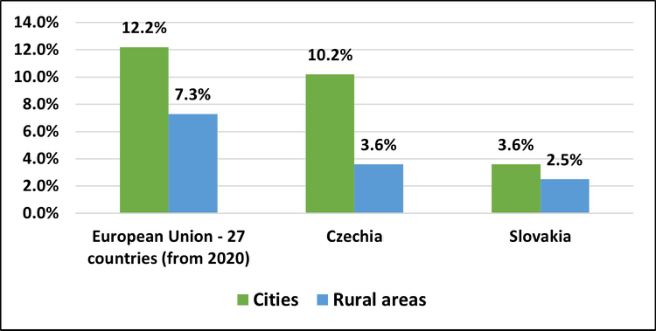
Figure 1: The Housing cost overburden rate by degree of urbanisation (Eurostat, 2021).
knowledge was gained in personal consultations and by the method of brain- storming with professionals and scientific workers in the field of Housing Aaffordability, Price and Housing policy, from Slovakia and Czechia, docu- ments of Ministry of Agriculture and Rural Development of the Slovak Republic (Land ownership arrangement of the Slovak Republic) etc.
THE PRICE HOUSING AFFORDABILITY IN SLOVAKIA AND CZECHIA Affordable housing can generally be characterised as housing that a house- hold can pay if it consumes no more than 30 per cent of its income. On the other hand, there are no such cost restrictions, e.g., transport. Com- mon sense suggests that landlords in remote locations may be forced to pay more than 15% of income, which is the standard of nominal availability, for transportation costs (Hamidi, Ewing, Renne, 2016) Stone (2006) notes that affordability of housing is a challenge facing each person in meeting the costs of their actual or potential housing on the one hand and in non- housing-related expenses within their income constraints on the other. Other authors also deal with the financial affordability of housing in their works, e.g., Hulchanski (1995) Chaplin, Freeman (1996) and the like. With rising home and rent prices, housing costs can be a burden. It can be measured by the degree of congestion in housing costs, which expresses the proportion of the population living in a household. The total cost of housing repre- sents more than 40% of disposable income (Labudova, Sipkova, 2018). In the EU in 2020, 12.3% - in Czechia 10.2% and in Slovakia 3.6% - of the urban population lived in such a household, while the corresponding rate for rural areas was 7.0% - in Czechia 3.6% and in Slovakia 2.5% (see Fig. 1) (Eurostat).
Developments in the residential market in the Slovak and Czech Republics in the last two years are associated with the impact of the pandemic on the functioning of the company and related government measures. The housing problem no longer af-fects just the socially disadvantaged but also the middle- income groups. The pandemic has caused significant economic damage on the
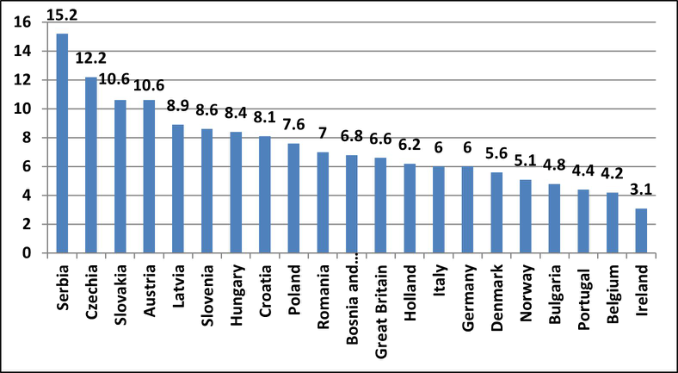
Figure 2: The number of annual salaries needed to buy an average apartment - 70 m2 (Delloite, 2020).
one hand, but on the other hand, residential property prices are constantly rising. The availability of new housing in the Slovak Republic was the third- worst after the Czech Republic in 2020 compared to 21 European countries (Fig. 2).
According to data from the Czech Statistical Office and the Slovak Sta- tistical Of-fice, a tenth of Czech households pay 40 per cent of their total income for housing, so rent is the most significant monthly expenditure for hundreds of thousands of people. The situation is similar in Slovakia – the average Slovak household spends almost a quarter of its total spending mon- thly from the family budget. However, the mortgage payment is not included in this amount. One of the reasons for the growing unavailability is the fact that large cities privatized most of their assets during the 1990s. While in the mid-1990s, Prague owned approximately 190,000 flats, today it has 30,000, with 25,000 managed by individual city districts. Municipal and cooperative apartments have stopped being built altogether. If Prague decides today that it wants to renew its housing stock and starts building a thousand municipal flats a year, it will take more than 160 years before it could return to the number from the beginning of the privatization years.
However, it would only be possible if the capital city owned large develo- pment areas where it could build. The absolute majority of the land was sold not only by Prague but also by Bratislava, often well below cost. In addition, privatization has under-gone massive deregulation: rents and land use plan- ning. Czech cities thus completely lack two primary tools to deal with the housing crisis.
One of the consequences of the deficit in housing affordability in the Czech Republic and the Slovak Republic is the increase in daily travel distances to the Centre’s, ranging from 100 to 120 km. This increases real estate prices even in previously underestimated, often structurally handicapped, regions (Ústí nad Labem Region, Czech Republic). As a result, in addition to environmental externalities, the impact is again on the quality of life in the
Current Economic Limits of Housing Affordability in the Czech and Slovak Republics 89
regions, which are becoming internal peripheries (actually housing estates for commuters in metropolitan areas).
There has been an extraordinary increase in inputs in the last two years: materials and labour. It is due to inflation and logistical failures because of the COVID-19 pandemic. Increasing (especially energy and environmental) con- struction standards also contribute to rising housing prices (and thus reducing affordability) of housing. It is not possible to build and approve a project that would have the character of an eco-nomically economical, so-called functionally minimal, house.
Labour unavailability (again as a result of the C-19) also plays a role, as restrictive pandemic measures have restricted the movement of foreign workers (Ukraine, Mol-dova), on which the construction industry in these countries depends.
UNCLEAR OWNERSHIP RELATIONS TO LAND Unexplained land ownership is a problem that hampers the developer’s inte- rest in land investment. Unclear ownership relations arose as a result of land inheritance over the years and a result of some inventories that were never completed or were destroyed, e.g. during the war, etc. Land ownership rights are also unclear. With the advent of socialism, people lost ties to their pro- perty, so the current owners did not know about their land. Ambiguous ownership relations bring developers the risk that in the future, landowners can apply for their land and thus come not only to the maintained land but also to the real estate (Machajdikova, 2010).
Another problem hindering more dynamic construction in rental housing stock is the fragmentation of land ownership in Slovakia. Under the influence of historical development, this fragmentation has reached such a stage that the fraction the co-ownership is expressed is unreadable for the non-expert (Machajdikova, 2010). Its fair value is unimaginable for the real estate mar- ket. Therefore, it is pretty standard for a tiny plot of land to have several or even hundreds of valid co-owners, and many do not even know that they are co-owners of a particular plot of land. If the developer wants to acquire land owned by several such co-owners, finding them and requesting consent to buy them is necessary. Ongoing inheritance proceedings can complicate such a situation, the unknown residence of a co-owner or even several co-owners, respectively their stay abroad, etc. It should be emphasized that clearly defi- ned ownership rights significantly influence new investments into the real estate market.
CONCLUSION
The authors’ effort was to point out the importance of selected determinants that significantly affect the economic limits of housing affordability in the Czech Republic and Slovakia, based on their long history of the common state.
The problem of housing and the shortage of rental apartments has a much larger dimension. Another determinant is associated with the functioning of
the housing market - housing mobility, which is closely linked to desirable and undesirable job mobility. Housing prices in deprived regions with high unemployment are significantly lower than prices in areas with high econo- mic growth rates. It is precisely the requirement to ensure increased housing mobility that is currently coming to the fore very intensively, in the context of greater labour mobility and thus better opportunities for it to enter the labour market. Immediate availability of housing, especially rent, for employees is a fundamental condition for developing a dynamic labour market, while the lack of rental housing blocks employment development.
In conclusion, we state that costs play and will continue to play a domi- nant role in defining housing requirements and their availability. These are not only the costs of procuring housing in the position of investment costs but also the demands on the number of operating costs, aspects of the moral and physical life of the apartment, etc. One of the basic costs of housing is the acquisition of a mortgage and the level of interest rates, which depend on inflation. Generally, a growing economy (inflation) leads to higher mortgage rates and a slowing economy leads to lower mortgage rates. If inflation fears are strong, interest rates will rise to curb the money supply, but in times when there is little risk of inflation, mortgage rates will most likely fall. The relati- onship between interest mortgage rates and bond prices has inverse meaning: increasing of the interest mortgage rate, the bond interest rate declines. The relation-ship between this change in the interest rate and the price of the bond can be measured by duration. It reflects a bond’s price changes and change of the interest rate (Zatrochova, Janakova, 2017).
ACKNOWLEDGMENT
This contribution is supported by the project VEGA no. 2/0170/21 entitled “Global change management in vulnerable areas”.
REFERENCES
Deloitte (2020). Analysis of the rental Housing in Prague. p. 52. Eurostat Housing statistics: Housing cost overburden: cities or rural area, 2021.
https://ec.europa.eu/eurostat/cache/digpub/housing/bloc-2b.html?lang=en Hamidi, S., Ewing, R., Renne, J. (2016). How Affordable Is HUD Affordable Housing? Housing Policy Debate 26 (3), 437–455 (2016) Hulchanski, J. D. (1995). The concept of Housing ffordability: Six contemporary uses
of the housing expenditure-to-income ratio. Housing Studies 10(4), 471–491. Chaplin, R., Freeman, A.(1996). Towards an Accurate Description of Affordability.
Urban Studies 36(11), 1949–1957. Labudova, V., Sipkova, L.(2018). Housing Affordability in EU 28 Countries. RELIK, 195–2004. Machajdikova, J.(2010). Land fragmentation - a brake on the implementation of
construction projects. Nehnuteˇlnosti a Bývanie ISSN 1336-944X,02/2010, 26–34. Stone, M.E.(2006). What is housing affordability? The case for the residual income approach. Housing Policy Debate, 17, 151–183. Zatrochova, M., Janakova, H. (2017). Assessment and assumption for the current
interest mortgage rate and bonds Yields, Finance and performance of firms in science, education, and practice, 339–353.
LISTED IN THE AHFE DIGITAL BOOKSTORE CATALOGUE
Explore the complete digital volume
Human Factors in Architecture, Sustainable Urban Planning and Infrastructure
Read this individual research paper free through the original publisher, or explore the full digital proceedings book.
ISBN 978-1-958651-34-6
Explore this ISBN in the AHFE Bookstore ↗Listed in the July 2026 bookstore catalogue; search by ISBN to confirm current availability · Digital book purchase optional