Dunisani Sydwell Shivambu, William Nkomo, Motheo Tjebane, Gift Laolang (2026). Strategies for Sustainable Retrofits in Higher Learning Institutions' Infrastructure in African Countries: A Bibliometric Review. In: Sustainable Built Environment. AHFE Open Access, vol. 225, pp. 193–203. https://doi.org/10.54941/ahfe1007910
Higher learning institutions across African developing countries face aging infra-structure, increasing energy demands, and the need to align with sustainability goals. Retrofit-ting existing buildings offers a cost-effective strategy to improve environmental performance and occupant well-being. However, limited consolidated knowledge exists on sustainable retrofit strategies within the African higher education context. This study evaluates such strategies through a bibliometric review of 33 Scopus-indexed publications, using VOSviewer to analyse citation networks and keyword co-occurrence. The findings show that China dominate the re-search output, while African contributions remain limited, with South Africa leading the region. Key themes identified include sustainable development, green building, energy efficiency, and construction practices. The results highlight a significant research gap in African focused studies and emphasise the need for capacity building among academics and practitioners. This study provides insights to guide future research and support the effective implementation of sustainable retrofitting in higher education infrastructure.
The construction industry is one of the most vital sectors of the global economy. It contributes to the nation’s capital; it also plays a vital role in the country’s development process. Further-more, Enshassi (2019) indicated in their study that the construction sector plays a significant role in the commercial sector. However, there are numerous scientific evidence and legislative studies that have concluded that climate change is the most significant threat to our environment, and this is a challenge if our modern times and the construction industry has contributed to the Green House
Gases emissions through design, on-site construction, manufacturing of material and distribution (Lou et al., 2017).
Also, building infrastructure contributes to substantial energy and resource consumption and ecological changes. According to Kaja and Goyal (2023), over 45% of global waste, 40% of the world’s energy, and 40% of the world’s natural resources are consumed by building infra-structures. The terms sustainable development and green building are utilized synonymously, and they have gained global recognition in the engineering and building industry in the past years as the world became more aware of the sensitive issues relating to climate change (Bajwa et al., 2025). The term sustainable development can be defined as a way of improving the quality of life and giving people the opportunity to live their lives in a healthy environment, with improved environmental, economic, and social conditions for present and future generations (Lima et al., 2021).
According to Saka et al. (2021), one of the most top challenges in the implementation of green retrofitting is the lack of incentives and support especially from the government. The United States (U.S) government has made funds available to support retrofitting of existing building in the country (SMACNA, 2019). According to Okere (2017), one of the main challenges in the implementation of sustainable development and green building in Africa is the availability of methods and tools for the construction industry to effect the change. Construction projects in most developing countries such Nigeria, Ghana, Ethiopia and South Africa, have been perceived as unsustainable considering the three sustainable practices of economy, social and environment (Aghimien et al., 2019).
To optimize the adoption of sustainable green retrofitting in higher education projects, facilities management professionals should be given substantial training in green strategies and their benefits. Through mentorship, the highly experienced professionals can transfer knowledge and skills to ensure appropriate methods are adopted (Jagarajan et al., 2015). This research study aims to conduct a bibliometric review of the current literature on strategies for sustainable retrofits in higher learning infrastructure projects. By reviewing and analysing the previous studies that were conducted by various researchers, the study aims to recognise the gaps and limitations of the existing literature. The study will be conducted systematically, including selection of the study, extraction of relevant data, and analysis. This structured methodology is in-tended to produce expressive insights that can guide future studies in this area.
RESEARCH METHODS This research study adopted a bibliometric review method, which is a quantitative method for examining academic literature based on relevant quantifiable indicators, including trends in publications, keyword co-occurrence, map factors, citations of research studies, and authorship (Dontha et al., 2021). Bibliometric analysis allows scholars to evaluate the research flows, knowledge structure, and thematic development of the specific research field. This method is predominantly valuable for identifying research
Strategies for Sustainable Retrofits in Higher Learning Institutions’ 195 gaps, globally recognised publications, various collaboration networks and upcoming research topics (Aria & Cuccurullo, 2017).
The adoption of this methodology was primarily driven by the need to systematically analyse the literature associated with the research study. The bibliometric review is also appropriate for mapping the growth and research interest of mentorship sustainable development over time, which can influence future theoretical and experiential research. For this bibliometric review, publications were sourced from the Scopus database tool due to its compatibility, extensive coverage, and reliability when it comes to bibliometric analysis tools. The database was developed by Elsevier, and it is well known for its largest abstract and citation databases of well-reviewed literature, which covers various disciplines such as technology, science, humanities, and social sciences (Burnham, 2020). Unlike databases such as Google Scholar, Scopus provides more quality assurance and well measured indexing which improves the reliability and replicability of the bibliometric results (Singh et al., 2021).
The research data for this review was collected employing a designed search string in the Scopus database. The linking keywords utilized were “Training, Green building, Construction projects, AND sustainable development” to assess mentorship-driven strategies for sustainable retrofits in universities’ projects. The Boolean operator AND was utilized to certify that all the articles included each of the keywords, hence increasing the significance of the literature retrieved from Scopus (Badami et al., 2023). Also, inclusion and exclusion criteria were adopted for the study. According to (Khan et al., 2022), inclusion and exclusion criteria are important to adopt in a research study to guarantee consistency, relevance, and quality assurance of the nominated studies. For this bibliometric review, the inclusions were (i) journal articles and conference papers, (ii) records published from January 2015 to 28 May 2025, and (iii) English only. From the first search on Scopus, 49 publications were discovered, but only 33 publications were retrieved that were relevant to the research study. The data that was retrieved was ana-lysed using VOSviewer software. VOSviewer is a software tool that was made for making, exploring, and visualizing bibliometric links based on network data. The software is effective in showing various bibliometric maps seamlessly and engagingly, which allows researchers to recognise patterns and movements within the analysed literature (Gauffriau, 2021).
DATA ANALYSIS AND DISCUSSION Publication and Citation
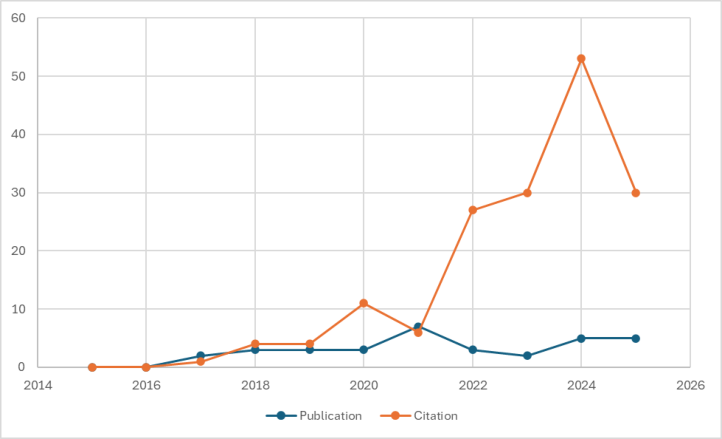
For this research study a bibliometric literature review method was utilized to review and ana-lyse previous published studies related to green building and sustainable development strategies between 2015 and 2025 to assess mentorship-driven strategies that can be adopted to ensure sustainable retrofits in higher institutions of learning. A publication graph of the annual frequency of the 33 publications has been provided in Figure 1 showing the
period between 2015 and 2025. The graph shows that 0 publications were done in 2015 and 2016. In 2017, that’s when publications were done, and only two were published. 2018, 2019 2020 saw an in-crease in publications to three publications for each year. Also, 2021 saw an increase to 7 publications. 2022 saw a drastic decrease in publications to 3 publications. In 2023, publications decreased again to 2. In 2024, there was an increase in publications to 5. By the 28 May 2025, there were 5 publications made on Scopus. These contribution shows that more research needs to be done to contribute to mentorship-driven strategies that will contribute to in sustainable retrofits.
Figure 1: Publication and citation.
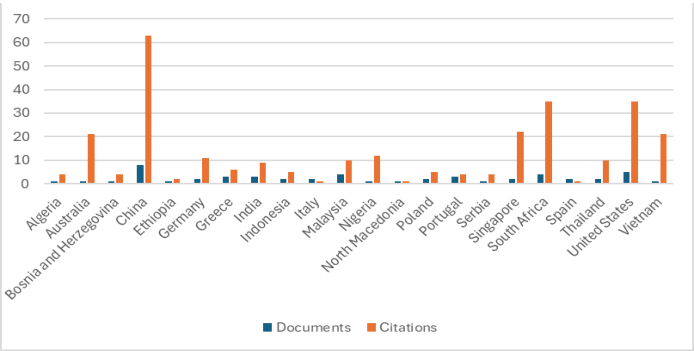
Countries The bibliometric analysis further examined the leading countries contributing to research on strategies for sustainable retrofits in higher institutions. A total of 22 countries met the search criteria, as illustrated in Figure 2. China emerged as the leading contributor, with 8 publications and 63 citations, followed by the United States with 5 publications and 35 citations. African countries were also represented, with South Africa leading the region with 4 publications and 35 citations. Nigeria, Algeria, and Ethiopia each recorded 1 publication. The limited number of publications in countries such as Nigeria, Algeria, and Ethiopia emphasise the need for target-ed academic and professional development initiatives to address existing knowledge gaps.
Figure 2: Graph of publications and citations reported in countries.
Sources
Table 1 illustrates the relationship between the sources and the citations made based on the publications that were reviewed, Earth and Environmental Science is the leading source with 4 documents and 22 citations. Also, Sustainability recorded 2 documents and 29 citations with impact factor of 0.688.
Table 2 demonstrates trending words of occurrence from the 33 publications that were ana-lysed. The minimum number of occurrences that were analysed was 3 and above. The term “sustainable development” appeared 20 times and ranked the highest, highlighting the im-portance of adopting sustainable strategies in infrastructure projects. “Construction industry” and
“sustainable construction” appeared twelve highlighting how they play a vital role in the development process related to green retrofitting. Additionally, “project management” appeared 11 times, indicating project management’s significance in sustainable development to ensure that the projects are executed Lastly, “construction” and “green buildings” appeared 10 times, indicating a strong interest in the implementation of sustainable practices. Table 2 shows the keywords from the highest to the lowest occurrence derived from the analysis, which indicates the significance of implementing sustainable practices in universities’ infrastructure pro-jects.
Table 2: Cluster keywords.
Table available in the original PDF paper.
Theme Description
Cluster Keywords Occurrences Total Link Strength
12
67
Construction
11 10 7 5 4
61 58 49 25 23
3 3
20 17
1 (Red) Construction Industry Project Management Construction Surveys Construction Projects Questionnaire Surveys Office buildings Human Resource Management
20
83
Sustainable Development
12
71
5 3 3
35 13 12
2 (Green) Sustainable Development Sustainable Construction Sustainable Practices Buildings Environmental Impact
Green Building
10 5 3 3 3
54 20 14 11 7
3 (Blue) Green Buildings Sustainable Building Green Development Students Sustainable development goals
5 4
31 30
Professional Practice and Energy Efficiency
4 (Yellow) Green Building Construction Professionals Energy Efficiency Sustainability
4 4
19 14
Strategies for Sustainable Retrofits in Higher Learning Institutions’ 199 Clustering Analysis
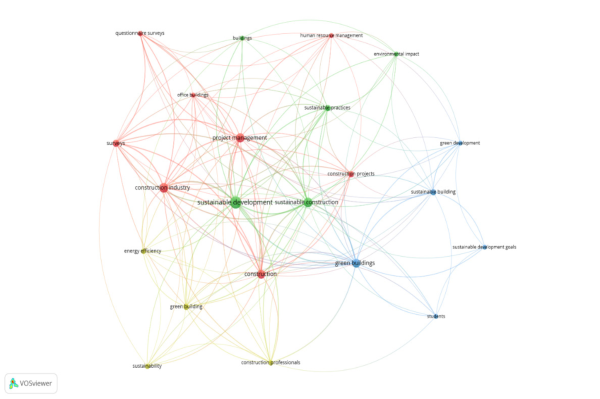
Figure 3 illustrates the co-occurrence of keywords derived from the analysis, which was con-ducted to identify distinct research themes and assess the relationships among key terms relevant to this study.
Figure 3: Keywords Co-occurrence Network.
Cluster 1 (Construction), highlighted in red, focuses on construction. This cluster includes research on construction and project management models for green buildings. The construction industry is considered the most vital because it plays a major role in the social & economic growth of most countries worldwide. It represents more than half of the overall national capital investment in most countries worldwide. It can contribute more than ten per cent of the country’s gross domestic product (GDP) (Alaloul et al., 2021). To achieve sustainability in green retrofits, construction strategies must be adopted to effectively introduce various elements that ensure buildings are safe, energy-efficient, and optimise resource use (Ahn et al., 2017).
Cluster 2 (Sustainable Development), highlighted in green, focuses on sustainable development within the construction industry. Previous studies have identified that, to ensure sustainable development practices, methods such as certification tools to measure building sustainability should be implemented to track performance (Solís-Guzmán et al., 2024). Also, policies must be introduced and enforced to improve how the buildings are performing. Sustainable development can lead to well-optimised utilisation of resources, lower carbon emissions, and a conducive working environment (Dauda and Ajayi, 2022). Furthermore, if sustainable development is well implemented, there will be a balance among the economic, social, and environmental requirements, ensuring that all buildings are economically feasible and ecologically and socially responsible throughout their lifespans (Merzouk et al., 2025).
Cluster 3 (Green Building), highlighted in blue, focuses on green building. This cluster associates green building initiatives with students’ participation and with Sustainable Development Goals (SDGs) for various institutions, which are aligned with the Sustainable Campus Framework (SCF) of different institutions of higher learning, such as SDG 4 (Resilient infrastructure) (Andi Sri Wahyuni, György Málovics & Judit Gébert, 2025). Although significant progress has been made in implementing sustainable projects across institutions, there are still gaps, especially in Africa, in adopting sustainable practices.
Cluster 4 (Professional Practice and Energy Efficiency), highlighted in yellow, focuses on green performance and professional practice in achieving sustainability outcomes in construction projects. According to Darko et al. (2017), built environment professionals must be well-trained in relevant knowledge to adopt sustainable practices in the implementation of green buildings. Adoption of sustainable practices cannot be enforced solely through the introduction of new policies and legislation, but also through behavioural changes and continuous development programmes for built environment professionals (Fei et al., 2021).
Implications The findings of this bibliometric review show numerous critical implications for practice, re-search and policy in the environment of sustainable retrofits in higher education sector. The in-adequate number of publications especially in within developing regions shows that mentor-ship-driven strategies for sustainable retrofitting has not been explored to a certain extent com-pared to developed regions, hence more research studies need to be conducted. The extent of research studies from developed such as the United States and China, compared to the research contributions from African countries, underlines a geographical research gap that future re-searcher must focus on. Increasing African-based practical studies would improve relative understanding of sustainability challenges distinctive to the Global South.
The clustering analysis further indicates that sustainable retrofits need a mixed theoretical and practical approaches. Cluster themes show deep importance on sustainable development, green buildings, and construction management, yet professional training and behavioural transformation within built-environment professionals are not sufficiently investigated. This gap under-lines the need for research study that explores mentorship models, capacity-building pro-grammes, and Continuing Professional Development (CPD) frameworks tailor-made for built environment professionals in the infrastructure environments. Improving theoretical contributions in this field can inform more strong implementation models.
Furthermore, the appraisal’s identification of recurring keyword like sustainable development, green buildings, and project management shows that forthcoming research studies must in-crease their methodological focus beyond practical construction strategies to integrate social, educational, and
Strategies for Sustainable Retrofits in Higher Learning Institutions’ 201 organisational dimensions of sustainability adoption. Research investigating established policy readiness, behavioural incentives, skill transfer mechanisms, and cross-disciplinary partnership would offer more universal perceptions on how higher learning institutions can increase sustainable development initiatives.
Finally, the review indicates that emerging research must adopt more practical approaches. By tackling these gaps, future research studies can contribute meaningfully to theory expansion, strengthen professional practice, and support higher learning institutions in meeting Sustainable Development Goals (SDG’s) especially that are related to resilient and ecologically re-sponsible infrastructure.
Conclusion and Recommendations The bibliometric review provides a comprehensive overview of the existing literature on strategies for sustainable retrofits in higher learning institutions infrastructure in African developing countries. By analysing previous studies, it is evident that green building practices and sustain-able development have increased globally, but the implementation strategies for sustainability remain underdeveloped, especially in the African context. The 33 publications provided relevant information for the research study. The results revealed limited but increasing research on the implementation of sustainable development in green retrofitting, particularly in developing regions, with significant contributions from China, as documented in 63 citations and 8 publications. With focus on African countries, South Africa, Nigeria, Algeria, and Ethiopia they met a criterion in relation to this study. However, South Africa was the leading country with research study inputs.
African developing countries are still at an early stage in terms of implementation-focused re-search and practical application. This emphasizes the need for collaboration amongst African countries in research, policy development, and capacity building to support sustainable retrofit initiatives across the continent. Also, the results underline the need for Continuing Professional Development (CPD), including training of built environment professionals to fast track the adoption of sustainable retrofitting practices.
The cluster analysis has identified key themes in various research studies on green building policies, professional training, the role of the construction sector, and sustainable development practices. Additionally, the review outlines the significance of collective research, knowledge sharing, and high- quality publications. This study serves as an initial reference for experts, policymakers, and scholars seeking to improve the sustainability of higher education infrastructure through strategic training, and it lays a foundation for future research to close the gaps identified in this study.
REFERENCES
Dauda, J. A., & Ajayi, S. O. (2022). Understanding the impediments to sustainable structural retrofit of existing buildings in the UK. Journal of Building Engineering, 60, 105168. https://doi.org/10.1016/j.jobe.2022.105168 Donthu, N., Kumar, S., Mukherjee, D., Pandey, N., & Lim, W. M. (2021). How to
conduct a bibliometric analysis: An overview and guidelines. Journal of Business Research, 133, 285–296. Enshassi, A., Saleh, N., & Mohamed, S. (2021). Barriers to the application of lean construction techniques concerning safety improvement in construction projects. International Journal of Construction Management, 21(10), 1044–1060. Fei, W., Opoku, A., Agyekum, K., Oppon, J. A., Ahmed, V., Chen, C., & Lok,
K. L. (2021). The critical role of the construction industry in achieving the sustainable development goals (SDGs): Delivering projects for the common good. Sustainability, 13(16), 9112. Gauffriau, M. (2021). Counting methods introduced into the bibliometric research literature 1970–2018: A review. Quantitative Science Studies, 1–44. https://doi. org/10.1162/qss_a_00141 Jagarajan, R., Abdullah, M. N., Asmoni, M., Lee, J. Y., & Jaafar, M. N. (2015).
An overview of green retrofitting implementation in non-residential existing buildings. Jurnal Teknologi (Sciences & Engineering), 73(5). Kaja, N., & Goyal, S. (2023). Impact of construction activities on environment.
International Journal of Engineering Technologies and Management Research, 10(1). https://doi.org/10.29121/ijetmr.v10.i1.2023.1277 Khan, K. S., Bueno-Cavanillas, A., & Zamora, J. (2022). Systematic Reviews in Five Steps: II. How to Identify Relevant Studies. Medicina de Familia. SEMERGEN, 48(6), 431–436. https://doi.org/10.1016/j.semerg.2021.12.006 Lima, L., Trindade, E., Alencar, L., Alencar, M., & Silva, L. (2021). Sustainability in
the construction industry: A systematic review of the literature. Journal of Cleaner Production, 289, 125730. Lou, E. C., Lee, A., & Welfle, A. (2017). Greenhouse gases (GHG) performance of refurbishment pro-jects: Lessons from UK higher education student accommodation case studies. Journal of Cleaner Production, 154, 309–317. Merzouk, M., Zhao, J., & Xu, Z. (2025). Sustainable building project management in
Algeria: Challenges, strategies, and future directions for environmentally friendly construction. Buildings, 15(6), 883. https://doi.org/10.3390/buildings15060883 Saka, N., Olanipekun, A. O., & Omotayo, T. (2021). Reward and compensation incentives for enhancing green building construction. Environmental and Sustainability Indicators, 11, 100138. https://www.sciencedirect.com/science/ article/pii/S2665972721000398 Sheet Metal and Air Conditioning Contractors’ National Association (SMACNA). (2009). Products and services update newsletter (September 17, 2009). https://apps.smacna.org/apps/newsletters/pdfs/ ProductsandServicesUpdateNewsletterSeptember172009.pdf Singh, V. K., Singh, P., Karmakar, M., Leta, J., & Mayr, P. (2021). The journal
coverage of Web of Science, Scopus and Dimensions: A comparative analysis. Scientometrics, 126(6), 5113–5142. https://doi.org/10.1007/s11192-021-03948-5 Solís-Guzmán, J., Garzón-González, P., González-Vallejo, P., & Marrero, M. (2024).
Sustainability evaluation of residential buildings based on the footprint family: Application to case studies in Andalusia. Buildings, 14(4), 1131. https://doi. org/10.3390/buildings14041131
Strategies for Sustainable Retrofits in Higher Learning Institutions’ 203 Tamang, L., Raynes-Greenow, C., McGeechan, K., & Black, K. I. (2017). Knowledge,
experience, and utilisation of sexual and reproductive health services amongst Nepalese youth living in the Kathmandu Valley. Sexual & Reproductive Healthcare, 11, 25–30. Wilkerson, B., & Trellevik, L.-K. L. (2021). Sustainability-oriented innovation: Improving problem definition through combined design thinking and systems mapping approaches. Thinking Skills and Creativity, 42, 100932. https://doi. org/10.1016/j.tsc.2021.100932
LISTED IN THE AHFE DIGITAL BOOKSTORE CATALOGUE
Explore the complete digital volume
Sustainable Built Environment
Read this individual research paper free through the original publisher, or explore the full digital proceedings book.
ISBN 979-8-950676-01-7
Explore this ISBN in the AHFE Bookstore ↗Listed in the July 2026 bookstore catalogue; search by ISBN to confirm current availability · Digital book purchase optional