Andrej Adamuscin, Miroslav Panik, Julius Golej (2022). Economic Impact of COVID-19 on Real Estate Prices in Slovakia. In: Human Factors, Business Management and Society. AHFE Open Access, vol. 56, pp. 336–344. https://doi.org/10.54941/ahfe1002286
The Slovak real estate market is relatively young compared to developed countries. Real estate is one of the assets with a low risk of loss, but also with low liquidity. Real estate prices are subject to changes caused by economic cycles. Due to the rapidly changing market conditions, already realized real estate is considered a relatively certain investment, while investments in its construction are marked by high risk. Real estate prices are determined by several socio-economic and demographic factors.The COVID-19 disease also raised levels in the real estate market. None of us expected the crisis caused by the new coronavirus. Although many forecasters agree that the economic crisis is a phenomenon that recurs cyclically about every 10 years, few would have predicted the enormous global proportions it could have.The article aims to answer the questions of how the corona crisis-affected real estate prices in Slovakia and how prices will develop until the end of 2021.
The COVID-19 pandemic has caused shock and uncertainty in the world’s economic system since its inception. COVID-19 caused the biggest crisis in the health, labor market, humanitarian aid, and economic crisis with a direct impact on the real estate market. International trade has contracted sharply, global value chains have been severely disrupted, and uncertainty is grow- ing in global financial markets, which persists to this day. The pandemic had an intense impact on both the euro area economy and Slovakia. Year- on-year growth in euro area property prices rose from 4.3% at the end of 2019 to 5.8% in the last quarter of 2020, the highest growth rate since mid-2007 (ECB Economic Bulletin, 2021). According to Kaynak, Ekinci, and Kaya (2021), many studies examine the strong relationship between the con- struction industry and economic growth and the relationships between the construction industry and other sectors. In these studies, a significant part of the input-output analyzes was performed for the construction sector, espe- cially in developing countries. Linkage indicators for this sector have been found to be much more important and influential than direct link indicators. However, only a minimal study examines changes in construction in the face of an unexpected shock. On the other hand, many studies have been carried out on factors affecting prices in the real estate sector, which constitute a
Economic Impact of COVID-19 on Real Estate Prices in Slovakia 337
significant part of the construction sector. Most studies focus on explaining the determinants of housing prices using macroeconomic variables rather than explaining the impact of an unexpected shock variable. According to Tomal and Marona (2021), research to identify the effects of a global pan- demic on individual segments of economic life is important in this context. Therefore, research is also underway in the area of the widely understood real estate market (including the housing market). The real estate market not only creates jobs in the economy, but also by connecting the process of housing construction and maintenance with other sectors, it has a multiplier effect and contributes significantly to the formation of the labor market and the level of gross domestic product (GDP) in individual economies. Studies conducted during the COVID-19 pandemic have shown a decline in house prices and rents in city centers, thus increasing prices and rents outside of the centers. Gupta et al. (2021) explained that housing markets predict that urban rent growth will exceed suburban rent growth in the foreseeable future. Liu and Su (2021) tested the impact of the COVID-19 pandemic on housing demand. The findings of their study show that the pandemic has led to a shift in hou- sing demand from densely populated areas and a significant shift in housing demand from large cities to municipalities and cities with lower population densities. Taking into account both economic and behavioral factors, Duca, Hoesli, and Montezuma (2021) show differences in property prices between countries at the beginning of the pandemic, with places heavily dependent on tourism showing slower price increases, while elsewhere the increase has strengthened. In some localities, the price of flats has fallen compared to the price of family houses. This could indicate that wealthier households are looking for more space and more real estate as a result of the crisis. Tomal and Marona (2021) investigated the impact of the COVID-19 pandemic on rents using econometric models that are capable of predicting changes in the housing market in the event of a crisis.
CURRENT STATE OF THE REAL ESTATE MARKET IN SLOVAKIA Slovakia, like the whole world, was exposed to the strong influence of COVID-19 in the first half of 2020 and was marked by economic failure. The rapidly spreading disease has led to an increase in anti-pandemic measures, which have led to the declaration of a state of emergency. Measures against the spread of the virus have led to a halt in production and consumption, fear and uncertainty have reduced investment in the economy. The labor market situation has gradually deteriorated since the beginning of 2020. In April and May, there was a year-over-year decline in employment in almost the entire spectrum of industries. According to the Central Office of Labor, Social Affairs, and the Family, the registered unemployment rate increased the most from March 2020 from 6.2% to June 2020 to 8.2%. It was an increase at a historically high rate. Since the summer of 2020 (when restrictions were partially lifted), recovery has begun, although its trajectory has been affected by pandemic-related developments. The crisis has prompted a change in pre- ferences about the type of housing. Demand has increased for houses with outdoor spaces. Despite the sharp decline in economic activity, real estate
prices remained unchanged compared to the financial crisis in 2008. The financing conditions and monetary conditions of the European Central Bank (ECB), the measures contributed to a decline in average interest rates on new housing loans. The real estate market in Slovakia felt the effects of the virus, especially in the months of March-April 2020, when the demand for resi- dential real estate slowed significantly or stopped. Subsequently, during the months of May and June 2020, the real estate market recovered largely and prices remained unchanged due to the persistently low supply of real estate. The persistent problem of the low supply of new apartments and houses is the result of complicated and lengthy permitting processes, as well as out-of-date zoning plans. In the following pandemic period (Q3 2020 - Q4 2020), resi- dential property prices began to increase due to high demand, despite fears of adverse economic impacts. On the other hand, the amount of rent for hou- sing was corrected. The decline in rental prices was caused by the influx of new buildings to the market and the release of short-term rental apartments, which were used for tourist purposes for long-term rental. At the same time, it should be noted that the natural preference of Slovaks is to buy an apartment rather than rent it (in 2018, up to 91.3% of Slovaks owned the property they inhabited) (Bencont, 2020). In the middle of 2020, there was a recovery in the real estate market and there was also a more significant increase in new credit transactions, which is mainly related to the release of quarantine mea- sures and the reopening of the economy. Therefore, real estate prices also rose during the second quarter of 2020 and interest in buying them persisted. The average price of housing increased by up to 11.2% year-on-year, which was the fastest growth since the real estate boom in 2008. The price per square meter of real estate reached the level of 1,762 EUR / m2 (NBS, 2021). Several factors influence the growth of apartment prices. Some of them, such as the resumption of economic activity after the crisis of 2020, the improvement of future prospects, persistently low interest rates, or rising prices of buil- ding materials, were not only specific to Slovakia but also to the rest of the European Union and the developed world. The growth of real estate prices in these countries also corresponded to this fact. Slovakia has a problem with the level of supply of new residential real estate, while the number of vacant real estate is falling to historical lows. This problem has been evident in Bra- tislava, the capital of the Slovak Republic, for years, and the volume of supply gradually decreased to 40–45% of the level of 2017. Low supply means low competition from sellers, resulting under price growth in conditions of high demand. If we add the mentioned macroeconomic factors, we get a year-on- year price growth approaching 20% at the end of 2021. Another factor is the rise in inflation. Many people invest their free money to protect themselves from inflation. In the case of Slovakia, these investments go mainly to resi- dential real estate and land. Other factors include the sharp rise in prices for land, construction work, and materials, which are reflected in the prices of new buildings. We do not expect real estate prices to increase sharply to 20% in the pandemic period. We can probably no longer expect a further decline in interest rates in the Slovak Republic, and the expected wage growth for the coming years is estimated at 5–6% year-on-year. There is and will be a deterioration in the availability of housing, especially for young people, who
Economic Impact of COVID-19 on Real Estate Prices in Slovakia 339
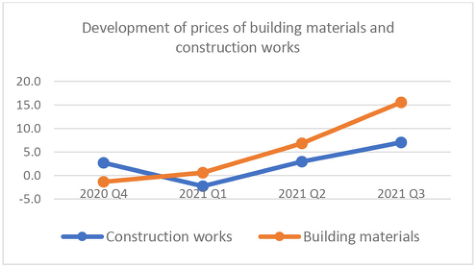
Figure 1: Development of prices of building materials and construction works (Source: Construction Yearbook, 2021).
will have to opt for rent before buying their own property. As a result, part of demand will disappear, and the rate of price growth should slow down. For the year 2022, we expect an increase in apartment prices in Bratislava to the level of up to 10% (Bencont, 2022). The prices of construction materi- als and labor have risen significantly in the last 3 quarters, so they will soon not reach the level of the previous year. Development of prices of building materials and construction works in on Figure 1.
However, the supply side was more significantly affected. Housing sup- ply was affected by the Covid-19 pandemic, mainly due to the suspension of construction production and the postponement of planned projects, and the shortage and increase in the price of construction materials. National lockdown also had a negative effect on construction and subcontracting com- panies, which caused the lack of intermediate products and the necessary material. People’s interest in mortgages has not diminished even at the time of the greatest anti-pandemic restrictions. Despite the fact that the economy was affected, neither the volume nor the total amount of loans decreased. Interested parties, who nevertheless postponed the purchase due to the pan- demic for now, are returning to the intention to buy real estate, and this is pushing prices up again. Customers are also motivated by the low interest rate of mortgages, where with a 3-year fixation the interest rate is from 0.5% p.a. In 2022, this growing trend is very likely to continue. The gap between supply and demand in the real estate market is so large that it cannot be filled even by a possible acceleration in the construction of new residential properties. Current prices are also an example of the transfer of household savings to real estate due to the threat of persistent and projected inflation. If the ECB does not intervene through monetary instruments, in particular by changing the key interest rate, commercial banks will continue to compete with each other for cheap credit.
METHODS AND METHODOLOGY Various quantitative mathematical-statistical methods are used to analyze the factors that influence the development of real estate prices and to model
the development. In the presented article, we used the regression and cor- relation analysis method. Correlation analysis uses statistical methods and procedures to assess the intensity of statistical dependence between quan- titative variables (Pacakova, 2009). One of the best known correlation characteristics is the Pearson correlation coefficient ρxy, which measures the two-sided linear dependence of two variables, x and y. The correlation coefficient takes values from the interval <-1, 1>, while the sign determi- nes the direction of the dependence. Regression analysis is a set of statistical methods and procedures used to study the interrelationships between two or more variables through a regression model (Pacakova, 2009). The regres- sion model is a mathematical rule that simplifies the relationships between variables (XinZan, Xiaogang Su, 2009). Correlation and regression analy- sis is generally known, so we do not describe it in more detail in this article.
RESULTS AND DISCUSSION
Based on economic theory and previous research, 10 variables were selected for further analysis. We used time series from 2013 to 2020 (complete data for 2021 were not available for several determinants). Registered unemploy- ment rate, construction revenues, housing loans, GDP, real estate price per m2 in Slovakia, interest rates on housing (5 to 10 years fixation), demography of the Slovak Republic aged 22-44, construction output index, Harmoni- sed Index of Consumer Prices (HICP), net inflation. The Covid-19 pandemic indirectly affected the real estate market, so we included two variables, the construction output index and construction sales, which reflect the reduction in construction output and the change in the prices of construction materials and labor prices caused by the pandemic virus.
The correlation matrix (in Table 1) contains the correlation coefficients between the individual variables. Housing loans 0.95, demography with - 0.95 and GDP with a correlation coefficient of 0.90 have the largest impact on housing prices. These correlation coefficients show a strong linear depen- dence. For example, the construction output index, or net inflation, as well as construction sales, has a small impact on housing prices. All variables whose Pearson’s correlation coefficient, which is a measure of linear depen- dence, is ≥0.90, were included in the regression analysis. The most important determinants are:
Population aged 25-44,
GDP,
Loans to households for house purchase.
From the resulting regression in the Table 2, it is clear that the model as a whole is suitable with the F value of the statistic 1.3411E-05. The model sufficiently explains the reality (at 99%) and the variables included in the model have a satisfactory p-value and are included in the model justifiably.
Economic Impact of COVID-19 on Real Estate Prices in Slovakia 341
Economic Impact of COVID-19 on Real Estate Prices in Slovakia 343
CONCLUSION
The Covid-19 pandemic had a minimal and indirect effect on housing prices. The crisis has affected the demand and supply side. Demand, especially at the beginning of the pandemic in 2020, declined to stop interest in buying real estate. People feared the disease and postponed inspection and purchase until later. They held the funds because of uncertainty. Real estate inspections were adapted to reality and took place virtually or a direct purchase took place. When the applicant arrived in person, the deal was very likely. Later in the second and third quarters of 2020, this demand resumed and increased. The supply side was affected by the Covid-19 pandemic, mainly due to the suspen- sion of construction production and the postponement of planned projects, and the shortage and increase in the price of construction materials. Lockdo- wns in construction and subcontracting companies also had a negative effect, as did a lack of intermediate products and the necessary materials. Based on previous studies, 10 factors have been selected that could currently affect residential property prices. Using correlation analysis, statistically significant determinants were determined, which significantly affect residential property prices. Based on the results, a simple regression model was compiled, which satisfactorily explains the pricing of residential real estate using three key factors: the population aged 25-44, gross domestic product, and the volume of loans provided to households for housing.
ACKNOWLEDGMENT
This contribution is supported by the project VEGA no. 2/0170/21 entitled “Global change management in vulnerable areas”.
REFERENCES
Bencont. (2020, 2021, 2022). Quarterly analyzes of the real estate market. Available on: https://www.bencont.sk/trhove-analyzy/reality/ Communication from the Commission to the European Parliament and the Cou-
ncil. Strategy for the sustainable competitiveness of the construction sector and companies operating in this sector (Oznámenie komisie európskemu par- lamentu a rade. Stratégia pre udržateˇlnú konkurencieschopnosˇt sektora stave- bníctva a podnikov podnikajúcich v tomto sektore). /* COM/2012/0433 final */ Available on: https://eur-lex.europa.eu/legal-content/SK/TXT/HTML/?uri=C ELEX:52012DC0433&from=DE Construction Yearbook. (2021). Ústredie ŠÚ SR. Available on: https: //www7.statistics.sk/PortalTraffic/fileServlet?Dokument=6274b793-59da-4f 44-8895-8ea5fd780be9 Duca, J.V., Hoesli, M. and Montezuma, J. (2021). “The resilience and realignment of house prices in the era of Covid-19*”, Journal of European Real Estate Research, Vol. 14 No. 3, pp. 421–431. https://doi.org/10.1108/JERER-11-2020-0055 European Central Bank (ECB). (2021). ECB Annual Report 2020. Online. Available
on: https://www.ecb.europa.eu/pub/annual/html/ar2020~{}4960fb81ae.sk.html European Central Bank (ECB). (2021). “Euro area house price developments during the coronavirus pandemic. Economic Bulletin, Issue 4, ECB, 2021.
Eurostat (2021). Impact of Covid-19 crisis on construction. Available on: https://ec.europa.eu/eurostat/statistics-explained/index.php?title=Impact_of _Covid-19_crisis_on_construction&oldid=541796 Gupta A., Mittal V., Peeters J., et al. (2021). Flattening the curve: pandemic-induced revaluation of urban real estate. NBER Working Papers. Liu S., Su Y. (2021). The impact of the Covid-19 pandemic on the demand for density:
Evidence from the US housing market. Econ Lett 207: 110010. Monitoring. (2020). Impact of the Covid 19 pandemic on employment in the Slovak Republic (Vplyv pandémie Covid 19 na zamestnanosˇt v SR). Available on: http://monitoringmsp.sk/2020/08/10/vplyv-pandemie-covid-19-na- zamestnanost-v-sr/ NARKS. (2021). Available on: https://www.realitnakonferencia.sk/ National Bank of the SR (NBS). (2021). Available on: https://www.nbs.sk/sk/statisticke-udaje/vybrane-makroekonomicke- ukazovatele/ceny-nehnutelnosti-na-byvanie National Center for Health Information (NCZI). (2022). Available on: https://covid- 19.nczisk.sk/sk Pacáková, V. (2009). Štatistické metódy pre ekonómov. Bratislava: IURA Edition,
2009, s. 411, ISBN 978-80-8078-284-9 Kaynak, S., Ekinci, A., Kaya, H.F. (2021). The effect of COVID-19 pandemic on residential real estate prices: Turkish case[J]. Quantitative Finance and Economics, 2021, 5(4): 623–639. doi: 10.3934/QFE.2021028 Statistical Office of the SR (ŠÚSR). (2022). Available on: https://slovak.statistics.sk Tomal, M., Marona, B. (2021). The impact of COVID-19 pandemic on the private rental housing market in Poland: what do experts say and what do actual data show? Critical Housing Analysis 8(1): 24–35. doi: 10.13060/23362839.2021.8.1.520. Xin, Z. – Xiaogang, S. (2009). Linear regression analysis: theory and computing.
World scienfic, 2009, s. 328, ISBN 9789812834102
LISTED IN THE AHFE DIGITAL BOOKSTORE CATALOGUE
Explore the complete digital volume
Human Factors, Business Management and Society
Read this individual research paper free through the original publisher, or explore the full digital proceedings book.
ISBN 978-1-958651-32-2
Explore this ISBN in the AHFE Bookstore ↗Listed in the July 2026 bookstore catalogue; search by ISBN to confirm current availability · Digital book purchase optional