Xiaoxi Pan (2022). Frontier Analysis of Resilience Research in Design Ecology. In: Human Factors in Architecture, Sustainable Urban Planning and Infrastructure. AHFE Open Access, vol. 58, pp. 8–13. https://doi.org/10.54941/ahfe1002327
The epidemic has once again made urban resilience a core argument for responding urban crises while ensuring urban safety. As an important research field of design ecology, resilience make contributes to build a healthier and sustainable city, which urgently need further research and development. This paper takes 11896 literature retrieved from the Web of Science TM core collection database and 629 literature retrieved from CNKI from 2006 to 2021 as the research object. Using CiteSpace scientific knowledge visualization software, combined with literature content analysis and interpretation, this paper sorts out the general situation of its development then identifies research hot spot and frontier. Results show that:(1)the previous studies mainly focus on resilient cities, sponge cities, stormwater management, resilient landscapes, sustainable design and blue-green infrastructure; (2) the frontier of resilience research in design ecology is: climate change, community resilience, disaster response, risk assessment, etc. In addition, compared with foreign scientific research orientation, domestic research mainly focuses on practical applications in planning and design, lacking systematic theoretical and technical research support. In conclusion, points out the shortage of resilience research and how to put forward the future research. Finally, it meets the needs of building resilient cities in the 14th Five-Year Plan, providing guidance and method reference for the follow-up researches of resilience.
The outbreak of the new crown epidemic has brought severe challenges to urban construction governance and mechanisms, public health safety, com- munity health, etc., and has triggered new thinking on urban safety and sustainable development from all walks of life. In the discussion of sustai- nable urban development, resilience has become one of the core arguments, the core of which is to effectively cope with various changes or shocks and reduce the uncertainty and vulnerability of the development process. The concept of “resilient city” has been continuously discussed in China since it was first proposed by the central document in the “14th Five-Year Plan” and the 2035 Vision, and the development of a resilient city has gradually become a consensus. At present, many cities in China have proposed to build resilient cities, enhance the ability of infrastructure to cope with natural disa- sters, increase the vitality and power of sustainable urban development, and explore a safe, sustainable and more resilient future.
Frontier Analysis of Resilience Research in Design Ecology 9
VISUALIZATION TOOL MKD is an effective means of knowledge management, which has been widely used since it was introduced into China in 2005 (Ran, L et al. 2019). MKD specifically refers to the graph obtained after visual analysis of the structure, law and development process of scientific knowledge with the kno- wledge domain as the object (Chen, Y et al. 2015). At present, CiteSpace has gradually become a major visual research tool in the research with a huge number of documents, which can effectively avoid the doping of subjective factors in the traditional literature analysis method, and achieve scientific statistical analysis.
This study uses CiteSpace, the most widely used visual analysis software, to conduct statistical and visual analysis of research literature in the field of resilience. In terms of cooperation network analysis, national and regional distribution, and research institutions, the research status and development trends in the field of resilience are more clearly displayed in the form of charts.
DATA SOURCES In order to fully reflect the research situation at home and abroad, this study selected the WOS core collection database and CNKI database as the data- base sources. CNKI is a Chinese infrastructure project, and its CNKI database is dominated by domestic scholars. Therefore, only Chinese literature is sele- cted for analysis, which mainly reflects the research of domestic scholars; the WOS core collection database of Web of Science is mainly composed of foreign scholars, all of which are in English, which can mainly reflect the research of foreign scholars.
The Chinese literature was searched through CNKI. In order to ensure the greatest direct relevance of the literature, “Engineering Science and Tech- nology Series II-Architectural Science and Engineering-Regional Planning, Urban and Rural Planning” was selected as the core source, the retrieval theme was resilience, and the retrieval time was 2021. On March 10, the time span from 2006 to 2021, a total of 629 related literatures were retrie- ved. Through manual screening of irrelevant documents and elimination of duplicate documents, 558 Chinese documents were finally obtained.
The English literature was searched through the Web of Science website, and the core collection was used as the data source. In order to obtain rele- vant literature on design ecology and ensure the accuracy and completeness of the literature, after several adjustments to the retrieval content, the final retrieval theme is TS = (resilien* AND (urban OR landscape OR park OR green space)), and the retrieval The language is English, and the retrieval time is from 2006 to 2021, and a total of 11,896 English literatures were retrieved. After manual screening and exclusion of non-articles, 9972 English literatures were obtained.
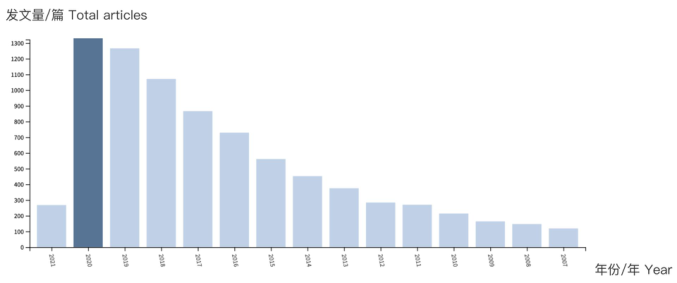
After the search, the statistical results were visually analyzed through the “Analyze Search Results” built-in web page. It was found that the number of English documents retrieved increased year by year, with the fastest growth in 2019, and reached its peak in 2020 (see Figure 1). It can be seen that the
10 Pan
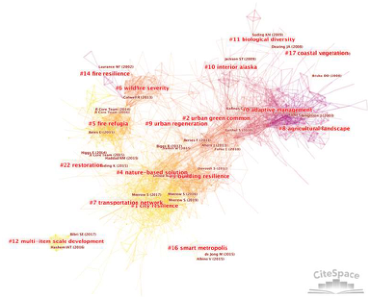
Figure 1: Statistical histogram of English literature publication years. (From the analysis results of Web of Science).Figure 2: CNKI design ecology resilience thematic analysis network map of chinese literature. (Drawn by the author).
time point of this study has certain importance and significance for analysis and prospect.
RESEARCH TOPIC ANALYSIS The CiteSpace visualization software was used to analyze 558 Chinese docu- ments in HowNet, with the time span from 2006 to 2021, and the program was run after selecting “subject headings” and “keywords”. After setting the display style, the analysis results are shown in the figure (see Figure 2). It can be seen that the domestic research in the field of resilience focuses on resilient cities, resilience, urban resilience, green infrastructure, resilient communities, climate change, disaster prevention and mitigation, and sponge cities. Resili- ent cities, resilience, and urban resilience are all important research nodes in this field. Among them, the centrality of resilient cities is the highest at 0.66, and it occupies an obvious central position in the domestic design ecology resilience research field.
Using the same method to analyze 9972 English literatures, it can be seen that foreign research in the field of resilience focuses on urban resilience,
Frontier Analysis of Resilience Research in Design Ecology 11
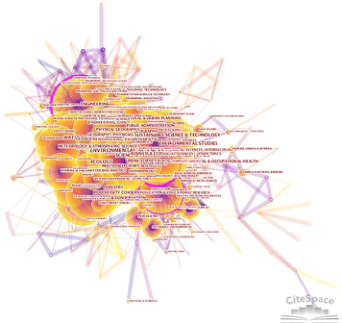
Figure 3: CNKI design ecology resilience research direction analysis network map. (Drawn by the author).
ecosystem services, green infrastructure, community resilience, smart cities, and urban green spaces.
RESEARCH DIRECTION ANALYSIS The results of Web of Science analysis and retrieval showed that 9972 English literatures involved 137 research directions. The largest number of litera- tures is ENVIRONMENTAL SCIENCES ECOLOGY, with a total of 8318 papers, accounting for 99.225% of all search records. It is an important rese- arch direction in the field of design ecology resilience research. In addition, biodiversity conservation (BIODIVERSITY CONSERVATION), engineering (ENGINEERING), urban research (URBAN STUDIES) and so on are also research directions with a large number of literatures (see Figure 3).
RESEARCH INSTITUTION ANALYSIS Research institutions with a large number of Chinese literature publications include China Planning Institute (Beijing) Planning and Design Co., Ltd., China Southwest Architecture Design and Research Institute, South China University of Technology School of Architecture, Tongji University School of Architecture and Urban Planning, Zhejiang University School of Architecture and Engineering, Chongqing University School of Architecture and Urban Planning, etc. Through the analysis of Chinese literature research institutions through CiteSpace, there is currently no research institution with a very pro- minent centrality, which shows that the research in the field of resilience of design ecology in my country has not formed a certain cooperation network.
ANALYSIS OF IMPORTANT CORE LITERATURE AND INTERPRETATION OF RESEARCH PRIORITIES The research related to the concept of resilience originated in the middle of the 19th century in the West. It was originally used in the field of industrial manufacturing to describe the ability of materials to not easily deform during
12 Pan
processing. Later, it was used in multidisciplinary systems such as physics, psychology, and ecology. It has continuously evolved and developed, and has experienced theoretical innovations ranging from engineering resilience to ecological resilience, and then to evolutionary resilience. At present, in the context of urban-rural integration and rural revitalization, more and more scholars have begun to integrate the resilience theory previously applied to cities into their research on rural areas, and explore the unique geographical, cultural, and social environment of rural areas. Facing the same disturbances as cities, such as climate change, development and construction, the research and application value that resilience can bring.
Although resilience is an interdisciplinary academic concept, its theoreti- cal development process differs significantly in different disciplinary systems (Downes B J et al. 2013). In the natural science system, resilience was originally used in engineering disciplines, and then important development occurred in ecology, and concepts such as engineering resilience, ecologi- cal resilience, and socio-ecological resilience were successively generated. Engineering resilience emphasizes the ability of a system to quickly restore stability after disturbance (Mcaslan A, 2010), and is a mainstream resilience concept in the field of engineering technology and early ecological disciplines (Fokle C, 2006). However, because it does not accurately describe the cha- racteristics of ecosystems that will transition between different steady states and change their functional structures after being disturbed, Holling propo- sed the concept of ecological resilience in 1973, that is, “the persistence of the system and the absorption of disturbances to maintain the original popu- lation or state. Invariant ability” (Holling C S, 1973). However, ecological resilience still cannot well explain the fact that human behavior can change ecosystem resilience, so researchers extended ecological resilience to socio- ecological resilience in the late 1970s and 1990s, and defined it as “systemic resilience”. The ability to retain original function, structure, and feedback after a disturbance”, which is constrained by adaptive capacity (a person’s ability to manage resilience) and variable capacity (the ability to create new stable states when adaptation is not possible) (Walker B et al. 2004).
Under the background of the multiple pressures of nature, society and economy, the concept of resilience originated from physics, mathematics, engineering and ecological disciplines, gradually crossed the boundaries of natural and social disciplines, and evolved into an important part of solving human social problems. means. Rural community resilience, as one of the research branches of resilience in the field of social sciences, focuses on how rural communities respond to changes in disasters to maintain survi- val and development. It is considered to be the ability of community systems to resist external disturbances and maintain their own functions and stru- ctures. The collective and individual ability to cope with change. Focusing on these different capabilities, theoretical research on rural community resi- lience has gone from focusing on passive coping capabilities (absorption, recovery, self-organization, etc.) to active coping capabilities (active adapta- tion, transformation capabilities, etc.), and then to the combination of active
Frontier Analysis of Resilience Research in Design Ecology 13
and passive capabilities. The paradigm shift of resilience results and norma- tive judgments has been applied and practiced in many aspects such as rural response to disasters and socio-economic recessions.
CONCLUSION
Resilience is an emerging academic topic, and there are still many topics that need to be further explored. First, although the characteristic criteria of resi- lient cities are easy to accept, the degree of resilience is difficult to express through quantitative means. The selection of the toughness factor and its weight is a difficult point. Second, due to the different existing conditions and environments faced by different regions and cities, it is not very mea- ningful to simply compare the resilience differences of two or more cities. Relatively speaking, it is more realistic to study the resilience changes of a single city before and after a period of time. Third, the research on urban resilience is still in the stage of theoretical perfection, and the actual degree of promotion is still low. Although some academic studies have pointed out that some communities or groups have achieved better results by enhancing resilience, there are no actual cases fully guided by urban resilience.
For my country, although great achievements have been made in urban disaster reduction, the current model can be classified as simple and passive engineering thinking to some extent. The power of social governance and popular participation has not yet been fully tapped and mobilized. From this perspective, the issue of urban resilience is of great value to my country’s urban development. However, due to the inherent differences between China and Western countries, the localization of resilience measures undoubtedly has a long way to go.
REFERENCES
Chen, Y., Chen, C., Liu, Z., Hu, Z., & Wang, X. (2015). The methodology function of CiteSpace mapping knowledge domains. Studies in Science of Science, 33(2), 242–253. doi: 10.3969/j.issn. 1003–2053.2015.02.009 Downes B J, Miller F, Barnett J, et al. How do we know about resilience? an analysis
of empirical research on resilience, and implications for interdisciplinary praxis[J]. Environmental research letters, 2013, 8(1): 014041. Fokle C. Resilience: The emergence of a perspective for social-ecological systems analyses[J]. Global environmental change, 2006, 16(3): 253–267. Holling C S. Resilience and stability of ecological systems[J]. Annual review of
ecology and systematics, 1973(4): 1–23. McAslan A. The concept of resilience: understanding its origins, meaning and utility[R]. Adelaide: Torrens Resilience Institute, 2010, 1–13. Ran, L., & Zhou, Y. (2019). A Review of Research on Urban Waterlogging Based on
CiteSpace Mapping Knowledge Domains. Landscape Architecture Frontiers, 7(4), 66–87. Walker B, Holling C S, Carpenter S-R, et al. Resilience, adaptability and transformability in social-ecological systems[J]. Ecology and society, 2004, 9(2): 5.
LISTED IN THE AHFE DIGITAL BOOKSTORE CATALOGUE
Explore the complete digital volume
Human Factors in Architecture, Sustainable Urban Planning and Infrastructure
Read this individual research paper free through the original publisher, or explore the full digital proceedings book.
ISBN 978-1-958651-34-6
Explore this ISBN in the AHFE Bookstore ↗Listed in the July 2026 bookstore catalogue; search by ISBN to confirm current availability · Digital book purchase optional