Jangwoon Park, Hongwei Hsiao, Hoang Wong, Baekhee Lee, Kang Yen Lee, Joo Hwan Son (2024). Measurements of preferred heated seat temperatures for providing thermal comfort for drivers. In: Human Factors in Design, Engineering, and Computing. AHFE Open Access, vol. 159, pp. 2104–2110. https://doi.org/10.54941/ahfe1005778
With global climate change exhibiting drastic temperature changes, drivers will need more robust protections especially within colder climates. Since heated seats are in direct contact with a driver's body, it is the most efficient device in maintaining a driver's body temperature in cold environments. However, because thermal comfort thresholds differ for each person and vary depending on demographic factors (e.g., gender, age, and even ethnicity), the temperature range provided by existing heated seats are insufficient. The goal of this study is to set an effective temperature range by analyzing the relationships between environmental air temperatures/humidities and preferred temperatures of the heated seat for various demographics. In this study, measurements of the preferred heated-seat temperatures, in seated postures, were obtained from various people of four ethnicity groups (Asian, African American, Hispanic, and Caucasian) and two age groups (20-40 vs. 40-60) in three ambient temperature conditions (e.g., -7°C, 0°C, and 7°C). An environmental chamber capable of providing various temperatures and humidity levels was used in conjunction with a specially designed seat that allows participants to precisely control the temperatures of six areas within it (e.g., upper-back, lower-back, seatback bolster). By utilizing the collected datasets, statistical relationships between the air temperatures/humidities in the vehicle and the participants’ selected heated-seat temperatures were quantified. Furthermore, the effects of age, gender, and race on preferred heated-seat temperature will be quantified. The study result will provide the optimal ranges of preferred heated-seat temperatures for automobile manufacturers in designing heated seats.
The importance of heated seat functionality in cars is increasing due to climate change. As temperatures fluctuate dramatically, maintaining a comfortable temperature while driving has become a crucial factor. Particularly in winter, sudden cold snaps make the heated seats essential for maintaining the driver’s body temperature (Anderson et al., 2013).
Measurements of Preferred Heated Seat Temperatures 2105
Furthermore, this feature contributes to reducing fatigue during long drives and enhancing the overall driving experience (Lee et al., 2012).
Automobile heated seats operate in various ways and have different design characteristics depending on the manufacturer (Wang et al., 2020). Heated seats function by using electrical resistance. When electricity flows through the heating wires installed within the seat, heat is generated through resistance, warming the seat (Budnicki et al., 2017). Typically, drivers can adjust the temperature via a button, and some high-end vehicles are equipped with automatic temperature control features that allow the heating elements to operate based on the surrounding temperature (McGinley et al., 2016). The design of heated seats varies by vehicle; luxury sedans often combine heated functions with leather seats, while sports cars and SUVs provide ergonomic designs tailored to the driver’s body shape, offering both comfort and functionality (Nagamachi & Lokman, 2011). The degree of temperature produced by heated seats varies by manufacturer, and research evaluating their suitability is currently lacking (Lee et al., 2024). Each manufacturer uses different technologies and materials to adjust the performance of their heating elements, leading to variations in temperature even at the same settings (Niu et al., 2022). This discrepancy makes it difficult for consumers to accurately assess their satisfaction with the heated functions of specific models (Kranjec & Premk, 2020). Moreover, existing studies have primarily focused on the performance of individual products, leaving a gap in comprehensive research analyzing suitability based on various demographic factors and external environmental conditions. The necessity for such research is expected to significantly impact the design of heated seats and consumer choices in the future.
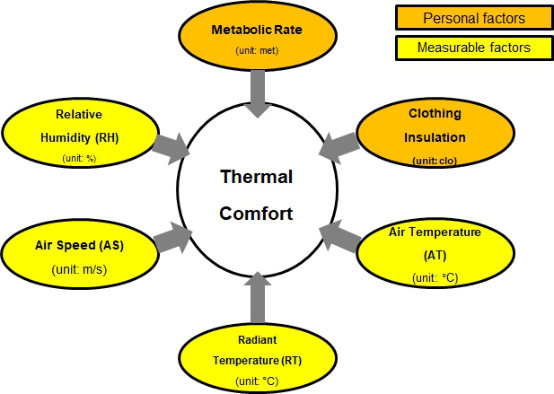
This study aims to conduct experiments with a diverse group of participants to identify the optimal temperature range for heated seats and develop a model for estimating the appropriate temperature based on surrounding climate information and driver variables. To achieve this, participants of various races, genders, and age groups will be recruited to record their preferred heated seat temperatures. During the experimental process, environmental variables such as temperature and humidity were collected in real time to analyze how these factors influence individual temperature preferences. Figure 1 is a diagram of six factors that can affect thermal comfort. Thermal comfort is influenced by environmental factors and personal factors. For example, environmental factors include ambient temperature and humidity, while personal factors include gender, age, and metabolic rate. Ultimately, the developed estimation model is expected to contribute to improvements in heated seat design by vehicle manufacturers and play a crucial role in enhancing driver comfort.
Figure 1: Environmental and personal factors affecting thermal comfort.
METHODS
We recruited 50 participants, considering various body sizes, ages, genders, and races. The inclusion criteria for the study are individuals with no physical issues sensing heat on a seat, and a wide range of body heights and weights. The exclusion criteria include pregnant women and participants who are sick or physically unwell. Participants were provided with clothing (0.4 Clo), excluding underwear, socks, and shoes. Each participant completed 3 different temperatures (–7
C, 0
C, 7
C) using both heated and unheated (control) seats. The temperature of –7
C was chosen as it represents the coldest typical temperature in winter. Precautions for the study included no alcohol consumption within 12 hours before the experiment, maintaining regular meal habits, and avoiding strenuous exercise (such as singles tennis, jumping rope, running, jogging, race walking, and aerobic dancing) 2 hours prior. The procedure required participants to complete a questionnaire 30– 40 mins experiment. The study recorded both objective measures such as air temperature, relative humidity, as well as subjective measures, including thermal comfort (7-point scale) and preferred temperatures on the six areas of the heated seat (upper-back, lower-back, side bolster of back, fore-cushion, rear-cushion, and side bolster of cushion). A walk-in cold room was used to simulate winter conditions, with the indoor temperature set between – 7
C and 7
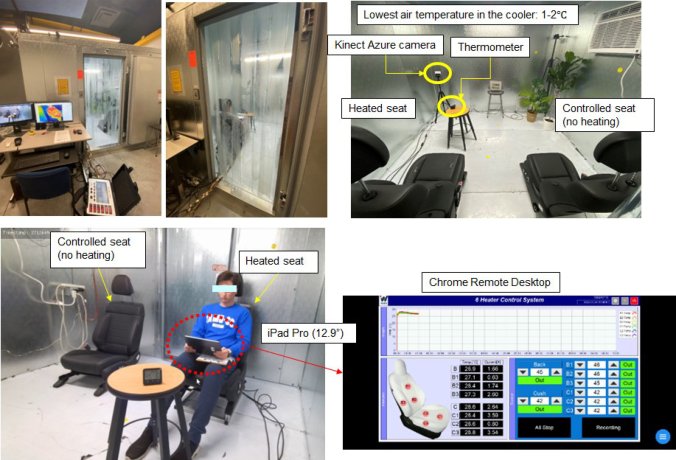
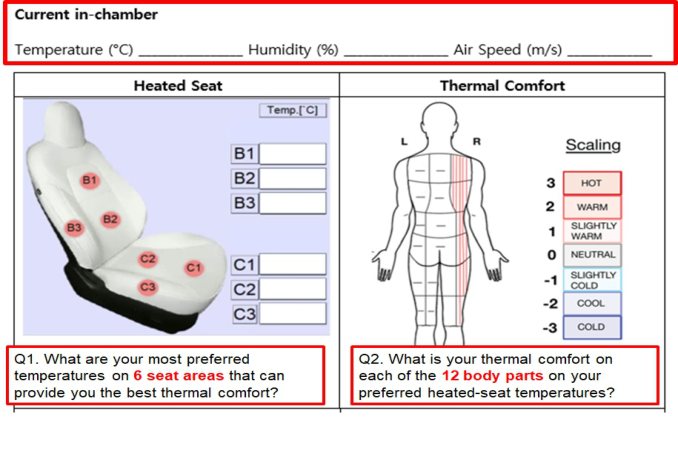
C and humidity ranging from 30% to 70%, reflecting real-world conditions for heated seat use. The experiment was designed to control as many factors as possible that could affect thermal comfort, aside from temperature and humidity. Participants assessed thermal comfort for 12 body parts using a questionnaire in the given temperature environment and performed a task to find their preferred temperature for six areas of the seat by using a custom-built vehicle seat and seat heat tester software, which are invented by vehicle-seat manufacturing company in South Korea (see the Figure 2 & 3).
Measurements of Preferred Heated Seat Temperatures 2107
Figure 2: Testing environment: Walk-in cooler, clothing, custom-built vehicle seat and seat heat tester software, and thermometer.Figure 3: The questionnaire to evaluate thermal comfort on 12 body parts and preferred temperature on 6 areas of the custom-built heated seat.
RESULTS
A total of 51 participants were recruited for the experiment, and their distribution is shown in the following table (see the Table 1). We aimed to recruit participants from a wide range of ethnic backgrounds to ensure
diversity. Additionally, we made efforts to include people from various age groups, ensuring that both genders were represented in nearly equal numbers. This balanced recruitment approach helps enhance the generalizability of the study findings by accounting for differences in age, gender, and ethnicity across the participant sample.
Table 1. Demographic information of the 51 participants.
Table available in the original PDF paper.
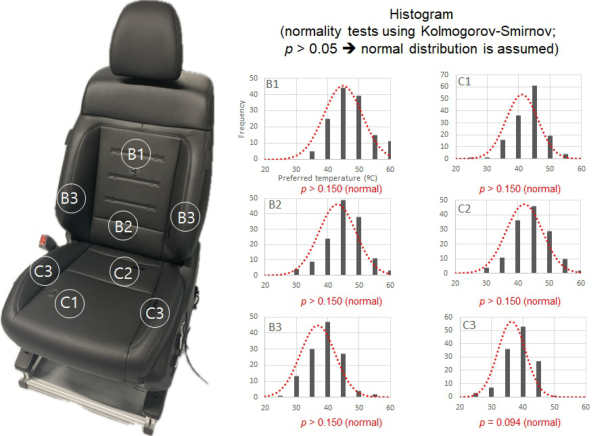
The preferred temperatures for six different regions of heated seats, collected from 51 participants, were found to follow a normal distribution (see Figure 4). This pattern suggests a consistent trend across the sample population, indicating that most participants shared similar preferences within a certain temperature range. The normal distribution also implies that outliers or extreme preferences were relatively uncommon, with the majority of the data clustering around the mean. As a result, this finding provides a reliable foundation for further statistical analysis and the development of predictive models for heated seat designs.
Figure 4: Normal distributions of the preferred temperatures for the six areas of the heated seat.
Measurements of Preferred Heated Seat Temperatures 2109
DISCUSSION
This study developed an experimental protocol that considers a diverse range of participants in terms of ethnicity, gender, and age to determine the preferred temperature range under various winter climate conditions, and data were collected accordingly. Notably, we were unable to find any previous studies that had conducted a similar experiment. This suggests that our research may be breaking new ground in exploring temperature preferences across different demographics. Additionally, we anticipate that a similar experimental protocol could be used to investigate the optimal ventilated seat temperature preferences during summer conditions. Such a follow-up study could further broaden our understanding of how seasonal factors influence comfort in vehicle seats, providing valuable insights for automotive design.
The data collected in this study is significant as it provides a reference for the three adjustable temperature settings of heated seats. By comparing the range of preferred temperatures selected by participants, we can assess whether the existing temperature ranges of the seats are adequate. This comparison is crucial for determining if current designs meet user expectations and comfort levels. Furthermore, we will analyze the differences in preferred temperatures across various regions of the heated seats. Observing these regional preferences will help us understand whether differential temperature settings are necessary in future seat heater designs. Ultimately, these insights could lead to improved user satisfaction and more effective heating solutions in automotive seating.
Finally, we plan to develop a classification model for preferred temperatures based on the collected data, taking into account ambient temperature, humidity, and the physical conditions of the participants. Currently, many commercialized vehicles are equipped with an “Auto” feature that automatically senses the surrounding temperature and adjusts the heated seat temperature to one of three levels: high, medium, or low (Lee et al., 2024). However, since this feature relies solely on ambient temperature, its accuracy may be limited. By considering a broader range of environmental and human variables, we aim to create a more precise statistical model (Park et al., 2016a, 2016b, 2019a). This improved model will enable us to provide a temperature setting that better suits the individual driver, enhancing overall comfort and satisfaction. Ultimately, our goal is to contribute to more effective heated seat designs that meet diverse user needs.
ACKNOWLEDGMENT
The study was sponsored by Hyundai Motor Company.
REFERENCES
Anderson, G. B., Bell, M. L., & Peng, R. D. (2013). Methods to calculate the heat index as an exposure metric in environmental health research. Environmental Health Perspectives, 121(10), 1111–1119. https://doi.org/10.1289/ehp.1206273 Budnicki, D., Lee, J. H., & Stolarski, T. A. (2017). A new approach to automobile seat
heating systems using alternative energy sources. Energy Procedia, 123, 75–80. https://doi.org/10.1016/j.egypro.2017.07.253
Kranjec, J., & Premk, M. (2020). Subjective evaluation of the comfort of heated car seats. Applied Sciences, 10(7), 2430. https://doi.org/10.3390/app10072430 Lee, B., Salas, M., Morrison, N. and Park, J., 2024. Exploring User Interface
Designs and Temperature for Automotive Heated Seats (No. 2024-01-2410). SAE Technical Paper. Lee, Y. H., Jeon, S. M., Park, S. H., Kim, Y. B., & Kim, S. H. (2012). The effect of climate control seats on driver’s physiological responses and comfort. Applied Ergonomics, 43(2), 306–314. https://doi.org/10.1016/j.apergo.2011.06.011 McGinley, M. A., & Harvey, C. J. (2016). Comfort-focused climate control systems
in luxury cars. Journal of Automotive Engineering, 230(4), 639–649. https://doi. org/10.1177/0954407015616868 Nagamachi, M., & Lokman, A. M. (2011). Kansei engineering: A user-oriented ergonomic methodology for product design. Springer Science & Business Media. https://doi.org/10.1007/978-1-84996-502-8 Niu, Y., Wang, X., Zhang, Y., & Lu, J. (2022). Performance comparison of different
heating technologies for automotive seat applications. Energy Reports, 8, 428– 438. https://doi.org/10.1016/j.egyr.2022.01.131 Park, J., Ebert, S. M., Reed, M. P., & Hallman, J. J. (2016a). Statistical models for predicting automobile driving postures for men and women including effects of age. Human factors, 58(2), 261–278. Park, J., Ebert, S. M., Reed, M. P., & Hallman, J. J. (2016b). A statistical model
including age to predict passenger postures in the rear seats of automobiles. Ergonomics, 59(6), 796–805. Park, J., Jung, K., Lee, B., Choi, Y., Yang, X., Lee, S., & You, H. (2019a).
Development of statistical geometric models for prediction of a driver’s hip and eye locations. International Journal of Industrial Ergonomics, 72, 320–329. Wang, C., Pan, Z., Ji, Z., & Luo, Z. (2020). Study on the application of composite materials in the automotive heating system. Materials Today: Proceedings, 37, 1587–1592. https://doi.org/10.1016/j.matpr.2020.06.563
LISTED IN THE AHFE DIGITAL BOOKSTORE CATALOGUE
Explore the complete digital volume
Human Factors in Design, Engineering, and Computing
Read this individual research paper free through the original publisher, or explore the full digital proceedings book.
ISBN 978-1-964867-35-9
Explore this ISBN in the AHFE Bookstore ↗Listed in the July 2026 bookstore catalogue; search by ISBN to confirm current availability · Digital book purchase optional