André Klussmann, Christoph Mühlemeyer, Patrick Serafin, Inna Levchuk, Karl-Heinz Lang, Hansjürgen Gebhardt (2018). Physical Strength and Hand Dimensions of a Population Sample: Results and Differences in Age and Gender. In: Advances in Physical Ergonomics and Human Factors: Part I. AHFE Open Access, vol. 1. https://doi.org/10.54941/10031
Anthropometric data and data about hand force could be a very important assistance for the ergonomic design of products, such as hand tools, machines etc. The aim of this study is to collect data about hand force and dimensions of the hand-arm-system of a representative sample of the population in Germany. The maximal isometric force and hand dimensions were determined among 1,214 participants (432 females, 782 males). The cases taken into account in force measurements include pulling strength, gripping strength and torque strength.
Data about hand forces and hand dimensions are of particular importance for an ergonomic work place design. In order to e.g. develop ergonomically well-designed tools (e.g. pliers or screwdrivers), it is helpful to know about hand dimensions and strength of potential users. Certainly, there are a number of anthropometric databases in Germany. However, depending on the time of measurement, it is questionable, whether these data still represent today's general public. This is particularly true for data on hand dimensions. Also, no coherent data on force values are available.
METHODS
To analyze a large sample of the general public, a standardized method inventory was developed. It consists of a standardized background questionnaire (e.g. age, gender, occupation, sport activities, handedness, body weight and height), a 3D scanner to determine relevant hand dimensions and a force-measure-stand to determine maximum forces.
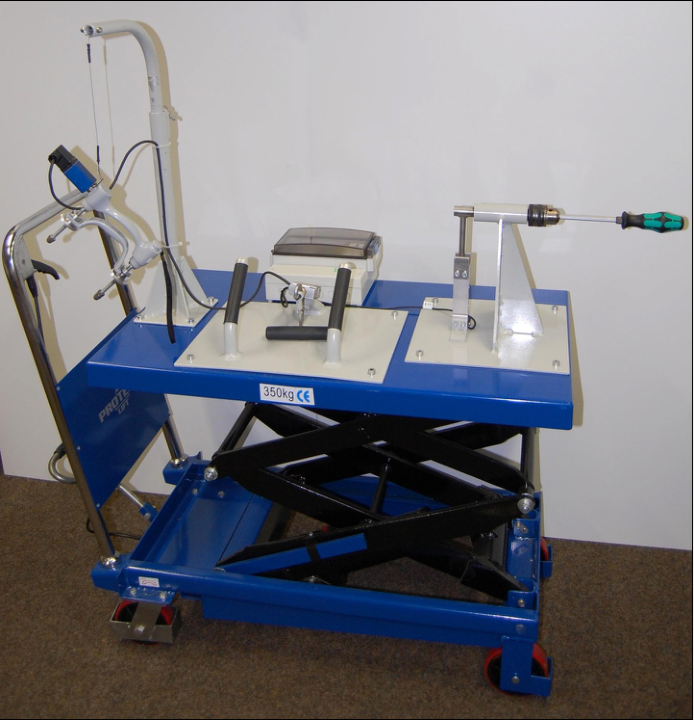
Measurement of the maximal isometric force For the standardized measurement of maximal isometric force, the participants within this study were asked to exert the maximal isometric force possible on MVE-level (Maximum Voluntary Effort). For this purpose, a test stand with three selected force cases was developed. Because the measurement should be carried out in a standing position, a height-adjustable design of the test stand was selected (Figure 1). This allowed, despite individual variations of anthropometric dimensions, taking similar body postures by adjusting the height of the test stand.
Figure 1. Height-adjustable test-stand
The maximal isometric force was determined in three cases, including pulling, gripping and turning with left and right hand separately (Figure 2).
Figure 2. Body posture during force measuring. Pulling strength (left), gripping strength (middle) and torque strength (right).
Figure available in the original PDF paper.
To achieve a high level of standardization and reproducibility, the body posture for the selected force cases was specified. For each case, an optimal body posture was defined in such a way that participants could perform hand forces under similar and advantageous conditions.
As an orientation for the measurement of the pulling strength, we used body postures described in other studies (e.g. Kluth et al, 2007): body in upright position, muscles of the hand-arm-shoulder system involved in force exertion, other arm rests on designated grip to support upper body.
For the measurement of the grip strength, a Jamar-Dynamometer was used. The standardized dynamometer was modified for a continuously variable adjustment of the grip size. The American Society of Hand Therapists (ASHT) recommends a standardized body posture for measurements by using Jamar-Dynamometer in standing position. In this regard, the elbow should be in flexion at 90°, while the forearm and wrist remain in a neutral position.
For the measurement of the torque strength, three screwdrivers with different handle sizes were provided and the torque was actuated in the supination direction. The body posture for this case was adapted from previous studies (see Strasser and Wang, 2007). This allowed a comfortable standing body posture without twisting along the spine. By the rotation of the screwdriver with the right hand the subject stands left from the test stand (the same but mirrored position for the left hand), toes form a line at an angle of 60° to the longitudinal axis of the screwdriver.
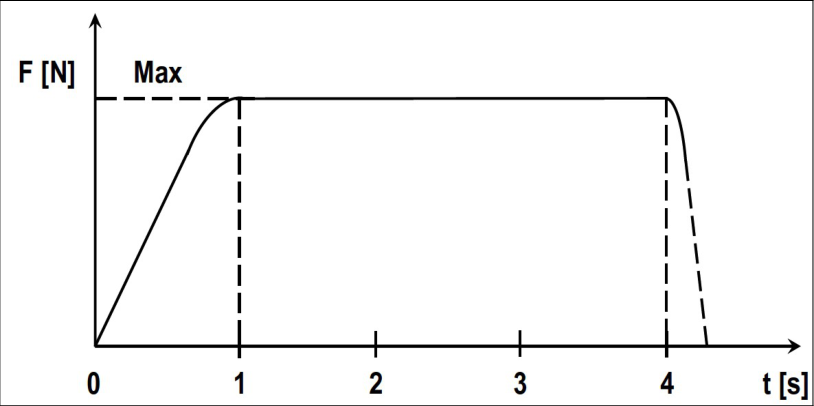
For the purpose of standardization and a coherent study design, the “square method” was used. This means force has to be increased rapidly (within 1 second) to the maximum and then be hold for 2 - 6 seconds (Rohmert et al., 1992). In our study the duration of holding the maximal force was defined to 3 seconds (Figure 3). In the meantime, the software automatically recorded the strength. The strength result is the highest moving average value over a two seconds interval after the 1-second build up phase.
Figure 3. The “square method” for the determination of maximum isometric force.
Force has to be increased rapidly (within 1 second) to the maximum and then be hold for 2 - 6 seconds (Rohmert et al., 1992).
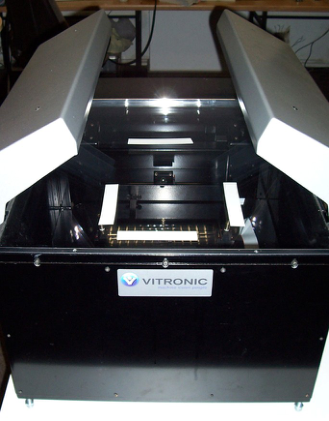
Assessment of anthropometric data For the assessment of anthropometric data of the hand-forearm system, a 3D-scanner was used (Figure 4. left picture). Besides, data of the hand-arm-system that could not be measured by the 3D-scanner was determined with the help of measuring templates (Figure 4. right picture).
Figure 4. 3D-scanner (left picture) and measuring templates (right picture).
RESULTS
Results of measurement of the maximal isometric force Overall, 1,214 participants, age between 5 and 91 years could be included in this study. According to age, the sample was nearly normally distributed, except the age group of the 30-39 years old, which were underrepresented. According to gender, much more males could be convinced to participate than females: 432 females and 782 males, see Figure 5.
number of participants
number of participants
0
0
under 10 y 10-14 y 15-19 y 20-29 y 30-39 y 40-49 y 50-59 y 60-69 y 70-79 y 80 y and older under 10 y 10-14 y 15-19 y 20-29 y 30-39 y 40-49 y 50-59 y 60-69 y 70-79 y 80 y and older
age
Figure 5. Distribution of the sample according to age and gender.
Figure available in the original PDF paper.
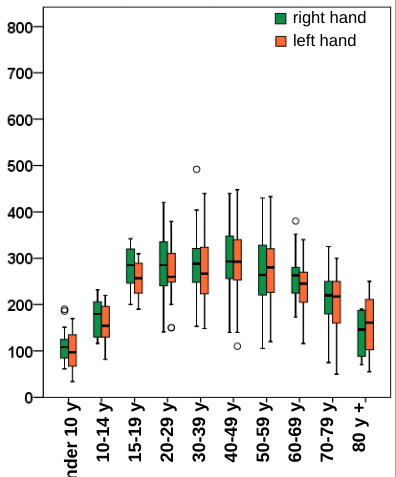
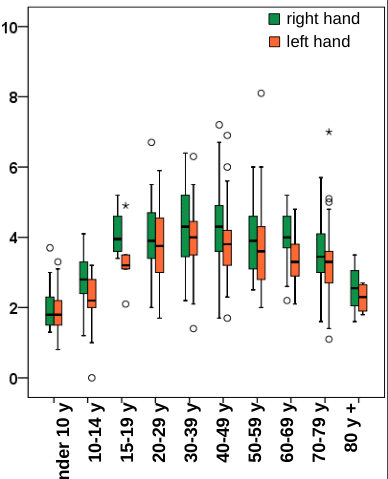
The maximal isometric force of the 1,214 participants, determined in the three categories “pulling force” (Figure 6), “Grip force” (Figure 7) and “torque force” (Figure 8).
Figure 6. Pulling force of participants, separated in males (n=782, left chart) and females (n=432, right chart).
Figure available in the original PDF paper.
female participants
male participants
right hand left hand
right hand left hand
grip force [N]
80 y +
80 y +
10-14 y
15-19 y
20-29 y
30-39 y
40-49 y
50-59 y
60-69 y
70-79 y
10-14 y
15-19 y
20-29 y
30-39 y
40-49 y
50-59 y
60-69 y
70-79 y
under 10 y
under 10 y age
age
Figure 7. Grip force of participants, separated in males (n=782, left chart) and females (n=432, right chart).
female participants
male participants right hand left hand
right hand left hand
torque force [Nm]
80 y +
80 y +
10-14 y
15-19 y
20-29 y
30-39 y
40-49 y
50-59 y
60-69 y
70-79 y
10-14 y
15-19 y
20-29 y
30-39 y
40-49 y
50-59 y
60-69 y
70-79 y
under 10 y
under 10 y age
age
Figure 8. Torque force of participants, separated in males (n=782, left chart) and females (n=432, right chart).
The relation between the average maximum force of men and women could be confirmed as described in previous studies. Females have on average 2/3 of the maximum force of men (e.g. Hettinger 1983). Maximum forces in the age groups of 15 to 69 years are relatively equal, but high individual differences occur.
Results of assessment of anthropometric data As described above, several anthropometric measurements have been done to get data especially about the hand arm system. As an example, the mean diameter of the index finger is displayed in Figure 9 (only working age sample from 18 to 65 years). The mean diameter is increasing with age. Compared with already existing older data (e.g. in the German National Standard DIN 33402-2) the values in our study are higher in most cases. This could be important to know for product designers and for future standardization.
Figure 9. Mean diameter of index finger, separated in males (n=520, left chart) and females (n=318, right chart).
Figure available in the original PDF paper.
DISCUSSION/CONCLUSIONS Interestingly enough, the level of force only slightly differs among participants in the age from 15 to 69 years. These results are not in accordance with most data from literature, like e.g. from Hettinger (1983). In this publication (among others), the 20 to 25 years old males were described as strongest, with permanent significantly decreasing force with increasing age. Further analysis and results, including coherences between hand dimensions and force are planned to give more useful information for ergonomic design of products. Limitation: As this is a cross-sectional study, no individual force development can be deduced.
ACKNOWLEDGEMENTS
This study was part of the “Design4All” project, which took place from 2009 to 2012. The Ministry of Economy, Energy, Industry, Small and Medium Businesses and Trades of the State of North Rhine-Westphalia in combination with the “NRW Ziel 2 Programm” of the European Regional Development Fund (ERDF) funded this project.
REFERENCES
Hettinger, T. (1983): Isometrisches Muskeltraining. 5. Edition. Stuttgart, New York, Thieme. Kluth, K., Kellermann, H.G. and Strasser, H. (2007): Assessment of the ergonomic quality of file handles. In Strasser (Ed), Assessment of the ergonomic quality of hand-held tools and computer input devices. Amsterdam: IOS Press, p. 143-151. National Standard DIN 33402-2 (2005), Ergonomie. Körpermaße des Menschen – Teil 2: Werte. Rohmert, W., Rückert, A., Schaub, K. (1992): Körperkräfte des Menschen, Technische Hochschule, Institut für
Arbeitswissenschaft, Darmstadt. Strasser, H. (2007): Assessment of the ergonomic quality of hand-held tools and computer input devices. Amsterdam: IOS Press. Strasser, H and Wang, B. (2007): Effects of Hand Preference and Direction of Rotation on Screwdriver Torque Strength and Physiological Costs of Muscles Involved in Arm Pronation and Supination. In Strasser (Ed), Assessment of the ergonomic quality of hand-held tools and computer input devices. Amsterdam: IOS Press, p. 67-74.
LISTED IN THE AHFE DIGITAL BOOKSTORE CATALOGUE
Explore the complete digital volume
Advances in Physical Ergonomics and Human Factors: Part I
Read this individual research paper free through the original publisher, or explore the full digital proceedings book.
ISBN 978-1-4951-2104-3
Explore this ISBN in the AHFE Bookstore ↗Listed in the July 2026 bookstore catalogue; search by ISBN to confirm current availability · Digital book purchase optional