Hansjürgen Gebhardt, Christoph Mühlemeyer, Karl-Heinz Lang, Beate Schlutter, Anja Vomberg (2018). Anthropometric Considerations for Designing a Test Finger to Avoid Electrical and Mechanical Hazards. In: Advances in Physical Ergonomics and Human Factors: Part I. AHFE Open Access, vol. 1. https://doi.org/10.54941/10032
Institute of occupational medicine, safety and ergonomics (ASER), D-42329 Wuppertal, Germany b Commission for Occupational Health and Safety and Standardization (KAN), D-53757 Sankt Augustin, Germany ↗
Standardized test fingers are used for testing products against mechanical and electrical hazards. The most common one is given in EN 61032. An application for this test finger is the classification of enclosures by the IP (International Protection) - Code according to EN 60529 (2000). The dimensions of this test finger, mentioned in these standards, have remained unchanged for several decades. In the meantime the corresponding anthropometric dimensions of the human being have changed as well as the standard of safety and the level of safety awareness. Therefore, it has been investigated, whether the dimensions of the test finger specified in these standards are still in accordance with anthropometric considerations and whether they represent a sufficient level of safety. This article is based on a project, which has been performed on behalf of the Commission for Occupational Health and Safety and Standardization (KAN). By this article, the report is carried forward.
During the last decades, significant changes in the work environment can be observed. Here, the standard of safety as well as the safety awareness could be increased significantly. This is reflected by the development of work accidents e.g. in Germany over a longer period shows this very clearly. Compared to the situation in the 1960s, the number of working accidents per 1.000 full-time employees in Germany decreased to about ¼. in 2011 (cf. Government report (2012)). Without successful prevention activities and active and passive safety measures, this continuously decreasing trend is difficult be explained.
In the same time, human body dimensions have changed more or less extensively. Buzzwords like "acceleration of body height" and "horizontal growth" describe these changes. They are reflected in both, an increase of the mean body longitudinal dimensions as well as in an increase of the mean circumference dimensions. This topic will later be discussed in more detail.
An analysis of occupational accidents in the commercial sector based on numbers given by the German Social Accident Insurance (DGUV) shows, that the hand is often still the injured part of the body. With 34.5 % in 2011 (corresponding to about 306,000 occupational accidents) more than every third occupational accident in Germany is affected. In 19 % of these cases the index finger is the relevant part of the body. In about half of these accidents superficial wounds and lacerations are observed (cf. Standke (2013)).
Summarizing these observations, it can be concluded, that since the dimensions of the standard test finger were established - presumably in the 1960s - significant changes of relevant body measurements are observed and must be taken into account. These facts raised the question, whether the existing dimensions and the associated testing is still able to ensure a sufficient and contemporary protection against electrical and mechanical hazards. Primary target group are employees, accordingly exclusively the protection of adult and juvenile persons are considered.
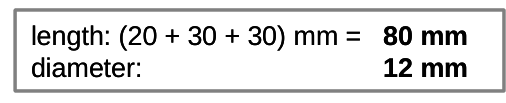
THE COMMON STANDARD TEST FINGER What is the common standard test finger ? This question quickly leads to the European Standards EN 60529 (2000) and EN 61032 (1998). In these standards, an identical test finger is described. This test finger is shown in Figure 1. Main Characteristics are tripartism, taking account of the finger joints as well as a diameter of 12 mm and a length of 80 mm. Deviations from these dimensions may only be found in standards, if the protection of non-adult persons is to be tested. For this purpose, the standard EN 61032 (1998) provides probes with reduced diameter and length.
When focussing on occupational safety and health – and therefore focussing on the protection of adults - the jointed test finger presented in Figure 1 and its dimensions may be seen as the current state of the art.
Insulating material
Insulating material
Equation reproduced from the original PDF.Equation reproduced from the original PDF.Figure 1: Dimensions of the jointed test finger according to EN 60529 (2000) and EN 61032 (1998) SAFETY DISTANCES IN INTERNATIONAL STANDARDS
Figure available in the original PDF paper.
The international standard EN ISO 13857 (2008) specifies safety distances to prevent hazard zones being reached by the upper and lower limbs. As this standard is mandated under the Machinery Directive, in the EC this standard and its specifications are relevant for the safety of machinery and leads to the presumption of conformity.
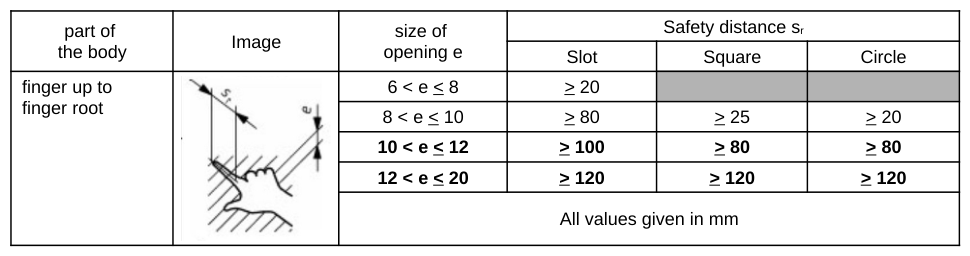
Depending on size and type of a regular opening safety distances are indicated for reaching through by finger up to the finger root for persons of 14 years and elder. A distinction is made between slotted, squared and circulared openings. The given minimum distances should ensure that risk areas can not be reached by the finger up to the finger root (cf. Table 1).
Table 1: Safety distances to prevent reaching through regular openings by the finger acc. to EN ISO
A comparison of the data given in Figure 1 and Table 1 shows, that the diameter of 12 mm can be found in both considerations. However, for openings larger than 12 mm (up to 20 mm), in EN ISO 13857 (2008) a safety distance of > 120 mm is indicated. Compared to the common test finger with a given length of 80 mm, there is a significant difference of more than 40 mm.
Therefore the question is: which safety distance is appropriate and contemporary in view of the objectives for safe products? This can be checked by looking at the current anthropometric data situation. As indicated before, the relevant body dimensions to be analyzed are the length and the breadth of the finger close to the body (proximal). Although in general the middle finger has a greater length than the index finger, this is insignificant due to anatomical conditions. Consequently, the following investigations concentrate on the dimensions of the index finger.
ANTHROPOMETRIC DATA FOR FINDING SOLUTIONS Anthropometric data collections
In the framework of this investigation, current distributions of relevant body dimensions were considered and compared with the dimensions of the common test finger. Since it is a check for safety-related measures, the relevant percentiles to apply are the first percentile for the diameter (resp. the breadth) and the 99th percentile for the length (cf. EN 614-1 (2009) or BGI 523 (2003)). As far as available, national as well as international distribution data were included in the evaluation. As relevant anthropometric data, the body measurements for index finger length and -breadth were considered.
The international Technical Report ISO/TR 7250-2 provides that kind of information for several ISO member bodies. The intension of this Technical Report is to gather the most current distributions for defined anthropometric dimensions for populations in ISO member bodies. As the collection of data started only a few years ago, the number of member bodies, who are already participating, is still fairly restricted.
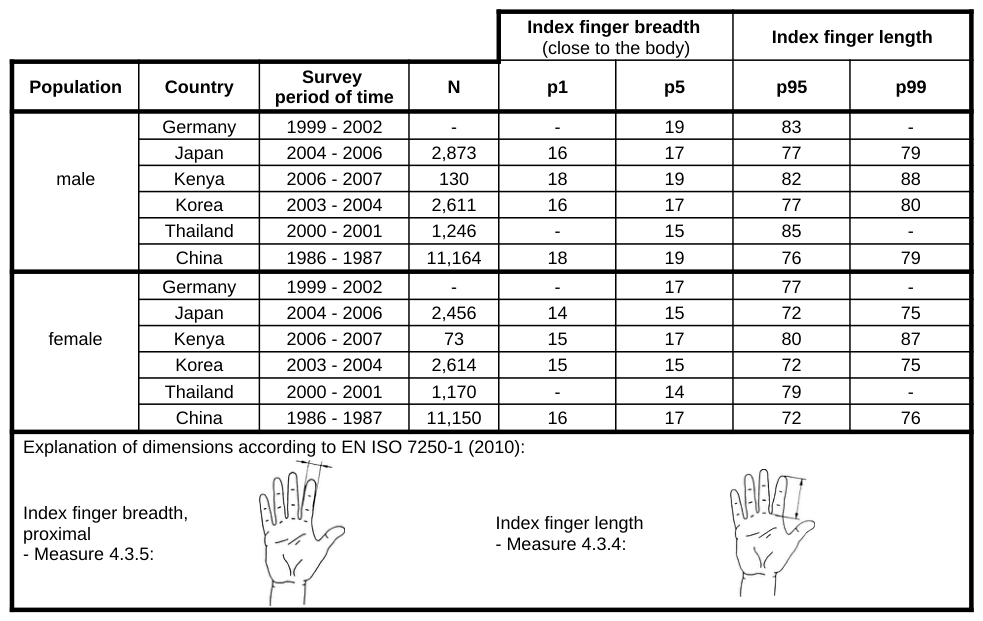
Table 2 shows the distribution data from those ISO member bodies, which already provide data for the body measurements concerned. As far as available, the number of measurements of the underlying data base (N), the first (p1) and the 5th percentile (p5) of the index finger breadth (proximal) as well as the 95th (p95) and the 99th percentile (p99) of the index finger length is provided (cf. Mühlemeyer et al. (2012)).
When looking closer at the distribution data given in ISO/TR 7250-2 (2013) it is noticeable, that there are quite a few gaps. Some countries, which are not considered in Table 2 have not yet been made available any information for the considered body measurements. In other cases (e.g. Germany) no information is provided about the size of the sample nor the first and 99th percentile. This is due to the fact, that in case of Germany the information are copied from the national standard DIN 33402-2 (2005), where these information are also missing. Looking at the distribution data from Thailand, also information about the first and 99th percentile are also not reported.
Table 2: Index finger breadth and Index finger length: relevant percentiles for populations in various ISO member bodies
(data from data from ISO/TR 7250-2 with first supplement (E2012)) Index finger breadth
By analyzing the distribution data for the proximal Index finger breadth, given in Table 2, for the first percentile a range from 14 to 18 mm is observed. Therefore the choosen diameter of 12 mm for the test finger according to EN 60529 (2000) provides a high level of safety as also openings are tested, where more or less no adult person is able to reach through with her or his finger.
In contrast to the choosen diameter of the common test finger, its length must be seen critically. Here, the values for the 95th percentile is already up to 83 mm. Looking at the 99th percentile (cf. Table 2) this value is almost up to 88 mm. This circumstance has already been reported in an overview of anthropometric data in standards (Gebhardt et al. (2009)).
Besides this observation, we have to take into account, that the values given in Table 2 are measured in accordance with EN ISO 7250-1 (2010). These values are systematically smaller than the possiblity of reaching through openings by the finger up to the finger root. That´s because the measurement is defined as (just) the distance from the tip of the second finger to the proximal fingercrease on the palm of the hand (cf. EN ISO 7250-1 (2010)).
This leads to the assumption, that with a length of 80 mm, a significant number of (mostly male) people are not optimally covered and protected when using the common test finger. Therefore, there is a remark in the standard, that “the jointed test finger shall have adequate clearance from hazardous parts” (cf. EN 60529 (2000)). In contrast to the chosen diameter, the chosen length and its possible level of protection is clearly limited. In order to realize a consistently high level of protection, an adaption due to antropometric considerations is very much recommended (cf. Mühlemeyer et al. (2012)).
Of course we have to consider, that the observed discrepancy is only relevant for larger openings with more than 12 mm in diameter as for smaller openings the test finger will not pass through. This is in accordance with the required safety distances given in EN ISO 13857 (2008). Assuming square or circular shaped openings, for opening sizes of 10 to 12 mm, the required safety distance is at least 80 mm while the required safety distance is at least 120 mm for opening sizes of 12 to 20 mm (cf. Table 1). This also means, that in case of the classification according to the IP (International Protection) Code the classification IP 1XB is mainly affected (see also EN 60529 (2000)).
In order to find reasons for this discrepancy, besides a higher level of safety and safety awareness, the development of body measurements in the past decades should be investigated.
Development of body measurements The development of body measurements during the recent decades may be summarized as follows: people are on average getting larger and wider. The shift of the mean value towards higher values naturally has also an impact on the marginal areas, that shifted in at least the same way. This refers to the German and European population, but also to large other parts of the world´s population. The first development is often described by the term "acceleration in length", the second development may be described by "horizontal growth". Especially in this area, also an advanced scattering is observed.
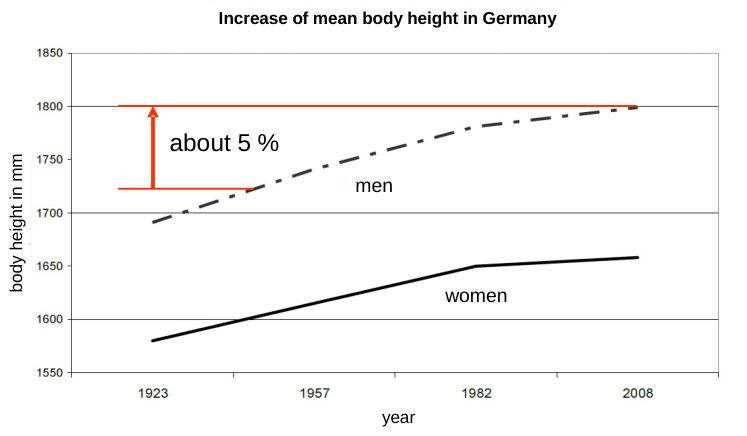
The observed increased growth in length mainly relates to the long bones, which also include the finger bones. Scheffler & Schüler (2013) show the increase in mean body height for adults in Germany. Since the 1950s, an increase in mean height for men of approximately 90 mm is observed, which corresponds to about 5%. A similar development may be observed also for women (see Figure 2).
Increase of mean body height in Germany Increase of mean body height in Germany
about 5 %
about 5 % men men body height in mm body height in mm
women
women
year year
Figure 2. Increase of mean body height in Germany (from: Scheffler&Schüler (2013) with amendment) According to experience this observation, which at first applies to the average longitudinal dimensions, is at least similar or even more pronounced for the edge regions of the distribution. Therefore the first and 99th Percentile are affected in an at least similar or even more pronounced way.
This may be confirmed by current measurements shown in Figure 3. Here the index finger (pass-through) length and the proximal index finger breadth were measured. In total 384 male as well as female subjects took part in the measurements. The measurements were carried out in Germany with regional focus on North Rhine-Westphalia (see also Wetzel (2012)).
The here given measurements for the “Index finger pass-through length" correspond more or less exactly to the required anthropometric value. Due to the fold of skin between the fingers, compared to the Index finger length defined in ISO 7250-1 (2010), on average the values measured here are about 5 mm larger.
Index finger (pass-through) length vs. Index finger breadth (N = 384)
Index finger (pass-through) length vs. Index finger breadth (N = 384) Zeigefingerlänger vs. Zeigefingerbreite (N = 384) Zeigefingerlänger vs. Zeigefingerbreite (N = 384)
[mm]
[mm]
Zeigefingerbreite in cm
Zeigefingerbreite in cm
5
5
Index finger breadh (proximal) [mm]
Index finger breadh (proximal) [mm]
0
0
Zeigefingerlänge in cm Zeigefingerlänge in cm Index finger passthrough length [mm] Index finger passthrough length [mm]
Figure 3. Index finger pass-through length vs. proximal Index finger breadth; Results from N = 384 measurements in the framework of a Ziel2-project
Figure available in the original PDF paper.
The lines in Figure 3 are also showing the dimensions of the current standard test finger (80 mm in length, 12 mm in diameter). Even for this small group of about 400 subjects, the presented data clearly show, that the selected length can not ensure an optimal protection. People with finger dimensions in the upper right quadrant are not optimally protected respectively potentially at risk. Simultaneously it can be shown, that for the same subjects the diameter of 12 mm may be seen as a good choice for a high level of protection for adult people.
CONCLUSIONS
Summing up the results of the investigation, it can be noted, that a diameter of 12 mm for a test finger still offers a high level of protection. Also the tripartism, taking into account the finger joints, is a very good approach for testing and simulating possible hazardous situations. However, the changes of the last decades, both in what concerns the anthropometric measurements as well as the safety standard and safety awareness, seems to require an adaptation of the length of the test finger to ensure the same level of safety protection as the chosen diameter.
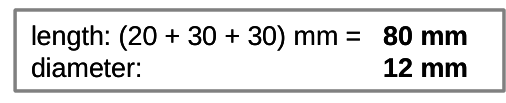
A proposal has been derived taking into account these considerations (see Figure 4). The proposal starts from the largest 99th percentile of the Index finger length given in the current ISO/TR 7250-2 (2013), which is about 90 mm (see Table 2). The proposal further takes into account the following safety-enhancing supplements:
the fact, that so far data from only very few ISO member bodies are available, is considered by a supplement of 10 mm,
the fact, that by measures in accordance with EN ISO 7250-1 (2010) the potential depth of penetration is not fully reflected, is considered by a further supplement of 5 mm,
the fact, that fingernails may increase the index finger length, is considered by a further supplement of 5 mm.
Anthropometric considerations for designing a test finger to avoid electrical and mechanical hazards lead to a minimum length of (90 + 10 + 5 + 5) mm = 110 mm to ensure a safety level, that corresponds to current anthropometric data on the one hand and current safety awareness on the other. This is reflected by the considerations given in EN ISO 13857 (2008), where, for the safety of machinery, a safety distance of at least 120 mm is demanded. As the investigation shows, this corresponds to current anthropometric data and still leaves a desirable safety cushion.
Starting point and (Safety) Supplements:
Figure 4. Proposal for the length of a contemporary test finger, derived from anthropometric and safety considerations
Figure available in the original PDF paper.
This is in contrast to the length of the common jointed test finger given in EN 61032 (1998), where a length of just 80 mm is demanded. There is a significant discrepancy to the current anthropometric data on the one hand and to the requirements in standards on machinery on the other. Although the intentions are comparable, it looks as if the length of the test finger has not been adjusted to the anthropometric changes and also the growing safety standard of the last decades.
A correction of the dimension and a unification of safety standards is a meaningful task. This is especially related to the test finger length. Again, basically positive is the diameter of 12 mm, which offers a high level of protection. Also basically positive is the tripartism of the common jointed test finger, which allows to take into account the mobility of the finger. The fact, that the test finger according to EN 61032 (1998) is also used for the IP-Code testing according to EN 60529 (2000), may be seen either as a challenge as well as an opportunity.
According to the investigation presented here, an adjustment of the test finger length to at least 110 mm seems to be necessary, representing the changes in anthropometric data but also the changes in safety and safety awareness during the past 50 years. As at least the IP Code 1XB is affected and in order to comply with a contemporary level of safety, without such an adjustment testing institutions using EN 60529 (2000) should interpret the reference "adequate clearance from hazardous parts” given in the standard in a rather wide range.
ACKNOWLEDGEMENT
Some of the datasets, used in this study were measured in the framework of the “Design4All” project, which took place within the “NRW Ziel 2 Program” from 2009 to 2012. This project was funded by the Ministry of Economy, Energy, Industry, Small and Medium Enterprises and Trades of the State of North Rhine-Westphalia in combination with the European Regional Development Fund (ERDF).
REFERENCES
BGI 523 (2003), “People and Workplace”. Edit: Association of Metal BGs (VMBG). Carl Heymann Verlag. 2003 edition [o: BG-Broschüre BGI 523 Mensch und Arbeitsplatz. Hrsg: Vereinigung der Metall-Berufsgenossenschaften (VMBG). Carl Heymanns Verlag. Ausgabe 2003] DIN 33402-2 (2005), “Ergonomics - Human body measurements - Part 2: Values”
[o: Ergonomie - Körpermaße des Menschen - Teil 2: Werte], Beuth, Berlin EN 60529 (2000), “Degrees of protection provided by enclosures (IP code)”, Beuth, Berlin EN 61032 (1998), “Protection of persons and equipment by enclosures. Probes for verification”, Beuth, Berlin EN 614-1 (2009), “Safety of machinery - Ergonomic design principles - Part 1: Terminology and general principles”, Beuth, Berlin EN ISO 13857 (2008), “Safety of machinery - Safety distances to prevent hazard zones being reached by upper and lower limbs”,
Beuth, Berlin EN ISO 7250-1 (2010), “Basic human body measurements for technological design - Part 1: Body measurement definitions and landmarks”, Beuth, Berlin Gebhardt, H., Mühlemeyer, C. (2012), “Requirements for a jointed test finger in accordance with DIN EN 60529 based on
current anthropometric data”. [o: Anforderungen an einen gegliederten Prüffinger nach DIN EN 60529 auf der Grundlage aktueller anthropometrischer Daten.]. Published by: Verein zur Förderung der Arbeitssicherheit in Europa e.V. (VFA). Sankt Augustin http://www.kan.de/fileadmin/Redaktion/Dokumente/KAN-Studie/de/2012_prueffinger.pdf Gebhardt, H., Schäfer, A., Lang, K.-H., Schultetus, W. (2009), “Anthropometric data in standards - inventory and demand analysis with special consideration of OSH”. KAN Report 44, [o: Anthropometrische Daten in Normen – Bestandsaufnahme und Bedarfsanalyse unter besonderer Berücksichtigung des Arbeitsschutzes]. Published by: Verein zur Förderung der Arbeitssicherheit in Europa e.V. (VFA). Sankt Augustin http://www.kan.de/fileadmin/Redaktion/Dokumente/KAN-Studie/de/2009_KAN-Studie_AnthropometrischeDaten.pdf Government report (2012) on the „State of safety and health at work and on the accident and occupational diseases in the
Federal Republic of Germany in 2011“. Bundestag printed paper 17/11954 from 19.12.2012 [o: Bericht der Bundesregierung über den Stand von Sicherheit und Gesundheit bei der Arbeit und über das Unfall- und Berufskrankheitengeschehen in der Bundesrepublik Deutschland im Jahr 2011, BT-Drucksache 17/11954 vom 19.12.2012] ISO/TR 7250-2 (2013), “Basic human body measurements for technological design - Part 2: Statistical summaries of body measurements from national populations”, Beuth, Berlin Mühlemeyer, C., Gebhardt, H., Klußmann, A., Schlutter, B., Vomberg, A. (2012): Anthropometric design of test equipment
safety-related measures on the example of the protection provided by enclosures. [o: Anthropometrische Gestaltung von Prüfmitteln sicherheitsrelevanter Maße am Beispiel der Schutzarten durch Gehäuse] In: Society for Work Science (ed.): Report of the 58th Work Scientific Congress of the Society of Industrial Science "design of sustainable systems of work - way to healthy, efficient and safe working," University of Kassel, 22.-24.02.2012, GfA Press, Dortmund, pp. 181-184 Scheffler, C., Schüler, G. (2013), “Rough draft of a guide for the proper selection and application of anthropometric data”.
[o: Rohfassung eines Leitfadens für die richtige Auswahl und Anwendung anthropometrischer Daten], Preliminary Final Report of KAN -study 51; Eds.: Commission Occupational Safety and Standardization (KAN), Sankt Augustin. Schlutter, B. (2012): “Test finger: Tested and found to be too short”. [o: Prüffinger: Geprüft und für zu kurz befunden], KANletter 02/2012, p 9 Published by: Verein zur Förderung der Arbeitssicherheit in Europa e.V. (VFA). Sankt Augustin http://www.kan.de/publikationen/kanbrief/neue-grundlagendokumente-der-ergonomie/prueffinger-geprueft-und-fuer-zu- kurz-befunden/ Standke, W. (2013), “Work accident statistics 2011”; [o: Statistik Arbeitsunfallgeschehen 2011], editor: German Social Accident
Insurance (DGUV), Munich, 2013 Wetzel, M. (2012), “Data acquisition and analysis strategies using selected anthropometric measures”[o: Datenermittlung und Auswertestrategien am Beispiel ausgewählter anthropometrischer Maße], Bachelor's Thesis, University of Wuppertal, FB D Department of Safety Engineering
LISTED IN THE AHFE DIGITAL BOOKSTORE CATALOGUE
Explore the complete digital volume
Advances in Physical Ergonomics and Human Factors: Part I
Read this individual research paper free through the original publisher, or explore the full digital proceedings book.
ISBN 978-1-4951-2104-3
Explore this ISBN in the AHFE Bookstore ↗Listed in the July 2026 bookstore catalogue; search by ISBN to confirm current availability · Digital book purchase optional