Xuezhi Zhang, Xiaoghui Zheng, Songtao Ding, Taijie Liu band He Fang (2018). Error Analysis for Three-Dimensional Anthropometric Survey of Young Chinese Males. In: Advances in Physical Ergonomics and Human Factors: Part I. AHFE Open Access, vol. 1. https://doi.org/10.54941/10021
Based on the requirement of design and manufacture, a three-dimensional anthropometry survey was conducted in China in 2010-2011. 10319 young Chinese males (18~36 years old) were measured. The errors of the three-dimensional scanning method and the errors between three-dimensional scanning method and traditional manual method were analyzed in this paper. Three different error analysis methods were used to study the accuracy of the anthropometric survey. The results showed that the accuracy of the anthropometric data is acceptable.
The development of three-dimensional (3-D) measurement technology has made 3-D measurement more economical and viable for ergonomic applications. Many countries had proposed the plan to carry out 3-D anthropometry survey to capture the surface morphologies of human body, such as Size Korea 2004(Park, Nam, Lee, & Park, 2009), the Civilian American and European Surface Anthropometry Resource (CAESAR)(Kathleen, 2002), and so on. Dimension data are still absolutely necessary for design and manufacture(Li, Chang, Dempsey, Ouyang, & Duan, 2008; Zheng, Niu, & Ding, 2011). As a result, many scientists have paid more attention on study of extracted dimension data.
3-D anthropometry technology appeared in 1950’s, and had been under investigation since then. During these years, more and more anthropometry studies were focused on this technology. Meanwhile, there are still many problems unsolved, including multi-resolution description of 3-D anthropometric data(Niu, Li, & Salvendy, 2009), the landmark identification(Kouchi & Mochimaru, 2011) and shape comparison(Ball et al., 2010), etc. Because of the importance of reducing errors and securing data quality, data checking procedure and error analysis are important(Jun-Ming Lu, 2008).
An anthropometry survey was carried out in China from 2010 to 2011, and 10319 young Chinese men were measured with an advanced 3-D scanning method. To ensure the validation of the anthropometric data derived from the measurements, the error analysis was studied in this paper.
METHODS
Equipment
A laser scanner VITUS Smart XXL was used in this measurement, which is designed to generate highly precise 3-D image of the human body. This technology can be utilized for a variety of applications. VITUS is based on optical triangulation, currently an accurate method for touchless 3-D imaging. The scanning volume is 1200mm×1000mm×2100mm, and the measurement time is approximately 12 s.
To value the validation of 3-D scanning method, the manual method for anthropometry was also adopted. The equipments for manual methods includes sliding caliper, spreading caliper, tapes, anthropometer, etc.
Subjects All the subjects were collected from the mainland of China. The mean age of the 10319 males subjects were 22.1 years old (ranged from 18~36 years old). At the same time, 107 subjects were random sampled to be measured by manual methods.
Scanning Procedure Each subject was scanned in three designed postures for the survey. Pose A is a standing posture. The subject stands erect with the head in the Frankfurt Plane. The heels are together, the upper limbs hang relaxed at the side, palms facing the body. Pose B is also a standing posture. The subject stands with feet 200mm apart, with the head Frankfurt Plane. The upper arms are abducted to form a 20 degree angle with the sides of the torso, and the forearms hang vertically; the palms face backward. Pose C is a sitting posture. The subject sits erect with the head in the Frankfurt Plane. The upper arms hang down at the side, but they are bent 90 degrees at the elbow, and the palms are flat, facing each other; the feet are hanging freely in which the subject assumes. The software ScanWorx was used to extract dimensions from the 3-D graphs. The data measurement and extraction accords with the quantity control requirement in the standard ISO 7250.
RESULTS AND DISCUSSION
Validation of Repetitive Scanning Measurement To value the repeatability of using the 3-D canning data to estimate and calculate body dimensions, a repetitive experiment was performed and the results were analyzed using SPSS 16.0. During every measurement, the same subject was scanned for six times, and the subject was requested to come out from the scanner area and do the three postures again.
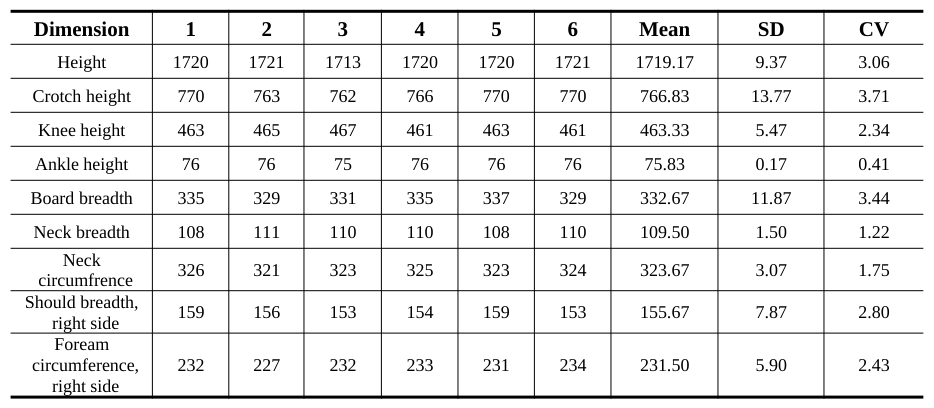
The error of the adopted 3-D scanner is less than 1 mm in horizontal circumference, less than 2 mm in horizontal dimension, less than 3 mm in altitudinal dimension. The scanning rate is very fast, so the error caused by the movement of body during scanning could be ignored. The results of the data of scanning are listed in Table 1. Nine main anthropometric dimensions, including height dimension, breath dimension and circumference dimension, were selected to characterize the error. The results illuminate that the difference between the result of every times, and the error ranges are acceptable.
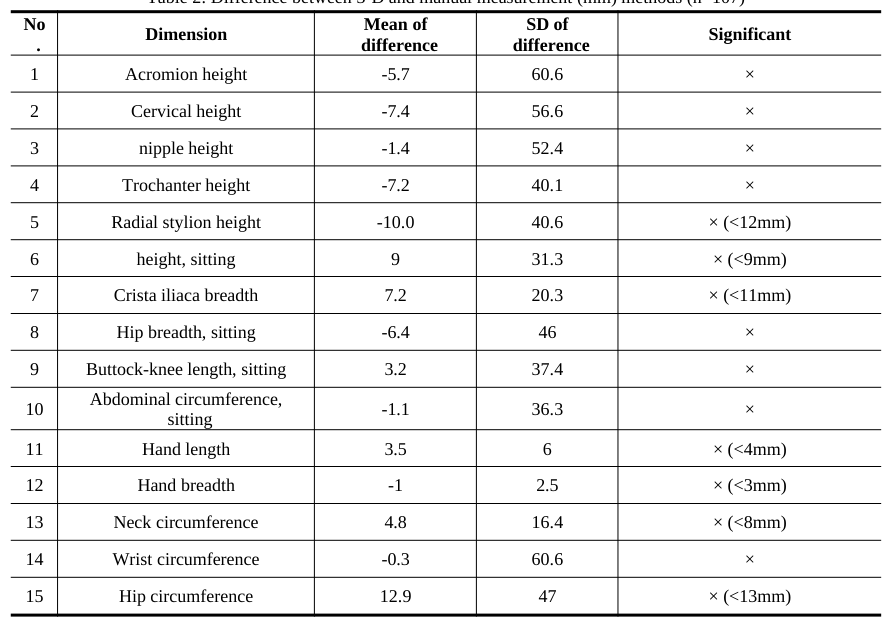
Comparison Between Scanning Method and Manual Method To compare the difference of between the data of scanning method and manual method, 15 anthropometric dimensions were selected. These dimensions cover the height dimension, breadth dimension and circumference dimension. 107 subjects were selected to perform the measurement by both scanning method and manual method. The results of the measurements are listed in Table 2. The differences between the data of two measuring methods did not appear to be a special trend and the differences are quite small. As a result, the anthropometric dimension data from 3-D scanning method are not statistical significant with that from manual method. The errors of 3-D scanning method are acceptable.
Table 1: data of repetitive 3-D scanning measurement for same subject(mm) Dimension 1 2 3 4 5 6 Mean SD CVTable 2: Difference between 3-D and manual measurement (mm) methods (n=107) No SD of difference Significant . Dimension Mean of difference 1 Acromion height -5.7 60.6 ×
According to the comparison between the data from 3-D scanning method and manual method, there are still some differences according to the measurement method, but the differences are both acceptable. Because the anthropometric survey for a large number of subjects is difficult to carry out by manual method, and the 3-D scanning method can reserve the 3-D graphs of human, the 3-D scanning method are suitable method to carry out an anthropometric survey for Chinese young males.
Error controlling index E. PanchÓn proposed an index for quality control in anthropometric surveys. Such indices are applicable only to a few anthropometric variables but the results found by this control can be an indication of the quality of the complete measurement process. The indices are defined as follows.
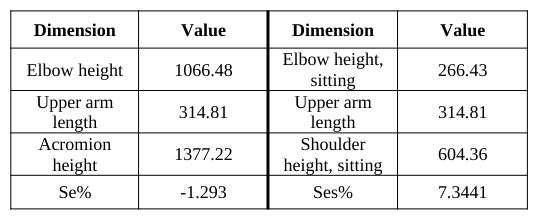
Filling the results of this anthropometric survey into these equations, we can conclude the results of these indices. The values of each dimension needed in the equations and the values of Se and Ses were listed in Table 3. The Se% of this survey is -1.293, and the Ses% of this survey is 7.3441. Both of these values can meet the requirement of a reliable anthropometry. The results indicated that the accuracy of this anthropometric survey for Chinese young males is acceptable.
Table 3: The values of indices for quality control in anthropometric surveys Dimension Value Dimension Value
CONCLUSIONS
In this article, we discussed the error detection procedure and applied the procedure to study the 3-D measurements from the anthropometric survey for Chinese young males. Three methods were used to calculate the accuracy of this survey, including repetitive scanning measurement, comparison between scanning method and manual method and error controlling index. All the results of these methods showed that the accuracy of this anthropometric survey should be acceptable.
REFERENCES Ball, R., Shu, C., Xi, P., Rioux, M., Luximon, Y., & Molenbroek, J. (2010). A comparison between Chinese and Caucasian head shapes. Applied Ergonomics, 41(6), 832-839. Jun-Ming Lu, M.-J. J. W. (2008). Automated anthropometric data collection using 3D whole body scanners. Expert
Systems with Applications, 35, 407-414. Kathleen, M. R. (2002). Civilian American and European surface anthropometry resource (CAESAR) final report (No. AFRL-HE-WP-TR-2002-0169). OH, USA: Air force research laboratory. Kouchi, M., & Mochimaru, M. (2011). Errors in landmarking and the evaluation of the accuracy of traditional and
3D anthropometry. Applied Ergonomics, 42(3), 518-527. Li, Z. Z., Chang, C. C., Dempsey, P. G., Ouyang, L., & Duan, J. (2008). Validation of a three-dimensional hand scanning and dimension extraction method with dimension data. ergonomics, 51(11), 1672-1692. Niu, J. W., Li, Z. Z., & Salvendy, G. (2009). Multi-resolution shape description and clustering of three-dimensional head data. Ergonomics, 52(2), 251-269. Park, J., Nam, Y., Lee, E., & Park, S. (2009). Error detection in three-dimensional surface anthropometric data.
International Journal of Industrial Ergonomics, 39, 277-282. Zheng, X. H., Niu, J. W., & Ding, S. T. (2011). Dimension Extraction from three Dimensional Hand Data without Prior Manual Landmarking. Paper presented at the IEEE The 18th International Conference on Industrial Engineering and Engineering, Ji Lin, China.
LISTED IN THE AHFE DIGITAL BOOKSTORE CATALOGUE
Explore the complete digital volume
Advances in Physical Ergonomics and Human Factors: Part I
Read this individual research paper free through the original publisher, or explore the full digital proceedings book.
ISBN 978-1-4951-2104-3
Explore this ISBN in the AHFE Bookstore ↗Listed in the July 2026 bookstore catalogue; search by ISBN to confirm current availability · Digital book purchase optional