Štefan Markulik, Lukáš Kamenický, Jana Namešanská, Anna Nagyová (2018). The Interrelationship between Quality Production and Safety in Factories. In: Advances in Physical Ergonomics and Human Factors: Part I. AHFE Open Access, vol. 1. https://doi.org/10.54941/1002
This paper describes the importance of the role of factory employees' perceptions of safety and their influence on the production quality. The employees’ perceptions of safety largely depend on the relationship between employees and the company’s top management. Increased safety awareness positively influences the degree of occupational safety and health management within an organization.
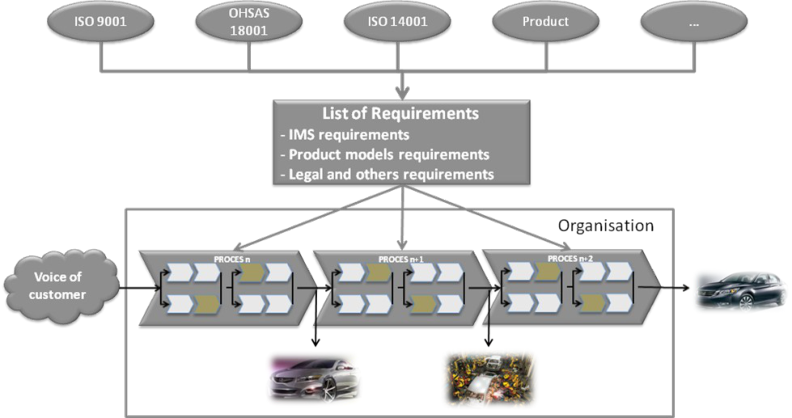
Every organization, regardless of the subject of its activity, makes an effort to meet their customer’s requirements related to the products they offer. Only satisfied customers can help the company to generate profit, and profit is an important factor for the further development of the organization. The organization’s development can involve for example investing in employees by creating ergonomic and safe workplaces and social environment, developing their skills, investment in the development of production facilities and last but not least, product innovation. This can be achieved by quality management in the product creation phase, which is an integral part of the overall management within an organization. Various approaches are used to promote quality management in practice, such as Lean, Kaizen, Six-Sigma, alongside with integrated management systems according to standards ISO 9001, OHSAS 18001, ISO 14001, etc. The utilization of the integrated management system in practice is not limited to implementing the quality requirements; it also includes proactive management of occupational safety and health and other management system requirements. The core of the integrated system is formed by the requirements of all the constituent management systems in the organization of the as well as specific requirements arising from the product characteristics, which must be jointly managed and linked to processes in the organization (see Figure 1). Therefore, it is important for an organization to effectively transform these requirements into product characteristics. It involves responding timely to any changes in these requirements and thus preventing misunderstandings and subsequent losses / increased costs.
Physical Ergonomics I (2018)
Figure 1. System of Requirements
ORGANIZATIONAL CULTURE IN THE INTEGRATED MANAGEMENT SYSTEM
By integrating the Quality Management System (QMS) and the Occupational Health and Safety Management System (OH&SMS), an organization wants to demonstrate its commitments to customers, as well as employees, in the context of sustainable development. Given the historical development of management concepts, structure of standards, accountability of senior management and organizational culture, there is a high degree of integration of these systems. This means interlinking the customer-oriented and employee-oriented systems into a single unit, which is related to the fulfillment of objectives based on the common policy.
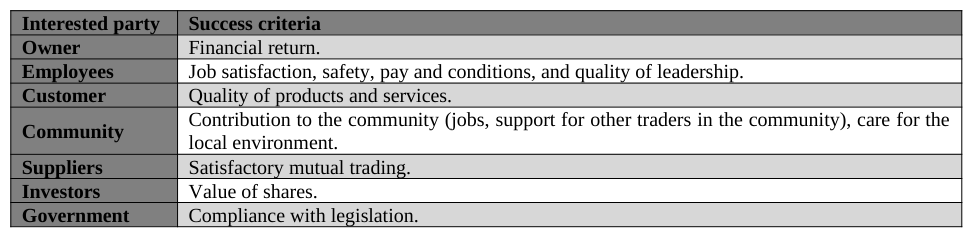
Organizational culture and policy At present, the application of new management systems and procedures frequently uses the term "culture". The word has its origin in Latin and refers to the sum of material and spiritual results of human activity. The term "safety culture" summarizes all human activities that create conditions for safe work and safe life in the man-machine- environment system. The culture of quality involves the creation of conditions for the formation of products whose final characteristics meet the requirements of all parties involved (see Table 1).
Table 1: Criteria used by interested parties to judge organization effectiveness or success Interested party Success criteria Owner Financial return. Employees Job satisfaction, safety, pay and conditions, and quality of leadership. Customer Quality of products and services.
Physical Ergonomics I (2018)
The prerequisite for the implementation of safety or quality culture is the creation of conditions in which occupational health and safety (part of the production procedure) is understood as a common task for the employer and employees at all levels of organization. The acceptance of this principle ought to be conditioned by the fact that occupational health has to be an integral part of the policy of any organization in ensuring product quality. Organization policy, which is a strategic document for the organization management, should be a proof of it. The policy must define a framework for setting objectives.
The integrated management system policy has to:
be appropriate to the purpose, all activities and the organization's own ability to fulfill this policy,
include a commitment to comply with the requirements of the integrated system, including the relevant legislative and other requirements to which the organization has made commitments,
include a commitment to continual improvement,
be published and understood by all employees,
be reviewed for at regular intervals to ensure its validity and applicability.
Organizational culture, planning and objectives The organization culture leads the senior management to defining a characteristic motto that captures the idea of its culture. Common mottos in industrial practice include “Safety first” (typical for steelworks operating in Slovakia) or “Quality is not a coincidence” (manufacturer of rubber belts for tracked vehicles). The focus on safety should be included in the objectives of all decisions made at the planning stage, whether it involves planning the introduction of new technology and complex devices, or various kinds of activities (e.g. Sinay and Markulik, 2012). In order to achieve this goal, it is necessary to pay attention to all components of the man-machine-environment system. Neglect of one component causes system imbalance, and, upon occurrence of an adverse event, also the interruption of the production process or activity. The consequences of such interruption affect all system components. Therefore, the organization’s progress requires proper planning, which is a part of Deming’s famous PDCA cycle. Senior management must ensure as early as in the planning phase that objectives necessary to meet the requirements (e.g. legislative) on the product will be developed and available for the relevant staff.
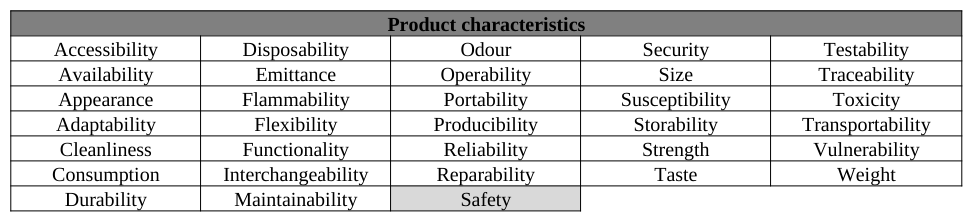
Product characteristics in the relationship between safety and quality ISO 9000 defines quality as “degree to which a set of inherent characteristics fulfils requirement”. One of basic and necessary characteristics of a product is its safety (see Table 2). In order to increase the safety of a product, it is necessary to apply the latest science and technology knowledge.
Table 2: Product characteristics
Physical Ergonomics I (2018)
ISO 9001 and in automotive industry in ISO/TS 16949. When the value of these characteristics is quantified or qualified, they are termed product requirements. We used to use the term quality requirements but this caused a division in thinking that resulted in people regarding quality requirements as the domain of the quality personnel and technical requirements being the domain of the technical personnel.
All requirements are quality requirements – they express needs or expectations that are intended to be fulfilled by a process output that possesses inherent characteristics.
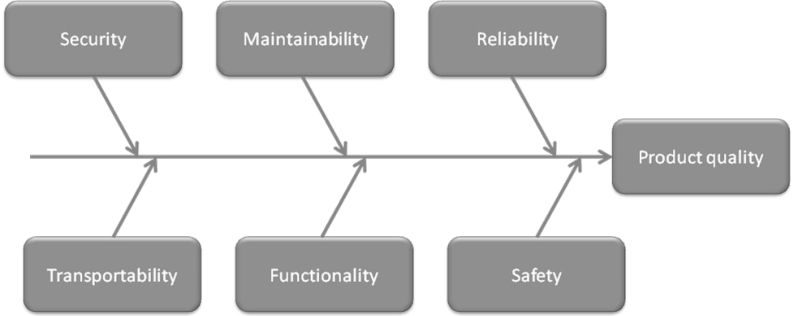
Quality – safety – reliability Quality is thought to be a non-time dependent characteristic and reliability a time-dependent characteristic. Quality is thought of as conformance to specification regardless of whether the specification actually meets the needs of the customer or society. If a product or service is unreliable, it is clearly unfit for use and therefore of poor quality. If a product is reliable but emits toxic fumes, is too heavy or not transportable when required to be, it is of poor quality. Similarly, if a product is unsafe it is of poor quality even though it may meet its specification in other ways. In such a case the specification is not a true reflection of customer needs.
For example: A nuclear plant may meet all the specified safety requirements but if society demands greater safety standards, the plant is not meeting the requirements of society, even though it meets the immediate customer requirements. You therefore need to identify the interested parties in order to determine the characteristics that need to be satisfied. The needs of all these parties have to be satisfied in order for quality to be achieved. But you can say, “This is a quality product as far as my customer is concerned” (see Figure 2).
Figure 2. Determinants of product quality
Physical Ergonomics I (2018)
How is workplace safety related to product quality? What is higher priority – product quality, including its safety features, or safe working environment? Is it indeed the sole interest of the organization’s management to have no (serious) accidents at work, or is a deeper thought behind it? These are the questions that experts in the field of industrial management are currently dealing with, in order to achieve the highest prosperity of the organization and ensure sustainable development as part of its culture. An organization with an integrated management system must determine, provide and maintain the infrastructure needed to achieve its objectives, ensuring the product compliance, the safety of workers with regard to environmental protection. This includes buildings, machinery and equipment, work areas and support services such as logistics and communications. The organization has to determine and manage the work environment in which employees can work effectively. Failure to follow these terms may result in non-compliance of the product, delivery delays, accidents or damage to the environment.
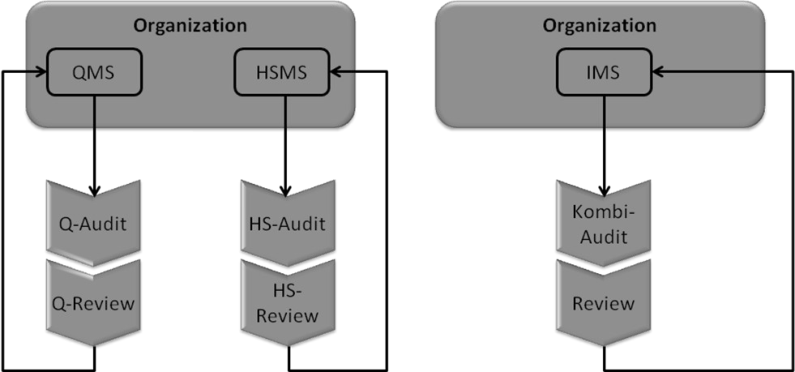
Product quality is a priority objective of any organization, as it covers all requirements for the product (listed in Tab. 2). The use of effective methods for achieving the goal requires constant checking of the compliance with these parameters using a combined audit, often referred to as an integrated audit (see Fig. 3).
Figure 3. Audits integration
Physical Ergonomics I (2018)
Based on the abovementioned definition of quality, product quality can be perceived as a set of characteristics (see Tab. 2).
Generally, these characteristics can be divided into subsets of quality characteristics and characteristics of safety and reliability throughout the product lifecycle (see Fig. 4).
Figure 4. New product development parameters in product life cycle In terms of management approach, the balance between the principles of quality culture within the managerial activities and the principles of safety culture is one of the key principles in the context of integrated management systems or increasingly used methods of generic management (e.g. Winzer and Sinay, 2009). Underestimation or neglect of the application of the principles of safety culture in the workplace is inconsistent with efforts to ensure effective implementation of activities under the Quality Management Systems – compliance with the principles of the culture of quality.
Figure available in the original PDF paper.
Physical Ergonomics I (2018)
Mastering the attributes of safety culture and quality culture in the management of an organization results in the awareness of the following facts:
health and safety at work, safety of technical systems and the quality of production must be a part of the overall development strategy of the organization, which is a tool for increasing its prosperity,
prevention must be a priority (in its broad sense), which must be integrated into all activities of the integrated management system,
responsibilities under health and safety at work, safety of technical systems and product quality must be clearly and unambiguously defined,
health and safety at work, safety of technical systems and the quality of production must be a matter for all employees of the organization, starting with the management of the organization,
the principles of continuous improvement must be applied, as part of risk and quality management,
the concept of non-compliance must bear the same meaning within the entire organization in the field of quality and safety (other terms may also be used in the field of safety, such as accident, injury, damage, etc.).
CONCLUSIONS
The objective of an organization is to provide high-quality products, which means compliance with all the legal requirements and customer requirements. That is why the organization has to establish, implement and maintain procedures to identify and incorporate these requirements into future product characteristics. Well implemented and maintained integrated management system can be a useful tool in meeting these requirements. In today’s competitive environment, a high-quality product means not only meeting the requirements on the product itself, but also the timeliness of its delivery and competitive price. Product delivery time is often a decisive criterion for the customer. The supplier of the product should implement an integrated management system that will prevent the occurrence of adverse situation causing increased risk of workplace accidents, machine failures or nonconforming products. This may be caused by the imbalance of load in the man-machine-environment system.
Acknowledgement
This contribution is the result of the project Research into integrated risk research into new and newly emerging risks related to industrial technologies within integrated safety as a precondition for management of sustainable development, No. APVV-0337-11, and the project Research into the process of management of risks related to machines and technical systems in the safety and security interface, VEGA No. 1/0107/12.
REFERENCES
Hoyle, D. (2005), “Automotive Quality Systems Handbook: Incorporating ISO/TS 16949:2002. Second edition 2005”. ISBN 0- 7506-6663-3. Pardy, W., Andrews, T. (2010), “Integrated management systems: Leading Strategies and Solutions” ISBN 978-0-86687-196-0. Prístavka M., Hrubec J., Bujna M., Kotorová M., (2011) “Quality control in production processes” In: Toyotarity. Control in
Organizations. Dnipropetrovsk: Yurii V. Makovetsky, 2011. ISBN 978-966-1507-76-9, s. 121-129. Sinay, J., Markulik, Š. (2012), “Môže byť kultúra kvality a kultúra bezpečnosti podmienkou prosperujúcej spoločnosti?” Kosice, ISSN 1803-9138 Sinay, J., Kamenicky, L. (2013), “Bezpečnosť a kvalita produkcie – predpoklad pre integráciu v rámci manažérskych systémov”
Ostrava. ISBN 978-80-02-02463-7 Škůrková, K., Šesták, M. (2009), “The capacity of turning process by screws production” In: Production engineering.
Novosibirsk : Novosibirsk State Technical University, S.49-56, ISBN 978-5-7782-1165-0. Thiele, J. (2007), “Entwickulng, Erprobung, Evaluierung und dauerhafte Etablierung eines forderungsgerechten integreirten Managementsystems“ Shaker Verlag, Aachen, ISBN 978-3-8322-6345-4 Winzer, P., Sinay, J. (2009), “From Integrated Management System towards Generic Management Systems – Approaches from
Slovakia and Germany” Shaker Verlag, Aachen/BRD, ISBN 978-3-8322-8508-1
Physical Ergonomics I (2018)
LISTED IN THE AHFE DIGITAL BOOKSTORE CATALOGUE
Explore the complete digital volume
Advances in Physical Ergonomics and Human Factors: Part I
Read this individual research paper free through the original publisher, or explore the full digital proceedings book.
ISBN 978-1-4951-2104-3
Explore this ISBN in the AHFE Bookstore ↗Listed in the July 2026 bookstore catalogue; search by ISBN to confirm current availability · Digital book purchase optional