Debra Henneberry, Dimitrios Ziakkas, Stephanie Brown (2024). How Wearable Technologies Enhance the Implementation of Peer Support Programs in Aviation Training. In: Human Factors in Design, Engineering, and Computing. AHFE Open Access, vol. 159, pp. 1585–1593. https://doi.org/10.54941/ahfe1005726
Integrating wearable technologies and affective computing into aviation training presents a promising avenue for enhancing Peer Support Programs (PSPs), a critical component in promoting pilots' and aircrew's mental health and well-being. PSPs have traditionally offered emotional and psychological support to aviation professionals, fostering a culture of mutual care and intervention. However, traditional PSPs face challenges in real-time monitoring and early detection of stress, fatigue, and emotional distress. Wearable technologies, such as biometric sensors, smartwatches, and EEG headsets, combined with social and affective computing, provide a novel approach to addressing these limitations by enabling continuous, real-time assessment of physiological indicators linked to emotional and cognitive states.This paper explores how wearable technologies can augment the effectiveness of PSPs by offering several key advantages. First, real-time monitoring through wearables allows for early detection of mental health challenges, enabling timely peer or professional intervention. Second, the data collected from wearable devices can be used to create personalized mental health profiles, allowing for more targeted support tailored to trainees' individual needs. Third, affective computing enhances peer interactions by analyzing emotional states in real time, fostering empathy, and improving group dynamics during training sessions. Fourth, wearable technologies provide real-time feedback to trainees on their emotional and cognitive states, helping them develop self-awareness and emotional regulation skills, which are crucial for high-stress aviation environments.Furthermore, integrating wearable technologies into PSPs supports a broader safety and mental well-being culture in aviation. By normalizing the use of such technologies in training, the industry can reduce the stigma surrounding mental health monitoring and encourage open discussions about psychological resilience. The paper also addresses ethical concerns about data privacy and consent, proposing best practices for handling sensitive biometric and emotional data in aviation training contexts.Based on the literature review, wearable technologies and affective computing offer significant potential to transform PSPs in aviation training. This approach provides a proactive, data-driven approach to supporting the mental and emotional well-being of aviation professionals. This integration not only enhances individual well-being but also contributes to overall aviation safety by ensuring that pilots and crew members are mentally and emotionally prepared for the demands of their roles.The presented research examines how Europe has proactively explored wearable technologies to enhance PSPs. This is partly due to EASA’s comprehensive safety management system requirements, which encourage innovation in mental health support. In the U.S., while there is growing interest in using technology to monitor pilot well-being, regulatory and cultural challenges have slowed the widespread adoption of wearables in PSPs. In both the U.S. and Europe, these technologies can:1. Improve Early Detection: Wearables can help detect signs of stress, fatigue, and emotional distress earlier than traditional PSP methods, allowing for more effective peer support interventions.2. Facilitate Personalized Support: The data collected can be used to create personalized mental health profiles, enabling more tailored support for pilots and crew members.3. Enhance Training and Performance: Real-time feedback on emotional states during training sessions can help pilots develop better emotional regulation and resilience, ultimately improving performance in high-stress environments.Finally, implementing wearable technologies in PSPs requires careful consideration of ethical and privacy concerns. In Europe, robust data protection laws like GDPR provide a model for how sensitive health data can be handled responsibly, balancing privacy with the benefits of real-time monitoring. In the U.S., the lack of a unified regulatory framework presents challenges, but the growing emphasis on safety and well-being in aviation could drive further adoption of these technologies.In conclusion, this paper examines how Wearable Technologies Enhance the Implementation of Peer Support Programs in Aviation Training, following the ICAO ADDIE approach in the USA and Europe.
The aviation industry is characterized by its high-stakes environment, where safety, precision, and performance are paramount. Pilots are subject to significant physical and mental demands, which makes maintaining their well-being a critical component of overall operational safety. In recent years, peer support programs have become integral to ensuring pilots’ mental health. These programs, which provide a structured system for emotional and psychological support, have proven effective in helping pilots manage stress, fatigue, and other mental health challenges that can arise from the high-pressure nature of their work. However, traditional peer support programs often rely on periodic check-ins, self-reporting, and anecdotal evidence to gauge pilot well-being. While helpful, these methods have inherent limitations, such as the inability to provide real-time insights into a pilot’s mental or physical state (Harris, 2017). As aviation technology advances, there is increasing interest in leveraging wearable technologies to overcome these limitations and improve the effectiveness of peer support programs. Wearables, such as biometric sensors and augmented reality (AR) devices, continuously monitor physiological indicators, such as heart rate, stress levels, and fatigue, allowing for more timely and personalized interventions. Despite the significant potential of wearable technologies to enhance peer support programs, notable challenges related to their integration into aviation training exist. Regulatory bodies, such as the Federal Aviation Administration (FAA) in the United States and the European Union Aviation Safety Agency (EASA) in Europe, play critical roles in determining how these technologies can be implemented. The FAA, in particular, has adopted a cautious approach, primarily due to concerns about privacy, data security, and pilot consent. In contrast, EASA has been more progressive in exploring the use of wearables and Artificial Intelligence (AI) to improve pilot safety and well-being (EASA, 2021).
This paper seeks to address the following key questions:
How can wearable technologies be integrated effectively into peer support programs within aviation training environments?
What role does Artificial Intelligence (AI) play in enhancing the capabilities of these wearables to support pilots’ mental health and well-being?
How do the regulatory approaches of the FAA and EASA differ regarding their support for using wearable technologies in peer support programs?
The mental health and well-being of pilots have garnered increasing attention in recent years, with several high-profile incidents highlighting the need for better support systems within the aviation industry. Peer support programs have emerged as a key solution to this challenge, providing pilots access to confidential emotional and psychological assistance. However, the success of these programs depends largely on their ability to identify and address mental health issues early, before they escalate into more severe
How Wearable Technologies Enhance the Implementation of Peer Support Programs 1587
problems. This is where wearable technologies can make a significant difference.
Wearables offer a non-invasive means of collecting real-time data on pilots’ physiological and psychological states. Devices such as smartwatches, biometric sensors, and AR headsets can track a range of metrics, from heart rate variability (HRV) to cognitive load, providing valuable insights into a pilot’s stress levels and overall mental health (Alreshidi et al., 2024). Coupled with AI, which can analyze these data points in real-time, wearable technologies promise to transform peer support programs by making them more proactive, responsive, and personalized.
This research addresses a critical gap in the current aviation safety model by exploring wearable technologies within the framework of peer support programs. While traditional peer support programs are reactive, wearable technologies allow for continuous monitoring and early detection of potential issues, enabling peer support teams to intervene before mental health challenges impact a pilot’s performance or safety.
The primary objective of this paper is to examine how wearable technologies, integrated with AI, can enhance the implementation of peer support programs in aviation training. The study will also compare the regulatory environments of the FAA and EASA, focusing on understanding how their differing approaches influence the adoption of wearable technologies. In detail, the research objectives are:
To assess the current state of wearable technology integration in aviation training and peer support programs.
To explore the potential of AI-driven analytics in enhancing the functionality of wearable technologies within these programs.
To conduct a comparative analysis of FAA and EASA’s regulatory frameworks, highlighting the opportunities and challenges of wearable technology implementation in aviation.
To provide recommendations on how wearable technologies can be safely and effectively integrated into peer support programs under both FAA and EASA guidelines.
This study explores real-world examples and case studies of airlines or aviation training centers implementing wearable technologies. These case studies will provide empirical evidence of how wearables can enhance peer support and improve pilot well-being. By analyzing the technological and regulatory aspects of wearable technology integration, this study aims to provide a comprehensive overview of the current state of innovation in this area and the potential for future advancements.
METHODOLOGY
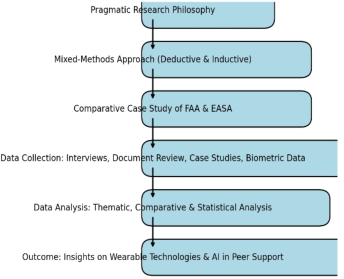
This study primarily adopts a deductive approach, testing hypotheses based on existing theories and regulatory frameworks regarding peer support programs, AI, and wearable technologies in aviation training. Additionally, an inductive element is incorporated through collecting and analyzing qualitative data from interviews with aviation experts, trainers, and regulatory stakeholders, allowing for new insights or modifications to existing theories. Moreover, a comparative case study strategy is employed
1588 Henneberry and Ziakkas
to analyze and compare the implementation of wearable technologies in peer support programs across two regulatory bodies: the FAA and EASA. Case studies from aviation training centers or airlines utilizing wearable technologies were examined, focusing on their peer support programs’ structure, challenges, and outcomes. The mixed-methods approach is appropriate for this study, as it integrates qualitative and quantitative data. Qualitative data from interviews and regulatory documents will provide in-depth insights into the implementation challenges and opportunities for wearable technologies in aviation. Quantitative data, such as the biometric outputs from wearables and mental health assessments, will support the analysis of the technology’s effectiveness in peer support programs. The research follows a cross-sectional time horizon, collecting data from various sources at a single point in time (Saunders, 2019). This time frame aligns with the study’s focus on understanding the current state of wearable technology integration in peer support programs within the confines of the FAA and EASA’s present-day regulatory frameworks.
Regulatory documents, white papers, and industry reports from FAA and EASA were analyzed to understand the legal frameworks and the extent of support for wearables and AI in aviation peer support programs.
Semi-structured interviews will be conducted with aviation safety experts, training officers, airline managers, and peer support coordinators. These interviews will provide qualitative data on the perceived benefits and challenges of wearable technologies and AI in supporting pilot mental health and well-being. A sample size of 10–15 individuals from airlines operating under both FAA and EASA regulations will be targeted.
A thematic analysis will be performed on the interview data, identifying common themes related to the benefits, challenges, and regulatory issues surrounding wearable technologies in aviation training. Moreover, descriptive statistics will be used to analyze biometric data, focusing on heart rate variability, stress recovery rates, and cognitive performance. A comparative analysis between the FAA and EASA will focus on how these regulatory bodies support or restrict the integration of wearables and AI in peer support programs based on the previous research steps. This analysis will explore the impact of wearable devices on reducing stress and fatigue among pilots. A presentation of the research methodology is presented in Figure 1.
ANALYSIS The analysis section delves deeper into how wearable technologies, integrated with Artificial Intelligence, are applied in aviation training, especially within peer support programs, and compares their implementation within the regulatory frameworks of the Federal Aviation Administration and the European Union Aviation Safety Agency. This section is structured into three parts:
Wearable Technologies in Aviation Training
Comparative Analysis of FAA and EASA Approaches
AI-Driven Enhancements to Peer Support Programs
How Wearable Technologies Enhance the Implementation of Peer Support Programs 1589
Figure 1: Research methodology presentation following the research onion approach (Ziakkas et al., 2024).
Wearable Technologies in Aviation Training Wearable technologies, such as smartwatches, biometric sensors, augmented reality headsets, and AI-enhanced devices, are increasingly being adopted in aviation training. These wearables provide real-time data on physical and mental health markers, cognitive load, and pilot performance, enabling trainers and peer support programs to monitor and assess pilot well-being more effectively.
Based on the literature review, we focus on the following types of Wearable Technologies:
Biometric Sensors: Smartwatches, chest straps, and biometric wristbands track physiological markers such as heart rate, heart rate variability, skin conductance, and sleep quality. These metrics are closely associated with a pilot’s stress levels, fatigue, and overall mental health. In peer support programs, continuously monitoring these markers allows for early detection of stress or fatigue, prompting timely interventions.
Smart Glasses and AR Devices: Augmented Reality devices such as smart glasses are being used to provide pilots with immersive training experiences. These devices overlay digital information in real time, allowing pilots to interact with virtual elements during flight simulations. Such devices are also being explored in peer support programs to offer real-time feedback on cognitive performance and mental load during stressful scenarios (Ziakkas et al., 2023b).
Wearable Electroencephalography (EEG) Sensors: Wearable EEG headbands monitor brain activity and cognitive load, providing insights into a pilot’s mental fatigue and cognitive performance. These sensors are particularly useful when decision-making and cognitive performance are critical in high-stress situations.
1590 Henneberry and Ziakkas
Impact of Wearable Technologies on Peer Support Programs: Wearables allow peer support teams to monitor pilots’ physiological and psychological states in real time. Stress levels, fatigue, and mental well-being can be tracked continuously, providing a more accurate picture of a pilot’s health than traditional self-reporting methods (Canali et al., 2024). The data collected by wearables enable peer support programs to offer personalized interventions. For example, if a pilot’s biometric data indicates elevated stress levels, peer support counselors can intervene with tailored stress management techniques or adjust flight schedules to allow more rest. AI-driven predictive models use wearable data to anticipate when a pilot may be at risk of mental health issues, such as burnout or excessive fatigue. Peer support programs can proactively address these concerns before they escalate into more severe problems.
Comparative Analysis of FAA and EASA Approaches The FAA and EASA are the two primary aviation safety regulators in the United States and Europe. Their approaches to integrating wearable technologies and AI in peer support programs differ due to variations in regulatory frameworks, technological readiness, and privacy concerns. This section compares the two agencies’ strategies and their impact on the implementation of wearables in aviation peer support.
FAA (Federal Aviation Administration) The FAA tends to adopt a more cautious stance toward integrating wearable technologies and AI, particularly concerning privacy, data security, and pilot consent. While the FAA has recognized the value of peer support programs for mental health, it has not yet fully embraced wearable technology as part of standard aviation training. Privacy is also a significant concern for the FAA. The collection and use of biometric data from wearables may raise questions about data ownership, privacy, and how this information is used by airlines or regulatory bodies. As such, the FAA requires strict data protection and transparency protocols before such technologies are widely adopted. While the FAA has not yet fully implemented wearable technology across the aviation industry, pilot programs have been conducted in collaboration with private airlines to test the efficacy of wearables in training environments. These trials have been limited in scope and are still experimental (FAA, 2020).
EASA (European Union Aviation Safety Agency): EASA has been more proactive in incorporating wearable technologies into aviation training and peer support programs. The agency’s Data4Safety initiative, launched in 2018, actively explores using data-driven technologies, including wearables, to enhance aviation safety and training. EASA’s Data4Safety program promotes the collection of large-scale, anonymized data from wearable devices to improve aviation safety (EASA, 2021). This initiative enables wearables to monitor pilot health, fatigue, and cognitive performance, feeding into real-time safety protocols and training adjustments. Furthermore, EASA has been more open to integrating mental
How Wearable Technologies Enhance the Implementation of Peer Support Programs 1591
health and well-being into its regulatory framework, recognizing that wearables can provide critical insights into pilot stress and fatigue. EASA’s support for wearable technology aligns with its broader emphasis on human factors in aviation safety.
AI-Driven Enhancements to Peer Support Programs Artificial Intelligence plays a significant role in enhancing the capabilities of wearable technologies in aviation peer support programs. AI allows for real-time analysis of wearable data, enabling quick, data-driven decisions that can positively impact pilot training, performance, and mental health. Nowadays, AI systems can process biometric data from wearables in real time, identifying patterns that suggest high-stress levels, fatigue, or potential cognitive overload. This real-time analysis allows peer support teams to intervene quickly, providing pilots with immediate assistance or adjusting their training schedules to prevent burnout. AI algorithms analyze data from EEG sensors, heart rate monitors, and other wearable devices to assess cognitive load. When pilots experience high mental fatigue, AI systems can recommend rest periods or cognitive training exercises that help restore optimal performance levels. AddAI-powered predictive models use historical biometric data to predict when a pilot may be at risk of stress or fatigue. For example, if a pilot’s wearable data consistently increases heart rate variability during night flights, the system can flag the need for peer support intervention or an adjusted flight schedule. AI systems use data from wearables to customize training programs based on individual pilot performance. By continuously monitoring stress, cognitive load, and fatigue, AI can tailor training regimens to enhance a pilot’s strengths and address areas of weakness, improving overall safety and effectiveness (Ziakkas et al., 2023a).
Ethical and Privacy Considerations While AI offers significant benefits, it raises ethical questions concerning pilot privacy. Both FAA and EASA will need to address issues related to data ownership, consent, and the extent to which wearable data can be used for training or regulatory purposes.
FINDINGS The findings of this research explore how wearable technologies and AI enhance the implementation of peer support programs in aviation training, and they highlight the differences in regulatory approaches between the Federal Aviation Administration (FAA) and the European Union Aviation Safety Agency (EASA). One of the most significant findings of this research is the ability of wearable technologies to continuously collect and provide real- time data on pilots’ physiological and psychological states. These devices can monitor critical health markers such as heart rate variability (HRV), skin conductance, stress levels, and sleep patterns, all of which are important indicators of a pilot’s readiness to perform, cognitive health, and overall well-being. Artificial Intelligence (AI) plays a critical role in processing and
1592 Henneberry and Ziakkas
analyzing the data collected from wearables. Through machine learning and predictive algorithms, AI systems can forecast when a pilot might experience high stress or fatigue levels, allowing peer support teams to take preventive measures (Ziakkas et al., 2022). The FAA’s regulatory framework prioritizes pilot autonomy, requiring all data collection through wearables to be consensual. While important, this focus on privacy protection has slowed the broader adoption of wearable technologies in peer support programs. Wearables are considered an additional layer of health monitoring rather than an integral part of the safety and mental health framework. EASA’s regulatory framework strongly emphasizes mental health as part of its broader focus on human factors in aviation safety. Wearables are seen not only as a tool for monitoring physical health but also as a key component in supporting mental well-being and preventing burnout. EASA has fully integrated these technologies into peer support programs, enabling more proactive interventions based on real-time health data.
The following table (Table 1) summarizes the research findings.
Table 1. Comparison of FAA – EASA peer support programs in aviation training (Ziakkas et al., 2024).
Table available in the original PDF paper.
Aspect FAA EASA Regulatory Approach Cautious, with concerns about privacy and data security Proactive, promotes data-driven safety initiatives such as Data4Safety Adoption of Wearables
Strong emphasis on pilot privacy and data ownership
Limited pilot programs Actively incorporates wearables into safety and training frameworks Focus on Privacy
Emphasizes anonymized, large-scale data collection for safety improvements Mental Health Focus
Recognizes mental health importance but slow to integrate wearables AI is still being explored in limited pilot programs
Actively integrates mental health and well-being into the regulatory framework AI Integration
AI is actively used to analyze wearable data for predictive analytics
CONCLUSION
Wearable technologies and AI present a transformative opportunity to enhance peer support programs in aviation training, providing real-time, data-driven insights into pilot well-being. While regulatory challenges and ethical concerns remain, particularly concerning privacy and data security, the potential benefits for pilot mental health and operational safety are undeniable. As the aviation industry continues to evolve, the successful integration of these technologies will require collaboration between regulatory bodies, airlines, and technology providers to ensure that the full potential of wearables and AI can be realized safely and ethically.
How Wearable Technologies Enhance the Implementation of Peer Support Programs 1593
ACKNOWLEDGMENT
The authors thank faculty members of Purdue University and Human Factors analysts from HF Horizons for their invaluable feedback and contribution to this work.
REFERENCES
Alreshidi, I, Moulitsas, I & Jenkins, KW. 2024. Advancing aviation safety through machine learning and psychophysiological data: A systematic review. IEEE Access 12:5132–5150. https://doi.org/10.1109/access.2024.3349495. Canali, S, Schiaffonati, V & Aliverti, A. 2022. Challenges and recommendations for
wearable devices in digital health: Data quality, interoperability, health equity, fairness. PLOS Digital Health 1(10): e0000104. https://doi.org/10.1371/journal. pdig.0000104. European Union Aviation Safety Agency (EASA) (2021) Digitalisation and data analytics in aviation safety management. Available at: https: //www.easa.europa.eu/newsroom-and-events/news/digitalisation-and-data- analytics-aviation-safety-management (Accessed: 9 September 2024). Federal Aviation Administration (FAA) (2020) Guide to cockpit innovations.
Available at: https://www.faa.gov (Accessed: 9 September 2024). Harris, D. 2017. Decision Making in Aviation. Routledge. Saunders, M., Lewis, P., & Thornhill, A. (2019). Research methods for business students Eighth Edition. In Research Methods for Business Students. Pearson Education Limited. Ziakkas, D, Chazapis, S & Plioutsias, A. 2022. Safety climate assessment:
The implementation of psychological fatigue indicators in airline fatigue risk management systems. Transportation Research Procedia 66:26–39. https://doi.or g/10.1016/j.trpro.2022.12.004. Ziakkas, D, Suckow, MW & Pechlivanis, K. 2023a. The artificial intelligence (AI) certification challenges in future single pilot operations (SiPO). AHFE International (January, 1). https://doi.org/10.54941/ahfe1003848. Ziakkas, D., Vink, L.-S., Pechlivanis, K., & Flores, A. (2023b). Implementation guide
for artificial intelligence in aviation: A human-centric guide for practitioners and organizations.
LISTED IN THE AHFE DIGITAL BOOKSTORE CATALOGUE
Explore the complete digital volume
Human Factors in Design, Engineering, and Computing
Read this individual research paper free through the original publisher, or explore the full digital proceedings book.
ISBN 978-1-964867-35-9
Explore this ISBN in the AHFE Bookstore ↗Listed in the July 2026 bookstore catalogue; search by ISBN to confirm current availability · Digital book purchase optional