Daniel Badro, Olayele Adelakun, Xiaowen Fang (2024). What Factors Influence Team Creativity and Innovation?. In: Human Factors in Design, Engineering, and Computing. AHFE Open Access, vol. 159, pp. 2055–2064. https://doi.org/10.54941/ahfe1005773
Extensive research has been conducted on team creativity and innovation. Past research has allowed for scholars to gain a better understanding of the various factors that influence team creativity and innovation. There are different factors that influence team creativity and innovation. Mittone et al. [1] list risk preferences, past performances, and the consequences of failing to innovate as factors that influence creativity. Burpitt et al. [2] mention that leader empowering behavior is a factor that influences innovation. Past research has been unable to present and illustrate the various relationships between the factors listed above. The gap in knowledge lies wherein researchers have not yet identified the relationships between the factors and how these relationships influence team creativity and innovation. The research problem revolves around the need to identify and illustrate the relationships between the various factors that influence team creativity and innovation. The objective of this research is to formulate a method by which these factors can be presented. A cohesive framework, about team creativity and innovation, will be established. This framework will consist of the various relationships between the factors and how these factors influence one another. This framework was inspired by the components of creative performance proposed by Amabile [3]. In this framework, motivation, domain knowledge, and problem-solving ability are the three primary factors directly impacting team creativity while they can be affected by organizational influence, team members’ influence, and individual personality. Team Creativity is about how a team can develop original and innovative solutions to a problem. It is directly impacted by motivation, domain knowledge, and problem-solving abilities. It focuses on the idealization while innovation stresses implementation. Resources include resources required in implementing a creative solution in different forms such as materials, technologies, tools, human resources, etc. Implementation process is the actual process in which utility and value are realized. Many creative ideas and solutions can’t be realized due to many different reasons and constraints. Therefore, these ideas do not lead to actual innovations. It is those creative ideas that are fulfilled and become practical innovations. In the innovation stage, team creativity and resources are the two inputs to the implementation process. During the implementation process, utility and value is achieved and inputs are converted into innovation outcomes and results. In addition to the framework posed, the researchers will explore the most important factors underlining team creativity and innovation by eliciting knowledge from innovation experts and industry leaders. To obtain information, we will design a survey that consists of open-ended questions. We will leverage the connections we have in order to obtain information from students in addition to industry professionals that are actively supervising digital innovation projects. These industry professionals can be CIOs, Project Managers, Entrepreneurs, etc. We will strive to ask open-ended questions for each construct in the proposed team creativity and innovation framework. An example question can be “based on your experience, what are the most important issues in organizational influence that has impacted team creativity and innovation?”[1] Mittone, L., Morreale, A., Vu, T. What Drives Innovative Behavior? An Experimental Analysis on Risk Attitudes, Creativity, and Performance. Journal of Behavioral and Experimental Economics, 98. 2022.[2] Burpitt, W.J., Bigoness, W.J. Leadership and Innovation Among Teams: The Impact of Empowerment. Small Group Research, 28(3), 414-423. 1997.[3] Amabile, T.M. The social psychology of creativity: A componential conceptualization. Journal of Personality and Social Psychology, 45(2), 357-376. 1983.
Extensive research has been conducted on team creativity and innovation. Past research has allowed for scholars to gain a better understanding of the various factors that influence team creativity and innovation. There are different factors that influence team creativity and innovation. Mittone et al. list risk preferences, past performances, and the consequences of failing to innovate as factors that influence creativity. den Hartog et al. point to team variance in extraversion, team variance in agreeableness, and team variance in conscientiousness as factors that influence creativity. Chen et al. allude to the fact that there are certain domains of work that improve creativity. Du et al. conclude that positivity can affect creativity. Oldham et al. argue that skill variety, challenges, task identity, task significance, task feedback, and autonomy predict innovation at work. Burpitt et al. mention that leader empowering behavior is a factor that influences innovation. Ramirez et al. conclude that mutual trust, open exchange, regular contact, democracy, attendance, and team management influence innovation. Schumpeter et al. argue that team members’ influence has the ability to impact team creativity and innovation. It refers to the method by which team communication and interactions occur. Baer states that an individual personality is a variable that can impact team creativity and innovation. Caldwell et al. emphasize the importance of domain knowledge within team creativity and innovation. However, the research conducted does consist of limitations. Past research
has been unable to present and illustrate the various relationships between the factors listed above. The gap in knowledge lies wherein researchers have not yet identified the relationships between the factors and how these relationships influence team creativity and innovation. The research problem revolves around the need to identify and illustrate the relationships between the various factors that influence team creativity and innovation. The objective of this research is to formulate a method by which these factors can be presented. A cohesive framework, about team creativity and innovation, will be established. This framework will consist of the various relationships between the factors and how these factors influence one another. In addition to this, the researchers will explore the most important factors underlining team creativity and innovation by eliciting knowledge from innovation experts and industry leaders. This paper is organized to present the readers with a literature review. Within this literature review, the subsections of team creativity, innovation, and other factors that influence team creativity and innovation are discussed. The subsequent sections consist of the research framework, the research methodology, and the conclusion as well as the next steps.
RESEARCH METHOD One of the goals of this research is to elicit valuable practical knowledge from experts. To obtain information, we will design a survey that consists of open- ended questions. We will leverage the connections we have in order to obtain information from students in addition to industry professionals that are actively supervising digital innovation projects. These industry professionals can be CIOs, Project Managers, Entrepreneurs, etc. We will strive to ask open-ended questions for each construct in the proposed team creativity and innovation framework. An example question can be “based on your experience, what are the most important issues in organizational influence that has impacted team creativity and innovation?
LITERATURE REVIEW
Team Creativity Creativity allows for the visualization, imagination, and reconstruction of certain events regardless of past, present, or future. Guilford defines creativity in terms of two criteria: novelty and adaptability. The creative person must be novel in their approach and adaptable to various situations. Madjar et al. allude to creativity as the production of new and useful ideas. Scholars argue that it is creativity that allows for the visualization, imagination, and reconstruction of certain events regardless of past, present, or future. There is a fundamental difference between individual creativity and team creativity. Bharadwaj et al. find that individual creativity refers to activities undertaken by individual employees within an organization to enhance their capability for developing something meaningful and novel within their work environment. However, Amabile refers to team creativity as the process that involves the production, conceptualization, or development of novel and useful ideas, processes, or procedures by an individual or by a team
What Factors Influence Team Creativity and Innovation? 2057
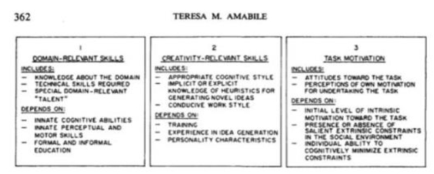
of individuals working together. Shin et al. define team creativity as the production of novel and useful ideas concerning products, services, processes, and procedures by a team of employees working together. Shalley et al. describe team creativity as both process and outcome. As a process, team creativity involves engaging in behaviors and activities that are directed at developing novel solutions that might be effective. As an outcome, team creativity is concerned with whether what the team produces, which can be ideas, solutions, products, or processes, is in itself deemed to be both novel and useful. Carmeli et al. argue that team creativity is the generation of new ideas and valuable solutions that are based on collective efforts and a collaborative exchange of perspectives and information. Bolinger et al. define team creativity as a collective process whereby diverse skills, knowledge, and perceptions of group members are coordinated to produce a product or performance that are both novel and appropriate for its intended purposes. The definitions mentioned in this subsection have been used in previous literature. However, the most common definition used revolves around team creativity being defined as a team working together to turn in to reality novel and useful ideas. It is important to note that there is not an all- purpose definition of team creativity. The definition of team creativity is one that is subjective in nature and depends on the context in which it is being used. In addition to the definitions provided, scholars have also illustrated team creativity through the use of frameworks. Amabile includes three dominant components: domain-relevant skills, creativity-relevant skills, and task motivations. Within each component, specific factors are needed and they are dependent on other factors to be realized.
Figure 1: Amabile’s framework depicting different factors that influence team creativity.
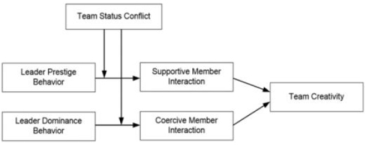
Sung et al. alludes to the notion that team creativity is dependent on team status conflict, leader prestige behavior, leader dominance behavior, supportive member interaction, and coercive member interaction.
Figure 2: Sung’s framework depicting different factors that influence team creativity.
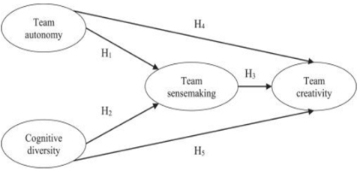
Talat et al. conclude that team creativity is dependent on team autonomy, cognitive diversity, and team sensemaking.
Figure 3: Talat’s framework depicting factors that influence team creativity.
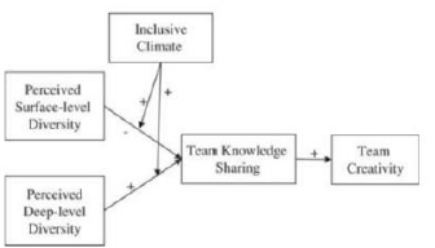
Bodla et al. attribute team creativity to perceived surface-level diversity, perceived deep-level diversity, inclusive climate, and team knowledge sharing.
Figure 4: Bodla’s framework depicting factors that influence team creativity.
Innovation Twiss et al. define innovation as a process that combines science, technology, economics, and management, as it is to achieve novelty and extends from the emergence of the idea to its commercialization in the form of production,
exchange, and consumption. Baregheh et al. describe innovation as the multi-stage process whereby organizations transform ideas into new and improved products, services, and processes in order to advance, compete, and differentiate themselves successfully in their marketplace. Thompson concludes that innovation is the generation, acceptance, and implementation of new ideas, processes, products, or services. West et al. allude to the fact that innovation is the effective application of processes and products new to the organization and designed to benefit it and its stakeholders. Damanpour refers to innovation as a means of changing an organization, either as a response to changes in the external environment or as a pre- emptive action to influence the environment. Innovation encompasses a range of types, including new products or services, new process technologies, new organizational structures, or new plans and programs pertaining to organization members. Reiman et al. describe innovation as the initiating mechanism of new processes or events all while brining changes in behavior, personnel, and approaches. Plessis notes that innovation is the creation of
What Factors Influence Team Creativity and Innovation? 2059
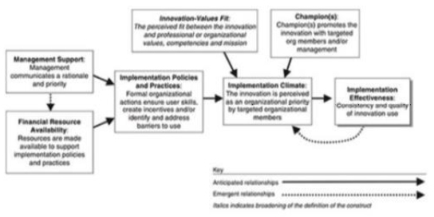
new knowledge and ideas to facilitate new business outcomes, aimed at improving internal business processes and structures and to create market driven products and services. Innovation encompasses both radical and incremental innovation. It is important to note that organizations have had difficulties in the overall conversion of creative ideas into actual innovative products. In addition, the introduction of a creative idea does not always develop from its initial ideation to its conversion. Amabile et al. note that the successful creation of new products, new services, or new business practices start with and is dependent on a creative idea and developing that idea beyond its initial state. The definitions mentioned in this subsection have been used in previous literature. However, the most common definition used revolves around innovation being defined as the introduction of new and improved products in order to compete within a marketplace. It is important to note that there is not an all-purpose definition of innovation. The definition of innovation is subjective in nature and depends on the context in which it is being used. In addition to definitions provided, scholars have also illustrated innovation through the use of frameworks. Helfrich et al. argue that innovation is dependent on different factors. These factors consist of management support, financial resource availability, implementation policies and practices, value fit, implementation climate, and employees.
Figure 5: Helfrich’s framework depicting factors that influence innovation.
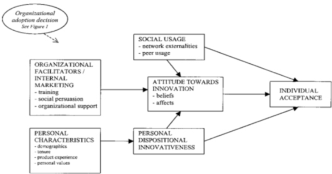
Frambach et al. illustrate the various items that innovation is dependent on. According to the framework, innovation is dependent on organizational facilitators, personal characteristics, personal dispositional innovativeness, attitudes towards innovation, social usage, and individual acceptance.
Figure 6: Frambach’s framework depicting factors that influence innovation.
Other Factors That Influence Team Creativity and Innovation Scholars in the creativity research area have conducted research on the various factors that influence creativity. Schilpzand et al. allude to the notion that variance of openness, regardless of how high or low, influences creativity. Medeiros et al. argue that the more experience one has, the more creative they are likely to be. Oldham et al. conclude that the more complicated the task at hand, the more creative one is likely to be. Somech et al. mention that a team’s functional heterogeneity has a positive correlation with team creativity. Wang et al. conclude that mentorship can improve the overall creativity of someone. Scholars in the innovation area have conducted research on the various factors that influence innovation. Burningham et al. mention that the support for innovation, negotiated vision, and an aim for excellence are the most consistent influencers of innovation. Hendarsjah et al. find that intra-team trust is integral within innovation. Damasceno et al. mention that effective commitment is an important factor in innovation.
The frameworks included in this section do provide some context around team creativity and innovation. In addition, the frameworks also provide various factors that comprise team creativity and innovation. However, the relationships between the factors are missing. The research gap lies wherein researchers have been unable to depict the relationships between the various factors. This research is necessary as it will allow for researchers to understand the various factors that comprise team creativity and innovation and the method by which these factors are interrelated and interconnected.
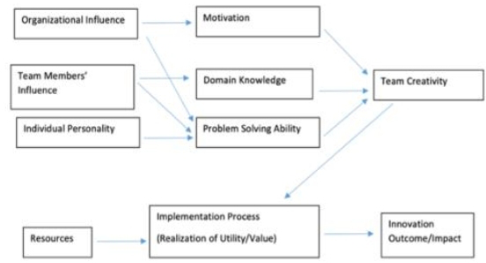
RESEARCH FRAMEWORK A framework about team creativity and innovation is posed in Figure 1 based on prior research on team creativity and innovation. This framework was inspired by the components of creative performance proposed by Amabile. In this framework, motivation, domain knowledge, and problem solving ability are the tree primary factors directly impacting team creativity while they can be affected by organizational influence, team members’ influence, and individual personality. In the innovation stage, team creativity and resources are the two inputs to the implementation process. During the implementation process, utility and value is achieved and inputs are converted into innovation outcomes and results.
Organizational Influence refers to the influence from an organizational environment such as the organizational culture and leadership style. It has been found by many researchers (Damanpour, 1996) that organizational culture and leadership styles play important roles in impacting team creativity and innovation. This construct is proposed to encompass all organizational effects on team creativity and innovation.
Team Members Influence is proposed to represent how team communications and interactions impact team creativity. Many studies (Amabile, 1996, Baer, 2012, Burpitt et al., 1997) have revealed that team dynamics have a direct impact on team creativity and innovation.
Individual Personality plays a key role in individual creativity (Bharadwaj et al., 2000, Chen et al., 2016). However, it is still unclear to researches how
What Factors Influence Team Creativity and Innovation? 2061
exactly different personality traits may be related to difference creativities. Most of them agree that personality is vital to team creativity and innovation.
Problem Solving ability is defined as to what extent a team can devise and implement a solution to a target problem. This is directly impacted by individual personality, organizational influence, and team members’ influence. It is also worth noting that some problem solving abilities can be trained and learned.
Motivation is the desire to accomplish a goal by solving a target problem. It is well known from prior research (Shalley et al., 2018) that task motivation plays a vital role in creativity. Motivation may be impacted by organizational influence.
Domain Knowledge is the specific knowledge needed to solve a problem in a specific domain. This can be learned and trained. In a team environment, members can complement each other in their domain knowledge.
Team Creativity is about how a team can develop original and innovative solutions to a problem. It is directly impacted by motivation, domain knowledge, and problem solving abilities. It focuses on the idealization while innovation stresses implementation. Resources include resources required in implementing a creative solution in different forms such as materials, technologies, tools, human resources, etc.
Implementation process is the actual process in which utility and value are realized. Many creative ideas and solutions can’t be realized due to many different reasons and constraints. Therefore, these ideas do not lead to actual innovations. It is those creative ideas that are actually fulfilled and become practical innovations.
Innovation outcome and impact can be assessed in different ways. While the absolute impact of an innovation is pivotal, the cost effectiveness should also be taken into consideration when evaluating various innovation outcomes. Cost effectiveness may ultimately determine the fate of an innovation. The framework will be depicted as follows:
Figure 7: The researchers proposed framework.
CONCLUSION AND NEXT STEPS A framework on team creativity and innovation is proposed. It provides a panoramic view of the creativity and innovation process. In the next step, a survey with open-ended questions will be conducted to elicit practical knowledge about team creativity and innovation. Outcomes are expected to be invaluable to practitioners and they will also help researchers continue their studies of team creativity and innovation with a solid theoretical foundation.
REFERENCES
Amabile, T. M. (1996) Creativity and Innovation in Organizations. Harvard Business School. Amabile, T. M. (1988) A model of creativity and innovation in organizations.
Research in Organizational Behavior. 10(2), 123–167. Amabile, T. M. (1983) The social psychology of creativity: A componential conceptualization. Journal of Personality and Social Psychology, 45(2), 357–376. Baer, M. (2012) Putting Creativity at Work: The Implementation of Creative Ideas
in Organizations. Academy of Management Journal, 55(5), 1102–1119. Baregheh, A., Rowley, J., Sambrook, S. (2009) Towards a multi-disciplinary definition of innovation. Management Decision, 47(8), 1323–1339. Bharadwaj, S., Menon, A. (2000) Making Innovation Happen in Organizations:
Individual Creativity Mechanisms, Organizational Creativity Mechanisms or Both? Journal of Product Innovation Management, 17, 424–434. Bodla, A., Tang, N., Jiang, W., Tian, L. (2018) Diversity and creativity in crossnational teams: The role of team knowledge sharing and inclusive climate. Journal of Management & Organization, 24(5), 711–729. Bolinger, A. R., Bonner, B. L., Okhuysen, G. A. (2009) Sticking together: the glue role
and group creativity. Creativity in Groups , 267–289. Burningham, C., West, M. A. (1995) Individual, Climate, and Group Interaction Processes as Predictors of Work Team Innovation. Small Group Research , 26(1). Burpitt, W. J., Bigoness, W. J. (1997) Leadership and Innovation Among Teams: The
Impact of Empowerment. Small Group Research, 28(3), 414–423. Caldwell, D. F., O’Reilly, C. A. (2003) The Determinants of Team-Based Innovation in Organizations. The Role of Social Influence. Small Group Research, 34(4), 497–517. Carmeli, A. M., Paulus, P. B. (2015) CEO ideational facilitation leadership and team
creativity: The mediating role of knowledge sharing. Journal of Creative Behavior, 49(1), 53–75. Chen, C., Himsel, A., Kasof, J., Greenberger, E., Dmitrieva, J. (2006) Boundless Creativity: Evidence for the Domain Generality of Individual Differences in Creativity. The Journal of Creative Behavior, 40(3), 179–199. Damanpour, F. (1996) Organizational complexity and innovation: developing and
testing multiple contingency models. Management Science, 42(5), 693–716. Damasceno, R., Dimas, I. D., Lourenço, P. R., Rebelo, T., Alves, M. P. (2021) Building Innovative Teams: Exploring the Positive Contribute of Emotions Expression and Affective Commitment. Frontiers in Psychology, 12. den Hartog, S. C., Runge, J. M., Reindl, G., Lang, J. W. B. (2020) Linking
Personality Trait Variance in Self-Managed Teams to Team Innovation. Small Group Research, 51(2), 265–295.
What Factors Influence Team Creativity and Innovation? 2063
Du, J., Ma, E., Cabrera, V., Mei, J. (2021) Keep Your Mood Up: A Multilevel Investigation of Hospitality Employees Positive Affect and Individual Creativity. Journal of Hospitality and Tourism Management, 48, 451–459. Frambach, R., Schillewaert, N. (2002) Organizational innovation adoption: a multi-
level framework of determinants and opportunities for future research. Journal of Business Research, 55, 163–176. Guilford, J. P. (1950) Creativity. American Psychologist, 5, 444–454. Helfrich, C. D., Weiner, B. J., McKinney, M. M., Miniasian, L. (2007) Determinants of implementation effectiveness: adapting a framework for complex innovations. Med Care Res Rev, 64(3), 273–303. Hendarsjah, H., Susanto, E., Handoko, T. H. (2019) Curvilinear relationship
between intra-team trust and team innovation: The moderating role of task complexity. Journal of Asia Business Studies, 13(3), 472–487. Madjar, N., Oldhman, G. R., Pratt, M. G. (2002) There’s no place like home? The contributions of work and nonwork creativity support to employees’ creative performance. Academy of Management Journal, 45(4), 757–767. Medeiros, K. E., Partlow, P. J., Mumford, M. D. (2014) Not too much, not too
little: The influence of constraints on creative problem solving. Psychology of Aesthetics, Creativity, and the Arts, 8(2), 198–210. Mittone, L., Morreale, A., Vu, T. (2022) What Drives Innovative Behavior? An Experimental Analysis on Risk Attitudes, Creativity, and Performance. Journal of Behavioral and Experimental Economics, 98. Oldham, G. R., Cummings, A. (1996) Employee Creativity: Personal and Contextual
Factors at Work. Academy of Management Journal, 39(3), 607–634. Plessis, M. D. (2007) The role of knowledge management in innovation. Journal of Knowledge Management, 11(4), 20–29. Ramirez, B. H., Berger, R., Brodbeck, C. F. (2014) Does an Adequate Team Climate
for Learning Predict Team Effectiveness and Innovation Potential? A Psychometric Validation of the Team Climate Questionnaire for Learningin an Organizational Context. Procedia – Social and Behavioral Sciences, 114, 543–550. Reiman, A. J., Dotger, B. H. (2008) What does innovation mean for moral educators?
Journal of Moral Education, 37(2), 151–164. Schilpzand, M. C., Herold, D. M., Shalley, C. E. (2010) Members Openness to Experience and Teams Creative Performance. Small Group Research, 42(1). Schumpeter, J. A. (1934) The Theory of Economic Development: An Enquiry into
Profits, Capital, Interest, and the Business Cycle. Oxford University Press. Shalley, E., Litchfield, C., Gilson, L. (2018) 20 Years Later: Team Creativity and Innovation. Team Creativity and Innovation, 129–156. Shin, S. J., Zhou, J. (2007) When is Educational Specialization Heterogeneity Related
to Creativity in Research and Development Teams? Transformational Leadership as a Moderator. Journal of Applied Psychology, 92(6), 1709–1721. Somech, A., Zahavy, A. D. (2011) Translating Team Creativity to Innovation Implementation: The Role of Team Composition and Climate for Innovation. Journal of Management, 39(3). Sung, S. Y., Choi, J. N. (2021) Leader status behaviors and team creativity: The
role of collective interactions and status conflict among members. Journal of Organizational Behavior, 42(8), 1120-1133. Talat, A., Khan, S. N., Chaudary, S., Neale, N. R. (2023) Investigating ICT for team creativity: A team sensemaking perspective. IIMB Management Review, 1–11. Thompson, V. A. (1965) Bureaucracy and Innovation. Administrative Science
Quarterly, 10, 1–20.
Twiss, B., Goodridge M. (1989) Managing Technology for Competitive Advantage: Integrating Technological and Organizational Development: From Strategy to Action. Trans-Atlantic Publications. Van de Ven, A. H. (1986) Central Problems in the Management of Innovation.
Management Science, 32(5), 590–607. Wang, J., Shibayama, S. (2022) Mentorship and creativity: Effects of mentor creativity and mentoring style. Research Policy, 51(3). West, M. A., Anderson, N. R. (1996) Innovation in top management teams. Journal
of Applied Psychology, 81, 680–693.
LISTED IN THE AHFE DIGITAL BOOKSTORE CATALOGUE
Explore the complete digital volume
Human Factors in Design, Engineering, and Computing
Read this individual research paper free through the original publisher, or explore the full digital proceedings book.
ISBN 978-1-964867-35-9
Explore this ISBN in the AHFE Bookstore ↗Listed in the July 2026 bookstore catalogue; search by ISBN to confirm current availability · Digital book purchase optional