Pedro Água, Vítor Conceição (2024). Enabling Factors in Complex Operations. Lessons from Jazz. In: Human Interaction and Emerging Technologies (IHIET 2024). AHFE Open Access, vol. 157, pp. 468–478. https://doi.org/10.54941/ahfe1005506
The contemporary world is facing a multitude of complex problems that are often rooted in the solutions of the past. Despite the ubiquity of systems in human activity, systems thinking and systems sciences are not widely incorporated into mainstream education curriculums. As a result, the lack of comprehensive understanding of systems and their rules has led to an increase in complexity resulting from political, economic, social, and technological factors. This has resulted in the emergence of new and complex issues that often prove to be insurmountable. Even sensitive domains such as security and defence have been affected, as their operations are required to be carried out in the same complex environment as everyone else. To address these growing problems, which are further exacerbated by the emergence of disruptive technologies, new ways of thinking are required, necessitating non-traditional approaches. One such approach is organisational design and management. Traditional management and organisational schools of thought are ill-equipped to address the rising complexity, and hence, alternative sources of knowledge should be sought. The Jazz Organization is one such field that provides answers to complex problems. They have been studied by special operations forces and even delicate medical teams, who have derived solutions that can be adapted to their contexts.The Jazz Organization differs from most organisational forms, as it has evolved over the last 100 years without much design thought. Like nature's systems, it emerged in a somewhat chaotic manner, yet it is quite effective in harnessing complexity and delivering delicate operations, where improvisation and creativity are key. Jazz musicians do not abide by routine; in fact, they unlearn routines as a key skill. They address problem-solving by jumping into uncharted territory, seemingly without fear. They accept "trial and error" as a normal modus operandi. Their structures are flexible, continuously adapting in the face of last-minute problems. They learn together within jam sessions, providing a unique leadership lesson as there is no central leadership figure, and every musician has his own shining moment during any performance. Lastly, jazz musicians introduce disruptions on purpose, so the entire ensemble can evolve into a better unknown.The benefits of adopting some of the lessons taken from jazz are significant for businesses, governments, special services, and any organisation engaged in complex operations. By following a critical and logical thinking process, a pragmatic analysis can be presented, and transformational action can be suggested. This alternative approach to organizational design and management can help address the growing problems that traditional management and organizational schools of thought are ill-equipped to manage.
The present world paradigm is facing a rise in complexity across many domains, with wicked problems whose origin is rooted in the solutions of the past. Despite the ubiquity of systems in human activity, the
Enabling Factors in Complex Operations. Lessons From Jazz 469
general lack of comprehensive understanding of systems and their rules has fostered increased complexity resulting from political, economic, social, and technological problems. To address such issues, the rise of complex operations has brought new forms of leadership and organisation. Any new major technological revolution (e.g., the industrial revolution or information revolution) has triggered new and innovative ways of leadership, where leaders must be comfortable with ambiguity. Whatever the individual’s position, the ambiguity is directly related to the leadership required (DePree, 1992). This context creates a paradigm where complex operations are the new normal. Depending on the context in which they occur, complex operations can be characterised by distinct features, among them the interconnectedness of components and their interdependencies within a specific system of interest or operations realm, with the output of some operations being the input into other stages, often with negative or positive feedback mechanisms at play. Such interconnectedness may require a high degree of coordination across sociotechnical systems involving people and technologies. This paradigm is commonly characterised by high risk, uncertainty, or resource intensive. It frequently requires technology and systems integration under a certain interoperability standard, requiring specialised knowledge, adaptation, and improvisation as part of the overall problem-solving approach – in sum, an overall complexity paradigm. This is true in the business world, government, and particular fields such as defence and security, where life and society are often at stake.
New leadership, management, and organisation methods are required to address this growing trend in complex operations, further accelerated by disruptive technologies. Traditional command-and-control organisational methods are unsuitable for such complexity paradigms (Rihani, 2002; Axelrod & Cohen, 1999; Dettmer, 2021; Snowden & Rancati, 2022). Moreover, many traditional organisational forms are equally ineffective (Mintzberg, 1979; Mintzberg, 1993).
Synergistic or “harmonic”operations, in which the whole system performs through effectiveness and efficiency as a result of a specific set of operations alignment, which mutually reinforce themselves towards the more significant “systems goal”, are critical for success (Valero y Vicente and Tomás, 1999, p. 97). Moreover, in his Wisdom of Crowds masterpiece, Surowiecki (2005) suggests that teams are crucial to success, something even more critical within complex operations, usually bringing together distinct human teams. However, for the desirable systemic performance to emerge within and across teams, an adequate professional coexistence is critical (Valero y Vicente and Tomás, 1999, p. 201), as teamwork demands cooperation, something that has been key along the evolution of societies (Axelrod, 1984), and for its side, cooperation also needs trust, a difficult factor to assure in any cooperative endeavour. Trust has been pointed out as the weakest link in any interoperability, multinational or just multi-organisational effort. It has been the cause of underperformance in cutting-edge projects, missions and complex operations.
470 Água and Conceição
After this introduction and the following section providing some relevant background, the third section briefly introduces the used metodology. The fourth section presents the results once the methodology was applied. In the fifth section, a discussion is provided, after which a concluding section ends this paper.
RELEVANT BACKGROUND With the rising complexity across all world affairs, businesses, industries, and governments, complex operations show the limits of traditional management and leadership approaches. A detailed analysis and diagnosis of the situation is the starting point for any design solution that is to be put in place. In designing such a solution, one must first understand the context of the particular operations and classify it according to one of five types (Snowden & Boone, 2007): simple contexts, complicated contexts, complex contexts, chaotic contexts or disorder. Afterwards, and with disregard for the simple and complicated contexts for which solutions are well known, one needs new forms of leadership, management, and organisation. One sui generis organisation that may answer complex problems, where adaptation and improvisation are key, is the Jazz Organization, which emerged in an apparently chaotic fashion without much design during the last 100 years. Like most natural systems, it is effective in harnessing complexity and delivering delicate operations, where improvisation and creativity are key (Barrett, 1998; Barrett & Peplowski, 1998; Bernstein & Barrett, 2011). The Jazz organisation leadership styles are not rooted in command and control or traditional forms of organisation (DePree, 1992). Such organisation has been regarded as suitable for innovative environments; it has been studied by special forces and even delicate medical teams, who are studying the jazz organisation in order to adapt it to their contexts (Tjan, 2010; Hulm, 2019; Groysberg & Masko, 2020). Organisations that prosper under complexity exhibit a certain degree of chaos, and their leaders will make some sense of it (DePree, 1992; Weick & Sutcliffe, 2015).
According to Barrett (1998, 2012), the jazz organisation has seven key characteristics that foster the emergence of desirable organisational performance and which may help lead and manage complex operations: Jazz musicians do not abide by routine; in fact, they unlearn routines as a critical skill. In the same sense that “a ship is safe at a harbour, yet was not built for such purpose”, routines are comfort zones that prevent evolution and achievement of higher performance levels, especially in the context of critical operations with all the inner complexity. Jazz musicians intentionally introduce disruptions so the entire ensemble can evolve into a better unknown.
Jazz musicians are comfortable jumping into the unknown. They address problem-solving by jumping into uncharted territory, seemingly without fear. Solving complex challenges and problems, such as those found in leading and managing complex operations, requires improvisation and easiness with the unknown. Miles Davis is known for opposing routines and jumping into the unknown, fostering innovation by putting his jazz ensembles out of balance
Enabling Factors in Complex Operations. Lessons From Jazz 471
in search for new songs and melodies. The Kind of Blue, Miles Davis’s most famous record, which took just two short recording sessions in 1959, is a clear product of this way of acting (Austin & Stormer, 2008).
Jazz musicians naturally engage in trial and error. They accept “trial and error” as a normal modus operandi. For someone watching and listening to a jazz ensemble trial, it may, at first sight, appear chaotic and without any strategy, which is due to jazz musicians being comfortable experimenting with new avenues of trial and error to find new songs and melodies.
Jazz ensembles use flexible structures. Their structures are flexible, continuously adapting in the face of last-minute challenges. Without some flexibility, a system such as a jazz ensemble could not innovate or evolve. Some constraints must be present for evolution to take place. However, a certain level of flexibility is a prerequisite for achieving such evolution (Snowden & Rancati, 2022). The jazz organisation encourages experimentation and exploration, which enable jazz musicians’ intuition to develop and create new solutions – aka new songs. The introduction of variation is one of the main levers to change a system (Garcia, 2004), and a systems thinking approach is critical for learning, as evidenced by distinct organisations, such as hospitals (Tucker & Edmondson, 2003).
Jazz ensembles provide the proper context for learning and innovation. They learn together in jam sessions, which provides a unique leadership lesson as there is no central leadership figure, and every musician has his own shining moment during any performance. Jazz sessions, being removed of traditional top-down command and control or other forms of centralised leadership, provide just the right environment for learning and innovation.
Leadership at its highest happens when someone follows someone else while he/she is under no obligation to do so. Therefore, most traditional references to leadership are ill-placed as they refer to paradigms where either command and control has been the rule, or people were (or are) part of organisations where an outrageous unbalance of power exists, so people are forced to accept their organisations’ ruling. Such a “pseudo leadership” paradigm is not possible in jazz organisations. Therefore, the benefits of jazz organizations in terms of learning and innovation are barely matched by most current world forms of leadership, management, or organisation. Moreover, creative people must work with others of equal competence, which is not readily achievable within traditional organisational forms (Depree, 1992).
Jazz musicians develop a superb ability to follow others. To lead effectively, one has to first learn followership, which demands superb personal skills and abilities—self-mastery in the first place. Besides being among the best musicians in the world, jazz musicians develop humble and crucial followership abilities. Only then can they make a relevant contribution within the complex operations context of which a jazz ensemble really is an example.
The ability to perceive an individual’s or group’s potential while it is not being displayed. Even if there is no centralised leadership within the jazz organisation, with every jazz player having his or her leading moments at a time within the group, some jazz musicians develop the ability to perceive other jazz musicians’ potential, encouraging them to go off limits in experimenting new avenues, hence creating new songs. Miles Davis is well
472 Água and Conceição
regarded as a distinct jazz musician, as he found several talented musicians under his ensemble sessions. Saxophonist John Coltrane is one such example (Austin & Stormer, 2008).
Having presented some of the main characteristics of the jazz organisation and surfaced some of the leadership features in a type of organization without centralized leadership or traditional command and control, a solution can be envisioned to adapt such knowledge to complex operations in diverse business contexts.
METHODOLOGY
Departing from a Business Policy approach to organisations (Valero y Vicente and Tomás, 1999), the methodological approach takes a Business Policy approach to organizations and the Theory of Constraints (TOC) (Goldratt, 1990; Goldratt; 1992). The business policy body of knowledge also contributes to the management of complex operations, which is not a theory but a task, which starts with analysis and diagnosis, followed by a future paradigm selection (Valero y Vicente & Tomás, 1999, p. 81). For such Analysis and diagnosis, the TOC’s four fundamental questions are in order (see Table 1).
Table 1. The TOC questions (Dettmer, 2003).
Table available in the original PDF paper.
Key Questions Objectives Why change? To pursue a desirable goal or new paradigm What to Change? What needs to change in order to eliminate undesirable effects What to Change To? What do changes look like to achieve desirable effects? How to cause the change? What enabling conditions or prerequisites are needed to
reach the desirable effects?
Answering the first two questions (‘Why change?’ and ‘What to change?’) is related to the problem definition and the realisation of such a problem’s consequences if it is not adequately addressed. The ‘Why change?’ question relates to the election of the Goal for the problem or system of interest (SoI). In the present case, the goal may be defined as Adequate Leadership and management of Complex Operations Achievable, which from its side implies management and leadership of complex operations. Answering the last two questions (‘What to change to?’ and ‘How to cause the change?’) prompts one to design a solution to address the defined problem(s) and how to deploy such a solution with the intended net benefits. The Logical Thinking Process, central to Goldratt’s Theory of Constraints, is behind the methodological approach used in this paper (Goldratt, 1992; Dettmer, 2003; Dettmer, 2021).
RESULTS
The results from the methodological approach are shown as logic trees. The Current Reality Tree captures the analysis and diagnosis of the current paradigm. The solution is represented by another logical tree, the Future
Enabling Factors in Complex Operations. Lessons From Jazz 473
Reality Three. Such logic trees were designed by following robust logical validation and using the Categories of Legitimate Reservation (Dettmer, 2003), a TOC tool to help validate logical relationships.
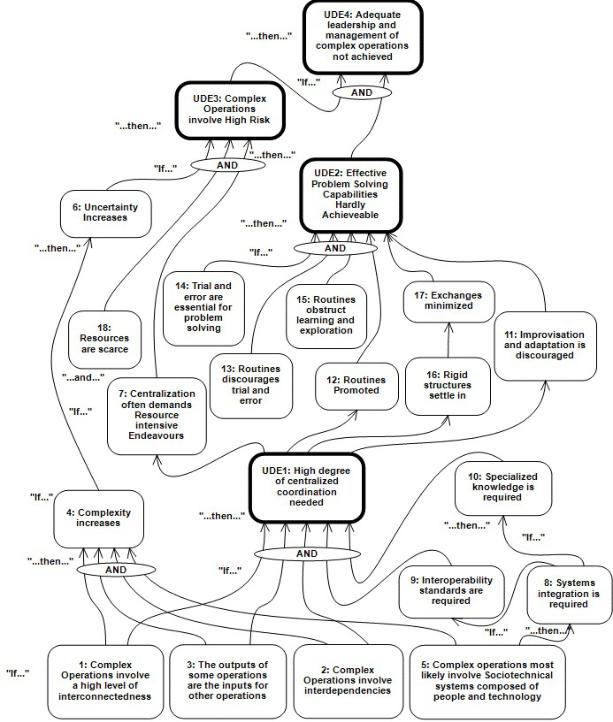
Current Reality Tree, or Designing the Problem The Current Reality Tree (CRT) is a TOC logic tree which helps in the analysis and diagnosis of the problem at hand, identifying the UnDesirable Effects (UDE) within such tree and linking them down to the originating root causes. When considering the complex operations paradigm and the need to identify why it is so difficult to understand, manage and lead within such a paradigm, a CRT is quite helpful in showing the causal relationships among critical concepts (see Figure 1).
Figure 1: CRT - defining the problem links the UDEs to root causes (author’s).
The CRT is a TOC logic tree which shall be read from the bottom up as “if A and B … then C”. From the CRT depicted, one can realise the undesirable effects resulting from causes such as (UDE1) High degree of centralised coordination needed, which promotes routines, and resources, rigid structures, while improvisation and adaptation are discouraged;
474 Água and Conceição
(UDE2) Effective problem-solving capabilities hardly achievable; (UDE3) Complex operations involve high risk, which prevents organisations from achieving an adequate level of leadership and management of complex operations; (UDE4) Adequate leadership and management of complex operations not achieved, which prevents achieving the organisation goal – the adequate leadership and management of complex operations. The chains of cause-and-effect down to the root causes are responsible for the undesirable effects (UDE 1-4) in the CRT and must be addressed by solution design in another logic tree.
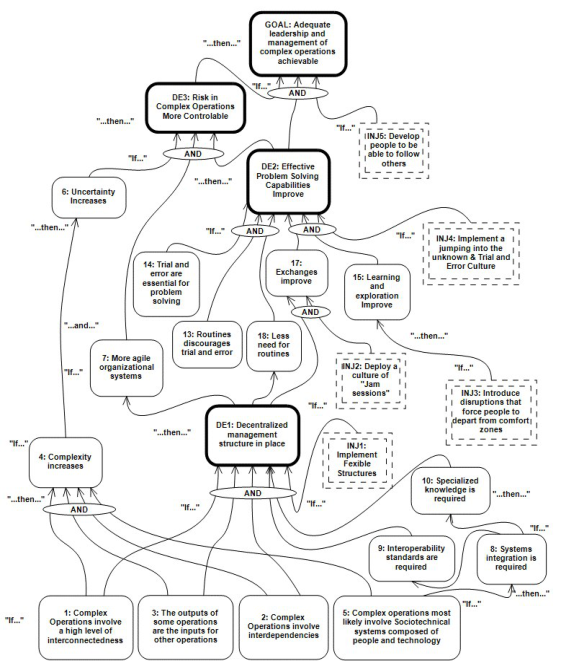
Future Reality Tree, or Defining the Solution One can design workable solutions by injecting measures inspired by the jazz organisation principles presented in the background section before. The TOC suggests three ways to generate actions to be injected into the CRT, which will reverse the UDEs (UnDesirable Effects): (1) Use of Evaporating Clouds, a TOC tool; (2) creating an injection action that eliminates or minimises an undesirable root cause, and (3) creating an injection which satisfies a critical success factor (Dettmer, 2003). Such actions are named injections INJ# in the FRT (see Figure 2).
Figure 2: FRT – designing the solution through injections INJ 1–5 (author’s).
Enabling Factors in Complex Operations. Lessons From Jazz 475
As depicted in the FRT, five injections are now considered, which reverse the previous UDEs. INJ 1-5. INJ1 (Implement Flexible Structures) is needed to force an organisational design that incorporates just enough constraints and coordination to allow diversity and variation to succeed. With flexible structures, organizations can encourage exploration and experimentation, leading to adaptation, innovation and, ultimately, improvement in complex operations. INJ2 (Deploy a culture of “Jam Sessions”), in an analogy with the jazz organisation, suggests that other organisations can do the same by encouraging exchange through opportunistic interaction and sharing of ideas and adequate questioning. INJ3 (Introduce disruptions that force people to depart from comfort zones) suggests that for effective problem solving, people should often leave their comfort zones and try unfamiliar and new actions. INJ4 (Implement a jumping into the unknown & Trial and Error Culture) fosters a culture of solving complex challenges, while one has no assurance that his/her action will succeed. This demands a certain level of ‘psychological safety’. Finally INJ5 (Develop people to be able to follow others), deserves some explanation as it cannot be taken at face value. This ability to follow others is related to the paradigm in jazz organisations where the mastery attained by each player (aka system’s element) is such that they can follow others as these change course during a play. Only when people and teams are so skilled and developed to such a high level is this achievable – as such skills and ability to follow others become ‘second nature’ to such people and organisations. Due to the effect of these injections, not only do we achieve the elimination or mitigation of the previous UDEs, but we also foster the emergence of Desirable Effects DE1 to 3 (DE 1-3) and the achievement of the system’s overall goal - Adequate leadership and management of complex operations achievable. The TOC assumes, and as a more detailed FRT would show, that sometimes feedback branches develop, which will reinforce the overall designed solution. For instance, in the previous FRT, it is easy to expect that the DE2 (Desirable Effect 2) will further reinforce the acceptance of the injections INJ1-4.
DISCUSSION
This paper and the underlying study make use of logical validation by using the Categories of Legitimate Reservation (Dettmer, 2003; Dettmer, 2011), as only determinism, not correlation, can ensure adequate validation. The solution (FRT) is robust enough as a starting point for a more comprehensive research or particular research lines aimed at specific endeavours, industries or businesses. Once the analysis and diagnosis are complete using a clarifying CRT, and a solution is designed employing an FRT, implementation follows in order to deploy the solution while maximizing the chances of harnessing complex operations. Any deployment, however, needs some form of enabling conditions for its success.
Prerequisites Tree, or Ensuring the Critical Enablers Are Set in Place Too often, it is not the systems that fail but the ability to maintain them. If suitable organisational enablers are not set in place, no real and enduring
476 Água and Conceição
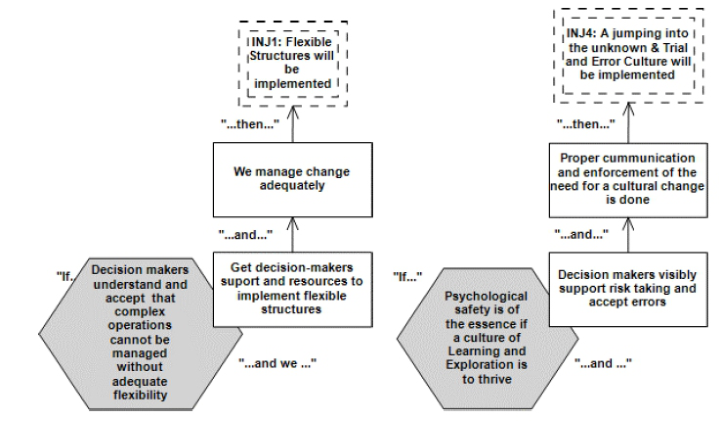
change will happen by just following the solutions depicted in the previous Future Reality Tree. The TOC provides an adequate type of tree for searching and clarifying the enabling factors that shall be in place for enduring change to happen – the Prerequisites Tree (PRT). The PRT is a set of branches made of chains of cause-and-effect influences that together ensure the system will perform as intended and sustainably. The PRT ensures that the designed injections will have the intended effects. As long as the “prerequisites” are in place, the system will perform as intended, maximising the performance within a complex operations paradigm (see Figure 3).
Figure 3: An example of a prerequisite tree to enable the solution in the FRT, exemplified with INJ1 and INJ4 (author’s).
CONCLUSION
Almost all domains are witnessing a rise in the complexity of their operations, and many are barely able to address it. Minimum acceptable performance ensures an organisation can survive. It cannot, however, excel; therefore, it is unlikely to be high-performing. The benefits of adopting some lessons from jazz are significant for businesses, governments, special services, and any organisation engaged in complex operations. Following a critical and logical thinking process, a pragmatic analysis of the complex operations paradigm was provided, and transformational actions were suggested. This approach to organisational design can help address the growing problems that traditional management and organisational schools of thought may be ill-equipped to solve. Jazz organisations derive strength from human bounds rather than human differences, thus a distinct type of organization where “leadership is granted by followers, not by organisational titles”. As suggested by DePree (1992, p. 106), “Just moving up in the hierarchy do not confer competence; so organisational power does not confer wisdom”. Leading complex operations
Enabling Factors in Complex Operations. Lessons From Jazz 477
takes more than following static formulas from traditional management teaching – it needs sense-making, improvisation and adaptation, and the jazz organisation is perhaps the most promising one to help succeed in the realm of complex operations.
ACKNOWLEDGMENT
The authors want to acknowledge CINAV and the Portuguese Naval Academy for their support.
REFERENCES
Austin, R. D., Stormer, C. (2008). Miles Davis: Kind of Blue. Harvard Business School Case 9-609-050. Axelrod, R. (1984). The Evolution of Cooperation. New York: Basic Books, Inc.,
Publishers. Axelrod, R., Cohen, M. D. (1999). Harnessing Complexity. Organisational Implications of a Scientific Frontier. New York: The Free Press. Barrett, F. J. (1998) Coda—Creativity and Improvisation in Jazz and Organizations:
Implications for Organizational Learning. Organization Science 9(5):605–622. https://doi.org/10.1287/orsc.9.5.605 Barrett, F. J., & Peplowski, K. (1998). Minimal structures within a song: An analysis of “All of Me”. Organization Science, 9(5), pp. 558–560. Barrett, F. (2012). Yes To The Mess. Surprising Leadership Lessons From Jazz.
Boston, Massachusetts: Harvard Business Review Press. Bernstein, E. S., and Barrett, F. J. (2011). Strategic change and the jazz mindset: Exploring practices that enhance dynamic capabilities for organizational improvisation. Research in Organizational Change and Development, 19, pp. 55–90. DePree, M. (1992). Leadership Jazz. New York: Dell Trade Paperback. Dettmer, H. W. (2003). Strategic Navigation. A Systems Approach to Business Strategy. Milwaukee, Wisconsin: ASQ Quality Press. Dettmer, H. W. (2021). System Thinking. Milton Keyes, UK: VBW Publishing. Garcia, J. M. (2004). Sysware. La toma de decisions empresariales en un mundo
complejo. Barcelona, Spain: Juan Martin Garcia Ed. (in Spanish). Goldratt, E. M. (1990). Theory of Constraints. Great Barrington, Massachusetts: North River Press. Goldratt, E. M., Cox. J. (1992). The Goal. New Haven, CT: North River Press. Groysberg, B., Masko, J. (2020). Lessons on Leading Through Chaos from U. S.
Special Operations. Harvard Business Review. Nov. Hulm, V. (2019). Symphony or Jazz. Mission-Planning Timelines. Military Review.
May-Jun. pp. 48–59. Mintzberg, H. (1979). The Structuring of Organizations: A Synthesis of the Research. United Kingdom: Prentice-Hall. Mintzberg, H. (1993). Structures in Fives. Englewood Cliffs, New Jersey: Prentice
Hall, Inc. Rihani, S. (2002). Complex Systems Theory and development Practice. Understanding Non-Linear Realities. London, UK: ZED Books. Snowden, D., Boone, M. E. (2007). A Leader’s Framework for Decision Making.
Harvard Business Review. November.
478 Água and Conceição
Snowden, D., Rancati, A. (2022). Managing complexity and chaos in times of crisis.
A guide for decision makers inspired by the Cynefin framework. Luxembourg: Publications Office of the European Union. Surowiecki, J. (2005). The Wisdom of Crowds. New York: Anchor Books. Tjan, A. K. (2010). Strategy as Jazz vs. Symphony. Harvard Business Review. Feb. Tucker, A. L., Edmondson, A. C. (2003). Why Hospitals Don’t Learn from Failures: Organizational and psychological dynamics that inhibit system change. California Management Review. Winter 2003 | Vol. 45, No. 2. Valero y Vicente, A., Tomás, J. L. L. (1999). Política de Empresa. El Gobierno de la
Empresa de Negócios. 4a Ed. Pamplona, Spain: EUNSA. (In Spanish). Weick, K. E., Sutcliffe, K. M. (2015). Managing the Unexpected. Sustained Performance in a Complex World (3rd Ed.). Hoboken, New Jersey: Wiley.
LISTED IN THE AHFE DIGITAL BOOKSTORE CATALOGUE
Explore the complete digital volume
Human Interaction and Emerging Technologies (IHIET 2024)
Read this individual research paper free through the original publisher, or explore the full digital proceedings book.
ISBN 978-1-964867-33-5
Explore this ISBN in the AHFE Bookstore ↗Listed in the July 2026 bookstore catalogue; search by ISBN to confirm current availability · Digital book purchase optional