Pedro Água, Anacleto Correia, José Bartolomeu (2025). Emerging Disruptive Technologies focused strategy: a constraint management approach. In: Human Interaction and Emerging Technologies (IHIET 2025). AHFE Open Access, vol. 197, pp. 441–449. https://doi.org/10.54941/ahfe1006737
Businesses across all industries are facing increasing challenges, which put their competitiveness at stake. Challenges range from disruptions driven by world conflicts and global politics to a perceived increase in socioeconomic risks. With the increased competition, businesses make a considerable effort to sustain a competitive edge in their arenas. A factor ever impacting business performance is technology—a major driver of competitiveness, accelerating innovation and new product development. All these factors together are putting pressure on business leaders and top management teams across any industry. They have to manage finite resources and funds, while at the same time dealing with tough choices on how to react to technological threats, which may affect their businesses, sometimes with catastrophic consequences, as has happened by the effect of technological change along history. At times, an apparent technological advantage may prompt business leaders to consider alternative technological paths. Such decision-makers oftentimes lack a framing and pragmatic approach to assess such potentially emerging technologies. The purpose of this paper is to suggest a strategy to deal with the danger posed by Emerging Disruptive Technologies (EDTs). It suggests businesses how to design a well-thought-out plan that will help them be more resilient and competitive when faced with the threat of possible EDTs. The methodological approach is based on causal logic and a constraints management approach. Taking the defining dimensions of EDTs (strategic, operational, tactical, technical, and organisational), the methodological approach starts by identifying and making problem symptoms visible, together with the chains of cause and effects, which typically originate and drive such symptoms. Oftentimes strategy design imply solving dilemmas and making suboptimal choices, however, by using some tools such as the Categories of Legitimate Reservation, as well as the concept of Conflict Resolution Diagram, both tools from the Theory of Constraint framework, apparent dilemmas, aka dichotomies, are broken allowing for the design of optimal solutions. The results are shown as logic trees, which help through all the strategy development stages, from problem characterisation to strategy design and planning for implementation. This paper also intends to provide academics as well as practitioners with a strategic problem solving framework, which can be further customised for any organisation or strategic situation where the threat of EDTs is a real concern. Overall, and moreover an EDT-influenced strategy is critical for supporting decisions concerning technology investment, capability development, and other strategic initiatives.
It is trivial to suggest that the business endeavour has never been so fierce in what competition concerns. Organizations, private, governmental or non-profit are all affected by potential Emerging Disruptive Technologies (EDTs) across any industry and business endeavour. Disruptive technologies can be understood as innovations that significantly change how businesses, industries, or consumers operate. EDTs often create new business models and markets, oftentimes displacing established ones. Such technologies can revolutionize how people interact with products, services, and information, often reshaping entire sectors. Throughout history, technological disruption dictated the fate of organisations, and often of whole nations (Anand & Barsoux, 2014). Nowadays, there seems to be a concern regarding,
for example, the potential for disruption of artificial intelligence. Such technology, however, is just one typology among different technologies with disruptive potential. Disruption is related to innovation, and this can take several forms, spanning from new products, processes or services. Today’s business world requires improved expertise regarding value creation and total cost analysis, as essential components needed to optimise business performance. For instance, globalisation brings the opportunities associated with expanded marketplaces, in the sense that there is a much bigger stage to sell products and services as compared to just a few decades ago.The downside, of course, is the heightened level of global competition, which may increasingly include “unexpected” challengers empowered by EDTs. To address the challenges posed by this evolving competitive landscape, businesses must actively embrace innovation. Adapting rapidly to new technologies, while simultaneously identifying how to deliver higher value- added products and services to the market, has become imperative. This paradigm intensifies competition and increases volatility across the business environment. It is therefore unsurprising that terms such as VUCA—denoting Volatility, Uncertainty, Complexity, and Ambiguity—are frequently invoked to characterise the current strategic context. We have seen ‘once-thought’ solid companies disappearing from lists such as the Fortune 500, with many highly prestigious 20th-century companies faltering. Names such as Kodak, Olivetti, among others, are illustrative of this point. Being faced with this endeavour, businesses everywhere know they have to offer something unique, with greater value; therefore, a focus on building EDT-based strategies may be of help.
This paper proposes a way to design strategies to promote EDTs, which enable a company to sustain a competitive edge in the marketplace. Another aspect of this problem concerns the need for organisations to protect against EDTs. Therefore, a starting point shall be concerned with how to characterise and assess the potential for disruption of considered technologies.
Assessing Emerging Disruptive Technologies Bartolomeu & Água (2023) suggested a pragmatic and practical framework for assessing the disruption potential of emerging technologies. Such a framework is composed of five Dimensions, which together can be characterised by fifteen variables (Table 1).
Table 1: Framework for assessing the impacts of potentially disruptive technologies. (Bartolomeu & Água, 2023).
Table available in the original PDF paper.
Dimensions Variables Indicators Impact Null Moderate Strategic Political Strategic objectives partially attained, attained or overcome; sustainable innovation; having a marketplace edge.
High Revolutionary Continued
Emerging Disruptive Technologies Focused Strategy: A Constraint Management Approach 443
Table 1: Continued Dimensions Variables Indicators Impact
Table available in the original PDF paper.
Economic Level of business development; market quota; number of new markets; new technology emerging; financial and human resources; scientific, technical, and engineering capabilities; infrastructure capacity; level of investment in R&D; and diffusivity/adoption rate. Cultural Level of acceptability or resistance to
specific technologies, and applications for cultural, religious or ethical reasons. Legal Effectiveness of limitations from regulations or norms. Operational Performance Production output, quality levels, waste
reduction, customer satisfaction, response time, and productivity. Congruence The level of integration of the technology itself with an innovative concept for its effective deployment. Opportunity Timing; failure into adoption; and/or
adopted first by competition. Tactical Secrecy Levels of surprise vis-à-vis competition. TTP Level of changes in tactics, techniques and procedures; changes in size, organisation, and training; boosting of R&D; and contribution to the effects on the marketplace. Technical Performance Key performance indicators, testing,
observations, reviews and audits, comparisons, and feedback. Maturity TRL 1 - Basic principles observed and reported; TRL 2 - Technology concept and/or application formulated; TRL 3 - Analytical and experimental critical function and/or characteristic proof-of-concept; TRL 4 - Component and/or breadboard validation in laboratory environment; TRL 5 - Component and/or breadboard validation in relevant environment; TRL 6 – System/subsystem model or prototype demonstration in a relevant environment; TRL 7 - System prototype demonstration in operational environment; TRL 8 - Actual system completed and qualified through test and demonstration; TRL 9 - Actual system proven through successful mission operations (Mankins, 1995). Interconnectedness Potential for integration with other
technologies of two or more well-understood technologies, where no correlation had previously been identified.
Continued
Table 1: Continued Dimensions Variables Indicators Impact
Table available in the original PDF paper.
Organisational Internal support Credible senior leader sponsorship; small team participation; junior personnel promotion pathways; disguising disruptive innovations as sustaining ones (Scott et al., 2019). Pacing gap Time required to establish laws,
regulations and oversight mechanisms for the safe development or implementation of a new technology. Cost Size and type of investment (initial and maintenance); human capital required; infrastructure required; replication viability of a product once it is developed.
Building on this framework, this paper argues that it is feasible to design strategies that enhance an organisation’s competitive advantage. However, the proposed framework alone is insufficient to achieve such an advantage. It is essential to architect a strategy that establishes clear cause-and-effect relationships, which work in synergy to reinforce the strategy as a whole.
Laying Out the Strategy Any strategy begins by selecting a desirable future paradigm, and the first step is to define such a goal. In this case, the goal could be ‘sustaining an organisation’s competitive edge in the face of EDTs. This objective serves as a helpful starting point for formulating a guiding problem statement. A problem statement provides a clear and concise description of the challenge to be addressed and is most effectively expressed in the form of a question. Problem statements are critical for effective problem-solving, as they focus the efforts of brainstorming and teamwork (Baaij, 2022; Chevallier, 2016).
This text follows an IMRaD Structure (Introduction, Methodology, Results, and Discussion). After this introduction, where the context is set and some relevant background is provided, Section 2 briefly introduces the methodology used for this research. Section 3 presents some results in the form of logic trees. Section 4 provides a discussion on the research, allowing for further critical thinking on this subject, followed by a concluding section.
METHODOLOGY
The methodological approach is based on the Theory of Constraints (TOC), a holistic analysis framework grounded in Aristotelian logic, where determinism is considered essential to establish causal relationships (Goldratt, 1990; Goldratt & Cox, 1992; Minto, 2009). In addition to employing a qualitative approach, the motivation to adopt a logical reasoning process in this research stems from the analytical and diagnostic potential offered by the four fundamental questions of the TOC (Table 2).
Emerging Disruptive Technologies Focused Strategy: A Constraint Management Approach 445
Table 2: The TOC questions (Dettmer, 2003).
Table available in the original PDF paper.
Key Questions or Process Stages Obs.
Why change? To pursue a desirable goal or a new paradigm. What to Change? What needs to change in order to
eliminate undesirable effects? What to Change To? What do changes look like to achieve desirable effects? How to cause the change? What enabling conditions or
prerequisites are needed to reach the desirable effects?
Answering the first two questions (‘Why change?’ and ‘What to change?’) relates to the problem definition and the realisation of such a problem’s consequences if it is not timely and adequately addressed. The question ‘Why change?’ relates to the selection of the Goal for the problem or system under analysis, which may be a whole organisation. In the current case, the goal may be defined as “Ensure a competitive edge based on EDT”. Answering the “What to change?” question demands a clarification and analysis of the undesirable effects (UDEs) which prevent the organisation from achieving the goal. Answering the last two questions (‘What to change to?’ and ‘How to cause the change?’) prompts one to design a solution to address the identified obstacles and how to deploy such a solution, giving place to the intended net benefits. The Logical Thinking Process is central to Goldratt’s Theory of Constraints and is behind the methodological approach used (Dettmer, 2003; 2007, 2021).
RESULTS
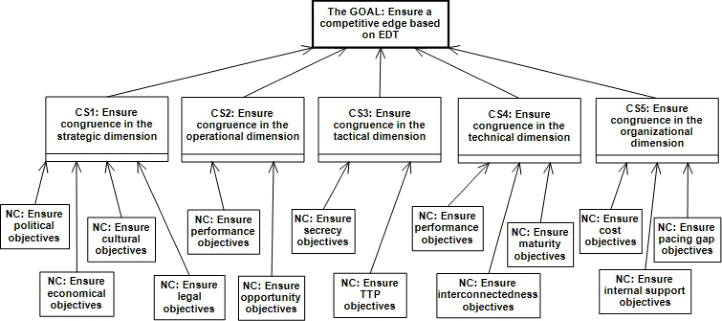
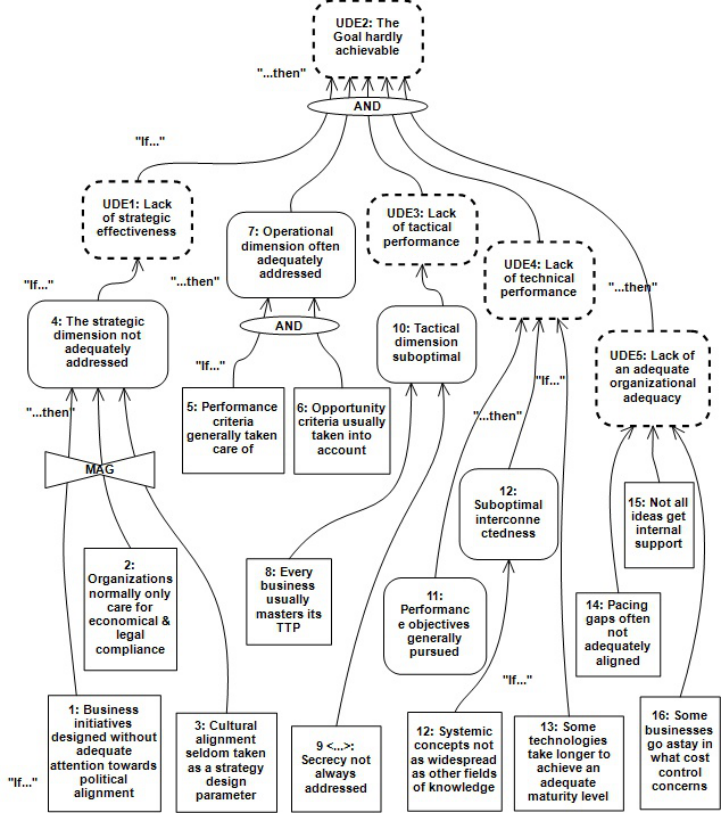
From Figure 1, it is clear that the strategy architecture relies on three different layers. At the top, there is the ultimate goal for the organisation, which tries to design an EDT-focused strategy. Such a goal is supported by a middle layer of critical success factors (CSF), which by their side are supported or enabled by a base layer of necessary conditions (NC). This arrangement broadly helps in shaping the desirable future paradigm; however, besides establishing a starting point, it still needs a comparison with the current reality, which demands the identification of the undesirable effects and their respective causes. Two steps are needed at this stage to solve the problem: (1) a problem statement, and (2) the identification of possible issues or obstacles which prevent an organisation from reaching the desired end state, and which can be made clear by the use of a TOC’s “Problem Tree” (Figure 2).
Clarifying the Current Reality – The Problem Tree The results derived from the application of the methodological approach are presented in the form of logical trees. The Problem Tree—referred to as the Current Reality Tree (CRT) within the TOC—captures the analysis and diagnosis of the current paradigm by identifying the undesirable effects that define the core problem. A second logical tree represents the proposed solution—the Solution Tree, also known as the Future Reality Tree (FRT)— which outlines a set of actions designed to address and resolve the identified
issues. Such logic trees were designed by following robust logical validation using the Categories of Legitimate Reservation, a TOC tool to help validate logical relationships (Dettmer, 2007).
Figure 1: A potential goal tree (author’s).
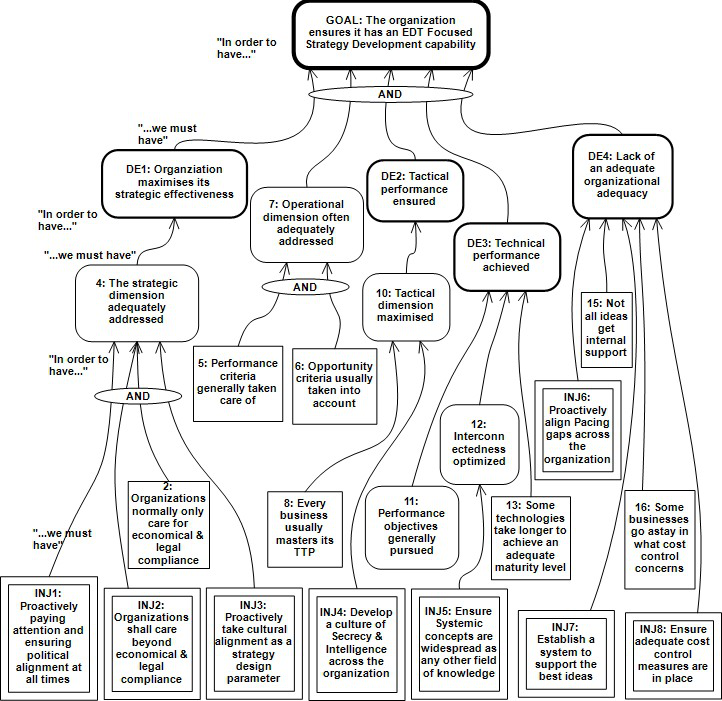
Designing the Future Paradigm – The Solution Tree In order to neutralise the UDEs mentioned before, it is helpful to have a problem statement help guide towards potential solutions. In this research, the problem statement, helps us find the needed actions, referred to as “injections” (INJ#) within the TOC approach and thinking processes.
The logical tree shown in Figure 3 presents a potential set of actions (INJ1 to INJ8), which eliminates or mitigates the UDEs identified in the Problem Tree (Figure 3), giving place to desired effects which together contribute to the achievement of the goal - Ensure a competitive edge based on EDT.
A first approach to a solution design could then be summarised by the set of actions (INJ1 to INJ8) as per Table 3.
Table 3: INJ1 to INJ8 as strategic initiatives towards a solution.
Table available in the original PDF paper.
Action Description INJ1 Proactively paying attention and ensuring political alignment at all times. INJ2 Organisations shall care beyond economic & legal compliance. INJ3 Proactively take cultural alignment as a strategy design parameter. INJ4 Develop a culture of Secrecy and intelligence across the organisation. INJ5 Ensure Systemic concepts are widespread as any other field of knowledge. INJ6 Proactively align Pacing gaps across the organisation. INJ7 Establish a system to support the best ideas. INJ8 Ensure adequate cost control measures are in place.
These injections will have prerequisites associated with them, which will be addressed in the next section.
Emerging Disruptive Technologies Focused Strategy: A Constraint Management Approach 447
Figure 2: The problem tree, depicting an organisation’s potential current paradigm (author’s).
DISCUSSION
The strategy development approach followed within the context of this research is based on cause-and-effect logics (as opposed to mere correlation). Regardless of the robustness and detail shown in the ‘solution tree’ (aka FRT), a strategy may fail or at least fall short of expectations during the deployment stage if the pre-requisites for such deployment are not being taken care of adequately. The TOC, however, has a helpful tool – the Pre-Requisites Tree (PRT), whose aim is to identify and establish the supporting pre-requisites for each identified injection placed in the FRT. The Pre-Requisites Tree, however, is not developed within the scope of this paper. Nonetheless, it should be said that in identifying pre-requisites for strategy deployment, it is
helpful to follow checklists such as the DOTMLPFI (Doctrine, Organisation, Training, Materiel, Leadership, Personnel, Facilities, Interoperability) to identify and architect the pre-requisites. Exemplifying by questioning: do we have the correct doctrine in place with associated standard operating procedures (SOP)?; do we have the proper organisational structure? Do we need to provide Training? Are all materials available? Do we have exemplary leadership in place? If not, how to get it? Is there enough personnel to deploy the strategy? Do we have adequate facilities? What Interoperability aspects shall be taken into account? Last, but not least, what is the most adequate timing to deploy the envisioned strategy? Checklists such as the DOTMLPFI suggested have long been valuable tools for helping with the implementation and deployment of solutions (Gawande, 2007).
Figure 3: The problem tree, depicting an organisation’s potential current paradigm (author’s).
Emerging Disruptive Technologies Focused Strategy: A Constraint Management Approach 449
CONCLUSION
Throughout history, EDTs have always had significant impacts on diverse organisations, small and large, sometimes with devastating consequences. Conversely, organisations which pursued technological disruption often gained a competitive edge that not only ensured survivability but also negatively affected their competitors. This research suggests a way to address this issue by proactively focusing on designing EDT-focused strategies, with a straightforward method based on the Theory of Constraints, hence providing a competitive edge. As a first-cut approach, this research has space for improvement, which will be pursued in a follow-up paper. Naturally affected organisations would design strategies to counter the threat brought about by EDTs or at least mitigate the effects; however, that is not the focus of this research. The subject is critical as it contributes to organisational sustainability and, therefore, contributes to more resilient organisations.
ACKNOWLEDGMENT
The authors would like to acknowledge the support of CINAV and the Portuguese Naval Academy.
REFERENCES
Anand, N., Barsoux, J. (2014). Quest: Leading global transformations. Lausanne, Switzerland: IMD eds. Baaij, M. (2022). An Introduction to Management Consultancy. 2nd Edition.
London: SAGE Publications. Bartolomeu, J., Água, P. (2023). A Framework For Assessing The Impact Of Potential Disruptive Technologies In Business. In: Tareq Ahram and Redha Taiar (eds) Human Interaction & Emerging Technologies (IHIET 2023): Artificial Intelligence & Future Applications. AHFE (2023) International Conference. AHFE Open Access, vol. 0. AHFE International, USA. http://doi.org/10.54941/ ahfe1004072 Chevallier, A. (2016). Strategic Thinking in Complex Problem Solving. Oxford
University Press. Dettmer, W. (2003). Strategic Navigation. A Systems Approach to Business Strategy.
Milwaukee, Wisconsin: ASQ Quality Press, 2003. Dettmer, W. (2007). The Logical Thinking Process. A Systems Approach to Complex Problem Solving. Milwaukee, Wisconsin: ASQ Quality Press, 2003. Dettmer, W. (2021). Systems Thinking. Milton Keyes, UK: VBW Publishing, 2021. Gawande, A. (2009). The checklist manifesto. New York, Picador. Goldratt, E. (1990). What is this thing called the Theory of Constraints, and how
should it be implemented? Great Barrington, Massachusetts: North River Press. Goldratt, E., Cox, J. (1992). The Goal. New Haven, CT: North River Press. Minto, B. (2009). The Pyramid Principle: Logic in Writing and Thinking. London: Pearson Education.
LISTED IN THE AHFE DIGITAL BOOKSTORE CATALOGUE
Explore the complete digital volume
Human Interaction and Emerging Technologies (IHIET 2025)
Read this individual research paper free through the original publisher, or explore the full digital proceedings book.
ISBN 978-1-964867-73-1
Explore this ISBN in the AHFE Bookstore ↗Listed in the July 2026 bookstore catalogue; search by ISBN to confirm current availability · Digital book purchase optional