Samuel Adekunle, Beauty John, Andrew Ebekozien, Clinton Aigbavboa (2024). Facilitating Technology Diffusion: Unveiling the Dynamics of Emerging Technologies on Construction Project Sites. In: Human Factors in Design, Engineering, and Computing. AHFE Open Access, vol. 159, pp. 1782–1791. https://doi.org/10.54941/ahfe1005745
Emerging technologies hold immense promise for enhancing productivity and safety in the construction industry. However, a persistent challenge remains: Why are these innovations not used on project sites and by site workers? This study investigates the phenomenon of bottom-up technology diffusion from construction sites. By examining the dynamics at the “grassroots” level, the study explores the barriers and facilitators that influence the adoption and utilization of emerging technologies by site workers. This was achieved through a mixed-methods approach, adopting interviews and on-site observations on selected construction sites in South Africa. The study uncovers factors such as power challenges, lack of trust, lack of training, resistance to change, and inadequate infrastructure, among others. The study also identified the strategies required to overcome this challenge of achieving technology diffusion to construction project sites. Ultimately, understanding the bottom-up diffusion process is crucial for bridging the gap between technological advancements and frontline workers, paving the way for a more inclusive and efficient construction industry.
The construction industry has witnessed different transformations that have impacted both products and processes. It is a labor-intensive field that relies on equipment to achieve its objectives. Construction equipment is vital to project success by providing efficiency and effectiveness in task completion. Augmenting human labor with mechanical equipment and adopting new technologies has proven to have positive impacts. For instance, it reduces construction downtime and maintenance costs, resulting in more accurate and consistent work across all phases of the construction process, thus positively impacting quality. These benefits extend to productivity, efficiency, and safety improvements for construction workers and property (Delgado et al., 2019). Automation is another way through which the
Facilitating Technology Diffusion: Unveiling the Dynamics of Emerging Technologies 1783
construction process can increase productivity (Chen, García de Soto, & Adey, 2018).
However, despite these advantages, emerging technologies are not readily available to site workers. Castro-Lacouture (2009) and Zhang et al. (2023) note that fully automating construction works can reduce labor costs and improve safety statistics. Yet, achieving this productivity requires cross- functional teams focused on implementing the latest technology for specific production processes. For example, mechanical excavators significantly expedite excavation compared to manual methods, while vertical hoisting through winches is less ergonomically stressful than manual hoisting. A step further is the automation of the construction processes. According to Hossein (2021), automation in construction can be termed as adopting technologies that can perform activities quickly and effectively compared to when human beings act them. Bademosi and Issa (2021) discussed that the introduction of automation in construction works improves construction safety, and safety management brings in safe operational procedures. Adherence improves when training is continual, but mainly because the population of construction workers is reduced as automation is adopted. It can be largely deductively inferred that construction automation improves the overall performance of construction works, impacting costs and productivity through efficiency improvements. This inference is possible when referring to previous research studies that looked at the adoption of automation in construction works, and similar findings were made concerning the areas of productivity and efficiency, as well as safety considerations (Adekunle et al., 2023; Bademosi and Issa, 2021).
Some benefits of adopting emerging technologies and automating some of the construction processes include:
- Costs savings The adoption of automation can save money as it reduces labour costs in the long run. Workers on construction sites save time spent on repetitive tasks by focusing on essential tasks requiring a new set of skills. Automation promotes accuracy, which can result in saving costs as there is little to no room for error and re-doing tasks (Tribulant, 2023)
- Operational efficiency Adopting automation on sites can also assist in improving efficiency as automated plants are more accurate and consistent than human operators, thus decreasing waste and increasing input on construction sites. There are low downtime rates as automated plants can give early warning systems when they are due for maintenance (Tribulant, 2023).
- Increased Productivity The adoption of automation can result in a productivity increase (McKinsey, 2020). The new technologies can assist construction workers on site. The workers would perform their tasks efficiently, and companies would have to invest in the growth of workers by retraining them so that they are well-equipped. Moreover, productivity can result in projects being handed over in time.
Despite these benefits, different stakeholders hold diverse perceptions of the adoption of emerging technologies, leading to fragmented efforts and adoption. Thus, the adoption and usage of emerging technologies are more pronounced among professionals than site workers. It should be noted that site workers are not mere stakeholders but critical stakeholders and implementers; they are leaders of change. Thus, the success of technological diffusion will not be considered complete if it is not adopted on construction sites. This research area has been neglected before, but it is important to the mass diffusion of technology. Thus, this study explored the adoption of emerging technologies dynamics on construction sites in South Africa, specifically looking at
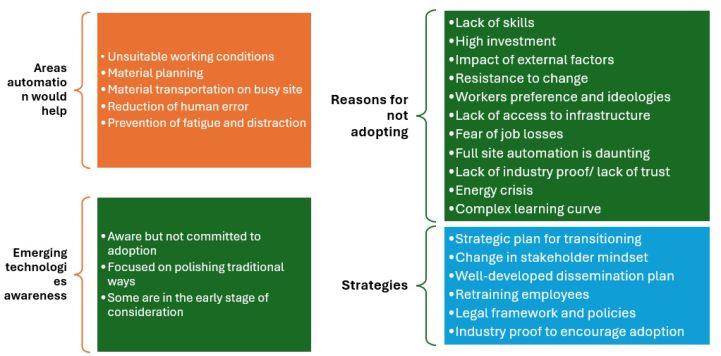
- Areas where automation could have improved - Awareness of emerging technologies - Reasons why contracting organisations do not use emerging technologies on project sites - Strategies for the adoption of emerging technologies on project sites
METHOD
The study adopted a qualitative approach, recognizing that understanding the study objective requires human experience, depth, and context. The study combined interviews and non-participant observation to capture multifaceted insights on the technology adoption on site. This approach made it possible to delve into first-hand experiences and perceptions related to the adoption of emerging innovation on construction sites. In addition, it enabled the observation of the present state of adoption and asked questions about the challenges of not adopting emerging technologies on construction sites in South Africa. Some construction sites were visited in South Africa to achieve the study objectives. The equipment on the construction sites was observed, and interviews were conducted with on-site personnel on the adoption of emerging technology on sites. Table 1 presents the project site information adopted for the study. The project sites are located in different provinces in South Africa, namely Gauteng, KwaZulu Natal and Limpopo.
Table 1. Project information.
Table available in the original PDF paper.
Site Code
Location Project Interviewed Personnel
Equipment in Use Emerging Technology Adopted No
S1 Midrand A large project of mixed-used property
Tower crane, skid steer,
Foreman, Project manager
No
S2 Midrand Luxury apartment development
Site manager, Site engineer
Telehandler, dumper truck, conveyor belt, skid steer, trencher, No
S3 Kempton park
Road construction Site Manager Tipper truck, roller, water tank (Continued)
Facilitating Technology Diffusion: Unveiling the Dynamics of Emerging Technologies 1785
Table 1. Continued Site Code Location Project Interviewed Personnel
Table available in the original PDF paper.
Equipment in Ue Emerging Technology Adopted
S4 Braamfontein 18-storey student
No Static pump, Bobcat, tower crane, spider crane
accommodation with petrol filling station basement
No
S5 Longlake Warehouse construction
Tower crane, Cherry picker No
S6 Centurion 12nr warehouse construction
Drum roller, Padfoot roller, tipper truck, Bobcat, excavator, water tank, cherry picker, grader, rotary laser level Bobcat, Tower crane No
Some of the sites are observed to have a structured system that guides workers and machinery within the site to ensure that all movement is structured and organised to improve efficiency within the site. In addition, most sites adopted digital forms of communication. Although not a new form of technology, job site radios are used by supervisors and managers. However, it should be noted that general workers on site do not have access to the radios. This might be due to the cost implications of supplying all the workers on site. Thus, they are mostly used to shouting when communicating. This can impact their health and well-being.
AREAS WHERE AUTOMATION WOULD HAVE ASSISTED Through observation of the site operations in the nine construction sites under review. Some observations were made on areas that would have been improved due to emerging technology adoption. Firstly, for some sites, areas where the adoption would have assisted were observed. Some sites are observed to be congested and narrow so that workers can perform their duties easily. Automation of some repetitive tasks would have reduced human congestion. Also, this is not sustainable in the event of a black swan event like the covid 19 again (Adekunle et al., 2023). This has been researched by Siddiqui, Vahdatikhaki and Hammad (2019) where they explored the tracking equipment on congested sites. One of the site managers interviewed emphasised that the working conditions are not ideal for the site workers. Most of the time, site workers work under direct sunlight for long hours; thus,
automating specific processes on the site would reduce that time significantly. Secondly, automating processes would help with more efficient material planning and transportation within the site. On one of the sites, one of the observed challenges is getting material to various areas within the site as there is constant movement of people and machinery performing these tasks. An automated system would make the transportation of materials more efficient.
Generally, it would have streamlined processes, reduced human error, and improved overall productivity. Tasks that require significant time and effort can be completed more efficiently with the help of automated systems. If automation were adopted, it would have enhanced the accuracy and performed tasks with high precision. They can minimize human errors that may occur due to fatigue, distractions, or other factors. Improved accuracy leads to reduced rework, waste, and delays, contributing to higher productivity levels.
CONTRACTING ORGANISATIONS AWARENESS OF EMERGING TECHNOLOGIES Based on the observation of the sites, most of mostly the construction was filled with mechanical equipment. The study proceeded to explore the awareness level of site workers. It is worthy of note that the site workers, more specifically the Project Manager, are aware of these emerging technologies. Still, they are not willing to learn or transition into automation. According to the project manager, S7, they are well aware, but “no company is looking forward to the emerging technologies, but instead all companies are focused on polishing their traditional ways of doing things”. This means that most site workers are aware of emerging technologies. However, management commitment and support are lacking (Adekunle et al., 2021; Akinradewo et al., 2022; Ikuabe et al., 2022; Otasowie et al., 2023). Also, most contracting firms are resistant to change. Since automation is not one of the things the company is willing to consider, there is no interest in what the technologies can bring or improve. Therefore, most contracting organisations stick to known ways of doing things.
The foreman on S1 stated that “the construction organisation is clearly aware of the impact automation will have on the site, such as increasing efficiency, eliminating repetitive and manual tasks, allowing for faster and more accurate completion of work”. Buttressing this perspective, the project manager added that the construction organisation is still in the early consideration stages of equipment automation. Therefore, the construction organisation hasn’t ruled out the possibility of adopting emerging technologies in the near future”. However, for this adoption to take place successfully, the construction organisation needs to have managerial- level support and investment in emerging technologies. Thus, awareness without commitment to adoption is a major challenge in adopting emerging technologies on construction sites. The managerial side of site workers are very aware of emerging technologies and their benefits to their work and processes. As stated by S7, despite their awareness, “no company is looking forward to the emerging technologies”. However, for this adoption
Facilitating Technology Diffusion: Unveiling the Dynamics of Emerging Technologies 1787
to successfully take place, the construction organisation needs to put in place a strategic plan in terms of transition of machinery, change of mindset, and automation process while also taking into consideration employee factors and other challenges that may arise from the premature implementation of technologies. However, S7 stated that instead, all companies are focused on polishing their traditional ways of doing things”.
REASONS FOR NOT ADOPTING EMERGING TECHNOLOGIES ON CONSTRUCTION SITE The respondents were also asked for their perception of the reasons why emerging technologies were not being adopted on the construction sites. S7 mentioned that “the lack of skills associated with adopting new technologies, as well as the initial investment that would be needed to adopt emerging technologies successfully” were critical factors hindering its usage. This aligns with studies conducted on barriers to the adoption of many emerging technologies in the construction industry (Aghimien, Aigbavboa and Matabane, 2019; John, Adekunle and Aigbavboa, 2022). Furthermore, S2 mentioned that the construction firm is “aware of the benefits that technologies can bring to the workers, but due to external environmental factors, it will affect their company outcomes to implement the technologies now”. S3 buttressed this by saying that “no company is looking forward to the emerging technologies, but instead all companies are focused on polishing their traditional ways of doing things”. They are used to the traditional way of doing things and would rather keep it as that’s what they understand better. Therefore, it was observed that the site workers are not using any of the emerging technologies. This might not be unconnected with the lack of skills, workers’ preferences, ideologies, and conceptions about technology aside from the organisational barriers. On the other hand, most site workers will not be familiar with or knowledgeable about how the emerging technologies would facilitate and improve their work.
It can be inferred that site workers are also not using emerging technologies because the construction organisation is still analysing if certain technologies are specifically designed for the unique requirements of the construction organisation’s existing works. As it stands, construction organisation is still lacking access to the necessary infrastructure and resources required to support adoption. According to the site manager in S3, “automation is an element which the company is not ready for”.
Respondents identified other reasons that have hindered the adoption of emerging technologies on project sites including the following: automation of the site is not sustainable to the company as it would lead to job losses, which the company does not want to let go of any of its employees. Secondly, it is difficult to automate a site as this does not only mean automating one aspect of the site, but it would need the entire site to be fully automated for it to work. This is perceived as a challenge as the construction industry in South Africa is not ready to have fully automated sites due to the unavailability of the equipment and skills related to the site. Furthermore, the cost implications related to fully automating the company’s construction sites are not one that
the company would be able to afford at the moment. Respondents opined that the company does not have the financial resources to invest in emerging technologies, some of which have not been industry-proven. The lack of finances and trust in new technologies makes construction organisations skeptical about project site implementation. Thus, they long to see these technologies successfully implemented on other construction sites before they can consider adopting some of these technologies for their operations.
Other considerations hindering the adoption of emerging technologies on project sites include:
- Project-specific requirements: The project is considered much simpler in nature, and sticking to proven methods is more practical and cost-effective.
- Cost considerations: Every project has its budget, and with their site, it will be very challenging to justify the expenses of acquiring, integrating, and maintaining these technologies. Therefore, they are sticking to the existing tools and practices.
- Suitability to current operations: These organisations are already effectively executing projects and meeting client expectations using existing technologies and processes. Thus, there is little incentive to invest in and implement new technologies. They believe in and practice traditional methods, and up to this point, it’s working very well for them as they still meet their targets. Most construction organisations own a vast number of machinery, which makes their chances of adopting automation slim as they have a plethora of equipment that can perform required tasks effectively and on time.
- Energy crisis: Currently, South Africa is facing an energy crisis. Many contracting organisations consider the situation unfavorable as automation requires energy or power.
- Complexity And Learning Curve: Contracting organisations consider automation to be a very complex subject that requires a learning curve for implementation and operation. It also requires investment in time and resources to train the workforce and ensure a smooth transition to the new technologies. More often than not, this cannot be done due to the duration given to complete a project. Another factor to consider is the budget, as the implementation will cause delays and financial constraints.
STRATEGIES FOR THE ADOPTION OF EMERGING TECHNOLOGIES ON PROJECT SITES This section outlines the strategies according to the respondents. For this adoption to successfully take place, the construction organisation needs to put in place a strategic plan in terms of the machinery transition, change of mindset, and automation process. As earlier identified as a barrier, construction organisations must take into consideration their employee’s training and other challenges that may arise from the implementation of technologies.
Construction organisations must look beyond the top-bottom approach for technology diffusion. There must be well-developed, well-planned, and holistic dissemination strategies that empower lower-level managers and site
Facilitating Technology Diffusion: Unveiling the Dynamics of Emerging Technologies 1789
workers. For instance, construction organisations should have BIM kiosks on Construction sites to aid site workers integration.
New technologies also require re-training of employees. Thus, previously skilled site workers might find themselves not skilled enough as a result of implementing new technologies. There is a need for a training program that caters to these workers at different levels to ensure their integration into the new industrial revolution dynamics.
There is also a need for a legal framework that guides the use of emerging technologies and their handling by construction workers. This will guide its usage, handling, and data management.
Figure 1: Technology diffusion on construction sites.
CONCLUSION
The adoption of emerging technologies and automation of processes in any sector plays a vital role in process efficiency and productivity, creating an environment of great success. Similarly, the construction industry has been revolutionised and transformed during every industrial revolution. However, the recent transformation has been due to the emerging technologies. However, less light has been beamed on the adoption of emerging technologies on project sites. The study achieved a holistic exploration of this through observation and interviews. It was found that many contracting organisers are aware of emerging technologies and their inherent benefits. However, budget constraints and energy crisis are their major concern, which leads them to continue using traditional methods since they are conducive. The study also identified the diverse strategies for adopting emerging technologies on construction sites including the establishment of BIM stations or BIM kiosks on construction sites. The study findings emphasise the importance of bottom-up input in decision-making, especially concerning the project environment.
REFERENCES
Adekunle, S. A. et al. (2021) ‘Key Constraints To Optimal Bim Penetration Among Nigerian Quantity Surveyors’, in F. Emuze (ed.) Department of construction management 50th anniversary conference ‘the next 50 years’ 15–16 November 2021, Port Elizabeth, South Africa. Port Elizabeth, pp. 66–73. Available at: https://pure.manchester.ac.uk/ws/portalfiles/portal/206816465/CM50_paper_ 22.doc.pdf. Adekunle, Samuel A. et al. (2023) ‘Intricacies and lifeline for the construction
industry amidst the coronavirus pandemic’, Construction Safety, Health and Well- being in the COVID-19 era, pp. 243–257. Available at: https://doi.org/10.1201/ 9781003278368-21. Adekunle, Samuel Adeniyi et al. (2023) ‘Understanding Safety of Construction Sites: Construction Site Workers’ Experience’, Emerging Debates in the Construction Industry, pp. 292–306. Available at: https://doi.org/10.1201/9781003340348-18. Aghimien, D., Aigbavboa, C. and Matabane, K. (2019) ‘Impediments of the
Fourth Industrial Revolution in the South African Construction Industry’, in S. M. Ahmed et al. (eds) 11th International Conference (CITC-11) September 9-11, 2019, London, UK. London, UK: Springer nature, pp. 421–429. Akinradewo, O. I. et al. (2022) ‘A principal component analysis of barriers to the implementation of blockchain technology in the South African built environment Principal component analysis of barriers’, Journal of Engineering, Design and Technology [Preprint]. Available at: https://doi.org/10.1108/JEDT -05-2021-0292. Bademosi, F., and R. R. Issa. 2021. “Factors influencing adoption and integration
of construction robotics and automation technology in the US.” J. Constr. Eng. Manag., 147 (8): 04021075. American Society of Civil Engineers. Castro-Lacouture, D. (2009) ‘Construction Automation’, Springer Handbook of Automation, pp. 1063–1078. Available at: https://doi.org/10.1007/978-3-540- 78831-7_61. Chen, Q., García de Soto, B. and Adey, B. T. (2018) ‘Construction automation: Research areas, industry concerns and suggestions for advancement’, Automation in Construction, 94, pp. 22–38. Available at: https://doi.org/10.1016/J. AUTCON.2018.05.028. Davila Delgado, J. M. et al. (2019) ‘Robotics and automated systems in construction:
Understanding industry-specific challenges for adoption’, Journal of Building Engineering, 26. Available at: https://doi.org/10.1016/j.jobe.2019.100868. Hossein, F., 2021. Digitization And Automation Of Construction. [Online], Available at: https://www.sdd-technology.com/blog/digitization-and-automation- of-construction [Accessed 27 May 2023]. Ikuabe, M. et al. (2022) ‘Hindering factors to the utilisation of UAVs for construction
projects in South Africa’, Modular and Offsite Construction (MOC) Summit Proceedings, pp. 154–160. Available at: https://doi.org/10.29173/MOCS277. John, B., Adekunle, S. A. and Aigbavboa, C. (2022) ‘Construction Industry and the Fourth Industrial Revolution: the Key Impediments in Developing Countries’, Proceedings of International Structural Engineering and Construction, 9(1), p. CON-29-1-CON-29-6. Available at: https://doi.org/10.14455/ISEC.2022.9(1). CON-29. McKinsey & Company, 2020. The next normal in construction, s.l.: McKinsey & Company.
Facilitating Technology Diffusion: Unveiling the Dynamics of Emerging Technologies 1791
Otasowie, K. et al. (2023) ‘Barriers to the Adoption of Building Information Modeling in Quantity Surveying Practice in South Africa’, Proceedings of the 31st Annual Conference of the International Group for Lean Construction (IGLC31), pp. 41–49. Available at: https://doi.org/10.24928/2023/0137. Siddiqui, H., Vahdatikhaki, F. and Hammad, A. (2019) ‘Case study on application
of wireless ultra-wideband technology for tracking equipment on a congested site’, Journal of Information Technology in Construction, 24(October 2017), pp. 167–187. Tribulant, 2023. What Are the Advantages of Implementing Automation in Power Plants?. [Online] Available at: https://tribulant.com/blog/business/what-are-the -advantages-of-implementing-automation-in-power-plants/ [Accessed 28 May 2023]. Zhang, M. et al. (2023) ‘Human–robot collaboration for on-site construction’, Automation in Construction, 150. Available at: https: //doi.org/10.1016/j.autcon.2023.104812.
LISTED IN THE AHFE DIGITAL BOOKSTORE CATALOGUE
Explore the complete digital volume
Human Factors in Design, Engineering, and Computing
Read this individual research paper free through the original publisher, or explore the full digital proceedings book.
ISBN 978-1-964867-35-9
Explore this ISBN in the AHFE Bookstore ↗Listed in the July 2026 bookstore catalogue; search by ISBN to confirm current availability · Digital book purchase optional