Samuel Adekunle, Clinton Aigbavboa, Obuks Ejohwomu, Bankole Awuzie, Andrew Ebekozien (2025). Digital Transformation and The Construction Industry Research Landscape: Exploring the evolving research methods. In: Human Factors in Design, Engineering, and Computing. AHFE Open Access, vol. 199, pp. 1941–1952. https://doi.org/10.54941/ahfe1007005
The construction industry has experienced a lot of digital transformation during the present industrial revolution. This transformation has disrupted every aspect of the construction industry. However, little attention has been paid to the impact of this technology driven disruption on the research landscape. This study aims to identify the present research methods and approaches to check for a commensurate transformation in the research landscape. To achieve this, a bibliometric review was carried out. The data for the study was extracted using keywords from the Scopus database, and the analysis was done using VosViewer. It was observed that researchers are moving more towards the adoption of mixed methods research. Also, researchers are adopting technology-driven research methods (data collection and analysis).
The construction industry is no longer the same as it used to be in previous industrial revolutions. In recent times, the construction industry has witnessed a lot of transformation due to the present technological revolutions (Adekunle et al., 2021). These emerging technologies in the fourth industrial revolution (e.g blockchain, artificial intelligence, Building information modelling among others) have greatly impacted every facet of the industry (Ejohwomu et al., 2021). These studies point to the impact of the many emerging technologies, benefits, and other dynamics regarding the adoption of several emerging technologies and innovations. Another good
thing observed is that, unlike previous industrial revolutions, the construction industry is more responsive to technology adoption.
These revolutions and transformations have not only impacted practical or industry practitioners but have also seen increased research interests from built environment researchers. As the technology adoption landscape continuously changes, there are commensurate efforts to achieve its widespread diffusion through research. Efforts have been made to capture the trend, albeit for specific technologies. For instance so Olawumi, Chan and Wong (2017) researched the evolution of BIM knowledge via a review of existing work. However, there is a dearth of holistic attention on the evolving research landscape in the digital transformation era and the method adopted. Heretofore, the research methodology and approach adopted by researchers are primarily formulated based on conventional approaches; hence, most standpoints are taken and done based on existing methods from previous industrial revolutions.
The research method deals with how research aims and objectives are achieved, specifically focusing on the data collection and analysis procedure. It is a critical aspect of the “how” of the research. MacDonald, & Headlam (2014) divides this into two aspects: qualitative and quantitative. The study opines that every researcher is either to count things, talk to people, or do both while conducting research. Creswell (2014) describe these two as “using words (qualitative) rather than numbers (quantitative) or using closed- ended questions (quantitative hypotheses) rather than open-ended questions (qualitative interview questions)”. Although the quantitative approach has been identified to be more prevalent over the centuries, qualitative research only became popular during the second half of the 20th century, thereby reducing the popularity of quantitative research (Sotirios Sarantakos, 2013).
However, it should be noted that there is a clear distinction between research method and research methodology. Research methodology dwells on the theoretical analysis of the methods applied in the study. Furthermore, it encompasses the process of the research, including the principles, theories, and values underpinning the choice and use of research methods. Research methodology is better understood and applied using the research onions (Saunders, Lewis and Thornhill, 2019). It is, therefore, to be noted that Research methods are a subset of research methodology.
A second look at the popularity and adoption dynamics between quantitative and qualitative research over the centuries, therefore, calls for a look into the present methods adopted due to the catalytic disruption introduced by the present digital transformation, especially in the construction industry. Thus, this study identified the various research methods adopted vis-à-vis the research areas in the digital transformation era. This was done to identify if there is a commensurate transformation in the research landscape, such as in the industry.
This study identifies the transformation in research methodologies within the construction industry; thus, it offers valuable insights into how academic and practical research approaches have shifted. Thus, highlighting the need for continuous methodological adaptation to stay abreast of the
Digital Transformation and the Construction Industry Research Landscape 1943
technological disruptions that the industry faces. It offers a foundation for understanding the trajectory of research methodologies.
METHOD
To achieve the study objectives, the study adopted a bibliometric approach. The data from the study was extracted from the Scopus database using keywords. These search keywords pull out all studies related to the keywords used in searching through publication titles, abstracts and keywords. To achieve specificity, the keywords adopted for the study and the Boolean connectors are “research”AND “method*”AND “AEC” OR “construction industry” OR “built environment”. The returned results are based on the keywords searched for in abstracts, titles and keywords of the publications. The choice of the Scopus database is due to its observed completeness, and thus, it has been adopted in several existing studies (Aghimien et al., 2019; Saka, Olawumi and Chan, 2019; Adekunle, Ejohwomu and Aigbavboa, 2021). Also, the study focused on the post-COVID-19 pandemic era, i.e. from 2020 to mid-2024. This is due to the observation that the COVID pandemic was a major disruptor for technology adoption, especially in the construction industry (Adekunle et al., 2023). The study wants to identify the research methods in this era. The search provided over 11,000 results; however, after the application of exclusion and inclusion criteria to ensure the data was tailored to the research aim, the following exclusion criteria were applied: Engineering as the subject area, only journal articles were selected, and the language of publication was limited to English language, which produces 3088 documents adopted for the study. The choice is because the study considers articles to be more detailed and comprehensive. The collected data was analysed using the Vos viewer visualisation software (van Eck and Waltman, 2019). Other information about the collected data are Average citation per document – 8.822 Total references – 168880 Authors – 7848 Authors of single-authored docs – 194 Single-authored docs – 207 Co-Authors per Doc – 3.68 Sources of documents – 432
For inclusion in the analysis, the threshold of 5, which is the default threshold, was adopted for the cooccurrence of keywords using the “all keywords” option.
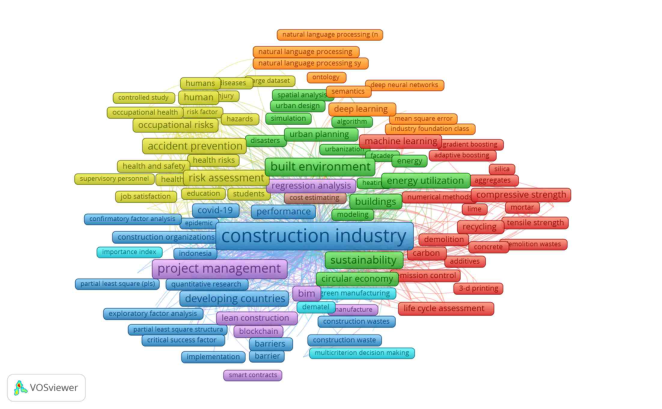
FINDINGS The findings of the study are presented in Figure 1 and Table 1. Figure 1 represents a visualization of a co-occurrence network of terms from a body of research. The clusters are color-coded and represent different thematic areas. Table 1 presents the clusters showing the research focus areas and the research methodology based on the clusters in Figure 1.
Figure 1: Network visualisation.Table 1: Clusters of the research focus and research methodology.
Table available in the original PDF paper.
Area Methodology
1
3D printing Forecasting Linear regressing Machine learning Multi-objective optimisation Neural networks Numerical methods Optimisation algorithm Predictive modelling Random forest
Additive manufacturing Building lifecycle Building materials Carbon footprint Digital fabrication Embodied carbon Intelligent building Lifecycle analysis Modular buildings Recycling Robotics Shape optimisation Structural design Structural optimisation Sustainability performance Timber construction
2
Adaptive management Agent-based model Behavioural research Comparative analysis Complex networks Computational fluid dynamics
Autonomous agents Building design and energy Business models Climate models Decarbonisation
Continued
Digital Transformation and the Construction Industry Research Landscape 1945
Table 1: Continued Area Methodology
Table available in the original PDF paper.
Decision support system Numerical model Qualitative assessment System theory Disaster mgt Energy savings Energy conservation Green building Green economy IAQ IEQ Occupant model Performance assessment Sensor Smart city Solar buildings Spatial analysis Sustainable cities Travel behaviour Thermal comfort Urban development and design Urban design/transport User experience Zero carbon
3
Cloud computing Computation theory CFA Correlation methods Descriptive stats EFA Least square approximation Mixed method Multivariate analysis PLS PCA Quantitative research Questionnaire surveys Reliability analysis Statistical mechanics
Construction 4.0 Construction business Construction education Construction enterprise Construction innovation Construction labours Construction performance Construction practice Construction stakeholders Construction technology Construction waste Construction workforce CSR Digital construction Economic analysis Emerging technologies Innovative approaches IoT Laws and legislation Natural resource management Project performance Project success Resource allocation Quantity Surveying
Continued
Table 1: Continued Area Methodology
Table available in the original PDF paper.
Value management Work life balance Decision making process
4
Accident prevention ANN Bayesian network Controlled study Grounded theory Fuzzy logic Discrete event simulation Interview Meta analysis mixed method research Online questionnaire Qualitative approach /research Questionnaire surveys SEM Systems thinking
AR Communication Construction accidents construction equipment Construction operations Construction Safety Construction site safety Construction work/worker Curricula E-learning Engineering education Exoskeleton Hazard identification Human engineering Human experiment Human resource management Education computing Environmental regulation Education and learning Immersive VR Job satisfaction Leadership Machinery Mental health Mixed reality Musculoskeletal disorder/system Occupational safety and risks Organisational culture Organisational learning Performance evaluation Personnel training PPE Information analysis Risk factors/perceptions Safety engineering Safety management Social sustainability Technology adoption Transformational leadership Wearable technology Unsafe behaviours Wages
Continued
Digital Transformation and the Construction Industry Research Landscape 1947
Table 1: Continued Area Methodology
Table available in the original PDF paper.
5
BIM Case based reasoning Case study Comparative studies Design science research ISM Multiple case study Theoretical modelling
Blockchain technology Construction contract Construction engineering Construction management Productivity Construction supply chain Industrialised construction Information dissemination Knowledge management Knowledge transfer Lean construction Logistics Maturity model Mega projects Modular construction Modern methods of construction Offsite construction Policy making Prefabrication Project management Project delivery PPP Quality mgt Small and medium sized enterprises Smart contract Stakeholder mgt Value engineering
6
Adoption barriers AHP Delphi method DEMATEL Fuzzy AHP Game theory Multi Criteria decision making Multicriteria analysis Relative importance index
Cost analysis Cost overrun Green construction Lifecycle costing Project delays Project risk mgt Scheduling Sustainability assessment Uncertainty analysis
7
AI Cluster analysis Convolutional neural network Deep neural networks
Automation Big data Building codes Compliance control
Continued
Table 1: Continued Area Methodology
Table available in the original PDF paper.
Construction engineering k Means clustering Learning algorithms Natural language processing Object detection
Cost engineering CPS Data acquisition Data handling Data mining Deep learning Digital twins Embedded systems Facilities management Industrial foundation classes IoT Interoperability Real-time systems Regulatory compliance Unmanned aerial vehicle Transfer learning
8
Construction markets Monte Carlo methods Questionnaire survey Semi-structured interview Stochastic systems Text mining
Cost-benefit analysis Cost estimating Highway engineering Intelligent systems International construction International trade Strategic management Social implication
A quick look at the clusters shows that they are majorly a nexus of emerging technologies and other aspects of innovation and various construction industry practices. Below is each cluster with the theme name ascribed based on the constituent keywords and the research methodology approaches adopted.
Cluster one (emerging technologies and sustainable construction) This cluster primarily focuses on predictive analytics and optimization techniques. It utilizes linear regression, machine learning (including neural networks and random forests), numerical forecasting and predictive modelling methods. Multi-objective optimization and optimization algorithms are used to optimize various parameters within models.
Cluster two (nexus of Smart technologies, Sustainable urban development and management models) This cluster involves a mix of methodologies focused on understanding complex systems and behaviours. Agent-based modelling, comparative analysis, and computational fluid dynamics are used to simulate and analyze
Digital Transformation and the Construction Industry Research Landscape 1949
systems with multiple interacting agents/components. Qualitative assessment and system theory are employed to understand the behaviour of these systems on a conceptual level.
Cluster three (digital transformation and construction industry product and processes) This cluster revolves around quantitative research methods and statistical analysis techniques. It includes methods such as computation theory, multivariate analysis (including PCA and PLS), and correlation methods for analyzing relationships and patterns in data. Descriptive statistics, reliability analysis, and questionnaire surveys are used to gather and analyze quantitative data.
Cluster 4 (Technology, education and well-being) This cluster encompasses a range of methodologies, including both quantitative and qualitative approaches. It includes techniques such as artificial neural networks (ANN), Bayesian networks, and fuzzy logic for modelling complex systems and decision-making processes. Grounded theory, interviews, and qualitative approaches are employed for in-depth understanding, collection and interpretation of data.
Cluster 5 (Construction efficiency and management) This cluster is centred around case-based research methodologies. It includes methods such as case studies, comparative studies, and multiple case studies for analyzing specific instances within a broader context. Design science research and theoretical modelling are used to develop and test theories.
Cluster 6 (Enhancing sustainability) This cluster focuses on decision-making methodologies and techniques for evaluating alternatives. Analytic Hierarchy Process (AHP), Delphi method, and multicriteria analysis are used for decision-making, forecasting and prioritization. Fuzzy AHP and fuzzy logic are employed to handle uncertain data.
Cluster 7 (Efficient data management and exchange) This cluster involves methodologies related to data analysis and pattern recognition. It includes techniques such as cluster analysis, convolutional neural networks (CNN), and deep neural networks for identifying patterns and clusters within data. Natural language processing (NLP) is used for analysing textual data and object detection for identifying objects within images.
Cluster 8 (international construction business) This cluster primarily utilizes probabilistic and stochastic methods for modelling and analysis. Monte Carlo methods are employed for simulating complex systems with uncertainty, while stochastic systems are used to model
systems with random behaviour. Text mining and questionnaire surveys are utilized to gather and analyze textual and survey data.
A critical look at these clusters shows that diverse methodologies have been employed. Some are solely quantitative, while some are qualitative, and some are mixed. However, it will be interesting to see researchers applying other types of methodology that are currently not being adopted in each area. Be that as it may, the researcher is still under the obligation to adopt the right methodology, which is appropriate for the study, based on the study context (Kumar, 2011). It is also worth noting that the research landscape is changing and undergoing a disruptive transformation, as is the case with industry. Most applied data collection and analysis methods are adopting emerging technologies, e.g. AI, ML, etc.
IMPLICATIONS The digital revolution has substantially changed research methods, particularly in the construction industry. Traditional research, which often focused on either qualitative or quantitative methods, is increasingly being replaced or complemented by mixed methods approaches. This change is primarily driven by the need for more robust and data-driven insights, which digital tools and technologies can better facilitate. As observed in the findings, researchers are increasingly adopting technology-driven methodologies, including artificial intelligence (AI), machine learning (ML), and predictive modelling, which offer the ability to process large datasets and generate previously unattainable insights using conventional methods.
The bibliometric review conducted in this study reflects a broader trend across industries, where digital tools enable more sophisticated data collection and analysis methods. For example, the use of visualization software like VOSviewer helps researchers to analyze vast amounts of data, identify trends, and establish correlations between different variables. This represents a significant departure from traditional approaches, which often relied on manual analysis and simpler statistical tools.
The digital revolution has also led to a democratization of data. With greater access to databases and real-time data analysis tools, researchers are no longer confined to isolated case studies or small data samples. Instead, they can analyze global trends, incorporate large datasets, and apply sophisticated modeling techniques to predict outcomes or optimize processes. This shift has enhanced the precision and relevance of research findings, making them more applicable to real-world scenarios.
CONCLUSION
The study focused on identifying the research methodologies being adopted by researchers in the present technological revolution and how digital transformation in the construction industry has catalyzed a shift in research methodologies. It was observed that researchers are moving more towards adopting mixed methods research. Also, researchers are adopting technology-driven research methods (data collection and analysis). The move
Digital Transformation and the Construction Industry Research Landscape 1951
towards mixed methods, with an increasing emphasis on technology-driven approaches like machine learning, neural networks, and predictive analytics, signals that the research landscape is not only evolving but also adapting to the complexities introduced by modern technologies. This shift implies that future research will likely focus on more comprehensive data integration and real-time analysis, fostering innovation and improved decision-making processes in construction practices. However, it is important to research the adequacy of existing philosophies, theories, and approaches to emerging research trends. This is important as the disruption caused by technology significantly impacts existing approaches, even in the construction industry and other sectors. Furthermore, researchers should explore the impact of the emerging data analysis methods on the research outcomes and impact. A comparative analysis can be done on the traditional and emerging research methods to identify the depth of data interpretation they offer.
REFERENCES
Adekunle, S. A., Aigbavboa, C. O., Ejohwomu, O. A., Ogunbayo, B. F. and Ikuabe, M.
(2023) ‘Intricacies and lifeline for the construction industry amidst the coronavirus pandemic’, Construction Safety, Health and Well-being in the COVID-19 era, pp. 243–257. Available at: https://doi.org/10.1201/9781003278368–21. Adekunle, S. A., Aigbavboa, C. O., Ejohwomu, O., Adekunle, E. A. and Thwala, W. D. (2021) ‘Digital transformation in the construction industry : a bibliometric review’, Journal of Engineering, Design and Technology, (2013), pp. 1–29. Available at: https://doi.org/10.1108/JEDT-08–2021-0442. Adekunle, S. A., Ejohwomu, O. and Aigbavboa, C. O. (2021) ‘Building Information Modelling Diffusion Research in Developing Countries: A User Meta-Model Approach’, Buildings, 11(7), p. 264. Available at: https://doi.org/10.3390/ buildings11070264. Aghimien, D. O., Aigbavboa, C. O., Oke, A. E. and Thwala, W. D. (2019) ‘Mapping
out research focus for robotics and automation research in construction-related studies: A bibliometric approach’, Journal of Engineering, Design and Technology [Preprint]. Available at: https://doi.org/10.1108/JEDT-09–2019-0237. Creswell, J. W. (2014) Research Design, Sage. Available at: https://doi.org/10.1192/ bjp.111.479.1009-a. Ejohwomu, O., Adekunle, S. A., Aigbavboa, O. C. and Bukoye, T. (2021)
‘Construction and Fourth Industrial Revolution: Issues and Strategies’, in P. (Editor) Emmanuel Adinyira, PhD (Editor), Kofi Agyekum (ed.) The Construction Industry: Global Trends, Job Burnout and Safety Issues.. First. Nova Science Publishers. Available at: https://doi.org/https://doi.org/10.52305/JDFM1229. Kumar, R. (2011) Research Methodology: a step-by-step guide for beginners. 3rd edn. London: SAGE Publications Ltd. MacDonald, S., & Headlam, N. (2014) Research Methods Handbook, Introductory
Guide to Research Methods for Social Research. Manchester, Manchester: Centre for Local Economic Strategies. The Centre for Local Economic Strategies (CLES). Available at: www.cles.org.uk (Accessed: 24 May 2021). Olawumi, T. O., Chan, D. W. M. and Wong, J. K. W. (2017) ‘Evolution in the intellectual structure of BIM research: A Bibliometric analysis’, Journal of Civil Engineering and Management, 23(8), pp. 1060–1081. Available at: https:// doi.org/10.3846/13923730.2017.1374301.
Saka, A. B., Olawumi, T. O. and Chan, D. W. M. (2019) ‘A Systematic Literature Review of Building Information Modelling in the Nigerian Architecture, Engineering, and Construction (AEC) Industry – The Case of Nigeria’, in Environmental Design & Management International Conference (EDMIC) 2019: Drivers and Dynamics of Change in the Built Environment, pp. 95–97. Saunders, M. N., Lewis, P. and Thornhill, A. (2019) Research Methods for Business students. 8th edn. Available at: www.pearson.com/uk (Accessed: 13 February 2021). Sotirios Sarantakos (2013) Social Research. Palgrave. van Eck, N. J. and Waltman, L. (2019) ‘Manual for VOSviewer version 1.6.10’,
Univeristeit Leiden. The Netherlands. Available at: http://www.vosviewer.com/ documentation/Manual_VOSviewer_1.6.1.pdf.
LISTED IN THE AHFE DIGITAL BOOKSTORE CATALOGUE
Explore the complete digital volume
Human Factors in Design, Engineering, and Computing
Read this individual research paper free through the original publisher, or explore the full digital proceedings book.
ISBN 978-1-964867-75-5
Explore this ISBN in the AHFE Bookstore ↗Listed in the July 2026 bookstore catalogue; search by ISBN to confirm current availability · Digital book purchase optional