Vasja Plesec, Blaž Hanželič, Gregor Harih (2024). Development of a Metamaterial Numerical Model for Improving 3D-Printed Lower-Limb Prosthetic Liners. In: Human Systems Engineering and Design (IHSED2024): Future Trends and Applications. AHFE Open Access, vol. 158, pp. 228–238. https://doi.org/10.54941/ahfe1005546
Lower limb prosthetic liners predominantly consist of solid elastomers or foam-like polymers, offering minimal room for customization due to constraints in the manufacturing process and materials used. The non-linear material characteristics of biological tissue and the intricate geometry of residual limbs underscore the importance of tailored prosthetic liners to enhance comfort and ensure stability within the liner-prosthesis interface. Additive technologies, particularly 3D printing, enable the rapid manufacturing of intricate shapes using diverse, flexible materials, facilitating extensive customisation. This study focuses on investigating the mechanical properties of 3D-printed metamaterial structures, exploring variations in types of unit cells and cellular density. Through the development of material models and subsequent analysis employing uniaxial compression test results and numerical simulations, this research aims to assess the potential of 3D-printed metamaterial structures in tailoring lower-limb prosthetic liners to provide lower and more uniform contact pressure between the residual limb and the prosthesis while ensuring the stability of the prosthesis.
Prosthetic liners currently in use present several significant challenges, including high costs, limited customization options, and inadequate accommodation for volume changes in the residual limb, particularly for incompressible elastomeric liners (Cagle et al., 2018). A promising alternative involves the utilization of flexible metamaterial cellular structures, which can be tailored to deliver specific mechanical responses by adjusting parameters such as wall thickness, cell size, cell type, and base material.
The innovative approach of employing metamaterial cellular structures as prosthetic liners aims to mitigate contact pressure and enhance user comfort, while also compensating for volume fluctuations in the residual limb through liner deformation. Crucially, this deformation must not compromise stability or result in excessive overall deformation compared to currently used liners. Therefore, it is desirable for the cellular structure to maintain relative stiffness until nearing the pain pressure threshold, ensuring stability
while primarily allowing for soft tissue deformation. As the pain pressure threshold is approached, the cellular liner should begin to deform to distribute pressure over a larger area, thereby minimizing stress concentration and preventing discomfort. It is important to note that the pain pressure threshold is a subjective parameter that varies among individuals with lower limb amputations. Considering that some patients may have difficulty detecting pain, it is essential to explore alternative methods for designing the metamaterial cellular liner, rather than relying solely on the pain pressure threshold.
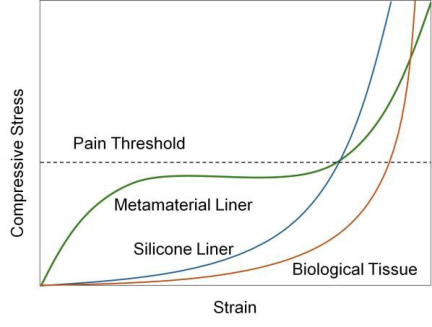
The deformation mechanism of the cellular structure includes a plateau region where deformation occurs under nearly constant stress, facilitating pressure redistribution and enhancing comfort. Figure 1 illustrates a schematic depiction of the liner, the biological soft tissue, and the silicone liner response on the stress- strain diagram, encompassing the pain threshold. The adaptability in material properties offered by metamaterial cellular structures makes the realization of these objectives feasible.
Utilizing 3D-printing technology in the fabrication of prosthetic liners presents several benefits, including the ability to customize the liner shape to conform to the residual limb’s morphology, the potential to produce cellular structures, and the capacity for cost-effective and rapid production (Yang et al., 2023). These advantages could significantly enhance the customization of prosthetic liners. In addressing this issue, various metamaterial designs have been investigated through numerical analysis in the present study. The subsequent sections detail the identification of cellular structures, development of metamaterial numerical model, and numerical analysis using a generic transtibial limb combined with a 3D-printed socket fabricated with Polylactic Acid (PLA) filament.
Figure 1: Schematic representation of cellular liner, soft tissue, and silicone liner response in a stress-strain chart, including pain threshold level.
IDENTIFICATION OF METAMATERIAL UNIT CELLS The extensive range of mechanical properties achievable through the design of metamaterial cellular structures has attracted significant attention for their potential applications in various technological domains (Hudak et al., 2022, Robinson et al., 2017, Novak et al., 2023). These structures possess advantageous properties such as lightweight construction, shock absorption, acoustic and thermal insulation, and high adaptability, often surpassing traditional materials in engineering applications (Gibson and Ashby, 2001). In biomechanics, the application of flexible structures is particularly valuable for improving interactions between soft tissue and products. These structures can be precisely designed to deform at specific pressure levels, thereby reducing stress concentration (Cupar et al., 2021). By controlling the base material, cell morphology (open or closed), topology, geometry, and relative density (the ratio between cell size and the density of the base material), cellular structures can be engineered to achieve notable improvements for specific applications (Kreši´c et al., 2023).
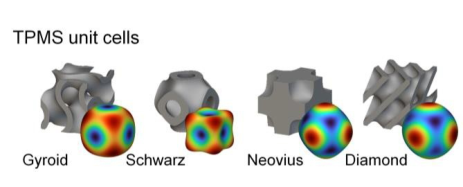
Cellular materials exhibit anisotropic behavior, which is dependent on the characteristics of the unit cell due to their porous structure. The unit cell, as the fundamental building block of the cellular structure, plays a crucial role in determining the mechanical properties of the overall structure. To identify the optimal unit cell with the highest degree of isotropy, various cell designs were investigated in the current study using nTopology (nTopology Inc., New York, USA). The primary objective of this investigation was to determine the cell design with the most isotropic response. An isotropic response of the cellular structure is desirable due to the intrinsic loading conditions experienced during prosthesis use, where stress occurs in various directions. Of particular interest were Triply Periodic Minimal Surface (TPMS) structures, which are mathematical constructs defining surfaces using three periodic functions in three dimensions, due to their ability to provide a continuous and smooth surface that can enhance mechanical performance and provide uniform pressure distribution (Novak et al., 2021). These structures are frequently used in materials science, especially in developing metamaterials with distinctive characteristics (Yang et al., 2019). Common TPMS structures analyzed in this study are shown in Figure 2, along with a spatial representation of the stiffness matrix, where higher stiffness values are depicted in red and lower values in blue.
Figure 2: Identification of metamaterial unit cells. Commonly used TPMS structures with a special representation of the stiffness matrix.
Development of a Metamaterial Numerical Model 231
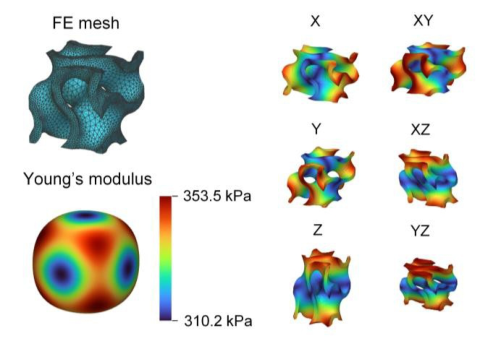
The geometry of the unit cell was initially created within a volume of 6 mm × 6 mm × 6 mm with a wall thickness of 1 mm to match the liner thickness. The unit cells were then meshed, and a Finite Element Analysis (FEA) was performed automatically using nTopology software, as shown in Figure 3. Six distinct loading conditions were examined – three normal and three shear directions – resulting in the development of a 6 × 6 stiffness matrix (Equation (1) and (2)).
Figure 3: Finite element analysis of the unit cell to determine its stiffness matrix.
This study examined the modulus of elasticity in three-dimensional space as a measure of the stiffness of cellular units in various directions. The material used in the simulation was thermoplastic polyurethane (TPU), defined by a modulus of elasticity of 2410 MPa and a Poisson’s ratio of 0.3897. The selection of the unit cells analyzed was based on the percent difference between the maximum and minimum values of the modulus of elasticity. It is important to emphasize that the modulus range is independent of the material used and instead relies on the topological, morphological, and geometrical characteristics of the unit cells.
Table 1 presents the variation between the maximum and minimum stiffness of the unit cells. The Gyroid and Neovius TPMS unit cells demonstrated the most favorable outcomes, with modulus ranges of 12.2 % and 11.52 %, respectively. Given the marginal discrepancy between these two unit cells, the Gyroid structure was selected for further numerical analysis due
to its widespread use and ease of 3D-printing, as commercial slicers typically include Gyroid structures as infill patterns.
Table 1. Variation in unit cell stiffness, expressed as percentage difference between maximum and minimum values.
Table available in the original PDF paper.
TPMS unit cell Maximum Young’s modulus range Gyroid 12.2 % Schwarz 45.8 % Neovius 11.5 % Diamond 17.7 %
METAMATERIAL NUMERICAL MODEL The initial analysis of the unit cells showed that the gyroid structure exhibited near- isotropic material properties and was an excellent candidate for prosthetic liner applications due to its straightforward fabrication using 3D-printing techniques. However, since the thickness of individual cells matched that of the liner, using a homogenized model derived directly from the unit cell identification in FE simulations produced inaccurate numerical results. To effectively employ the homogenized material model in an FEA, the structure needed a thickness approximately ten times that of a single cell to minimize the influence of the wall. Additionally, the unit cell identification analysis did not take the cellular structure’s wall into account.
Considering these factors, the mechanical behavior of the 3D-printed gyroid structure composed of flexible TPU material was evaluated using compression test data from our previous studies. The samples, measuring 30 mm x 30 mm, were fabricated with a FFF 3D printer, utilizing TPU filament with a shore hardness of 98A supplied by AzureFilm (AzureFilm d.o.o., Sežana, Slovenia) under the trade name Flexible 98A. This material is non-corrosive, exhibits minimal skin irritation, and has a melting point exceeding 100
C, ensuring its safety for products intended to contact biological tissue.
The mechanical response of gyroid-structured specimens was previously characterized through uniaxial compression tests at a testing speed of 110 mm/min, with infill densities of 6 %, 10 %, and 14 %. Infill density denotes the proportion of the internal volume occupied by solid material relative to the structure’s total volume. These specific densities have been chosen based on our previous studies and tests which have shown that they provide distinct behaviours corresponding to soft, medium and hard structural properties (Cupar et al., 2021).
To develop a stable numerical representation of the mechanical behaviour of 3D printed metamaterial cellular structures, a multilinear elastic material model (MELAS) was used based on previously published measurements (Cupar et al., 2021). The MELAS model approximates the mechanical behaviour of the cellular structure without directly incorporating its intrinsic geometry, thereby ensuring numerical stability during FEA. In contrast, using
Development of a Metamaterial Numerical Model 233
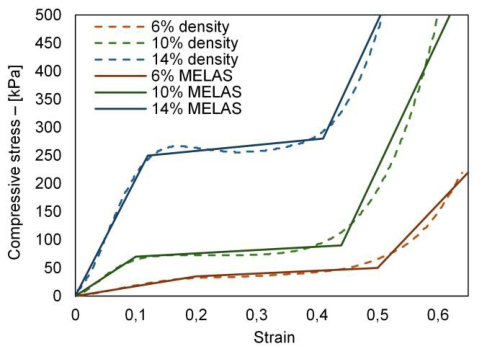
a hyperelastic material model to fit the response curves would typically introduce numerical instability. Consequently, the stress-strain curves of the structures were manually fitted with three distinct slopes for each material: the initial slope representing the structure’s stiffness, the plateau region, and the steep slope corresponding to the densification phase of deformation. A notable difference in stiffness between the 6 % and 14 % density structures was observed, suggesting the potential for selectively designing cellular structures to achieve desired mechanical properties. The stress-strain results from the uniaxial compression tests, along with the corresponding MELAS models, are presented in Figure 4.
Figure 4: Results from the uniaxial compression test featuring 6 %, 10 %, and 14 % gyroid infill patterns. Solid lines indicate MELAS models applied in numerical simulations, capturing the hyperelastic behavior of the cellular structures.
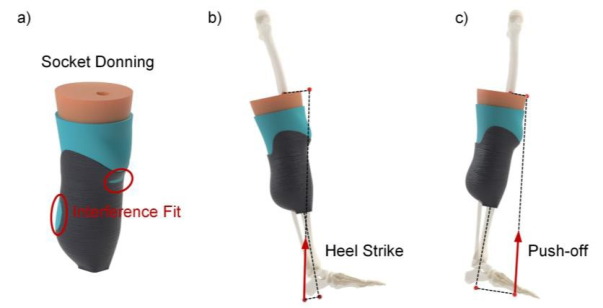
NUMERICAL ANALYSIS OF RESIDUAL LIMB – PROSTHESIS SYSTEM A previously developed and numerically validated generic transtibial model was used to assess the efficacy of cellular liners with varying densities (Plesec and Harih, 2023). This model was integrated with a rectified socket (total- surface- bearing rectification, TSB) fabricated from 3D-printed PLA material and subjected to loading conditions representative of real-life scenarios. Initially, the prosthesis was donned on the developed generic numerical transtibial limb model (Figure 5a) and subsequently exposed to loading conditions specified in the ISO 10328 P5 I (heel strike) and P5 II (push- off) at settling test force (Plesec et al., 2023). These conditions correspond to the heel strike and push-off phases of the normal gait cycle, respectively (Figure 5b and 5c). The material properties of the cellular liner were defined using the MELAS model, as detailed in the previous section.
The objective of the analysis was to obtain numerical results concerning contact pressure at the limb-liner interface, as well as the total deformation of the liner. This was done to evaluate the effectiveness of cellular liners
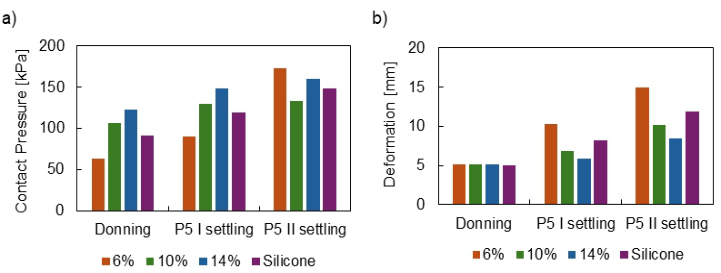
compared to commonly used silicone liners. The maximum contact pressure values at the residual limb-liner interface and the maximum deformation of the liner under varying loading conditions are depicted in Figure 6. The maximum deformation results encompass both deformation and translation of the liner, aiming to assess its influence on stability. Additionally, Table 2 summarizes the numerical results obtained from the simulation, with the best results (minimal pressure and deformation) for each load case highlighted in bold.
Figure 5: Loading conditions: a) prosthesis donning, b) heel strike and c) push-off based on the ISO 10328 settling test force.Figure 6: Numerical analysis results for donning, heel strike and push-off loading conditions: a) maximum contact pressure at residual limb – liner interface and b) maximum liner deformation.
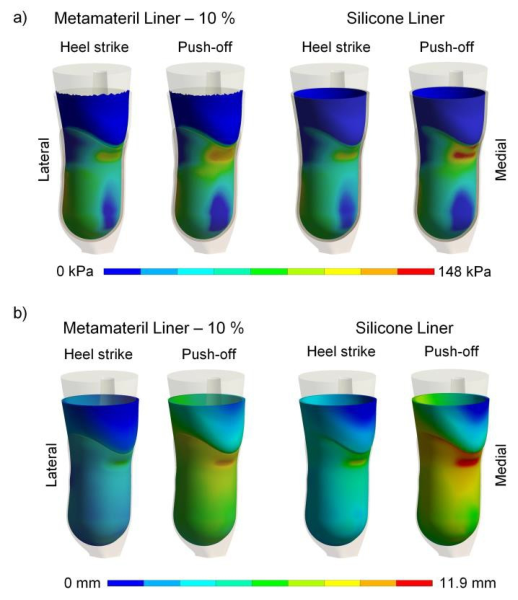
Beyond peak values, the distribution of pressure and deformation is also critical for evaluating the liners. Therefore, a comparative analysis of the pressure distribution and total deformation distribution between a 10 % gyroid structure and a silicone liner, utilizing a colour map, is presented in Figure 7.
Figure 7: Distribution comparison between metamaterial liner (10 %) and silicone liner: a) contact pressure and b) total deformation.
Contact pressure is a widely recognized criterion for evaluating the comfort of lower limb prostheses (Moerman et al., 2016). Our numerical simulations assessed the contact pressure between the residual limb and cellular liners with varying infill densities, comparing these results to those obtained with silicone liners. During the donning phase, the liner with 6 % infill density exhibited a 31 % reduction in peak contact pressure compared to
the silicone liner. Conversely, liners with 10 % and 14 % infill densities increased peak pressure by 17 % and 35 %, respectively. Notably, all contact pressures during this phase remained significantly below the lowest reported pain pressure threshold of 350 kPa (Lee, 2006). Although the donning phase typically does not exceed this threshold, prolonged stress can lead to discomfort over time.
The numerical outcomes for the P5 I load case, simulating the heel strike during gait, differed from the donning phase results. The 6 % infill liner reduced the maximum contact pressure by 24.4 % compared to the silicone liner. In contrast, both 10 % and 14 % dense infill liners performed worse than the silicone liner, indicating that these denser structures are too stiff for heel strike conditions and TSB socket rectification.
Under push-off conditions, the 10 % infill structure performed best, reducing peak contact pressure by 10.1 % compared to the silicone liner. On the other hand, the 6 % infill structure produced the highest contact pressure due to its excessive softness, leading to premature deformation and increased contact pressure.
Similarly, the 14% infill structure did not reduce the contact pressure adequately, thus unlikely to improve comfort. However, it is noteworthy that all contact pressures from heel strike and push-off phases were well within the reported pain threshold (Lee, 2006).
Our results demonstrate that the density of metamaterial cellular structures significantly affects peak contact pressure and its distribution. Softer structures performed better under lower loads, while medium- density structures were more effective under higher loads. Extremely sparse structures compressed prematurely under high loads, increasing contact pressure, whereas overly dense structures were too stiff during donning, reducing overall comfort. Nevertheless, in all load cases, the specific metamaterial cellular liner outperformed the frequently used silicone liner in reducing peak contact pressure. By adjusting cellular structure parameters, customized 3D-printed liners can be fabricated to effectively reduce contact pressure for specific cases.
Prosthesis stability, indicated by displacement, is critical to patient safety as excessive movement within the socket can compromise stability during use. During the donning phase, liner deformation was consistent across all liner types, with deformation ranging from 5.0 mm to 5.1 mm. These minimal deformation variations affect contact pressure redistribution, indicating that softer liners are better at reducing peak pressure during donning.
Significant deformation variations were observed during heel strike. The liner with the 14 % infill density performed best, reducing deformation by 2.3 mm compared to the silicone liner. The 10 % dense cellular liner also reduced deformation by 1.4 mm in comparison to the silicone liner, whereas the 6 % dense liner increased deformation by 2.1 mm. As expected, stiffer structures experienced less deformation, thereby enhancing stability. During push-off, the 6 % infill liner increased deformation compared to the silicone liner by 3 mm. In contrast, the 10 % and 14 % infill densities reduced deformation by 1.8 mm and 3.7 mm, respectively.
Development of a Metamaterial Numerical Model 237
Overall, our study highlights the potential of 3D-printed cellular liners to improve prosthetic comfort and stability by controlling metamaterial cellular structure parameters, presenting a promising approach for personalized prosthetic solutions.
CONCLUSION
Metamaterial cellular structures influence both comfort and stability, and by strategically adjusting their parameters, it is feasible to develop tailored and improved prosthesis liners using additive manufacturing technology. Denser infill structures may be more suitable for individuals who prioritize stability and can tolerate higher contact pressures, while less dense structures benefit those who prioritize comfort. Customized cellular structures can address pain sensitive areas on the residual limb, providing necessary flexibility. The numerical results from this study indicate that tailored metamaterial cellular liners could improve comfort by reducing contact pressure without increasing deformation, presenting a promising alternative to the commonly used silicone liners.
ACKNOWLEDGMENT
The authors acknowledge the financial support from the Slovenian Research and Innovation Agency (Research Core Funding No. P2-0063).
REFERENCES
Cagle, J. C., Hafner, B. J., Taflin, N. & Sanders, J. E. 2018. Characterization of prosthetic liner products for people with transtibial amputation. Journal of Prosthetics and Orthotics, 30, 187–199. Cupar, A., Kaljun, J., Dolšak, B. & Harih, G. 2021. 3D printed deformable product
handle material for improved ergonomics. International journal of industrial ergonomics, 82, 1–7. Gibson, L. J. & Ashby, M. F. 2001. Cellular solids: Structure and properties, Cambrige, Cambridge Univesity Press. Hudak, Y. F., Li, J.-S., Cullum, S., Strzelecki, B. M., Richburg, C., Kaufman,
G. E., Abrahamson, D., Heckman, J. T., Ripley, B., Telfer, S., Ledoux, W. R., Muir, B. C. & Aubin, P. M. 2022. A novel workflow to fabricate a patient-specific 3D printed accommodative foot orthosis with personalized latticed metamaterial. Medical Engineering & Physics, 104, 103802. Kreši´c, I., Kaljun, J. & Rašovi´c, N. The influence of different seed positions on mechanical properties of stochastic structures with semi-controlled nodes. 2023 International Conference on Applied Mathematics & Computer Science (ICAMCS), 8–10 Aug. 2023. 118–121. Lee, W. C. C. 2006. Computational and experimental analysis of the use of lower
-limb prostheses, concerning comfort, structural design and gait performance. ProQuest Dissertations Publishing. Moerman, K., Sengeh, D. & Herr, H. 2016. Automated and Data-driven Computational Design of Patient-Specific Biomechanical Interfaces. Germany, Europe: engrXiv.
Novak, N., Al-Ketan, O., Krstulovi´c-Opara, L., Rowshan, R., Abu Al-Rub, R. K., Vesenjak, M. & Ren, Z. 2021. Quasi-static and dynamic compressive behaviour of sheet TPMS cellular structures. Composite Structures, 266, 113801. Novak, N., Plesec, V., Harih, G., Cupar, A., Kaljun, J. & Vesenjak, M. 2023.
Development, fabrication and mechanical characterisation of auxetic bicycle handlebar grip. Scientific Reports, 13, 8158. Plesec, V. & Harih, G. 2023. Development of a Generic Numerical Transtibial Model for Limb-Prosthesis System Evaluation. Applied Sciences, 13, 2339. Plesec, V., Humar, J., Dobnik-Dubrovski, P. & Harih, G. 2023. Numerical Analysis
of a Transtibial Prosthesis Socket Using 3D-Printed Bio-Based PLA. Materials, 16, 1985. Robinson, M., Soe, S., Mcshane, G., Celeghini, R., Burek, R., Alves, M., Hanna, B. & Theobald, P. Developing elastomeric cellular structures for multiple head impacts. Conference proceedings International Research Council on the Biomechanics of Injury, IRCOBI, 2017. 182–189. Yang, E., Leary, M., Lozanovski, B., Downing, D., Mazur, M., Sarker, A.,
Khorasani, A., Jones, A., Maconachie, T., Bateman, S., Easton, M., Qian, M., Choong, P. & Brandt, M. 2019. Effect of geometry on the mechanical properties of Ti-6Al-4V Gyroid structures fabricated via SLM: A numerical study. Materials and Design, 184, 108165. Yang, X., Zhao, R., Solav, D., Yang, X., Lee, D. R. C., Sparrman, B., Fan, Y. & Herr, H. 2023. Material, design, and fabrication of custom prosthetic liners for lower-extremity amputees: A review. Medicine in Novel Technology and Devices, 17, 100197.
LISTED IN THE AHFE DIGITAL BOOKSTORE CATALOGUE
Explore the complete digital volume
Human Systems Engineering and Design (IHSED2024): Future Trends and Applications
Read this individual research paper free through the original publisher, or explore the full digital proceedings book.
ISBN 978-1-964867-34-2
Explore this ISBN in the AHFE Bookstore ↗Listed in the July 2026 bookstore catalogue; search by ISBN to confirm current availability · Digital book purchase optional