Zuk Turbovich (2024). Design Methodology for Product Designers in the Context of Domestic 3D-Printing. In: Human Interaction and Emerging Technologies (IHIET-AI 2024): Artificial Intelligence and Future Applications. AHFE Open Access, vol. 120, pp. 380–390. https://doi.org/10.54941/ahfe1004589
The study examined the domestic use of desktop 3D printers, recognizing that this market is still in a developmental stage, which will impact the overall products market. The study's goal focused on providing a straightforward understanding of the field to benefit its promotion by tutors and current or future interested parties. The study examined several precedents for focusing the technology on home end-users and reviewed the current situation in the market. The primary research findings include an illustration of the value chain changes that connect design sources and end-users, a taxonomy matrix of product types in the market, and a design methodology aimed at efficiently reflecting the design process and its application. The proposed methodology is structured on the basis of frameworks of design methodologies reviewed as part of the study. It presents an updated structure that includes aspects unique to the field. The discussion chapter focused on summarizing the possibilities inherent to the field concerning different perspectives.
Several additive manufacturing (AM) technologies are at a stage where they are evolving from being technologies that are solely capable of producing prototypes to such that can also produce functional parts. The transmis- sion housing of Boeing’s Chinook helicopter (Boeing, 2022), which was 3D printed and tested in practice, and General-Electric’s GE9X jet engine (GE Reports, 2020), which includes 3D printed parts, are two examples from the aviation industry. Two additional examples from the marine rehabilita- tion field include the large-scale 3D printed oyster reef, designed by “Reef Design Lab”, a studio from Australia (Reef Design Lab, 2017), and the “xCoral” project held by a group of Israeli researchers (Levy et al., 2023). These solutions represent projects produced by industrial and experimen- tal AM systems, which, according to the Wohlers Report, are being used to produce functional parts in approximately 50% of cases as follows: end- use parts (31.5%), jigs/fixtures (7.2%), polymer patterns/molds (7.2%), and metal tooling (3.7%) (Wohlers Reports, 2021). Another segment of AM systems that, unlike industrial AM systems, is affordable and accessible to the general public is the desktop 3D printers that are geared to home/office
Design Methodology for Product Designers in the Context of Domestic 3D-Printing 381
environments. The Wohlers Report indicates that sales of desktop 3D print- ers are often non-traditional and can be difficult to track. This is because countless small companies around the world, including many startups, pro- duce and sell machines (Wohlers Report, 2021). In this context, the report indicates that an estimated 753,211 desktop 3D printers were sold in 2020, and that this market portion has been constantly growing since it was first reviewed in 2007. While it is challenging to track this market share, countless designs featured on file-sharing sites, e.g., Thingiverse, GRABCAD, MyMini- Factory, and others, suggest that home users also use functional products produced fully or partially by domestic desktop 3D printers. Transformative change happens when industries democratize, when they’re ripped from the sole domain of companies, governments, and other institutions and handed over to regular folks (Anderson, 2014). Following this statement, the pos- sibility of general public owning automated means of production has the potential to bring about transformative change in the market of home con- sumer goods. Additionally, to maximize the value of the products for both the design rights holders and the end-users, it is essential to acknowledge the changes in the value chain that connect these two factors. The decen- tralization of the means of production, from a single power source or a limited number of power sources to the end-users, significantly impacts the entire value chain and affects the product design process based on the types of products that are prevalent in the market. Therefore, the study exam- ined the domestic 3D printer market’s nature in order to formulate a design methodology for product designers and engineers. The goal was to provide a simple understanding of the constraints and main possibilities inherent in the field and a tool that can assist in maintaining an efficient design process.
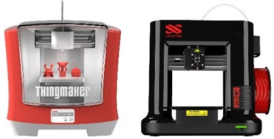
THE DOMESTIC 3D PRINTING MARKET Among the various 3D printing techniques, the Fused Filament Fabrication (FFF) printing technique, also known as Fused Deposition Modeling (FDM), is the most popular method for desktop 3D printers. The reason for this lies in the fact that 3D printers operating according to this method are accessible and offered at a relatively affordable price to the general public. According to the 2022 Sculpteo report, 82% of respondents who reported owning a desktop 3D printer use the FFF method for local printing, followed immediately by the Stereolithography (SLA) method at 66% (Sculpteo, 2022). However, the report does not specify whether the local use is for domestic or business pur- poses. In this report, 25% of all respondents are not professionally classified, which could imply that some are home users. In general, manufacturers and marketers of 3D printers with compact dimensions tend to promote them as desktop 3D printers, primarily targeting professional users rather than home users. Nevertheless, an example of a 3D printer explicitly marketed to home users can be seen in the 3D printer presented by Mattel and XYZprinting (see Figure 1). However, these printers were not commercially successful and are no longer available in the market today. It is evident that the attempt to enter the domestic market is still in progress. Still, the desktop printers marketed
382 Turbovich
today can be considered printers adapted to a domestic environment for all intents and purposes, even though most users are professionals.
Figure 1: Mattel’s ThingMaker (left) and XYZprinting’s da Vinci Mini W (adapted from bestbuy.com).
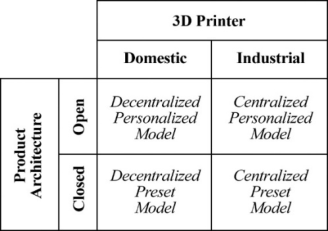
MODELS OF PRODUCT TYPES Out of the general market review, it was found that the types of products intended for production using a 3D printer and offered to home users are characterized by two main distinct variables: the production factor and the product architecture. Combining these two variables leads to four models (see Figure 2). On one hand, the means of production of the 3D printed product can be found in the possession of an external industrial source or by the end- user. On the other hand, the product architecture can either be closed or open for customization and personalization.
Figure 2: Classification matrix of models for 3D printed products designed for home end-users.
The most common models are those whose design is preset without the ability to change it. 3D printed products that are marketed to home users who own a 3D printer and fall under the Decentralized-Preset Model can often be found on general file-sharing websites for 3D printing, e.g., Ultimaker- Thingiverse, MyMiniFactory, pinshape, YouMagine, Cults, REPABLES, cgtrader, GRABCAD, TurboSquid, Tinkercad, redpah, Sketchfab and more. In addition to the general file-sharing websites, this model can also be found on well-known trading websites such as eBay and Etsy. Furthermore, IKEA offers the option to download part files suitable for 3D printing on a dedicated page on their website called “3D Printed IKEA Hacks”.
Design Methodology for Product Designers in the Context of Domestic 3D-Printing 383
3D printed products marketed to home users who do not own a 3D printer and included under the Centralized-Preset Model are no different from the other products offered to the general public. In this case, the uniqueness of 3D printers as a production method, compared to mass production systems, is often reflected in their capability to produce complex geometries and small quantities. Examples of such products can be found on the trading web- sites mentioned above, as well as on Amazon, AliExpress, and other cyber market spaces. Another channel that differs slightly from this model is a sub- model where manufacturers allow anyone, regardless of their background, to upload part files suitable for 3D printing. Those manufacturers, or pro- duction intermediaries, produce the parts and send them to the customers. Examples of such services can be found on websites like Shapeways, Sculpteo (Dassault Systems), and other similar platforms.
The models of the products, which the end-user can customize, embody one of the significant advantages of 3D printers over standard mass pro- duction methods. At the same time, these models are rare, and only a few examples can be found. The Decentralized-Personalized Model poses a chal- lenge for the designer because it requires a dynamic platform that allows design changes without relying on CAD software. Although CAD freeware is available for users to upload files suitable for 3D printing and make changes to the design, using this software requires skill and puts the end- user in the role of a designer. On the Ultimaker-Thingiverse website, there is a category of products where users can make personal adjustments. These adjustments include changing the dimensions of predefined features of the part, such as hole diameter and thickness of a specific element. Additionally, in some cases, users can add embossed or engraved text. An example of a Centralized-Personalized Model is the “Nervous System” jewelry design stu- dio. This studio utilizes an interactive rendering platform to enable intricate customizations in select products.
It is important to note that even in cases where customization and person- alization are possible, there are limitations set by the designers to ensure that the functional purpose of the product is not compromised. In addition, in the case of decentralized models, each end-user who owns a 3D printer can make basic personal adjustments by choosing the type of raw material, color, and scale.
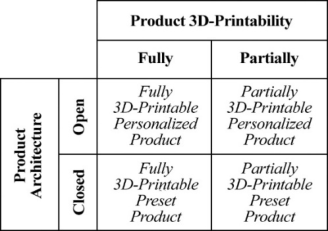
Characterization of Product in the Decentralized Models The decentralized models place the responsibility for producing the prod- uct and assembling it, if necessary, on the end-user. This responsibility encompasses another significant aspect that affects the assembly of the final product and its utilization. This feature refers to the ability to produce the product entirely using a 3D printer or the need to import additional means, parts, and components that cannot be printed, such as glue, rub- ber bands, metal hinges, batteries, electric motors, etc. Combining the value of personalization with the product’s reliance on complementary parts cre- ates a distinction among four types of products in the decentralized models (see Figure 3).
384 Turbovich
Figure 3: Classification matrix of charactrerization of products in the decentralized models.
According to the current situation, middleware is required to connect the steps of selecting the desired product, downloading the file, and producing the parts on a 3D printer. This middleware converts the geometry file of the parts into a machine language file known as G-code, and the generic term for these programs is “Slicer.” In this software, the printing parameters are determined, including the type of raw material, the orientation of the parts on the printing tray, the temperature of the nozzle, layer thickness, and more. Therefore, even in products that can be fully produced using a 3D printer, there are instances where the design source needs to specify printing param- eters to ensure the most accurate results possible. In most of the file-sharing websites mentioned above, in the context of the decentralized models, each file download page includes fields for necessary information about print- ing parameters, instructions on product utilization and operation, and any additional information, if needed.
In cases where a product cannot be fully produced using a 3D printer, the design source must employ strategic thinking regarding the comple- mentary means, parts, and components. There are three critical points to consider:
The accessibility of the complementary element for the end-user.
The cost of the complementary element.
The overall complexity level of the product’s production.
The first two points address local issues, while the third pertains to the end- user’s level of knowledge. The more these three points favor the end-user, the higher the chances that the design will be realized.
Design Source and End-User: The General Iterative Linking Process The traditional value chain, which connects design sources and end-users in a mass production system, embodies a significant segment that considers the production sources of the product parts and their assembly. This segment focuses on determining the production infrastructure, tools, assembly pro- cess, product packaging, transportation, storage, and all the efforts required to bring the products to the physical point of sale or make them available for online trading. The decentralization of the means of production from limited
Design Methodology for Product Designers in the Context of Domestic 3D-Printing 385
power sources to the home environment of end-users changes and simplifies the process that links between the design source and the end-user.
From the analysis of the process linking the design sources to the end- users, it was found that there is a general process structure (see Figure 4). On the one hand, this structure represents a direct and extremely short process, especially for products that can be fully 3D printed. On the other hand, it can describe a hybrid process that might also partially resemble the familiar process of online trading.
Figure 4: From ideation to realization - the general iterative process.
Unlike the typical product accessibility process, which involves inspection and control until the point of purchase and use, the control for products designed for home 3D printing extends to the distribution stage of the parts files on online sharing and trading platforms. This description is accurate for products that can be entirely produced using a 3D printer. However, it is valid with a reservation for products requiring additional means, parts, or assemblies to produce. The complementary means are mostly off-the- shelf products, so obtaining them is no different from the familiar processes. Realizing that the uncontrolled phase has transitioned from the usage phase to the production and assembly phase (in all types of distributed products) necessitates the design sources to analyze the three points mentioned earlier proactively. This analysis should be accompanied by a comprehensive collec- tion of all pertinent information that is crucial to be provided to end-users to enable the successful completion of the production process.
The first step in the controlled phase is the ideation phase. This phase is essentially no different from the idea development phase for other products. It is necessary to determine the product strategy and create a new business plan (Roozenburg and Eekels, 2002). At the same time, when it comes to domestic production, it is essential to pre-determine the type of product from the available options in the decentralized models and consider its impact on the business plan.
Concerning professional designers only, the design phase is a methodical phase that translates the values of the product strategy into visual and tan- gible forms. The fact that the 3D printer serves as the means of production for both the development models and the final product creates an efficient process that eliminates the need for separate function tests at the model level and the final product’s level. A unique and important technical consideration for the design sources is that the product designer’s knowledge of leverag- ing technology’s advantages and addressing its limitations while prioritizing design for assembly increases the likelihood that end-users will perceive the
386 Turbovich
time spent on production and assembly as a valuable resource that enhances their overall experience and adds emotional value to the product.
The digital distribution is the final step in the controlled phase. As men- tioned earlier, the distribution platform is commonly used to distribute parts files, provide the necessary information for the successful functioning of the product, and as a means to receive feedback from end-users. The distribution platform is actually used as the product’s digital packaging and the central hub for information and customer service.
The uncontrolled phase begins with the end-user downloading the part files. Downloading the part files initiates a series of steps that includes the definition of the production variables and the conversion of the part files into machine language files using the slicer software, the production of the parts using the home 3D printer, finishing and assembling the product if necessary, and fulfilling its functional purpose. A noteworthy feature to be aware of is that the end-user has the ability to return to the distribution platform at any time and download improved parts files, product additions, and other elements determined in the product strategy. The final stage is the feedback stage, and it is partially voluntary. Similar to most digital distribu- tion platforms, various types of feedback mechanisms are available. These include automatic feedback, such as views and downloads, predefined feed- back options such as “like” and “collect,” written feedback, and hybrid feedback, such as reporting.
The presence of the primary means of production in the home environment in combination with the internet distribution platforms enables a situation where insights obtained from long-term use of a particular product, together with receiving feedback from end-users, can be translated into updates and additions to the products at a speed that is closer to the rate of updates and improvements of software than of tangible products.
THE DESIGN METHODOLOGY Methodologies for designing tangible products describe a general process that begins with a task characterization and ends with a solution that includes plans for the production phase. As part of the research, three design method- ologies were reviewed: Pahl and Beitz (Pahl & Beitz, 1984), VDI 2221 (Jansch & Birkhofer, 2006), and Baxter (Baxter, 2018). These methodologies describe five principle steps that have inspired the proposed methodology. The five steps include:
Specification (Pahl and Beitz, VDI 2111) or Design specification (Baxter).
Concept (Pahl and Beitz), Function structure, Principle solution, and Module structure (VDI 2111), or Concept design (Baxter).
Preliminary design (Pahl and Beitz and VDI 2111) or Embodiment design (Baxter).
Definitive design (Pahl and Beitz and VDI 2111) or Detail design and Design for manufacture (Baxter).
Documentation (Pahl and Beitz, VDI 2111).
The reviewed methodologies differ in the details of the noted princi- ple phases. As can be seen, the VDI 2111 methodology provides a more
Design Methodology for Product Designers in the Context of Domestic 3D-Printing 387
detailed breakdown of moves between the specification and preliminary design phases. In addition, Baxter does not include the planning stage for pro- duction as part of the methodology and performs a two-stage decomposition for the definitive design stage.
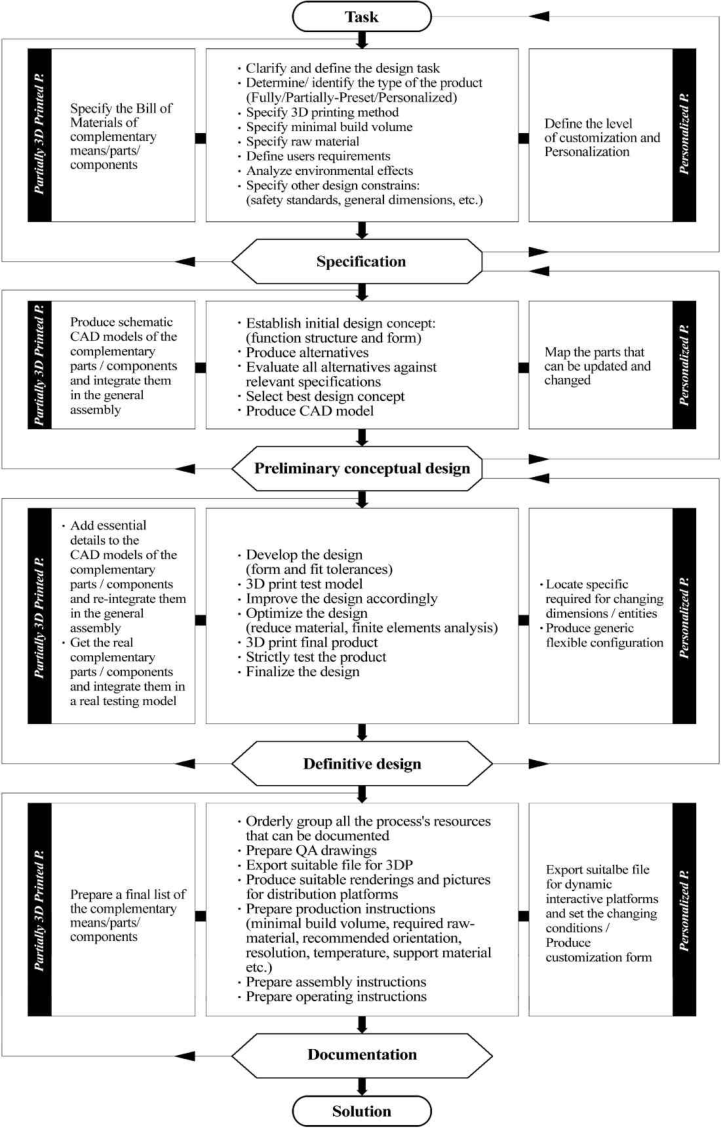
The Structure of the Methodology The general structure of the methodology (see Figure 5) describes a reversible process, similar to the methodologies of Pahl and Beitz and VDI 2111. Despite the explicit order of the stages, it is possible to go back to previ- ous stages in the process and update outcomes based on insights gained at this or another stage. The structure presents a central step column and two additional side columns that cover all the steps required to design the four types of products in the decentralized models, as follows:
The central column represents the design process for Fully 3D-Printable- Preset products.
The central column, combined with the right column, represents the design process for Fully 3D-Printable-Personalized products.
The central column, combined with the left column, represents the design process for Partially 3D-Printed-Preset products.
A combination of the three columns represents the design process for Partially 3D-Printed-Personalized products.
In the reviewed methodologies, a distinction is made between the stages of the concept, the preliminary design, and the definitive design. This difference is primarily due to the absence of technological solutions in the concep- tual design, and the bridging effort between the concept and production is carried out during the preliminary and definitive design stages. In the case of products intended for production using a domestic 3D printer, the cer- tainty regarding all aspects of the production process eliminates the need to create prototypes that only simulate parts of the final product. Instead, it is possible to create models using the actual production method. There- fore, the development process is significantly shortened, which is reflected in the methodology through the unification of the concept and initial design phases.
At the detailed level of the steps, during the Specification formulation stage, beyond clarifying the task and determining the product type, it is required to define the minimum build volume in advance based on the dimensions of the envelope of the largest part of the product. The minimum build volume definition creates a buffer between domestic 3D printers that meet the defined criteria and those that do not.
The preliminary conceptual design and definitive design phases are not fundamentally different from the development phases of the reviewed methodologies. However, they incorporate aspects related to the fact that production process has been transferred to the end-users. In the case of assembled products and integration of complementary parts/components, the design includes fit tolerances that may be affected when changing the scale of the parts in the Slicer software. Therefore, at these stages, gathering all the
388 Turbovich
Figure 5: Design methodology in the context of domestic 3D printing.
Design Methodology for Product Designers in the Context of Domestic 3D-Printing 389
crucial information that needs to be provided to the end users on the distri- bution platforms is essential. This includes addressing issues such as scaling, the preferred orientation of the parts on the printing tray, and other relevant considerations.
The documentation phase, which is the final phase before the solution, usually represents the phase of preparing the production file that includes drawings for production and quality assurance. In the case of products intended for domestic 3D printing, the product is ready for marketing on the web shelf after the design phase is completed. Therefore, in this case, It is required that in the documentation phase, beyond the preparation of a pro- duction file, it is necessary to collect all the information accumulated in the design phase that is relevant to the end-user, along with the production of high-quality illustrations, the preparation of assembly and use instructions, and the compilation of the final files of the parts.
DISCUSSION
Desktop 3D printers are one of the means that can bring about positive change in the home consumer goods market. Positive values, such as on- demand digital manufacturing (Weller et al., 2015), product repair, efficient utilization of raw materials, and recycling (Barnatt, 2013), can be easily implemented through this type of 3D printer. The general public is accus- tomed to products that require assembly before they can be used. Still, only those who engage in creative hobbies of some kind also experience the stages of production and finishing. The complexity of the production phase and the variety of processing tools required, leave the majority of the general pub- lic in the role of the end-user, and at most, the one who also assembles the product to some extent. People who design their products are often willing to pay more for them than for similar pre-assembled goods (Schreier, 2006). Therefore, there is reason to assume that involvement in the production pro- cess itself, without bearing the burden of the associated complexity, may also enhance the perceived value of the products among the end-users. This assumption requires examination and should be considered in the broader context of the consequences of domestic production. These consequences include the convenience of not having to travel to make a purchase or wait for the product to be delivered. Additionally, there is the ease of making personal customizations and other peripheral benefits. Some believe that 3D printers will be in most homes to produce products of all types (Wohlers Report, 2021). In light of the fact that numerous components, such as bat- teries, display screens, motors, bulb housings, and others, cannot currently be 3D printed in general, it is evident that this scenario will not occur in the foreseeable future. At the same time, the market research showed that in decentralized models, many products combine parts printed on a domes- tic 3D printer with complementary components that cannot be 3D printed. This fact demonstrates that domestic 3D printers can be a revolutionary factor in the segment of products that can be fully 3D printed, as well as a complementary means, to some extent, in the product segment that can be partially 3D printed. In conclusion, there is a noticeable market gap
390 Turbovich
between accessible and affordable desktop 3D printers for the general pub- lic and the low response to their purchase that cannot be ignored. This gap indicates that the market is in the development process, and the research results are aimed at enhancing efforts to promote it from the field of product design.
REFERENCES
Anderson, C. (2014). Makers: the new industrial revolution. New York: Crown Business. Barnatt, C. (2013). 3D printing: the next industrial revolution. Nottngham, England:
Explainingthefuture.com. Baxter, M (2018). Product design: a practical guide to systematic method of new product development. Boca Raton: CRC Press. Jänsch, J. and Birkhofer, H. (2006). The development of the guideline VDI 2221 -
the change of direction. Proceedings Design 2006, the 9th International Design Conference, Dubrovnik, Croatia, pp. 45–52. Levy, N., Simon-Blecher, N., Ben-Ezra, S., Yuval, M., Doniger, T., Leray, M., Karako- Lampert, S., Tarazi, E. and Levy, O. (2023). Evaluating biodiversity for coral reef reformation and monitoring on complex 3D structures using environmental DNA (eDNA) metabarcoding. Science of The Total Environment, 856, p. 159051. Pahl, G. and Beitz, W. (1984). Engineering Design. Springer. Reef Design Lab. (2017). 3D Printed Reefs for the North Sea. [online] Available at:
https://www.reefdesignlab.com/3d-printed-reefs. Roozenberg, N., F., M. and Eekels, J. (2002). Product design : fundamentals and methods. Ann Arbor: Umi Books On Demand. Schreier, M. (2006). The value increment of mass-customized products: an empirical
assessment. Journal of Consumer Behaviour, 5(4), pp. 317–327. Sculpteo report: The State of 3D Printing 2022 Edition. (2022). Available at: https://info.sculpteo.com/hubfs/downloads/The%20State%20of%203D%20 Printing%202022/The%20State%20of%203D%20Printing%202022.pdf?_ga= 2.219337113.1031252747.1700764909-1610359464.1700764909 [Accessed 12 Dec. 2023]. Weller, C., Kleer, R. and Piller, F. T. (2015). Economic implications of 3D printing:
Market structure models in light of additive manufacturing revisited. International Journal of Production Economics, 164, pp. 43–56. Wohlers, T., Robert Ian Campbell, Olaf Diegel, Kowen, J. and Mostow, N. (2021).
Wohlers report 2021 3D printing and additive manufacturing : global state of the industry. Fort Collins, Colorado Wohlers Associates. www.boeing.com. (2022). Boeing: Additive manufacturing: Chinook 3D printing. [online] Available at: https://www.boeing.com/features/innovation-quarterly /2022/01/chinook-3d-printing.page. www.ge.com. (2020). 3D Printed Engine: Bringing 3D Printing Inside The World’s Largest Jet Engine | GE Additive. [online] Available at: https://www.ge.com/additive/stories/3d-printed-jet-engine-meet-team-young- engineers-brought-3d-printing-inside-ge9x-worlds-largest.
LISTED IN THE AHFE DIGITAL BOOKSTORE CATALOGUE
Explore the complete digital volume
Human Interaction and Emerging Technologies (IHIET-AI 2024): Artificial Intelligence and Future Applications
Read this individual research paper free through the original publisher, or explore the full digital proceedings book.
ISBN 978-1-958651-96-4
Explore this ISBN in the AHFE Bookstore ↗Listed in the July 2026 bookstore catalogue; search by ISBN to confirm current availability · Digital book purchase optional