Zuk Turbovich (2026). Archetypes of Products in the Domestic Desktop 3D-Printing Products Market. In: Human Interaction and Emerging Technologies (IHIET-AI 2026): Artificial Intelligence and Future Applications. AHFE Open Access, vol. 201, pp. 392–405. https://doi.org/10.54941/ahfe1007193
Additive manufacturing, and particularly domestic desktop 3D printing (D3DP), has evolved from a prototyping-oriented technology into a practical means of producing functional products at the individual level. This study analyzes the domestic 3D-printed products market through a systematic review of file-sharing platforms, focusing on product categories, design sources, customization options, and dependency on non-3D-printed components. Five platform categories are identified: general-orientation, hobbyist-oriented, professional, traditional e-commerce, and AI-based services. Based on this analysis, six archetypes of domestic 3D-printed products are defined by design status (fixed, customizable, generative) and their dependence on complementary parts. In addition, the study proposes a product complexity evaluation framework tailored to domestic production, based on the number and characteristics of parts, required post-manufacturing treatments, and integration of complementary components. The framework enables comparative assessment of product readiness for use and supports design decision-making in the context of domestic desktop 3D printing.
Transformative change happens when industries democratize when they’re ripped from the sole domain of companies, governments, and other institutions and handed over regular folks (Anderson, 2012). In this context, developments over the years in the field of additive manufacturing (AM) systems, also known as 3D printers, have led to a values triangle of quality, accessibility, and affordability. This triangle, which enabled the domestic use of 3D printers for business or personal purposes, represents the democratic transition from being another technological solution owned by central power sources of production to a manufacturing means potentially available to anyone interested. Ever since the introduction of the first affordable desktop 3D printer (D3DP), the D3DP market segment has experienced significant growth, to the point that the Wohlers Report 2021 stated that sales of desktop 3D printers are often non-traditional and can be difficult to track (Wohlers Report, 2021). The availability of D3DPs to sources of interest outside the circle of the central power sources of the means of production led to a dramatic change in the value chain connecting the design sources of physical products and the end users. Although this dramatic change is
Archetypes of Products in the Domestic Desktop 3D-Printing Products Market 393 still not widely affecting the traditional market, several file-sharing websites offer a vast array of suitable 3D-printing files, and individuals who own a 3D printer can download and produce parts and products domestically. This scenario eliminates supply chain delays and last-mile distribution (Corsini et al., 2020), reduces supply chain costs in energy saving and fuel (Thakar, 2022), and creates direct contact between design sources and end users via cyberspace. In addition to file-sharing websites, a few well-known companies and e-commerce platforms, such as AliExpress, eBay, and Etsy, implement this scenario as part of their traditional operations and offer downloadable 3D-printing files for sale. These buds reflect that the domestic 3D printing market is still in its infancy, and recognizing the characteristics of the market in terms of the types of relevant products alongside the unique value chain can lead to informed advancement of the field and help academic, institutional, and commercial interested parties understand how to create maximum value for all involved. Therefore, the study examined the D3DP market in terms of prevalent product types and the supported cybernetic platforms.
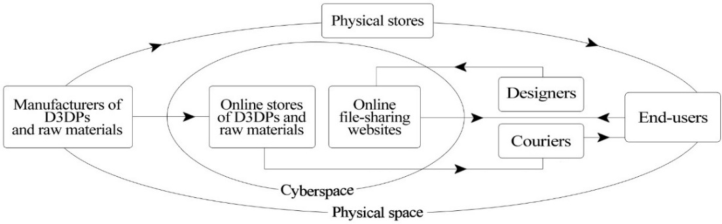
PRODUCT CATEGORIES IN THE DOMESTIC 3D-PRINTED PRODUCTS MARKET The structure of the D3DP market consists of five main human factors: manufacturers of 3D printers and raw materials, file-sharing website operators, couriers, designers, and end-users. In addition, there are two general engagement platforms: stores selling D3DPs and raw materials, and file- sharing websites for D3DP-compatible files (Figure 1). The first engagement of end-users with D3DP can be made cybernetically and physically through the selling platforms.
Figure 1: A schematic description of the D3DP market.
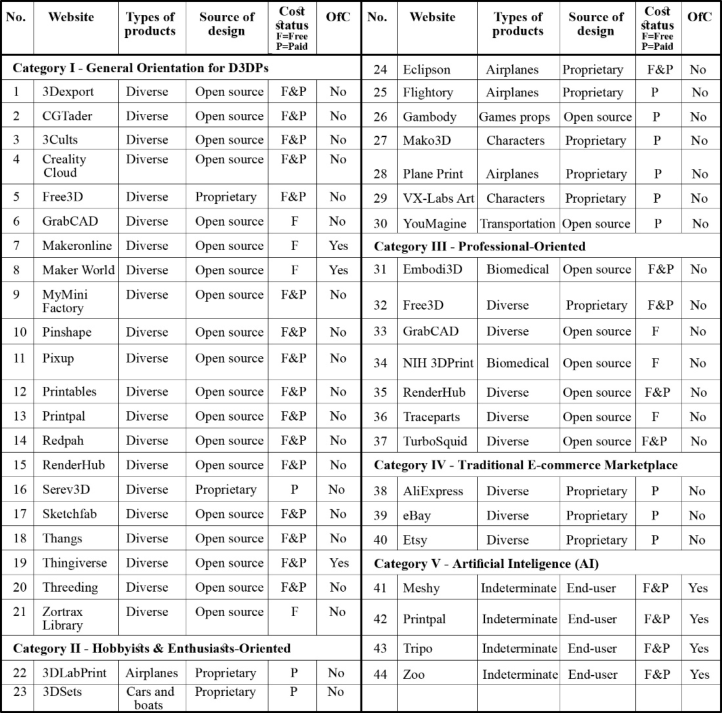
The hub where all the human factors involved in the domestic 3D-printed products market meet, excluding couriers, is the cybernetic platforms of file-sharing websites. As an initial step in this study, 40 websites were reviewed (Figure 2), excluding search engine websites, such as “Yeggi” and “STLFinder”. Note that four websites were classified into two categories, and therefore, there are 44 website rows. The initial analysis was conducted from the perspectives of designers and end-users, as domestic production of products can only occur once the D3DP is in the end-user’s possession. The analysis included the types of products, the design sources, the cost status, and the end-user’s option for customization (OfC) of the designs. The review
394 Turbovich has revealed that the file-sharing websites can be classified into five categories: 1. General Orientation for D3DPs, 2. Hobbyists & Enthusiasts-Oriented 3. Professional-Oriented 4. Traditional E-commerce Marketplace 5. Artificial Intelligence (AI).
Figure 2: List of websites for sharing and downloading files suitable for AM systems.
Category I – General Orientation for D3DPs Category I relates to the D3DP field in general. This category consists of websites specifically oriented to users who own D3DPs, or that include a designated section for downloadable 3D-printing files. All the reviewed websites offer various product categories, and most general product categories include subcategories. The product categories on each website differ in quantity, classification method, and titling. For instance, some websites include separate product categories for Art and Design, while others present them combined. Altogether, when combining categories with synonymous titles, 80 different product categories were identified. Among these categories, the most common, appearing on more than 50% of the reviewed websites, are the following six: Household, Games & Toys, Art & Design, Fashion, Education/Learning/Science, and Hobby & DIY. The
Archetypes of Products in the Domestic Desktop 3D-Printing Products Market 395 next most common product categories, which are represented on 30%- 50% of the reviewed websites, are 3D-printing, Characters/Creatures/ People, Costumes/Cosplay/Props, Health/Fitness/Sports, Miniatures, Tools, Architecture, Gadgets, and Jewelry. All the websites in this category feature a free search field, but they employ two distinct approaches to presenting the categories. The first convergent approach, which is taken in 55%, presents general categories and their corresponding subcategories. The second generic approach presents solely general categories.
Category II – Hobbyists & Enthusiasts-Oriented This category focuses on related subjects, has a clear orientation to 3D printing, and targets hobbyists & enthusiasts with a certain level of knowledge and dedication to the subject. There are two distinct types of products in this category, which differ in whether they can be brought to completion solely with D3DP or require the integration of non-3D-printable complementary parts/components (Table 1).
Table 1: Taxonomy of file-sharing websites in Category II.
Table available in the original PDF paper.
Fully 3D Printable Products Partially 3D Printable Products No. Website Subject Website Subject
1 Gambody Games & Props 3DLabPrint Airplanes 2 Maco3D Characters & Creatures 3D Sets Cars & Boats
The fully 3D-printable products group consists of two websites focused on realistic and imaginary characters and creatures, as well as a website that primarily features creatures and props from computer games and movies. All these websites are fully commercial and therefore charge a fee for every file. The second group, which consists of products that depend on non-3D-printable parts or components, is fully characterized by its association with the field of transportation. The six websites in this group primarily offer model parts and radio-controlled, motorized models of various means of transportation. The number of mass-produced parts required for integration into final products is significantly higher than for Category I partially 3D-printable products. Additionally, processes such as soldering and gluing are needed to assemble the products into their final configuration.
Category III – Professional-Oriented This category is characterized by addressing professional designers, engineers, and medical personnel. Websites catering to designers and engineers typically offer downloadable files suitable for 3D printing,
396 Turbovich alongside computer-aided design (CAD) software files and 3D model files. Additionally, these websites offer free and for-sale files across various design fields. “Free 3D”, “RenderHub”, and “TurboSquid” cater to a diverse range of design fields, including digital animators, architects, and industrial designers, and all models are considered high-quality. The difference between the free and premium models is not noticeable, and it can be assumed that it is more a matter of the design source’s decision, whether to prioritize gaining recognition and reputation solely or also seeking monetary return. “GrabCAD” and “Traceparts” are more geared towards engineering fields, such as mechanical, construction, and electrical engineering, and all the models are offered for free. It can be assumed that since “GrabCAD” is operated by “Stratasys”, whose main activity is the production of AM systems, the website serves as a free service to the company’s customers and other interested parties. In the case of “Traceparts”, the website advertises catalogs from manufacturers and distributors, which can explain why the models are offered for free. Medical and biomedical-oriented websites offer suitable files for 3D printing and other formats compatible with various software. Most of the files can be downloaded for free. However, some paid files are also available.
Category IV – Traditional E-commerce Marketplace This category covers e-commerce websites that sell goods, as well as downloadable 3D-printable files. Most of the files on the websites “AliExpress”, “eBay”, and “Etsy” are decorative models, such as characters, 3D ornaments, and designed corbels. Like the drones’ websites from Category II, “IKEA” includes a section named “IKEA hackers” on the company’s website, which presents complementary solutions to the company’s products created by external designers. Several 3D printing solutions are available, with suitable free files available for download. Still, since the links point to external websites, this website has not been included in the list.
Category V – Artificial Intelligence (AI) This category combines options available on websites with subcategories of products with OfC from Category I, options for saving 3D model mesh files like products from Category III, and a unique feature for creating computerized geometries by textual prompts. The option to generate a 3D model mesh file from 2D images exists on the “Meshy” website without any subject orientation, while on “Maker World”, under the “MakerLab” section, this option is related to certain types of products, e.g., “Image to Keychain”, “Make My Statue”, and “Make My Lithophane”. The option to produce 3D model mesh files is available on all websites in this category, but there is still no option to download editable CAD files, as on websites in Category III. The unique feature in this category, common to most AI-based services websites, is the option to generate output in response to textual prompts. Therefore, to test the generators, five prompt types were evaluated as shown in Table 2.
Table 2: List of types of prompts used to examine the AI generators.
Table available in the original PDF paper.
No. Type of Prompt Meshy Printpal Tripo Zoo 1 Single part: Basic quantitative prompts. - - - +
5 Assembly: Advanced qualitative prompts oriented to 3D printing.
The initial examination has revealed that, although all websites can generate computerized geometries from text, they are all limited to single parts, separated bodies, and cosmetic assemblies. From the end user’s perspective, the inability to produce functional assemblies renders these websites suitable only for single-part products, such as miniatures, statues, and vases. Like the focus differentiation between websites from Category III, the websites in this category can be classified accordingly. The generator of “Zoo” responded accurately to single-part basic quantitative prompts but failed to generate complex designs. Additionally, there are no other options besides “Text- to-3D”, and therefore, this website can be considered an engineering-oriented AI tool. The generators of “Meshy”, “Printpal”, and “Tripo” responded poorly to single-part basic quantitative prompts but succeeded in generating complex designs. In addition to the textual prompts, “Meshy”, “Printpal”, and “Tripo” offer options like “Image to 3D”, and “Meshy” and “Tripo” also include options like “AI Texturing”, rigging, and animation. Therefore, these websites can be considered AI tools oriented toward artistic design.
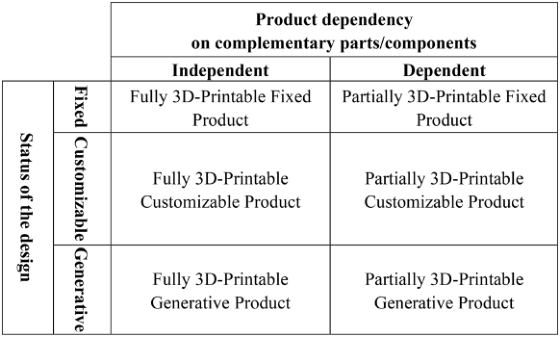
ARCHETYPES OF PRODUCTS IN THE D3DP PRODUCTS MARKET Based on the analysis of product categories in the D3DP market, the overview shows that products can be grouped into six archetypes. The classification is based on the product’s dependency on complementary parts/components and the design status, which can be fixed, customizable, or generative (Figure 3).
Figure 3: A taxonomy matrix of archetypes of product types in the D3DP market.
398 Turbovich Generally, the main advantage of products classified in the independent products column is that they fully retain the domestication value, thereby dramatically shortening the value chain connecting the design source to end users. On the other hand, products classified in the dependent products column require the integration of non-3D printable parts/components and are, therefore, subject to the conventional value chain conditions of the goods market. In this case, the design source should consider the accessibility and cost of these complementary parts/components, as well as the end-user’s level of expertise. In addition, for all the archetypes, two primary design considerations are intertwined and affect the time required to bring the product to a usable state. The first is the necessity of post-processing for every part, and the second is the number of parts and their characteristics. Regarding the first consideration, almost every conventional production process consists of the manufacturing stage, post-manufacturing treatment processes, and the finishing stage. In the case of domestic manufacturing processes using D3DPs, the type of AM system, material, part geometry, printing orientation, printing settings, and functional requirements determine the required post- manufacturing treatment. There are cases where no post-manufacturing process is required, and others where post-manufacturing treatment processes are necessary, such as removing support structures, sanding, and thermal reshaping. The second consideration, which relates to the number of parts and their characteristics, is known as the design for assembly (DFA) consideration. While in a conventional process, assembly time is a significant component of overall cost, in a domestic production process, this factor becomes negligible. However, once the end-user also functions as a producer, this consideration becomes equivalent to that for an assembly-line worker, and it affects the product’s readiness for use and its complexity. These two considerations are strategic design thinking factors that may affect potential end-users’ motivation to choose between producing this product and another.
Fully 3D-Printable Fixed Product This archetype, which encompasses products with immutable designs that can be entirely produced using D3DPs, is represented on websites across all categories. However, while on most websites, this archetype is represented by free or paid downloadable files, the review has revealed that four websites (Serev3D, Gambody, Maco3D, and VX-labs Art) that focus on characters, accessories, games, and props, and all the traditional e-commerce websites from Category IV offer paid files only. While this is obvious for files in Category IV, in the case of the four websites mentioned above, this indicates the specificity of the end users who are willing to pay for files of products intended for manufacturing using D3DPs. Alongside, it can also be assumed that, from the perspective of the design source, the designs are perceived as unique and of high value compared to competing products in the traditional market. Regarding the complexity of bringing products of this archetype into reality, as mentioned above, the total number of parts and the need for post-manufacturing treatments are the main factors that determine this level of complexity. Therefore, in a case where the design source would like to conduct an initial assessment of complexity, the evaluation can be based on summing the total number of parts and the number of parts that require post-manufacturing treatments. Note that the sum of these two factors provides an initial impression, since the level of
Archetypes of Products in the Domestic Desktop 3D-Printing Products Market 399 complexity is also affected by the characteristics of the parts and the difficulty of post-manufacturing treatments. Therefore, a more accurate scoring of the complexity can be formulated as follows:
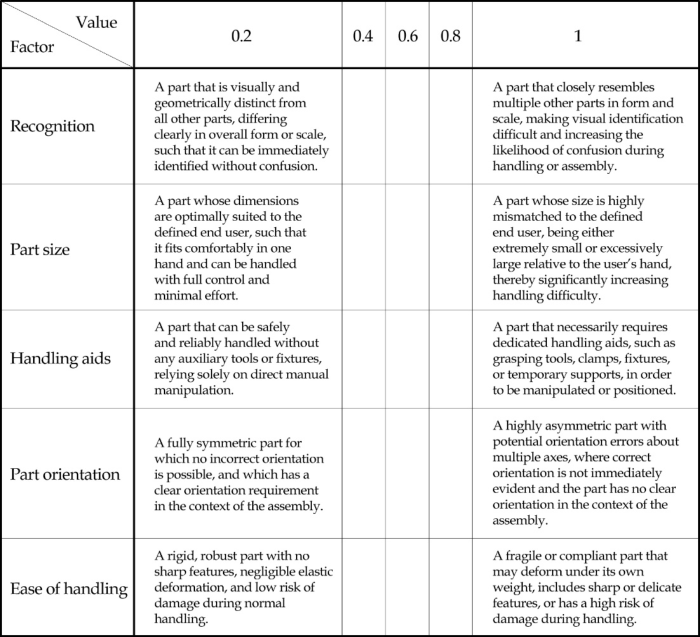
CScore = a (Nt – 1) + b Np Where: Nt = Number of parts in total Np = Number of parts required for post-manufacturing treatments a = Weighting mean constant of the characteristics of the parts b = Weighting mean constant of the difficulty level of the post-manufacturing. The Nt factor represents the total number of parts and is influenced by the mean weight of the constant a, which reflects the parts’ characteristics. Characteristics of parts are graded in DFA methodologies for conventional assembly lines based on several factors, such as part recognition, part size, handling aid, part orientation, and ease of handling (Prusak, 2002; Alkan et al., 2017). In the context of domestic production using D3DPs, the available means for the assembly task are unpredictable, as are the assembler’s age and skill level. Therefore, unlike the approach of ranking parts’ characteristics for professional assembly line workers, the ranking in this context should be simplified by defining a reference assembler-user and evaluating part characteristics generally relative to this reference. The factors presented in Figure 4 are the same as those identified in the references mentioned above regarding DFA methodologies.
Figure 4: Example of a single part characteristics rating table.
400 Turbovich Each of the five factors can be ranked on one of five scales, ranging from 0.2 to 1, with each scale being 0.2 higher than the previous one. If a part does not cause any difficulty for the user, each factor can be rated at the lowest level of 0.2, so that the sum of the factors for the part’s characteristics equals 1 and the part contributes no value to the effective score. On the other hand, a part whose characteristics may cause many difficulties for the user can be assigned a value of 1 for each factor, so that its total sum will be the maximum value of 5. The value of each factor can be determined by impression, based on the characteristics detailed below and as specified in the examples in Figure 4. The factors that need to be examined were simplified and adjusted to the context of domestic production and are as follows: Recognition: The level of contrast of the part relative to other parts. Notice that, unlike in a conventional assembly line, the color is determined by the end user and therefore cannot be included in the recognition factor. Part size: One-hand, two-hand handling, or two-person handling. Handling aids: In relation to the part size, whether a no-handling aid is required, or whether there is a requirement for the use of tooling. Part orientation: No orientation errors possible, or optional orientation errors about one to three axes. Ease of handling: This factor includes additional considerations, e.g., whether the part can break easily, has sharp features, and undergoes significant elastic deformation under its own weight. The Np factor, which represents the number of parts required for post-manufacturing treatments, is affected by the weighting constant b, which reflects the difficulty level of those treatments. This constant encompasses several treatments specifically related to D3DPs, as well as other familiar treatments. The most common post-manufacturing treatments for polymeric parts produced by D3DPs are material support removal, sanding or surface polishing, gap filling, coating, polymer coating, cold welding, vapor smoothing, washing, and UV curing (Dizon et al., 2021). Accordingly, the following list presents a proposed evaluation method for determining the constant b, which represents the difficulty level of applying post-manufacturing treatments. The method assigns a discrete score of 1–5 to each part requiring post-manufacturing treatment, consistent with the value range defined for the constant a. The division into five score levels is defined as follows:
- Score 1 – Non-Instrumented Post-Processing: Post-manufacturing actions that are intrinsic to part removal and do not require tools, specialized skills, or additional resources. These operations are typically brief, non-destructive, and have negligible influence on part geometry or surface integrity. Examples include manual brim removal and hand- detached, easily removable support structures. - Score 2 – Basic Tool-Mediated Post-Processing: Post-processing
operations requiring commonly available hand tools and consumables, involving limited technical skill and low risk of part damage. These treatments primarily address minor surface artifacts without altering functional or dimensional characteristics. Examples include support removal using simple tools, light sanding, and basic polishing.
- Score 3 – Skilled Manual Feature and Surface Conditioning: Postprocessing treatments that rely on operator skill, experience, and process control often comprise multiple manual steps or localized feature-specific operations. These treatments may deliberately modify surface quality or functional features and carry a moderate risk of part damage if improperly executed. The operations do not require dedicated industrial infrastructure but exceed basic tool-mediated finishing in terms of precision, judgment, and execution control. Examples include gap filling, surface putty application, priming, painting, and manual installation of threaded metal inserts using a soldering tool. - Score 4 – Infrastructure-Dependent Post-Processing: Post-manufacturing
treatments that require dedicated equipment, controlled environments, or external facilities. These processes significantly influence surface morphology or material properties and are generally inaccessible in standard domestic or small-scale workshop settings. Examples include vapor smoothing, UV curing, thermal reforming, pressure washing, and electroplating. - Score 5 – Integrated Multi-Stage Post-Processing Workflows: Complex post-manufacturing workflows involving the intentional combination and sequencing of multiple post-processing treatments across different difficulty levels. These workflows demand planning, iterative execution, and risk management, with cumulative effects on surface quality, dimensional accuracy, and material performance. Examples include sanding and gap filling, followed by vapor smoothing and electroplating.
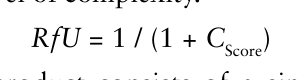
Once the complexity score is calculated, in the context of comparing self-designed alternatives or competing designs, the result can be directly compared or normalized to represent the readiness for use (RfU) on a scale from 0-1 based on the level of complexity.
Equation reproduced from the original PDF.
In a case where the product consists of a single part and there is no requirement for post-manufacturing treatments, the complexity score is 0, and the RfU is 1. In a case where the product includes many parts and many of them require post-manufacturing treatments, the RfU decreases towards 0.
Fully 3D-Printable Customizable Product This archetype, which encompasses products with ready-made designs that can be customized and entirely manufactured using D3DPs, is represented by three websites from Category I. As previously noted, these three websites are operated by D3DP manufacturers. Previous studies have shown that customization value is a key advantage of D3DPs over mass-produced products (Kudus et al., 2016; Sethuraman et al., 2023), and making this option available to end users is, in fact, an implementation of this advantage. The possibilities of customization differ by two main characteristics: 1. The option to enable functional modifications, such as modifying the integral
402 Turbovich diameter of a cover for a wall airduct, the volumetric dimensions of a storage box, or the frame size of a sign. 2. The option to enable cosmetic modifications, mostly adding or changing existing text, shapes, and images. Regarding product complexity, there is no difference between products from this archetype and those from the fixed designs archetype. The customization option doesn’t affect the total number of parts or the parts required for post-manufacturing treatments. Therefore, the complexity evaluation of self-designed alternatives or against competing products can be held similarly.
Fully 3D-Printable Generative Product Products from this archetype do not rely on pre-made designs. Instead, the source of the design becomes the end-user. This option for creating unique designs is available on the website “Printpal”, which is classified under both Categories I and V, as well as all websites in Category V. There are three ways to do that, as detailed below: 1. Design from scratch by using online platforms: This option is available on the “Makeronline” website from Category I, under the “AnyLab” section. The online platform simulates CAD software, offering options to create forms from primitive shapes and manipulate them with editing tools. In addition, this option is available on the “Zoo” website, which is classified under Category V. In this case, the online platform enables the combination of creating forms via text prompts and using basic design tools, such as CAD software. 2. Converting an image to a 3D model file: This option is available on the “Maker World” website from Category I, on the “Printpal” website, which is classified to Categories I and V, and on the “Meshy” and “Tripo” websites from Category V. While on the “Maker World” website this option is in the context of some product, e.g., figurines and flexible toys, on the other websites, there is no reference to a specific product. 3. Generating a 3D model file by Text prompt: This option follows the same manner as most AI tools, but in the context of generating a file of a 3D model. This option is available on all websites in Category V and, as previously noted, is currently limited to producing single-part products or separate parts. Since end-users also serve as the source of the design, the option to evaluate the product’s complexity becomes irrelevant.
Partially 3D-Printable Fixed Product This archetype encompasses products that require the integration of complementary parts or components to reach a usable state and is primarily represented in Categories I and II. While there are various complementary parts in products from Category I, products of this archetype in Category II are associated with means of transportation, and their complementary parts and components are closely related to these means. As noted previously, products of this archetype are subject to the conventional value chain for goods. Therefore, the design source should acknowledge the significant roles of accessibility, affordability, and end users’ assembly skills. These factors, along with the total number of complementary parts/components, affect the
Archetypes of Products in the Domestic Desktop 3D-Printing Products Market 403 complexity of the products, and in a case where an evaluation of self-designed alternatives or a comparison against competing products is required, these factors should be added to the formula of the complexity score, as follows:
CScore = a (Nt – 1) + b Np + d Nc Where: Nc = Number of complementary parts/components d = Weighting mean constant of the characteristics of the complementary parts/components. In accordance with the accessibility, affordability, and assembly skill level, the constant “d” can be graded into five levels as follows:
1. Household-Standard Components: Immediate accessibility, affordable, and easy-to-integrate parts, or components, such as nuts, bolts, rubber bands, drinking bottles, and other items commonly found in domestic environments. 2. Locally Available Standard Components: Easily accessible, affordable, and easy to integrate, such as magnets, springs, and rods. 3. Technically Mediated Components: Questionable accessibility (shipment may be required), affordable, and requiring basic technical knowledge for integration, such as light bulb sockets, electric cords, battery sockets, electric switches, and metal bars. 4. System-Dependent Functional Components: Questionable accessibility (shipment may be required), affordable, and requiring system-dependent integration involving configuration or calibration, such as electric motors with drivers and electric sensors. 5. Specialized Mechatronic and Power Components: Questionable accessibility (shipment required), questionable affordability, and requiring specialized knowledge-based integration, such as controlled electric motors with controllers, linear actuators, and pneumatic or hydraulic cylinders.
In cases where simplified bounded data is required, the option to normalize the complexity score using the previously mentioned Readiness-for-Use formula remains the same.
Partially 3D-Printable Customizable Product This archetype encompasses products with ready-made designs that can be customized and require the integration of complementary parts or components to reach a usable state. Products of this archetype were found on the “Maker World” and “Thingiverse” websites. On “Maker World,” these customizable products are organized by type, while on “Thingiverse,” they are presented alongside other customizable products under the “Customizer” section. Examples from the “Maker World” website can be found under the “Make My Lithophane” and “Lightbox Maker” sections, both of which require integration with lightning components. On the “Thingiverse” website, the examples range from lamp shades that require integration of
404 Turbovich lighting components to prosthetic arms that require integration of strings and spinners that require integration of ball bearings. Regarding the complexity of products in this archetype, the customization option doesn’t affect the total number of parts, the parts needed for post-manufacturing treatments, or the characteristics of the complementary parts/components. Therefore, the complexity evaluation of self-designed alternatives or against competing products can be held similarly to what is done for partially 3D-printable fixed products.
Partially 3D-Printable Generative Product Products of this archetype do not rely on pre-made designs. However, once a design is set, there is a requirement to integrate complementary parts/ components to reach a usable state. The decision to create a product that requires integrating complementary parts/components is made entirely by end-users, and there is usually a need for basic design knowledge to properly apply the integration features in the relevant parts. In principle, all the websites classified under Category V are capable of producing such products. However, since integration features are mainly functional, the “Zoo” website, which achieved better results with quantitative text prompts and includes an option to produce designs via an online design platform, is the most suitable AI tool. As with fixed 3D-printable generative products, since end-users also serve as the source of the design, the option to evaluate the products’ complexity becomes irrelevant.
DISCUSSION AND CONCLUSIONS One of the ways in which 3D printing will drive a manufacturing revolution is by facilitating personal fabrication (Barnatt, 2013). As this study revealed, personal fabrication is not limited to producing general solutions for private end users but also enables solutions for professional users and hobbyists. Since D3DPs are accessible, affordable, capable of producing reliable solutions, and carry unique values, such as on-demand digital manufacturing (Weller et al., 2015), product repair, and efficient utilization of raw materials (Barnatt, 2013), there is a question that needs further examination on why there are not more cybernetic platforms that provide high-quality solutions for professional end-users like plumbers, confectioners, physiotherapists, technicians who use tools, and alike. Since one of the conclusions in this study is that the subject-oriented approach is the most tradable in this market, it can be assumed that the lack of cybernetic platforms for a wide range of professional users could be because of design issues related to the D3DPs, the workflow, a gap in the perception about the technology and its capabilities, or other issues. Another conclusion is that AI tools may be powerful for generating complex geometries and visualizing design ideas, though they are less effective at generating functional assemblies. Besides basic design knowledge, designing functional assemblies requires understanding fit tolerances, force dynamics, and other DFA considerations. In the context of 3D printing and AI tools, developing formulations for textual prompts
Archetypes of Products in the Domestic Desktop 3D-Printing Products Market 405 that unify design specifications with optimized manufacturability and DFA considerations could lead to a significant breakthrough in product design as a whole, particularly in domestic production. From a wide perspective, people who design their products are often willing to pay more for them than for similar pre-assembled goods (Schreier, 2006). This claim reflects the fact that people see additional value in being involved in bringing products to their final usable state, and it underscores the unexploited potential in the D3DPs market, which fully delivers this aspect and adds the value of customization.
REFERENCES
Alkan, B., Vera, D., Ahmad, B., & Harrison, R. (2017). A Method to Assess Assembly Complexity of Industrial Products in Early Design Phase. IEEE Access, 5, 989–999. https://doi.org/10.1109/ACCESS.2017.2777406 Anderson, C. (2012). Makers: The new industrial revolution. New York, NY: Crown
Business. Barnatt, C. (2013). 3D printing: The next industrial revolution. CreateSpace Independent Publishing Platform. Corsini, L., Aranda-Jan, C. B., & Moultrie, J. (2020). The impact of 3D printing
on the humanitarian supply chain. Production Planning & Control, 31(13), 1048–1064. Dizon, J. R. C., Gache, C. C. L., Cascolan, H. M. S., Cancino, L. T., & Advincula, R. C.
(2021). Post-processing of 3D-printed polymers. Technologies, 9(3), Article 61. https://doi.org/10.3390/technologies9030061 Kudus, S. I. A., Campbell, R. I., & Pei, E. (2016). Assessing the value of 3D printed personalised products. In Proceedings of the 7th International Conference on Mass Customization and Personalization in Central Europe (MCP-CE 2016) (pp. 1–10). Novi Sad, Serbia. Schreier, M. (2006). The value increment of mass-customized products: An empirical
assessment. Journal of Consumer Behaviour, 5(4), 317–327. Sethuraman, N., Parlaktürk, A. K., & Swaminathan, J. M. (2023). Personal fabrication as an operational strategy: Value of delegating production to customers using 3D printing. Production and Operations Management, 32(7), 2362–2375. Thakar, C. M., Parkhe, S. S., Jain, A., Phasinam, K., Murugesan, G., &
Ventayen, R. J. M. (2022). 3D printing: Basic principles and applications. Materials Today: Proceedings, 51, 842–849. https://doi.org/10.1016/j.matpr. 2021.06.272 Weller, C., Kleer, R., & Piller, F. T. (2015). Economic implications of 3D printing: Market structure models in light of additive manufacturing revisited. International Journal of Production Economics, 164, 43–56. Wohlers, T., Campbell, I., Diegel, O., Kowen, J., & Huff, R. (2021). Wohlers report
2021: 3D printing and additive manufacturing state of the industry. Fort Collins, CO: Wohlers Associates.
LISTED IN THE AHFE DIGITAL BOOKSTORE CATALOGUE
Explore the complete digital volume
Human Interaction and Emerging Technologies (IHIET-AI 2026): Artificial Intelligence and Future Applications
Read this individual research paper free through the original publisher, or explore the full digital proceedings book.
ISBN 978-1-964867-77-9
Explore this ISBN in the AHFE Bookstore ↗Listed in the July 2026 bookstore catalogue; search by ISBN to confirm current availability · Digital book purchase optional