Wu Jiawen (2024). Innovative Design Research of Time-Honored Brands Based on Haipai Cultural Genes: A Case Study of Maochang Glasses. In: Usability and User Experience. AHFE Open Access, vol. 156, pp. 191–201. https://doi.org/10.54941/ahfe1005429
Using the Cultural Genome Theory to study the design strategies and paths for the innovative development of time-honored brands, we aim to assist in their transformation towards innovation. Employing the ZMET metaphor extraction method, we construct a cultural genome index system rooted in the Shanghai style culture. Through the Analytic Hierarchy Process (AHP), we filter and rank the cultural indicators, identifying those with higher weights. Focusing on Maochang Eyewear products, we conduct virtual product design practices informed by these cultural factors, collaborating with the brand to execute activities with significant exposure. Integrating the research methodology of cultural genome with the innovation path of time-honored brands effectively facilitates the synergy of cultural resources, offering new insights for brand transformation.
With economic development, against the backdrop of an upgrading con- sumption structure, time-honored brands face the dilemma of outdated product images and entrenched consumer groups. In recent years, the country has strengthened its focus on revitalizing time-honored brands, emphasizing the exploration and utilization of culture. The inheritance and development of time-honored brand can consider tapping into its unique cultural genes. Shanghai Maochang glasses brand boasts a profound historical and cultural background, and its geographical location as well as brand philosophy are deeply rooted in the Haipai culture. However, through research and visits, the author found that Maochang glasses failed to sufficiently consider and inno- vate from the perspective of young consumer groups in its transition journey. This led to the brand relying on the personal cognition and subjective con- sciousness of designers in the product development process, failing to fully grasp the needs of young consumers. Therefore, exploring innovative paths for such brands has become an important issue nowadays.
Ke et al. (2023) adopts a dual-ethical model perspective, focusing on the domestic context, to explore the ethical impact of traditional culture and marketization on innovation investment in time-honored brands. It is found that both traditional culture and the degree of marketization have a pos- itive impact on innovation in time-honored brands, and these two factors are mutually exclusive. Zhao and Xiang (2023) selected China Wufangzhai Company for case analysis, summarizing that the process of brand inher- itance and innovation is the integration of “dao” (philosophy) and “shu” (technique), requiring a deep excavation of the brand from different angles. Huang (2019) organized the packaging of time-honored brands and the char- acteristics of Haipai culture, constructed a Haipai packaging design gene library, and developed creative Haipai packaging designs using programming languages. Hu and Zhuang (2022) applied the theory of cultural genes, com- bined with interviews, to analyze the cultural genes of time-honored brands in Qingdao. Li (2022) applied interdisciplinary theory to study the combina- tion of nostalgia and time-honored food brand design and produced design practices.
Many articles combine the theory of cultural genes to conduct research, aiming to address the challenges faced by time-honored brands by delving into cultural essence and crafting unique brand genes. However, the research methods mostly rely on interviews and manual induction, often depending on the subjective decisions of designers. Therefore, this article introduces the theory of cultural genes combined with scientific and systematic methods to study the innovation path of time-honored brands and applies it to Maochang product design to verify its feasibility.
CULTURAL GENES The concept of “cultural genes” originated from Richard Dawkins’ book “The Selfish Gene” in 1976. He introduced the idea of “cultural replication” with the term “meme,” proposing that cultural genes are the basic units of cultural transmission and imitation (Dawkins, 2016). Dawkins’ innovative use of the concept of biological genes to analogize and explain the genet- ics of cultural transmission attracted considerable attention from scholars. “Chinese Systems Thinking: A Perspective on Cultural Genes” regards the underlying structures and ways of thinking that have profoundly influenced culture and history as cultural genes (Liu, 1990). Zhang (2022) first catego- rized and summarized the genes of the Central Plains culture, then, using the Analytic Hierarchy Process (AHP), calculated and analyzed the relationship between factors and visual design, transforming it into design strategies to create a set of image designs with distinctive Central Plains cultural charac- teristics. Liu et al. (2023) utilized the Analytic Hierarchy Process and shape grammar to extract the cultural genes of the Grand Canal and demonstrated the feasibility of this method through design practice. According to Professor Liu’s viewpoint, people’s underlying psychological structures can be regarded as cultural genes, and contemporary design increasingly emphasizes people’s emotional needs. The brand philosophy of Maochang glasses coincides with
Innovative Design Research of Time-Honored Brands Based on Haipai Cultural Genes 193
the core of Haipai culture. By tapping into the cultural genes of Haipai cul- ture and constructing cultural symbols based on different consumer positions, brand cognition can be formed (Ni and Liu, 2021). Therefore, this article proposes to combine the ZMET metaphor extraction method with the AHP hierarchy analysis method to extract the cultural genes of Haipai culture, applying cultural genes to Maochang product design and exploring the path of innovative design for time-honored brands.
The different formations of cultural genes result in various cultural rep- resentations, with different regions and environments presenting diverse cultural forms. Just as the description of organisms exhibits diverse character- istics, cultural genes also possess various classification methods. According to the classification of cultural heritage in the UNESCO World Heritage Con- vention, cultural heritage can be divided into tangible cultural heritage and intangible cultural heritage (Yang et al., 2019). Correspondingly, the forms of cultural genes are tangible cultural genes and intangible cultural genes. Tan- gible cultural genes are cultural genes with physical states, through which cultural transmission and inheritance are achieved. Examples include archi- tectural culture, literary culture, and artistic culture. Intangible cultural genes, also known as “non-physical culture,” exist in non-material forms, with oral storytelling and personal behavior being common modes of expression and transmission, such as handicraft culture, language culture, and skill culture. This provides a reference for the gene classification in this study.
CONSTRUCTING THE INDICATORS OF HAIPAI CULTURAL GENES Haipai culture, since 1843, has gradually formed as a unique cultural phe- nomenon in Shanghai, blending traditional culture from the Jiangnan region of China, the Wu and Yue cultures, and elements of modern industrial civ- ilization from Europe and America. It not only embodies modern urban culture in China but also represents the urban spirit of Shanghai. It leads fashion trends through the fusion and transformation of Chinese and West- ern cultures. The most representative visual feature of Haipai culture is the elements of old Shanghai, and its rich content and historical cultural connota- tions serve as important sources of creativity for Haipai cultural and creative products.
ZMET Metaphor Extraction Technique The ZMET metaphor extraction method is a means of integrating text and images organically and leveraging the unique metaphorical characteristics of symbols to elicit visitors’ inner feelings towards a viewpoint or issue through mental mapping. By encouraging users to engage in reflection, recollection, and the application of implicit knowledge, this method assists designers in accurately extracting impressions and emotional perceptions of regional cul- ture from the group. Traditional surveys and interviews often struggle to capture individuals’ true thoughts and feelings.
194 Wu
Process Design and Interviews The ZMET is a qualitative research method aimed at providing reasonable explanations for objective phenomena without the need to consider valid- ity issues. Therefore, it can use a small sampling approach based on the research object of this article (Jiang and Du, 2023). According to validation findings, the ZMET technique typically requires only 4 to 5 respondents to encompass around 90% of the ideas of a large sample of respondents, mak- ing concept extraction tend towards saturation (Zaltman, 1996). The recent product innovation of Maochang glasses targets primarily young consumers. Therefore, specific requirements were outlined for interviewees as follows: Firstly, they should belong to the young demographic and be willing to par- ticipate in related interviews. Secondly, they should have lived in Shanghai for a period of time and have some understanding and personal experience of Haipai culture. Based on these criteria, five interviewees were selected (see Table 1).
Table 1. Interviewee profile overview.
Table available in the original PDF paper.
Code Age Occupation Residence Note P1 24 Engineering Assistant Shanghai Lived in Shanghai since childhood P2 23 Graduate Student
Shanghai Lived in Shanghai since childhood P3 21 Undergraduate Student
Hubei Attended university in Shanghai, lived there for 3 years P4 22 Web Assistant
Anhui Attended university in Shanghai, lived there for 3 years P5 23 UI Designer Henan Attended university in Shanghai, worked in Shanghai for 1 year
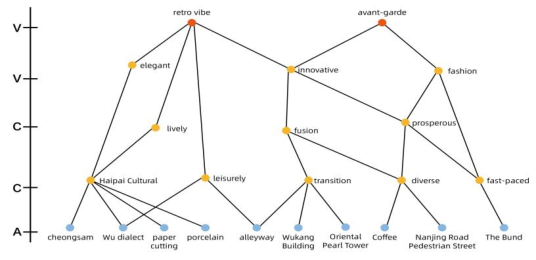
Seven days before the interview begins, the interviewees are asked to find 10 images that can express their feelings and thoughts about Haipai culture, with no restrictions on the source, and to prepare corresponding descriptions for the images. During the interview, the interview team first reads the sto- ries described by the interviewees and judges whether the stories have formed a relatively complete concept chain. The MEC (Means-End Chain) requires that the story reflects certain logical thinking, progressing from the surface to the core, from the specific to the abstract. In a complete story, there should be an initial concept reflecting attributes (A), a connecting concept reflecting consequences (C), and an ultimate concept reflecting values (V). For incom- plete stories, interviewers need to repair or reconstruct the story based on the Laddering Technique (Zaltman, 1982). After completing the interview, through the convergence of concepts, an impression value map of Haipai culture is drawn (see Figure 1).
Innovative Design Research of Time-Honored Brands Based on Haipai Cultural Genes 195
Figure 1: An impression value map of Haipai culture.
Interview Results Based on the results of the interviews, we sorted and analyzed the data, extracting the core concepts of Haipai culture as perceived by the interviewees and summarizing them into cultural factors. Taking one of the interviewees as an example (see Table 2).
Table 2. Interviewee partial interview data.
Table available in the original PDF paper.
Key Sentences Concept Extraction Classification
Coffee Metropolis East-West Fusion
Cuisine Culture Architectural Culture
You can find coffee shops everywhere in Shanghai, which is in line with its international metropolitan status. Coffee, being an imported beverage, gives me a sense of the fusion of Eastern and Western cultures, which resonates well with the essence of Shanghai’s local culture—a blend of delicacy and a touch of retro.
Nongtang Wu dialect
At first glance, this exudes a strong sense of Shanghainese culture. It’s a narrow lane bustling with life. As you step in, you can hear authentic Shanghainese dialect and the calls of vendors.
Wukang Building River view Handicrafts
Traditional Resi- dences Language and Culture Wukang Building, a famous landmark in Shanghai, attracts visitors for photography every year. With its predominantly European style, it blends beautifully with the riverside scenery. There are also some craft sales nearby.
Literature and Art
Historic Buildings Natural Landscapes Traditional Craft Culture This is a scene from Shanghai Huju, which is one of the intangible cultural heritages of Shanghai. Many people are involved in its inheritance, always evoking memories of my childhood.
Huju (Shanghai Opera) Intangible Cultural Heritage Childhood Memories Oriental Pearl Tower Old Shanghai
Landmark Build- ings Folk Culture
The Oriental Pearl Tower, the Shanghai World Financial Center, and the Bund are all iconic buildings of Shanghai, with a long history. In the pictures, we see the changes over time, giving a sense of old Shanghai.
Nanjing Road Pedestrian Street Holidays Strolling and Shopping
Landmark Build- ings Festival Customs Folk Culture
This photo is of Nanjing Road Pedestrian Street, where there are always many people during holidays, leading to traffic controls and the like. The current trend of city walks also indicates that Shanghai residents generally enjoy strolling and shopping.
196 Wu
After in-depth interviews with 5 interviewees, combined with collecting online data and video footage, a total of 9 main core factors were selected to express the primary classifications of Haipai culture. Specifically, they are: historical architecture, traditional residences, natural landscapes, culinary culture, handicraft culture, literature and art, folk beliefs, language customs, and festival customs.
EXTRACTION OF CULTURAL GENES BASED ON THE ANALYTIC HIERARCHY PROCESS (AHP) The Analytic Hierarchy Process (AHP) is a method that combines quali- tative and quantitative approaches. It decomposes decision problems that are difficult to compare into different levels, such as the goal level, criteria level, and alternative level, and then performs calculations and tests based on this structure. This process helps derive the final solution and prioritizes the importance of the goals to be achieved (Li et al., 2021).
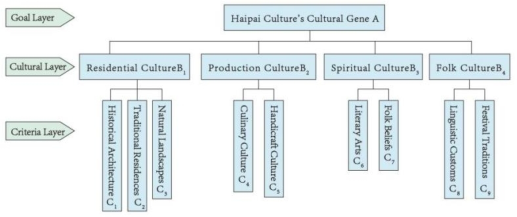
The nine core factors obtained using the ZMET metaphor extraction tech- nique are categorized into four classes and transformed into a hierarchical model. The cultural genes of Haipai culture are represented as the goal level A; Residential Culture B1, Production Culture B2, Spiritual Culture B3, and Customary Culture B4 are at the criterion level; Finally, the nine indicators are classified and represented as the solution level C (see Figure 2).
Figure 2: Model of hierarchical structure of haipai cultural genes.
According to the Analytic Hierarchy Process, scoring is conducted using a 1–9 scale (see Table 3). Pairwise comparisons are then made using the multi- plication and integration method to obtain the weight values of each element and to construct the judgment matrix A.
1 1 1
n j i
[Equation or mathematical symbol available in the original paper PDF]
[Equation or mathematical symbol available in the original paper PDF]
Equations and mathematical formulas are available in the original paper PDF.
b b b in ij i
b b b
[Equation or mathematical symbol available in the original paper PDF]
Equations and mathematical formulas are available in the original paper PDF.
A ij
[Equation or mathematical symbol available in the original paper PDF] n n b jn ji j b b b
Equations and mathematical formulas are available in the original paper PDF.
[Equation or mathematical symbol available in the original paper PDF]
[Equation or mathematical symbol available in the original paper PDF]
Innovative Design Research of Time-Honored Brands Based on Haipai Cultural Genes 197
Table 3. Judgment matrix scaling.
Table available in the original PDF paper.
Factor 1 compared to Factor 2 Scale Equally Important 1 Slightly Important 3 Moderately Important 5 Strongly Important 7 Absolutely Important 9 Midpoint of Judgment 2,4,6,8 Reciprocal Reciprocal of each other
According to the constructed judgment matrix, the weight values of each factor are calculated using the multiplication and integration method, as follows:
n X
cij Pn
n
k = 1 ckj(i, j = 1, 2, ..., n) (1) j = 1 To ensure the consistency of the evaluation process, it is necessary to conduct a consistency check on the results:
CR = CI RI(The RI value can be obtained by referring to a table) When the calculated CR < 0.1, the consistency test of the matrix passes. When CR > 0.1, it indicates that the consistency test of the matrix fails, and it is necessary to re-evaluate and score the factors in the matrix. Following the above approach, the judgment matrix scoring and weight calculation for the cultural genes of Haipai culture will be conducted, and three experts from the design industry will be invited to compare and score the factors (see Table 4 to Table 9).
Table 4. Criterion layer judgment matrix and weight values.
Based on the previous analysis and ranking of cultural genes related to Haipai culture using the AHP hierarchical analysis method, it is determined that Residential Culture has the highest weight value, followed by Production Culture, Spiritual Culture, and Customary Culture. The order of the solution layer is as follows:C1>C4>C6>C5>C2>C8>C3>C7>C9, Historical archi- tecture is the most representative cultural gene of Haipai culture, followed by culinary culture and literature and art. By selecting the most representative cultural genes and applying them to the design practice of Maochang glasses, Maochang can construct Shanghai cultural symbols, form distinctive brand recognition, adapt to the needs of new consumer groups in intense market competition, and enhance market share.
Innovative Design Research of Time-Honored Brands Based on Haipai Cultural Genes 199
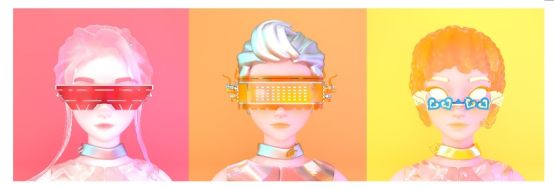
DESIGN PRACTICE Through product research on Maochang glasses and competitive analysis, combined with the brand’s future development direction, virtual eyewear products are chosen as the design output. The design practice is initiated based on the impression value map and calculation results. According to the calculation results, prototypes are selected from the top four ranked cultural genes for design. The final outcome consists of six virtual eyewear product designs (see Figure 3 to Figure 4).
Figure 3: The design of the first to third virtual glasses.Figure 4: The design of the fourth to sixth virtual glasses.
The first design draws inspiration from the Zhonghua Art Palace and Shanghai paper-cutting. The primary color is red, presenting a simple and fashionable style. The second design is inspired by the Wukang Building and crab feast, using alternating decorations with different materials. The third design takes the patterns made of shell fragments inlaid as the design pro- totype, simplifying and abstracting the pattern to express it in a minimalist technological manner. The fourth design is based on the neon signboard and calendar-themed cheongsam women at the Maochang flagship store on Nan- jing Road Pedestrian Street. The brand color of Maochang glasses is used as the main color, brightened in both brightness and luminance, with overall metallic and acrylic materials to create a futuristic technological feel. The fifth design is inspired by the Waibaidu Bridge, with the frame designed to resemble the silhouette of the bridge and abstracting the Huangpu River as a gemstone. The sixth design is based on the Oriental Pearl Tower, dismantling its appearance into two lenses and using dazzling materials to express a sense of technology.
200 Wu
The six designs created have received approval from the Maochang glasses brand. They have collaborated with the brand to bring the virtual designs to life through 3D printing, and showcased them through a themed eyewear fashion show titled “Encounter with Mirrors,” portraying visions for the future (see Figure 5). This exhibition has garnered media coverage and social attention.
Figure 5: Event site photos.
CONCLUSION
This study demonstrates through examples that the ZMET metaphor extrac- tion method and AHP hierarchical analysis method can sift and rank the cultural genes in Haipai culture based on consumers’ thoughts and feel- ings. It enriches the brand recognition of the time-honored brand Maochang glasses, rejuvenating its vitality and providing new paths and methods for the inheritance, innovation, and design transformation of time-honored brands. In the future, consideration can be given to expanding the brand genes of time-honored brands from various perspectives, further exploring the com- bination of time-honored brands and cultural genes, and exploring more comprehensive paths for the integration of brands and culture.
ACKNOWLEDGMENT
We would like to thank Maochang’s brand, all the interviewees and scoring experts for their support.
REFERENCES
Dawkins, R. (2016). The selfish gene. 4th edn. Oxford: Oxford Landmark Science. Hu, X., and Zhuang, Q. (2022). Research on Cultural Communication of Time- Honored Brands in Qingdao from the Perspective of Cultural Genes, Journal of the Party School of C. P. C. Qingdao Municipal Committee and Qingdao Administrative Institute. pp. 119–124. Huang Huiling. (2019). Research on Packaging Design of Shanghai Time- Honored Brands Based on Regional Culture, Master’s thesis, Xi’an University of Technology.
Innovative Design Research of Time-Honored Brands Based on Haipai Cultural Genes 201
Jiang, J., and Du, H. (2023). Research on User-Impression-Oriented Visual Design Method for Cultural Tourism Images, Packaging Engineering, 44(24). pp. 346–356. Li, X. (2022). Research on the Design of Time-Honored Food Brands with Nostalgic
Emotional Experience, Master’s thesis, Jiangnan University. Li, Y. Ren, S., and Gen, H. (2021). Comprehensive Protection of Ethnic Cultural Heritage from the Perspective of Cultural Genetic Inheritance, Urban Development Studies, 28(02). pp. 74–82. Liu, C. (1990). Chinese Systematic Thinking: A Cultural Genetic Perspective, China
Social Sciences Press. Liu, L., Li, M., Gao, Y., and Huang, C. (2023). Innovative Design Application of Canal Cultural Heritage from the Perspective of Cultural Genes, Packaging Engineering, 44(22). pp. 417–424. Ke, D., Li, G., Jiang, Y., Li, Y., and Liu, Y. (2023). Research on the innovation of
time-honored brands from the perspective of dual ethical patterns. Frontiers in Psychology, 13, 1041022. Yang, M., Wang, J., and Zhang, Y. K. (2019). Design of Cultural and Creative Products Based on Marine Genetic Evaluation in Qingdao. Packaging Engineer- ing, 40(6), pp. 21–27. Zaltman, G. (1996). Metaphorically speaking. Marketing Research, 8(2). pp. 13–20. Zaltman, G. (1982) Coulter R H. A Means -End Chain Model Based on Consumer
Categorization Processes, Journal of Marketing, (46). pp. 60–72. Zhang, Z. (2022). Research on Visual Design of Central Plains Culture Image from the Perspective of Cultural Genes, Master’s thesis, Dalian University of Technology. Zhao, Z., and Xiang, Y. (2023). Inherit or innovation? Research on the brand revital-
isation of China time-honoured brands, Asian Journal of Technology Innovation. pp. 1–24.
LISTED IN THE AHFE DIGITAL BOOKSTORE CATALOGUE
Explore the complete digital volume
Usability and User Experience
Read this individual research paper free through the original publisher, or explore the full digital proceedings book.
ISBN 978-1-964867-32-8
Explore this ISBN in the AHFE Bookstore ↗Listed in the July 2026 bookstore catalogue; search by ISBN to confirm current availability · Digital book purchase optional