Wei Bu, Yuting Zhao (2024). An Interactive Aesthetic Study of a Digital Display APP for Chinese Copper Chisel Paper Cutting Cultural Gene. In: Social and Occupational Ergonomics. AHFE Open Access, vol. 152, pp. 150–159. https://doi.org/10.54941/ahfe1005330
School of Architecture, Harbin Institute of Technology, Key Laboratory of Interactive Media Design and Equipment Service Innovation, Ministry of Culture and Tourism, Harbin, 150001, China ↗
This paper discusses the study of interactive aesthetics of the cultural digital display application of traditional Chinese folk art copper chisel paper cutting. The main reasons for selecting Foshan copper chisel paper-cutting as the research object are as follows: firstly, copper chisel paper-cutting is the first batch of national intangible cultural heritage, which has a history of 800 years, and has high historical research value and cultural protection value; secondly, the scarcity of raw materials and the fault line of the inheritors have caused copper chisel paper-cutting to be nearly extinct, and there is an urgent need to utilize the modern design method to carry out the salvage protection and living inheritance; finally, the mobile Internet and digital technology have broken the boundaries of space and time, and broadened the scope of the dissemination of intangible cultural heritage. In this paper, we design a digital display app for copper chisel paper-cutting culture, aiming to enhance users' knowledge and experience of copper chisel paper-cutting, stimulate users' aesthetic interest and creativity, and promote the dissemination and inheritance of copper chisel paper-cutting culture through the digital media and interactive aesthetics.The thesis firstly analyzes the artistic characteristics of copper chisel paper-cutting art, which is summarized as strong folklore connotation, unique material characteristics and subtle production technology. The paper extracts the cultural genes of copper chisel paper-cutting from both explicit and implicit cultural genes, including material genes, color genes, craft genes, composition genes, semantic genes and aesthetic genes, and reveals the profound cultural connotations and symbols contained in copper chisel paper-cutting. And based on the interactive aesthetic principles of information, emotion and behavior, the design framework of digital display applications is proposed.Then, based on the theoretical framework of interactive aesthetics, this paper discusses the design objectives, design principles and design strategies of digital display app. The authors believe that the digital display app should be able to effectively convey the connotation and value of copper chisel paper-cutting culture, and also consider the aesthetic needs and experience of users. Therefore, the authors constructed the design elements of the digital display app from three aspects: content, form and function. In terms of content, the authors chose representative and educational copper chisel paper-cutting works, as well as related history, techniques and inheritance information. In terms of form, the authors used multimedia means such as animation, music and video to enhance the visual and sound effects of the digital display app. In terms of function, the authors provide basic functions such as browsing, searching, collecting and sharing, as well as interactive functions such as collage, coloring and creating, which improve the usability and interestingness of the digital display app.The innovations of this paper are: firstly, the extraction and translation of cultural genes are taken as the core of the design, which preserves the aesthetic concepts and cultural connotations of copper chisel paper-cutting, and at the same time gives copper chisel paper-cutting a new form of expression and a way of dissemination; secondly, it applies the method of interactive aesthetics, which enhances users' perception and participation in the culture of copper chisel paper-cutting, and promotes users' aesthetic experience and cultural identity; thirdly, it combines the advantages of the mobile Internet and the digital Thirdly, by combining the advantages of mobile Internet and digital technology, the scope of audience and influence of copper chisel paper-cutting culture has been broadened, which provides new possibilities for the living inheritance of copper chisel paper-cutting culture.The conclusion of the thesis is that the cultural gene translation of copper chisel paper-cutting needs to utilize the technical advantages of digital media, create diversified forms of expression and interactive methods, and improve the cultural communication effect and user experience of copper chisel paper-cutting. Copper chisel paper-cutting culture digital display APP is an effective method of inheritance and innovation, which can maintain the cultural essence of copper chisel paper-cutting while breaking the rigidity of design, enriching the design resources of intangible cultural heritage, and giving the copper chisel paper-cutting a new value of the times and aesthetic significance.In addition, the thesis points out the prospects and limitations of the research.
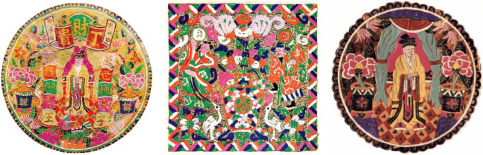
Intangible cultural heritage (ICH) refers to the various traditional cultural expressions that have been handed down from generation to generation by peoples and are considered part of their cultural heritage. ICH is an impor- tant symbol of a country’s historical and cultural achievements, and is an important part of excellent traditional culture. Copper chisel paper-cutting is one of the first national intangible cultural heritages in China (Fig. 1), which is unique in material, subtle in technique, profound in meaning, and highly distinctive. However, the scarcity of raw materials, the inheritor of the fault and learning difficulties have led to the disappearance of copper chisel paper- cutting for more than 30 years, which is in urgent need of rescue protection and living inheritance.
China’s ICH is characterized by intangibility, liveliness and inheritance, so it is impossible to rely solely on traditional research methods such as documentation, physical collections and field surveys, but needs to rely on digital technology (Noehrer et al., 2021). The use of digital technology to
An Interactive Aesthetic Study of a Digital Display APP for Chinese Copper 151
study ICH has many advantages. First, digital collection and storage technol- ogy can effectively prevent the loss and destruction of ICH. Second, digital platforms and mobile devices can expand the dissemination of ICH. Third, digital reconstruction, adaptation and creation can promote mutual exchange between ICH and other cultural forms. Therefore, this paper relies on digital media technology to design a digital display APP of copper chisel paper- cutting, so that more people can recognize the art of Chinese copper chisel paper-cutting, understand the culture of copper chisel paper-cutting, and learn the techniques of copper chisel paper-cutting. Ultimately, the goal of modernizing and passing on the art of Chinese copper chisel paper-cutting is realized.
The deployment of digitized heritage of China’s ICH started late, but advanced rapidly. In terms of digital collection and regeneration of paper- cutting, Dongmei Peng has excavated the elemental symbols underlying paper-cutting from a large number of paper-cutting patterns, and Xianquan Zhang has assisted in generating the image of paper-cutting with com- puter methods, so that the process of digitized paper-cutting can be viewed and changed. In terms of digital display and virtual reality application of paper-cutting art, Li Sisi proposed a system architecture of digital protection platform for paper-cutting art, which realizes digital and open creative experi- ence of paper-cutting art. Yan Li developed an immersive paper-cutting game platform by using virtual scene construction and game development tech- nology (Li et al., 2007). However, although the digital innovative design of paper-cutting art has received more and more attention in recent years, the effective design conversion rate is not high. On the one hand, digital design suffers from insufficient and atypical extraction of cultural symbols, result- ing in a single form of product that fails to meet the aesthetic needs of the public. On the other hand, it is easy to ignore the implication and spiritual characteristics of traditional culture in digital design, resulting in products with thin connotation, which cannot satisfy the public’s spiritual needs for the products well.
In order to solve the many problems encountered in the digitization phase of ICH, this paper introduces the concept of cultural genes. This is because ICH contains rich cultural genes, and studying ICH from the perspective of cultural genes can deconstruct the intrinsic structure and function of ICH, which is conducive to accurately digging out the cultural characteristics of ICH. The concept of “cultural gene” was first proposed by Kroeber in the 1950s, and then formally defined by British biologist Richard Dawkins in The Selfish Gene. Richard argued that the basic unit of cultural transmission or imitation is the cultural gene in a culture. On this basis, British scholar Susan Blackmore proposed multiple replication paths for cultural genes. Along with the rise of cultural gene theory, Chinese scholars have carried out localized explorations one after another. Liu Changlin believed that cultural genes are the parts of the cultural system that have special genes. Wang Dong opined that cultural genes are the basic elements of the inheritance of the cultural system. Luo Shijian viewed that cultural genes are the smallest factors con- stituting the traditional culture and the basic unit of the dissemination of the traditional culture. These studies have gradually contributed to the academic
152 Bu and Zhao
consensus that cultural genes are the basic units for storing the genetic infor- mation of a particular culture. In addition, cultural gene theory is widely used in the field of Chinese ICH design. For example, Yang Bingyun summarized the traditional Mongolian patterns from the three aspects of basic elements, structure, and color of patterns. Jun Huang extracted and reconstructed the elements of Yangshao tattoos in terms of shape, composition, and color con- figuration, deducing the “new” graphics. Existing cultural gene studies have all constructed cultural genealogical maps based on morphological genes, color genes, pattern genes and semantic genes.
To sum up, the digital display APP of the cultural genes of copper chisel paper-cutting provides a solution path for the excavation and visual expression of the cultural connotation of copper chisel paper-cutting.
Figure 1: Copper chisel paper cutting work (Foshan City Museum, China).
Figure available in the original PDF paper.
COPPER CHISEL PAPER CUTTING Copper chisel paper-cutting is the most characteristic variety of Chinese paper-cutting. It is distinctly different from traditional Chinese paper-cutting in four aspects: material & colour, technique & technology, texture & layers, shape & symbolism.
Material & Colour: Copper chisel paper-cutting uses copper, a metal spe- ciality of southeastern China, as raw material and makes it into copper foil paper with a thickness of only 0.1mm. This unique material has many valu- able physicochemical properties, such as being malleable, corrosion-resistant and heat-resistant. In addition, Chinese artisans use vibrant mineral pigments to paint on the golden copper foil, giving the copper chisel paper cutouts a rich colour palette (Fig. 2).
Figure 2: Copper chisel paper cutting special metal material.
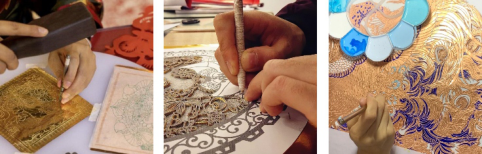
Craftsmanship & Technique: The process of making copper chisel paper- cutting is divided into six steps, namely, designing the drawing, binding the copper foil, chiseling, burring, printing, applying colours and mount- ing (Fig. 3). The process of chiselling is the most distinctive. In the process
An Interactive Aesthetic Study of a Digital Display APP for Chinese Copper 153
of chiselling, the craftsmen use special ball-shaped carving knives of several sizes as tools and strike the top of the knives with a wooden mallet to carve a concave point.
Figure 3: The process of making copper chisel paper-cutting.
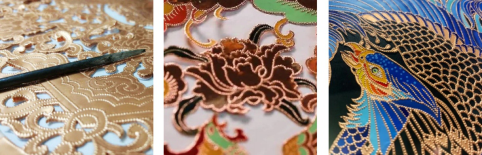
Texture & Layers: The surface of the copper foil will be left with even dots after being struck with tools, which will form a large concave-convex texture effect from dots to lines and from lines to surfaces (Fig. 4). And the strength of the craftsman’s chiselling will determine the degree of concavity and convexity of the dots, building up spatial layers in the paper-cut picture.
Figure 4: The unique texture of copper chisel paper-cutting.
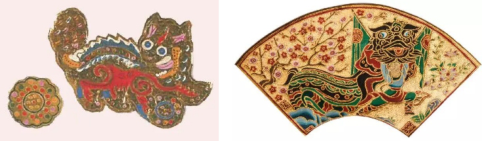
Shape & Moral: The shapes in copper chisel paper-cutting are often popu- lar with the Chinese people, implying their hope for a better life. For example, the ancient Chinese regarded the unicorn as a symbol of luck and ability, so paper-cutting with the unicorn as the theme is often used in weddings and marriages to signify great luck and good fortune (Fig. 5).
Figure 5: Chinese unicorn in copper chisel paper cutting.
154 Bu and Zhao
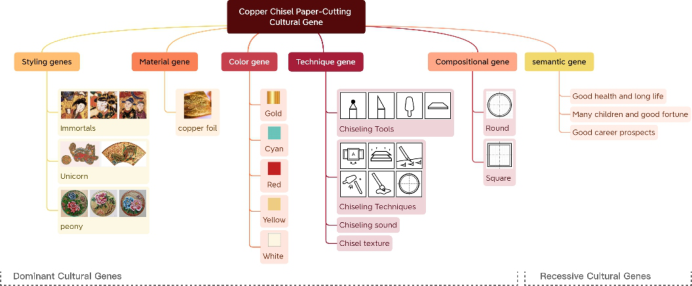
CULTURAL GENES OF COPPER CHISEL PAPER-CUTTING Cultural genes can be divided into dominant and recessive cultural genes according to their superficial characteristics. Explicit genes refer to those genes that can be perceived visually, audibly and tactilely, such as col- ors, materials, shapes and craftsmanship, while recessive genes are spiritual cultural genes, such as living habits, local customs and national spirit. By ana- lyzing the historical and cultural background of copper chisel paper-cutting, this paper summarizes the external features of copper chisel paper-cutting as modeling genes, material genes, color genes, craftsmanship genes, com- position genes, and the internal features as semantic genes. Then, the typical cultural factors that best represent copper chisel paper-cutting in each category are extracted to make a genealogical map of copper chisel paper-cutting culture, which is applied in the subsequent digitization stage (Fig. 6).
This study extracts three types of Chinese fairy, qilin and peony shapes from the styling gene, which all have strong auspicious symbols in Chinese paper-cutting. Extracting the copper foil material from the material gene, because metallic copper is the most obvious feature that distinguishes cop- per chisel paper-cutting from ordinary paper material paper-cutting. Gold, cyan, red, yellow and white are extracted from the color gene, which are the five traditional Chinese colors. From the process gene, four genes have been extracted: chiseling process, chiseling tools, chiseling sound and chisel- ing technique, which reflect the visual, auditory and tactile sensations that copper chisel paper-cutting brings to the human being when it is made. From the compositional gene, round-fit and square-fit compositions are extracted, and this symmetry law reflects the Chinese concept of pursu- ing perfection. From the semantic gene, three themes are extracted, namely, long and healthy life, many children and good fortune, and smooth career path, which symbolize the three most simple wishes of the ancient Chinese people.
Figure 6: Copper chiseled paper-cutting cultural genealogy map (self-painted by the author).
An Interactive Aesthetic Study of a Digital Display APP for Chinese Copper 155
DIGITAL DISPLAY APP The digitization process of ICH activates the originally conceptualized cul- tural genes through design, transforming them into new products that have the cultural characteristics of ICH and meet the design principles of the new era. Therefore, based on the theoretical framework of interactive aesthetics, this paper discusses the design objectives, design principles and design strate- gies of digital display App. The purpose is to make the digital display APP of copper chisel paper-cutting effective in conveying the connotation and value of copper chisel paper-cutting culture, while taking into account the user’s aesthetic needs and experience.
Concept and Characteristics of Interactive Aesthetics Interactive aesthetics is a new type of aesthetic form based on digital media, which refers to the quality of beauty felt by users in the process of interacting with products. Interactive aesthetics includes not only the visual aesthetics of the interactive interface, but also the experiential aesthetics of the operation action and the logical aesthetics of the interaction process. The characteristics of interactive aesthetics are mainly as follows:
Subjectivity. Interactive aesthetics emphasizes the subjective position of the user, who is no longer a passive receiver and observer, but an active partic- ipant and creator (Buchanan, 1998), and can choose the form and function of digital media according to their own interests and preferences to realize a personalized experience.
Dynamism. Interactive aesthetics emphasizes the dynamic change and update of digital media, which is no longer fixed and closed, but open and expandable. Digital media can adjust the display content in real time accord- ing to the user’s operation and feedback (Hashim, Noor and Adnan, 2009), realizing intelligent display experience.
Diversity. Interactive aesthetics involves not only the visual, but also the auditory, tactile and other senses, forming a comprehensive sensory stimulation. Interactive aesthetics emphasizes the use of multiple media and technologies to display multi-level information and realize multi-modal experience.
Co-creation. Interactive aesthetics emphasizes the symbiosis and co- creativity between users and digital media, where users and digital media are no longer antagonistic but integrated, and users and digital media can influence and promote each other to create and share together.
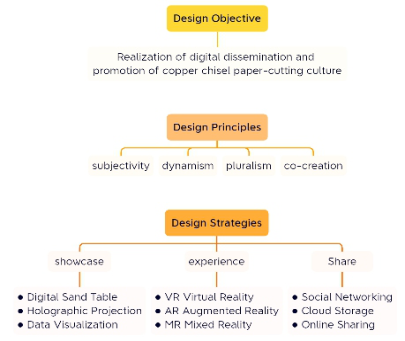
DESIGN OBJECTIVES, DESIGN PRINCIPLES AND DESIGN STRATEGIES Based on the theoretical framework of interactivity aesthetics, this paper pro- poses the design objective, design principles and design strategies of a copper chisel paper-cutting digital display APP (Fig. 7).
156 Bu and Zhao
Figure 7: APP design framework (self-painted by the author).
DIGITAL DISPLAY APP Based on the cultural genes of copper chisel paper-cutting extracted above and the theoretical guidance of the aesthetic framework of interactive aes- thetics, this study constructs the design elements of the digital display APP from three aspects: function, content and form.
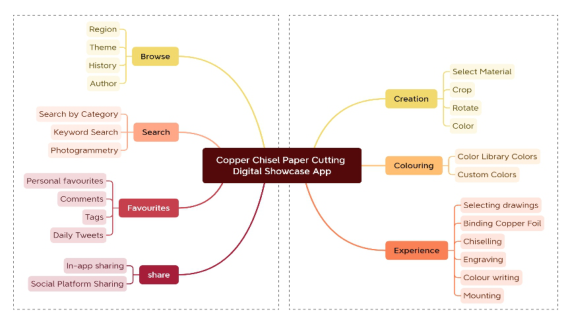
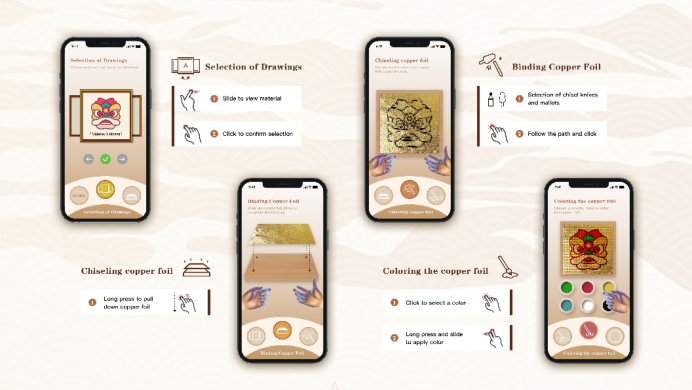
Functional Design of the APP According to the subjectivity and co-creation characteristics of interactive aesthetics, the digital APP of copper chisel paper-cutting should provide users with diversified choices, guide them to participate actively according to their own interests, and realize personalized experience. Therefore, the func- tional design of the APP not only includes basic functions such as browsing, searching, collecting and sharing, but also includes personalized interactive functions such as creating, coloring and experiencing (Fig. 8).
Figure 8: APP functional architecture diagram (self-painted by the author).
An Interactive Aesthetic Study of a Digital Display APP for Chinese Copper 157
APP Interface Design According to the theory of interactive aesthetics, the interface of copper chisel paper cutting digital APP should not only have visual aesthetics, but also have logical aesthetics in actual operation. Therefore, when designing the APP, it is necessary to take into account the visual interface style and the layout of the operation interface.
Interface Style. The interface style should be consistent with the aesthetic style of copper chisel paper cutting. In the main interface, gold is used as the main color, cyan and red are used as the accent colors, a round or square frame layout is used to classify and display the works of copper chisel paper- cutting, and the common shapes of copper chisel paper-cutting are redesigned using deconstruction and reorganization methods, which are applied to the design of the APP’s icons and illustrations, so that the users can feel the aesthetic style of copper chisel paper-cutting at a glance.
On the creation interface, the copper chisel paper-cutting works are divided into three themes, namely, long life, many children and good fortune, and smooth career, so that users can choose different themes for paper-cut cre- ation. The parameters of the digital background can be adjusted to simulate the raw materials used in the production of copper chisel paper-cutting. The shape of copper chisel paper-cutting tools can be refined and simplified, mak- ing copper chisel tool icons, which can be placed in the toolbar of the creation interface to guide users to complete the chiseling operation. Provide a library of traditional Chinese colors so that users can freely match the colors and paint their own copper chisel paper-cutting works.
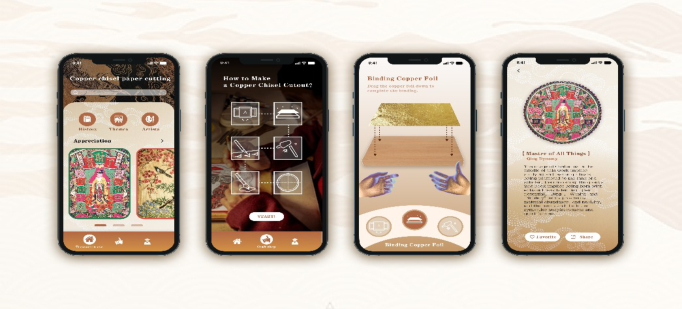
Interface Layout. The interface layout should be simple and clear, easy to operate, and conform to the user’s habit. Split screen or sliding mode can be used to display the design elements of function, content, and form sepa- rately, so that users can quickly find what they want. At the same time, some hints, guidance, feedback, and other information can be set in the appro- priate position of the interface to help users use the APP better. The main interfaces of the Copper Chisel Paper Cutting Digital Showcase APP are as follows: Treasure Pavilion, Workshop, and My Home Page (Fig. 9).
Figure 9: Digital presentation APP (self-painted by the author).
158 Bu and Zhao
APP Interaction Form Design The interaction desigppn of the copper chisel paper-cutting APP needs to follow the diversity of interaction aesthetics to realize a multimodal display experience. For example, when designing the experience of copper chisel paper-cutting, the user is guided to complete a chiseling experience by the psychological implication of visual icons, in which the user can hear the real chiseling sound and see the concave and convex effect after chiseling, so as to enhance the user’s sense of integration by the combination of visual, auditory, and tactile sensory experience (Fig. 10).
Figure 10: APP interaction form (self-painted by the author).
APP Design Validation In order to ensure that the design features of this copper chisel paper-cutting digital display APP can adequately meet the users’ needs, a series of test- ing and evaluation measures were taken in this study. Firstly, user testing was carried out, recruiting testers of different backgrounds and skill levels, and collecting valuable feedback on interface design, interaction logic, and function usage by designing tasks and observing their operational processes.
During the evaluation process, this study focused on the functionality, interface and content presentation segments of the APP. The functionality assessment showed that the functions of the APP performed well in terms of usability and accessibility, enabling users to smoothly navigate through the history of copper chisel paper-cutting, the process of the technique, and to enjoy the fun of creation and sharing. The interface evaluation showed that the visual effect of the APP was clear and aesthetic, and the interaction design was smooth and natural, providing users with a good user experience. The content evaluation showed that the APP displayed rich and accurate cul- tural content of copper chisel paper-cutting, while the personalised interactive function was also welcomed by users.
An Interactive Aesthetic Study of a Digital Display APP for Chinese Copper 159
Synthesising user feedback, this study collated the main strengths and weaknesses of the APP. Firstly, users generally think that the design of the APP is creative and can well show the cultural connotation of copper chisel paper cutting. At the same time, they also put forward some suggestions to improve the ease of use of the product, such as increasing the promptness of the creation tool and enriching the interactive sound effects in the experience session. Based on the evaluation results, this study optimises and improves the design of the APP accordingly to further enhance the user experience and promotion effect.
CONCLUSION
This study explores the extraction and transformation of the cultural genes of copper chisel paper-cutting to design a digital display APP, and utilizes inter- active aesthetics to enhance the user’s knowledge and experience of copper chisel paper-cutting culture. This is an effective method for the inheritance and innovation of copper chisel paper-cutting.
REFERENCES
Buchanan, R. (1998) ‘Branzi’s dilemma: Design in contemporary culture’, Design Issues, 14(1), pp. 3–20. Hashim, W. N. W., Noor, N. L. M. and Adnan, W. A. W. (2009) ‘The design of
aesthetic interaction: Towards a graceful interaction framework’, in Proceedings of the 2nd International Conference on Interaction Sciences: Information Tech- nology, Culture and Human. ICIS ‘09: The 2nd International Conference on Interaction Sciences: Information Technology, Culture and Human, Seoul Korea: ACM, pp. 69–75. Li, Y. et al. (2007) ‘3D paper-cut modeling and animation’, Computer Animation and Virtual Worlds, 18(4–5), pp. 395–403. Noehrer, L. et al. (2021) ‘The impact of COVID-19 on digital data practices in
museums and art galleries in the UK and the US’, Humanities and Social Sciences Communications, 8(1), p. 236.
LISTED IN THE AHFE DIGITAL BOOKSTORE CATALOGUE
Explore the complete digital volume
Social and Occupational Ergonomics
Read this individual research paper free through the original publisher, or explore the full digital proceedings book.
ISBN 978-1-964867-28-1
Explore this ISBN in the AHFE Bookstore ↗Listed in the July 2026 bookstore catalogue; search by ISBN to confirm current availability · Digital book purchase optional