Noriko OKABE (2024). Trust and satisfaction in the airline: Retention of skilled employees during COVID-19. In: Social and Occupational Ergonomics. AHFE Open Access, vol. 152, pp. 122–131. https://doi.org/10.54941/ahfe1005327
The airline industry has been hard-hit by the COVID-19 pandemic, airline workers' job stability has become uncertain, and many have suffered job instability. Thus, the employees might perceive role ambiguity. Conversely, the role of customer service employees is essential as they can add value to the products and services in the organization. According to previous studies, employees' perception of role ambiguity reduces trust in the organizations and task performance. The author explores how customer service employees' "positive emotion strategic behavior" and "negative emotional effects" played a role in increasing and decreasing the propensity of trust toward their company. The findings show that positive emotion strategic behavior, such as the employees' ''surface acting and deep acting", serve as trust repair and provide a valuable antidote in the workplace. Conversely, negative emotional effects, such as emotional exhaustion due to role ambiguity, devastate employees' intrinsic motivation.
The airline industry was hit hard by the COVID-19 pandemic, leading to a steep drop in financial performance and an increase in employee career turnover. Airline workers’ job stability has become incredibly uncertain during the pandemic. As a result, many airline workers have suffered job instability due to decreased working hours, lowered welfare benefits, changed work shifts and positions, and increased possibility of layoffs. In addition, air- line workers have been experiencing risks related to virus infection since the outbreak of COVID-19. This challenging environment in the airline industry might raise workers’ negative emotions toward their company, such as orga- nizational distrust and career turnover intention. During COVID-19, airline workers have been lowering their approach toward the airlines. Conversely, the airlines needed to retain the employees for a post-COVID-19 pandemic.
In this article, the author explores how customer service employees’ ‘posi- tive emotions’ and ‘negative emotions’, e.g., flight attendants, were mediators or moderators on the increasing and decreasing propensity of trust toward their airlines in the devastated environment during COVID-19.
Trust and Satisfaction in the Airline: Retention of Skilled Employees During COVID-19 123
LITERATURE REVIEW AND HYPOTHESES CONSTRUCTION Role Theory
Role theory indicates that role ambiguity lacks the information available to a given organizational position in the environment. Role ambiguity increases the probability that employees will be dissatisfied with their roles, experience anxiety, distort reality, and thus perform less effectively (Rizzo et al., 1970). For example, employees might perceive role ambiguity when the organization changes its employment policy, reduces social welfare, or reduces/increases working hours/schedules (Okabe, 2017). As a result, the employees may also lose trust in the organization. Thus, the author proposes the following hypothesis.
Hypothesis 1: Role ambiguity negatively correlates with organizational trust.
Positive Emotions and Negative Emotions The role of emotions in the workplace has been a constant research objective, often an implicit theme in the organization. The interactive effects of the work context and the employees’ emotional state frequently create job satisfaction, intrinsic motivation, stress, and mood (Pugh, 2001). A common expectation exists concerning the appropriate emotional reactions of individuals involved in service interactions (Hochschild, 1983). Professionals in the service indus- try must express positive emotions, such as friendliness and a warm reception. Past empirical evidence has indicated that employee practices can benefit the airlines. These benefits include higher customer satisfaction, better service quality evaluation, and improvement in customer willingness to return and recommend (Tsai, 2002).
Positive Emotional Strategies The display of positive emotion in employees (e.g., friendliness and warmth) is discretely required in many human contact service employees. Such a dis- play rule states that a positive reaction to customers is appropriate in the service interaction. Research has shown that friendliness positively correlates with customer satisfaction (Brown & Sulzer-Azaroff, 1994). “Surface acting” and “deep acting” are positive emotional strategies to match the customer’s expectations. “Surface acting”signifies that human service employees modify their emotions without shaping an inner feeling. Conversely, “deep act- ing” signifies that the employees modify their feelings to match the required emotional display rules (Grandy, 2003). This study used customer service employees’ surface acting and deep acting practices as positive emotion strategic behavior.
Hypothesis 2: Role ambiguity negatively correlates with a positive emotion strategy, “surface acting.”
Hypothesis 3: Role ambiguity negatively correlates with a positive emotion strategy, “deep acting.”
124 Okabe
Trust in Organizations While trust has played widely for its central role in establishing and maintain- ing close, cooperative, and productive relationships, damage to trust through defection and betrayal can have devastating consequences for relationships (Lewicki et al., 1998). Trust in organizations should be fundamental in an uncertain and complex environment such as the COVID-19 pandemic. As the airlines implemented reorganization and downsizing even during COVID-19, the employees were likely to perceive role ambiguity. Thus, employees may have a distrust of the organization. Employees’ positive emotional practice in the service organization provides better customer service, and customers are likely to become loyal customers. The employees’ positive emotion strat- egy might improve customers’ buying behavior and increase employees’ confidence in the organization. Thus, the author proposes the following hypothesis.
Hypothesis 4: The positive emotion strategy “surface acting” positively correlates with “trust” in the airline.
Hypothesis 5: The positive emotion strategy “deep acting” positively correlates with “trust” in the airline.
Emotional Exhaustion Emotional exhaustion is chronic mental and physical exhaustion due to excessive work and stress. Emotional exhaustion describes feelings of being emotionally overextended and exhausted by one’s work (Wright & Bonett, 1997). Thus, emotional exhaustion is the individual’s affective state and the result of continuous circumstances of mental and physical effort that can occur among individuals who do “people-work” or human service employ- ees (Robinson & Morrison, 2000). For example, customer service employees who perceive role ambiguity might also experience emotional exhaustion. In this study, emotional exhaustion is a negative dynamic variable. The author proposes the following hypothesis.
Hypothesis 6: “Role ambiguity” positively correlates with “emotional exhaustion.”
Distrust in the Organization According to previous research on personality, ‘distrust’ is caused by psycho- logical confusion (Lewicki et al., 1998). Therefore, service employees who perceive emotional exhaustion at work due to excessive stress and unreason- able physical effort, the experience of emotional exhaustion might decrease trust in the organization. Thus, the author proposes the following hypothesis.
Hypothesis 7: “Emotional exhaustion” negatively correlates with “trust.”
Moderating Effect of “Positive Emotion Strategic Behavior”
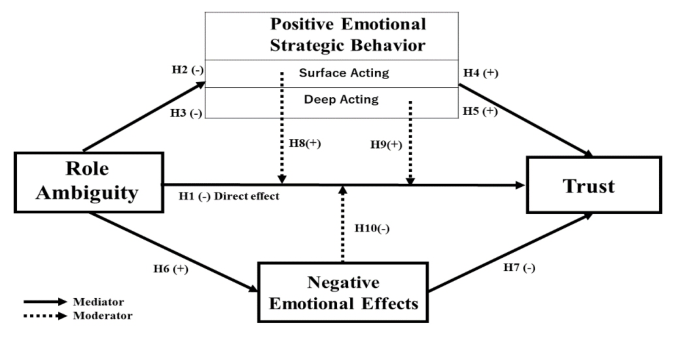
Figure 1 shows the hypotheses’ construction. According to the behavioral decision theory that examines trust and distrust from the viewpoint of ratio- nal choice, in a game situation where various motivations are mixed, “trust” is a cooperative act, and “distrust” is an uncoordinated act (Lewicki et al., 1998). Furthermore, positive emotional strategic behaviors, such as “surface
Trust and Satisfaction in the Airline: Retention of Skilled Employees During COVID-19 125
acting” and “deep acting,” express positive emotions through facial expres- sions and attitudes when dealing with customers; thus, they are considered cooperative behavior with the company. Therefore, positive emotional strate- gic behaviors such as “surface acting” and “deep acting” might moderate the reduced trust in the organization even in a devastated environment.
Hypothesis 8: “Surface acting” moderates the negative relationship between role ambiguity and trust.
Hypothesis 9: “Deep acting” moderates the negative relationship between role ambiguity and trust.
Figure 1: Hypotheses construction.
Moderating Effect of Emotional Exhaustion One reason trust in an organization is essential is that shareholders can effec- tively work together to achieve their goals. On the other hand, employees experiencing “emotional exhaustion” from excessive mental and physical stress at work might have reduced trust in the company. Therefore, emotional exhaustion might not moderate their distrust.
Hypothesis 10: Emotional exhaustion does not moderate the negative relationship between role ambiguity and trust.
METHOD
Participants. The final sample consists of 414 flight attendants (78% female) working for a European airline. Participants ranged in age from less than 20 years to more than 60 years and reported, on average, 39.9 years. Partici- pants also went in tenure from less than one year to more than 30 years and reported an average of 16.6 years.
Measures. This study used a 5-point Likert-type questionnaire to test the hypotheses. The author distributed to 500 flight attendants working for a European airline, and the author received valid responses from 414 (82.8%) respondents. Table 1 shows the descriptive statistics of the variables used in
126 Okabe
this study, the correlation analysis, and the reliability results by Cronbach’s alpha coefficient. Then, the multiple hierarchical regression analysis (Table 2) shows interaction effects, which indicate moderating effects, between the neg- ative relationship between role ambiguity and trust. Such variables are chosen as positive emotion strategies: “surface acting” and “deep acting,” as well as negative emotional effects, such as “emotional exhaustion.” In addition, as a post hoc analysis, the direct and mediator effects between variables used in this study were verified using covariance structural equation modeling (SEM); those analyses used IBM SPSS Statistics Base version 28, and SPSS Amos version 28.
RESULTS
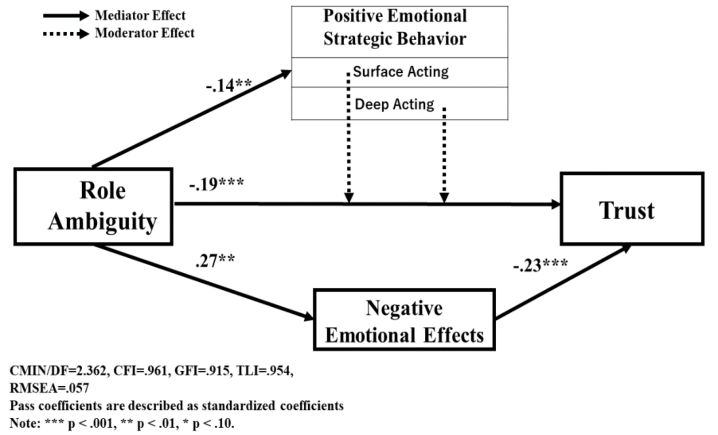
Multiple Models As a result of correlation analysis, a negative correlation (r = −.22, p <.001) was observed between role ambiguity and trust (Table 1). The results of covariance structural equation modeling (SEM) showed a negative path coefficient (r = −.19, p <.001) observed between role ambiguity and trust (Figure 2). Thus, Hypothesis 1, which predicted the negative relation- ship between role ambiguity and organizational trust, was supported. The goodness-of-fit summary of the SEM model shows CMIN/DF = 2.362, CFI = .961, GFI = .915, TLI = .954, RMSEA = .057.
8 Deep Acting 3.65 .90 .91 .01 .02 −.02 ∗∗ .02 .06 .18 ∗∗∗ .34 ∗∗∗ 1 Note: ∗∗∗p < .001, ∗∗p < .01, ∗p < .10.N = 414. 1 Gender: coded as Male = 0, Female = 1. 2 Job tenure: coded as 1 = 0 −5 years, 2 = 6 −10 years, 3 = 11 −15 years, 4 = 16 −20 years, 5 = 21 −25 years, 6 = 26 −30 years, 7 = more than 30 years. 3 Age: coded as 1 = less than 20 years, 2 = 21 −30 years, 3 = 31 −40 years, 4 = 41 −50 years, 5 = 51 −60 years, 6 = more than 60 years. 4 Reliability represents Cronbach Alpha coefficients.
Regarding Hypothesis 2, the correlation analysis shows a negative corre- lation (r = −.22, p <.01) between role ambiguity and a positive emotional strategic behavior: surface acting. Furthermore, the results of path analy- sis also show a negative coefficient (r = −.14, p <.01), which supported
Trust and Satisfaction in the Airline: Retention of Skilled Employees During COVID-19 127
Hypothesis 2, predicting the negative relation between role ambiguity and surface acting.
For Hypothesis 3, contrary to the prediction, no significant correlation was found between role ambiguity and deep acting. Furthermore, no signif- icant path coefficient was found between role ambiguity and deep acting. Thus, Hypothesis 3 rejected a negative effect between role ambiguity and deep acting.
Figure 2: Result of multi-mediation model.
For Hypothesis 4 and Hypothesis 5, there is no significant positive cor- relation between surface acting and trust or between deep acting and trust. Furthermore, path analysis shows no significant relation between surface act- ing and trust or between deep acting and trust. Therefore, the result rejected Hypothesis 4 and Hypothesis 5.
As for hypothesis 6, a significant correlation (r = .25, p <.001) is observed between role ambiguity and emotional exhaustion. Furthermore, path analy- sis also shows a significant relation (r = .27, p <.01) between role ambiguity and emotional exhaustion. Therefore, the result supported Hypothesis 6.
As for hypothesis 7, a significant negative correlation (r = −.26, p <.001) is observed between emotional exhaustion and trust. Furthermore, path anal- ysis also shows a significant negative relation (r = −.23, p <.001) between emotional exhaustion and trust. Thus, hypothesis 7 was supported.
Multiple Hierarchical Regression Analysis
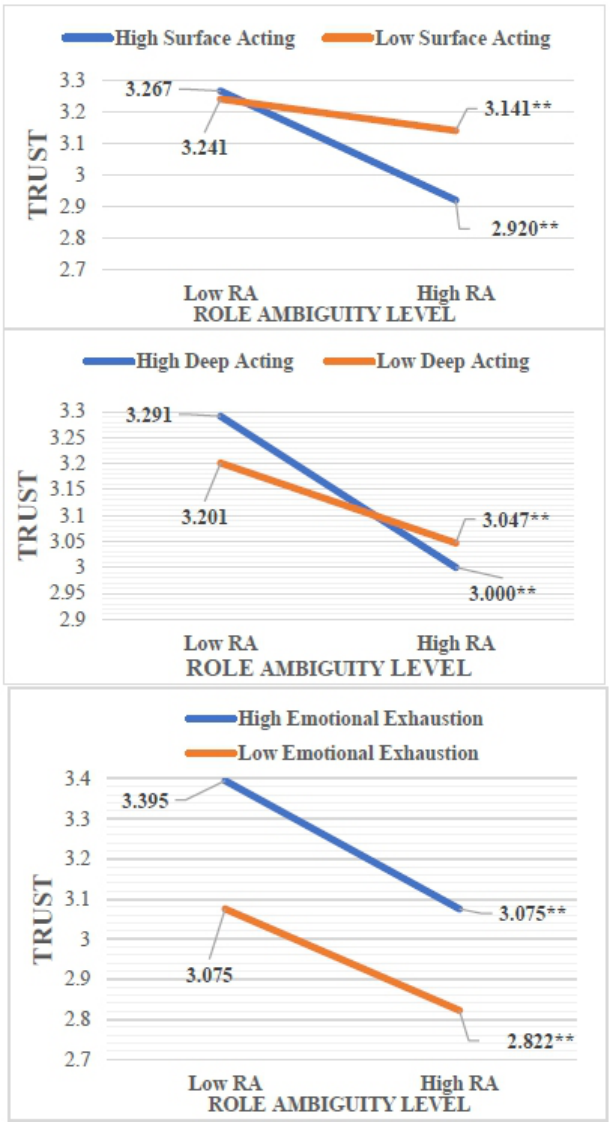
Table 2 shows the results of the multiple hierarchical regression analysis. The result indicates that when the interaction between “role ambiguity”and “sur- face acting” was included in the multiple regression equation, an exchange was significantly observed (B = −.64, p <.05) [F (8, 405) = 9.583, p <.001, 1R2 = .159]. Thus, in Hypothesis 8, the interaction between ‘role ambiguity’ and ‘surface acting’ considerably moderates the decreasing trust propensity to a certain extent when the perception of role ambiguity is low. On the other
128 Okabe
hand, if the employees’ perception of role ambiguity is high, the employees using ‘surface acting’ might be unable to moderate the decreasing trust trend. Therefore, Hypothesis 8 was partially supported. Figure 3 (upper) shows a plot graph showing the interaction of role ambiguity and surface acting.
Table 2 also indicates that an exchange was significantly observed when the interaction between “role ambiguity” and “deep acting” was included in the multiple regression equation. Figure 3 (middle) shows a plot graph of the interaction of role ambiguity and deep acting. As a result of multiple hier- archical regression analysis, when the interaction between “role ambiguity” and “deep acting” was included in the multiple regression equation, a sig- nificant interaction was observed (B = −.64, p <.05) [F (8, 405) = 9.814, p <.001, 1R2 = .162]. Thus, in Hypothesis 9, the interaction between “role ambiguity” and “deep acting” considerably moderates the decreasing trust propensity when the perception of role ambiguity is low.
Table 2. Multiple hierarchical regression analysis for testing the effects on trust.
Table 2 also indicates that exchange was significantly observed when the interaction between “role ambiguity” and “emotional exhaustion” was included in the multiple regression equation. Figure 3 (lower) shows the interaction of “role ambiguity” and “emotional exhaustion.” The result shows that when the interaction between “role ambiguity” and “emotional exhaustion” was included in the multiple regression equation, a significant interaction was observed (B = −.71, p <.05) [F (8, 405) = 9.655, p <.001, 1R2 = .160]. However, in Hypothesis 10, when employees’ perception of emotional exhaustion is high, and there is high role ambiguity in the workplace, the employees’ trust in the employer would be deficient.
DISCUSSION AND IMPLICATION The airline industry has been hard-hit by the COVID-19 pandemic, airline workers’ job stability has become uncertain, and many have suffered job instability. Thus, the employees might perceive role ambiguity. Conversely, the role of customer service employees is essential as they can add value to the products and services of the airline. According to previous research,
Trust and Satisfaction in the Airline: Retention of Skilled Employees During COVID-19 129
Figure 3: Interactions: “role ambiguity” and “surface acting” (upper), “role ambiguity” and “deep acting” (middle), and “role ambiguity” and “emotional exhaustion” (lower).
130 Okabe
employees’ perception of role ambiguity reduces trust in the organizations and task performance, and exhausted workers manifest lower levels of com- mitment and a greater likelihood of seeking employment elsewhere. The author explored how “positive emotional, strategic behavior,” such as surface acting as well as deep acting, and “negative emotional effects,” such as emo- tional exhaustion of customer service employees, e.g., cabin crew, played a role in the increasing and decreasing propensity of trust toward their airlines.
The findings show that the employees’ “surface acting” and “deep act- ing” have a propensity for trust repair when role ambiguity is not extremely high; therefore, it might provide a valuable antidote in the organization. Con- versely, emotional exhaustion due to role ambiguity devastates employees’ intrinsic motivation. Finally, this study showed the trust repair factors of skilled customer service employees, their positive emotions toward the orga- nization, and their acquired emotional strategic skills, which enforced their retention in the airline even under challenging environments.
LIMITATIONS AND FUTURE RESEARCH This paper has limitations that suggest avenues for future research. On the other hand, it presents an exploratory study in the cabin of the Boe- ing 777-300ER (77W) four-class long-distance flight layout to measure the user experience in smart cabins and cockpits to optimize human well- being and overall system performance. Future research could explore how environmental factors affect human factors in different dimensions.
ACKNOWLEDGMENT
This work is supported by JSPS KAKENHI Grant Number JP19K13800.
REFERENCES
Grandey, A. A. (2003). When “the show must go on”: Surface acting and deep acting as determinants of emotional exhaustion and peer-rated service delivery. Academy of Management Journal, 46(1), 86-96. Hochschild, A. R. (1983). The managed heart: Commercialization of human feeling.
Univ of California Press. Lewicki, R. J., McAllister, D. J., & Bies, R. J. (1998). Trust and distrust: New relationships and realities. Academy of Management Review, 23(3), 438–458. Okabe, N. (2017). Creating of customer loyalty by cabin crew A study of the
relation between emotional labor and job performance. Transportation research procedia, pp. 25, 149–164. Pugh, S. D. (2001). Service with a smile: Emotional contagion in the service encounter.
Academy of Management Journal, 44(5), 1018–1027. Rizzo, J. R., House, R. J., & Lirtzman, S. I.: Role conflict and ambiguity in complex organizations. Administrative Science Quarterly, 15(2): 150–163 (1970). Robinson, S. L., & Morrison, E. W (2000). The development of psychological
contract breach and violation: A longitudinal study. Journal of Organizational Behavior, 21(5), 525–546.
Trust and Satisfaction in the Airline: Retention of Skilled Employees During COVID-19 131
Shaw Brown, C., & Sulzer-Azaroff, B. (1994). An assessment of the relationship between customer satisfaction and service friendliness. Journal of Organizational Behavior Management, 14(2), 55–76. Tsai, W. C., & Huang, Y. M. (2002). Mechanisms linking employee affective delivery
and customer behavioral intentions. Journal of Applied Psychology, 87(5), 1001. Wright, T. A., & Bonett, D. G. (1997). The contribution of burnout to work performance. Journal of Organizational Behavior: The International Journal of Industrial, Occupational, and Organizational Psychology and Behavior, 18(5), 491–499.
LISTED IN THE AHFE DIGITAL BOOKSTORE CATALOGUE
Explore the complete digital volume
Social and Occupational Ergonomics
Read this individual research paper free through the original publisher, or explore the full digital proceedings book.
ISBN 978-1-964867-28-1
Explore this ISBN in the AHFE Bookstore ↗Listed in the July 2026 bookstore catalogue; search by ISBN to confirm current availability · Digital book purchase optional