Noriko OKABE (2025). The Impacts of Self-Esteem and Subjective Well-Being on Job Satisfaction and Performance. In: Social and Occupational Ergonomics. AHFE Open Access, vol. 190, pp. 56–64. https://doi.org/10.54941/ahfe1006597
This study explored how customer service employees’ self-esteem and subjective well-being could moderate the decreasing propensities of job satisfaction and job performance in the workplace with psychological contract violation (PCV). 200 Japanese customer service employees completed the online questionnaire. The mediated moderation model revealed that even when employees perceive a PCV as a predictor of burnout, they might work with high self-esteem and high subjective well-being and avoid decreasing the propensities of job satisfaction and job performance.
Contemporary employment relationships are in transition. Mutual obligations were the essence of the employment contract defining the relationship between employee and employer (Rousseau, 1989). Psychological contracts are characterized by an individual’s belief in reciprocal obligations between employees and employers. If an individual believes a reciprocal obligation between two parties, such as employees and employer, was violated, the employee might perceive a psychological violation. In this article, the author explored how customer service employees’ self-esteem and subjective well-being could moderate the decreasing propensities of job satisfaction and job performance.
LITERATURE REVIEW AND HYPOTHESES CONSTRUCTION In this study, the author used a combined model with both mediation and moderation to construct hypotheses. The variable control has both mediator and moderator status in this model (Baron and Kenny, 1986).
Psychological Contracts Rousseau (1989) defined a psychological contract as an individual’s beliefs about the terms and conditions of a reciprocal exchange agreement between that person and another party. A psychological contract is an individual’s belief regarding the terms and conditions of a reciprocal exchange
The Impacts of Self-Esteem and Subjective Well-Being on Job Satisfaction and Performance 57
agreement between that focal person and another party. Unlike formal or implied contracts, the psychological contract is inherently perceptual; thus, one party’s understanding of the contract may not be shared by the other. Psychological contracts, comprising perceived obligations, must be distinguished from expectations, which are employees’ general beliefs about what they will find in their jobs and the organization.
Psychological Contract Violation (PCV) A violation occurs when one party in a relationship perceives another as failing to fulfill a promised obligation. Since contracts emerge under assumptions of good faith and fair dealing and involve parties relying on the promises of the other, violations can lead to serious consequences for the parties involved (Robinson & Rousseau, 1994). When employees encounter a contract violation, their job satisfaction, job performance, and trust in the organization can decline. Moreover, Turnley & Feldman (2000) suggest that psychological contract violations are likely to have a pervasive negative impact on employee attitudes and behaviors, including increased neglect of in-role job duties, reduced willingness to engage in voluntary behaviors supportive of the organization, and increased attempts to leave the organization altogether. Thus, the negative consequences of psychological contract violations (PCV) are likely to go beyond employees’ hurt feelings and disillusionment; psychological contract violations may also result in behaviors damaging organizational effectiveness.
Psychological contract violations (PCV) have negative effects because they operate through a sense of unmet expectations and job dissatisfaction (Turnley & Feldman, 2000). Poter and Steers (1973) defined the discrepancy between what employees encounter on the job and what they expect to encounter as ‘unmet expectancy.’ The unmet expectations literature also suggests that such discrepancies lead to decreased job satisfaction, reduced commitment, lower job performance, and increased turnover (Wanous et al., 1992).
Job Satisfaction and Job Performance “Happiness” is a lay construct of job satisfaction and job performance. The previous research has proposed several different approaches to operationalizing happiness in the workplace. From the organizational viewpoint, job satisfaction is probably the most common and old approach to happiness in the workplace. Consistent with the previous research in this area, the author proposes the following hypotheses:
Hypothesis 1: Psychological contract violation (PCV) is negatively associated with employee ‘job satisfaction’.
Hypothesis 2: Psychological contract violation (PCV) is negatively associated with employee ‘job performance’.
Self-Esteem Self-esteem is the affective or emotional aspect of self and generally refers to how we feel about or value ourselves (one’s self-worth). Self-concept can also refer to the general idea we have of ourselves, and self-esteem can refer
58 Okabe
to measures about components of self-concept. The Rosenberg Self-Esteem Scale (RSES; Rosenberg, 1979) intends to measure a single dominant factor representing global self-esteem (Gnambs et al., 2018). This study proposes the following hypotheses concerning self-esteem and other variables.
Hypothesis 3: Psychological contract violation (PCV) is negatively associated with ‘self-esteem’.
Hypothesis 4: ‘Self-esteem’ is positively associated with ‘job satisfaction’. Hypothesis 5: ‘Self-esteem’ is positively associated with ‘job performance’. Hypothesis 6: ‘Self-esteem’ moderates the negative relationship between ‘PCV’ and ‘job satisfaction’.
Hypothesis 7: ‘Self-esteem’ moderates the negative relationship between ‘PCV’ and ‘job performance’.
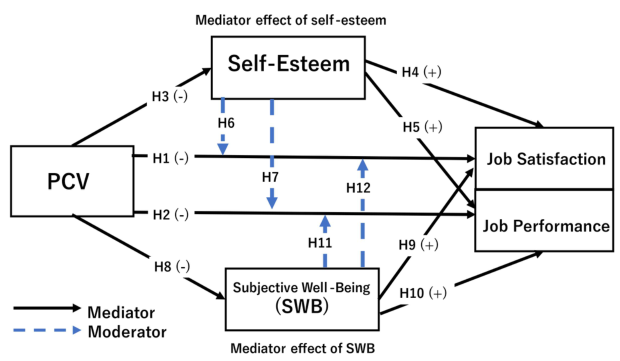
Subjective Well-Being Subjective well-being (SWB) is defined as people’s overall evaluation of their lives and emotional experiences, the personal perception and experience of positive and negative emotional responses, and the global-specific cognitive evaluation of satisfaction with life (Diener et al., 2002). It is measured from an individual’s perspective (i.e., self-reported), a characteristic that differentiates the field from clinical psychology (Diener et al., 1997). This study proposes the following hypotheses. Figure 1 shows the hypotheses in the mediated moderation model predicting job satisfaction and job performance to examine in this study.
Hypothesis 8: ‘Psychological contract violation (PCV)’ is negatively associated with ‘subjective well-being (SWB).
Hypothesis 9: ‘SWB’ is positively associated with ‘job satisfaction’. Hypothesis 10: ‘SWB’ is positively associated with ‘job performance’. Hypothesis 11: ‘SWB’ moderates the negative relationship between ‘PCV’ and ‘job satisfaction’.
Hypothesis 12: ‘SWB’ moderates the negative relationship between ‘PCV’ and ‘job performance’.
Figure 1: Hypotheses construction of mediated moderation model predicting job satisfaction and job performance.
The Impacts of Self-Esteem and Subjective Well-Being on Job Satisfaction and Performance 59
METHOD
Participants. A global leader in online surveys administered an online survey. The final sample comprises 200 Japanese customer service employees (54.5% female). Participants ranged in age from less than 20 to more than 60 and reported an average age of 24. Participants also ranged in tenure from less than one year to more than 30 years and reported an average tenure of 8 years. Measures. This study used a 5-point Likert-type questionnaire to test all the hypotheses from 1 (low) to 5 (High).
Psychological Contract Violation (PCV). This study used two items to assess the degree of the employee’s psychological contract violation (PCV), referring to the previous research (Robinson & Rousseau, 1994). “How well has your company fulfilled the obligations that they owed you?” (Reverse scored item), and “Has your company ever failed to meet the obligations that were promised to you?”
Self-Esteem. This study used three items from the Rosenberg Self-Esteem Scale (Rosenberg, 1979). “I feel that I have several good qualities.”, “I feel that I’m a person of worth.” and “I feel I do not have much to be proud of.” (Reverse scored item).
Subjective Well-being (SWB). Subjective well-being is defined by internal experience and measured from an individual’s perspective (i.e., self-reported), a characteristic that differentiates the field from clinical psychology (Diener et al., 1997). The current study used three items developed for the Japanese version of the Subjective Happiness Scale (SHS) (Shimai et al., 2004) to measure SWB, as subjective well-being has some synonyms including happiness (Proctor, 2014), and the respondents to the questionnaire are Japanese people. Subjective well-being respondents were asked the following questions: “In general, I consider myself a happy person.”, “I consider myself happier than people of my age.” and “Some people are generally not very happy, although they are not depressed. They never seem as happy as they might be. What extent does this characterization describe you?” (Reverse scored item).
Job satisfaction. The current study used two items from developing a qualitative or projective attitude scale. (Kumin, 1995; Robinson & Rousseau, 1994). The job satisfaction items asked the following questions: “Working for the company is very satisfying to me” and “I am satisfied with my job.”
Job performance. Job performance used three items, of which two items were assessed using William et al. (1991), and one based on a measure of service worker performance presented by Brown et al. (2002). The job performance items asked the following questions: “To what extent do you agree or disagree with the following statement? Do you perform your tasks and roles that are expected of you?”, “Do you adequately complete all duties assigned to you?”, and “What is your overall performance compared to all other colleagues?”
60 Okabe
RESULTS
Table 1 displays the descriptive statistics of the variables used in this study, including the variable means, standard deviations, intercorrelations, and internal consistency reliability (Cronbach’s alpha coefficient). Consistent with Robinson and Rousseau (1994), Table 1 shows PCV was negatively correlated with job satisfaction (r = −.54, p < .001), and this supports hypothesis 1. Providing additional support to overall findings, hypothesis 2 predicted a negative correlation between PCV and job performance. Table 1 shows a negative correlation between PCV and job performance (r = −.53, p <.001), supporting hypothesis 2. Hypothesis 3 predicted a negative correlation between PCV and self-esteem: however, a negative correlation was not robust, and hypothesis 3 was not supported. Conversely, hypothesis 4 predicted a positive correlation between self-esteem and job satisfaction; Table 1 shows a positive correlation between self-esteem and job satisfaction (r = .14, p <.01). This supported hypothesis 4. Likewise, hypothesis 5 predicted a positive correlation between self-esteem and job performance; Table 1 shows a positive correlation between self- esteem and job performance (r = .18, p <.01), and this supported hypothesis 5.
1Gender: coded as Male = 0, Female = 1. 2Job tenure: coded as 1 = 0 ∼5 years, 2 = 6 ∼10 years, 3 = 11 ∼15 years, 4 = 16 ∼20 years, 5 = 21 ∼25 years, 6 = 26 ∼30 years, 7 = more than 30 years. 3Age: coded as 1 = less than 20, 2 = 21 ∼30, 3 = 31 ∼40, 4 = 41 ∼50, 5 = 51 ∼60, 6 = more than 60 4Cronbach’s Alpha coefficients represent reliability.
Multiple Hierarchical Regression Analyses Examining Moderation Effects on Job Satisfaction and Job Performance A series of hierarchical regressions were used to test hypotheses 6 and 7, which were about moderation effects predicting job satisfaction, and hypotheses 10 and 11, which were about moderation effects on job performance.
Table 2 shows the results of the multiple hierarchical regression examining moderation effects predicting job satisfaction. The result indicates that when the interaction ‘PCV’ and ‘self-esteem’ was included in the multiple regression equation, an exchange was significantly observed (B = −.49, p <.01) [F (7, 193) = 16.259, p <.001, adjusted R2 = .349, 1R2 = .011].
Table 2 also shows the interaction ‘PCV’ and ‘SWB’ was included in the multiple regression equation, an exchange was significantly observed (B = -.63, p <.01) [F (7, 193) = 16.259, p <.001, adjusted R2 = .351, 1 R2 = .013].
The Impacts of Self-Esteem and Subjective Well-Being on Job Satisfaction and Performance 61
Table 3 shows the results of the multiple hierarchical regression analysis examining moderation effects predicting job performance. The result indicates that when the interaction between ‘PCV’ and ‘self-esteem’ was included in the multiple regression equation, an exchange was significantly observed (B = −.65, p <.01) [F (7, 193) = 16.656, p <.001, 1R2 = .022].
Table 3 also shows the interaction ‘PCV’ and ‘SWB’ was included in the multiple regression equation, an exchange was significantly observed (B = -.52, p <.01) [F (7, 193) = 15.699, p <.001, adjusted R2 = .341, 1 R2 = .008].
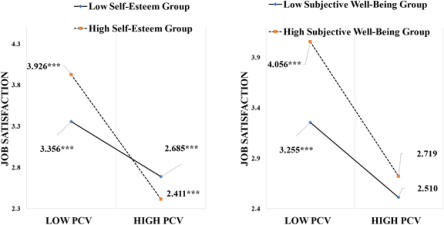
Concerning hypotheses 6 and 7, the interactions of ‘PCV’ and ‘self-esteem’ considerably moderate the decreasing propensities on job satisfaction, particularly when the employees’ perception of PCV is low. Those partially support hypotheses 6 and 7.
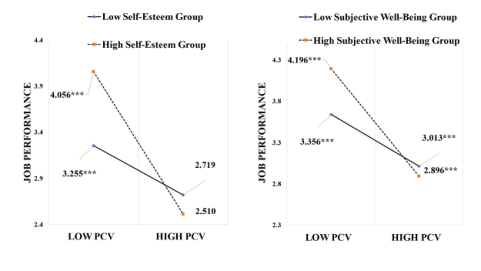
Likewise, concerning hypotheses 10 and 11, the interactions of ‘PCV’ and ‘SWB’ considerably moderate the decreasing propensities on job performance, particularly when the employees’ perception of PCV is low. Those partially support hypotheses 10 and 11.
Figure 2 and Figure 3 show these interaction effects; on the left, plot graphs indicate the interaction of PCV and self-esteem, and on the right, plot graphs indicate the interaction of PCV and SWB.
Table 2: Hierarchical regression examining moderation effects on job satisfaction.
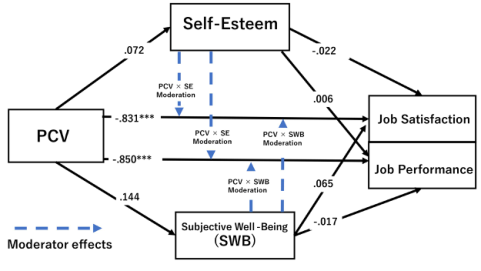
Figure 3: Plot graphs of the interaction effects predicting job performance.Figure 4: Result of mediated moderation model predicting job satisfaction and job satisfaction.
The Impacts of Self-Esteem and Subjective Well-Being on Job Satisfaction and Performance 63
DISCUSSION AND IMPLICATION Psychological contracts are frequently violated in organizations. Psychological contracts are reciprocal obligations in employment developed during and after recruitment. Robinson and Rousseau (1994) described that 54.8% of MBA graduates reported that psychological contracts had been violated by their employers. Violations generate distrust toward their employer, less job satisfaction, less job performance, and intention to quit the job.
In this article, the author explored how customer service employees’ self- esteem and subjective well-being could moderate the decreasing propensity of job satisfaction and the decreasing propensity of performance in the working environment with PCV.
The previous research on burnout has focused on individuals in helping professions, such as client service, health care, and teaching (Cordes et al., 1993). Those professionals frequently and intensely experience a high level of direct, frequent, and intense interaction with people. Maslach (1978) theorized that the potential for stress is greatest for professionals in helping people because they constantly deal with other people and their problems. Consistent with the previous research, this research showed that customer service employees’ PCV negatively correlated with employees’ job satisfaction and job performance.
Conversely, this study revealed that even when employees perceive a PCV in the workplace, they might maintain working with high self-esteem and high subjective well-being and avoid decreasing the propensity of job satisfaction and job performance. Finally, this study implies that emotionally skilled employees with higher self-esteem and higher subjective well-being might cope with their stressful working environment and relationships and recover from potential burnout.
ACKNOWLEDGMENT
This work is supported by JSPS KAKENHI Grant Number 24K16423.
REFERENCES
Baron, R. M., & Kenny, D. A. (1986). The moderator-mediator variable distinction in social psychological research: Conceptual, strategic, and statistical considerations. Journal of personality and social psychology, 51(6), 1173. Brown, T. J., Mowen, J. C., Donavan, D. T., & Licata, J. W. (2002). The customer orientation of service workers: Personality trait effects on self-and supervisor performance ratings. Journal of marketing research, 39(1), 110–119. Cordes, C. L., & Dougherty, T. W. (1993). A review and an integration of research
on job burnout. Academy of Management Review, 18(4), 621–656. Diener, E., Heintzelman, S. J., Kushlev, K., Tay, L., Wirtz, D., Lutes, L. D., & Oishi, S. (2017). Findings all psychologists should know from the new science on subjective well-being. Canadian Psychology/psychologie canadienne, 58(2), 87. http://dx.doi.org/10.1037/cap0000063
64 Okabe
Diener, E., Lucas, R. E., & Oishi, S. (2002). Subjective well-being: The science of happiness and life satisfaction. In C. R. Snyder & S. J. Lopez (Eds.), Handbook of positive psychology (pp. 63–73). New York: Oxford University Press. https:// doi.org/10.1093/oso/9780195135336.003.0005, Pages 63–73. Gnambs, T., Scharl, A., & Schroeders, U. (2018). The structure of the Rosenberg
self-esteem scale. Zeitschrift für Psychologie. Kumin, T. (1955). The construction of a new type of attitude measure, Personnel Psychology, 8, 65–78. https://doi.org/10.1111/j.1744–6570.1955.tb01189.x Maslach, C. (1978). The client role in staff burnout. Journal of Social Issues, 34(4),
111–124. Porter, L. W., & Steers, R. M. (1973). Organizational, work, and personal factors in employee turnover and absenteeism. Psychological bulletin, 80(2), 151. https:// doi.org/10.1037/h0034829 Proctor, C. (2014). Subjective Well-Being (SWB). In: Michalos, A. C. (eds) Encyclopedia of Quality of Life and Well-Being Research. Springer, Dordrecht. https://doi.org/10.1007/978-94-007-0753-5_2905 Rousseau, D. M. (1989). Psychological and implied contracts in organizations. Employee responsibilities and rights journal, 2, 121–139. https://doi.org/10.1007/BF01384942 Shimai S, Otake K, Utsuki N, Ikumi A, Lyubomirsky S. (2004). Development of a
Japanese version of the Subjective Happiness Scale (SHS), and examination of its validity and reliability. Nihon Koshu Eisei Zasshi. 2004 Oct;51(10): 845–53. Japanese. PMID: 15565993. Turnley, W. H., & Feldman, D. C. (2000). Re-examining the effects of psychological contract violations: Unmet expectations and job dissatisfaction as mediators. Journal of Organizational Behavior, 21(1), 25–42. Robinson, S. L., & Rousseau, D. M. (1994). Violating the psychological contract: Not the exception but the norm. Journal of Organizational Behavior, 15(3), 245–259. Rosenberg, M. (1979). Conceiving the self. New York: Basic Books. Wanous, J. P., Poland, T. D., Premack, S. L., & Davis, K. S. (1992). The effects
of met expectations on newcomer attitudes and behaviors: A revived meta- analysis. Journal of Applied Psychology, 77(3), 288. Williams, L. J., & Anderson, S. E. (1991). Job satisfaction and organizational commitment as predictors of organizational citizenship and in-role behaviors. Journal of Management, 17(3), 601–617.
LISTED IN THE AHFE DIGITAL BOOKSTORE CATALOGUE
Explore the complete digital volume
Social and Occupational Ergonomics
Read this individual research paper free through the original publisher, or explore the full digital proceedings book.
ISBN 978-1-964867-66-3
Explore this ISBN in the AHFE Bookstore ↗Listed in the July 2026 bookstore catalogue; search by ISBN to confirm current availability · Digital book purchase optional