Li-wei Qiu, Xiao Zhao, Hong-bao Wang, Liang-kui Jiang, Zhi-yong Liu, Ze-rui XIANG (2025). Visual Ergonomics and Its Applications in Complex Systems. In: Social and Occupational Ergonomics. AHFE Open Access, vol. 190, pp. 105–118. https://doi.org/10.54941/ahfe1006603
The study of ergonomics in various complex systems through visual channels is very important to ensure visual safety, visual performance, visual comfort and even visual health in people's life, study and work. Firstly, the definition of visual ergonomics is elaborated, along with the influencing factors of human, machine, and environment, and visual ergonomics evaluation indicators in three aspects e.g. physical load, psychological load, and performance are proposed. Then, the progress of application research on visual ergonomics in complex systems such as display terminals, transportation equipment, and indoor environments etc. is analysed. Finally, possible future development directions in research and application of visual ergonomics are suggested.
With the growing emphasis on visual issues in daily life, learning, and workplace settings, research on visual ergonomics has garnered increasing attention from academic and industrial communities (Anshel, 2007; Long et al., 2012). The goal of visual ergonomics research is to deeply explore the characteristics and behaviours of the human visual system to evaluate and optimize lighting conditions, thereby improving work efficiency, accuracy, and comfort, establishing and maintaining a relatively healthy work environment, and enabling people to work more safely and pleasantly (Long et al., 2012). As disciplines such as lighting engineering, vision research, optics, and human factors engineering became integrated into visual ergonomics (Helland, 2008), the field has increasingly focused on exploring human visual processes and the interactions between humans and other elements within systems. This aims to apply relevant theories, knowledge, and methodologies to design and evaluate systems that promote human well-being while optimizing system performance (Toomingas, 2014).
Over the past few decades, researchers have conducted extensive empirical studies and theoretical explorations on visual ergonomics, primarily focusing on product and workspace design, workers’ visual health and visual
performance evaluation, visual comfort, and productivity (Menozzi et al., 2020), laying a solid foundation for the discipline. In the past decade or so, visual ergonomics research has gradually expanded to major industrial sectors and fields, covering various vision-related tasks (Long and Long, 2012). Concurrently, governmental and international organizations have prioritized visual ergonomics by establishing multiple standards. For example, in 2011, the (ISO) formulated and implemented ISO 11591 (International Organization for Standardization, 2011), which specifically regulates the design and use of small vessels from a visual ergonomics perspective, providing reference guidelines for the layout and information presentation of vessel operation interfaces, thereby enhancing crew navigation safety and work performance. In 2016, the American National Standards Institute (ANSI) introduced ANSI/IES RP-29-20 (Illuminating Engineering Society, 2016), integrating knowledge from visual ergonomics, lighting design, and medical fields to provide lighting recommendations for specific patient care, offering medical lighting design guidelines for lighting designers and healthcare professionals to improve medical environments and protect patients’ visual health. In 2018, China issued GB/T 13379, which was revised in 2023 (Standardization Administration of China, 2023). This standard specifies the requirements for visual ergonomics in indoor workplace lighting, defines related visual ergonomics terminology, and ensures that lighting conditions meet the demands of work tasks while reducing potential eye fatigue and discomfort.
This paper reviews domestic and international research achievements in visual ergonomics from the perspective of human-machine-environment systems, analyses and summarizes the influencing factors and evaluation indicators of visual ergonomics. It focuses on summarizing and forecasting the application of visual ergonomics in complex systems such as display terminals, transportation equipment, and indoor environments, providing references for academia and industry to conduct visual ergonomics research.
Definition of Visual Ergonomics Visual ergonomics, also known as visual human factors engineering, is a sub- discipline of ergonomics that was officially recognized by the International Ergonomics Association (IEA) as a technical committee in 2009 (Long, 2014). The definition of visual ergonomics has dynamically evolved alongside its development: in 1914, Gilbreth introduced scientific principles to human factors/ergonomics (HF/E) research through field observations and experimental studies (Gilbreth, 1914); subsequently, together with Gilbreth in 1919, they explored the relationship between lighting conditions and work performance, discovering that good lighting not only reduces workers’ visual fatigue but also improves work accuracy and speed (Gilbreth and Gilbreth, 1919). Over the following 90 years, although research achievements in visual ergonomics were published successively (Long et al., 2012), researchers further expanded and refined the concept of visual ergonomics based on these studies, yet a unified definition remained elusive. It was not until 2012, at the annual scientific meeting of the Nordic Ergonomics
Visual Ergonomics and Its Applications in Complex Systems 107
Society (NES), that the International Ergonomics Association (IEA) provided a unified definition for visual ergonomics (Toomingas, 2014): Visual ergonomics is the multidisciplinary science concerned with understanding human visual processes and the interactions between humans and other elements of a system. Visual ergonomics applies theories, knowledge and methods to the design and assessment of systems, optimizing human well- being and overall system performance. Subsequently, Long and Richter (2014) further elaborated that visual ergonomics is a science aimed at optimizing the interaction between human visual experience and overall system performance, achieving a balance between subjective visual needs and objective task requirements by understanding visual processes and applying relevant theories and methods. In 2018, China’s GB/T 13379–2018 (Standardization Administration of China, 2018) specified the requirements for visual ergonomics in indoor workplace lighting, extending the definition of visual ergonomics to the field of indoor workplace lighting. The research themes expanded to include: visual environment, visually demanding work and other tasks, visual function and performance, visual comfort and safety, optical corrections, and other assistive tools. In 2023, China’s latest revision, GB/T 13379–2023 (Standardization Administration of China, 2023a), refined the definition of visual ergonomics, stipulating that visual ergonomics is the science of studying whether the light environment is suitable for individuals to achieve optimal visual safety, visual performance, and visual comfort; it explicitly defines visual performance as the ability and efficiency of individuals to complete specific visual tasks using their visual organs, characterized by the speed and accuracy of visual task completion. The English term “performance” associated with visual performance is sometimes translated as “effectiveness” in the field of visual ergonomics in China (Lin and Wei, 2016; Fang et al., 2003a), and thus visual performance is occasionally referred to as “visual effectiveness.”
After more than 110 years of germination and development, visual ergonomics has evolved from studying singular issues of visual fatigue into a comprehensive, multidisciplinary, and multi-level science. Despite multiple definitions of visual ergonomics, there is a lack of uniformity and coherence among them, making it challenging to form consistent guiding principles in practical applications. Based on the above literature, it can be concluded that visual ergonomics is a multidisciplinary and multidimensional comprehensive science that not only focuses on fundamental research in visual physiology and psychology but also emphasizes the application of research findings to system design and evaluation. Its core purpose is to ensure that individuals in a light environment achieve optimal visual safety, visual performance, and visual comfort, thereby optimizing human well-being and enhancing overall system performance.
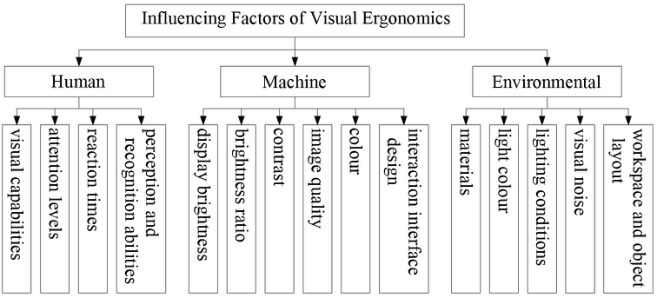
Influencing Factors of Visual Ergonomics The influencing factors of visual ergonomics primarily encompass three aspects: human factors, machine factors, and environmental factors (Long and Dhillon, 2019), as illustrated in Figure 1. Among these, human
factors focus on individual physiological, psychological, and cognitive characteristics, including visual capabilities (Chen et al., 2022), attention levels (Cheng et al., 2023), reaction times (Li et al., 2020a), perception and recognition abilities (Ben et al., 2023), etc. Due to significant individual differences, system design and evaluation must account for user diversity to ensure system usability and adaptability. Machine factors primarily concern the impact of hardware and software characteristics on visual ergonomics, including display brightness, brightness ratio, contrast, image quality, colour, and interaction interface design (Francesco et al., 2021; Wang et al., 2016; Gong et al., 2023). Display brightness and contrast are critical for providing clear visual information, while image quality and colour affect the user’s visual experience, and the intuitiveness and usability of the user interface are key to improving operational efficiency. Environmental factors also play a significant role in visual ergonomics. Materials (Raymond et al., 2019), light colour (Lin and Wei, 2016), lighting conditions (Jahangiri et al., 2023), visual noise (Gao et al., 2011), workspace and object layout (Standardization Administration of China, 2023b) directly influence visual ergonomics. Appropriate lighting levels and quality can provide a favourable visual environment (Standardization Administration of China, 2023b), while reducing visual noise, minimizing interference sources, and implementing rational workspace layouts and interface designs can effectively enhance the quality of visual ergonomics (Jahangiri et al., 2023; Gao et al., 2011; Standardization Administration of China, 2023b). Therefore, to improve visual safety, visual performance, and visual comfort in a light environment from the perspective of visual ergonomics, it is necessary to comprehensively balance human, machine, and environmental factors from a systemic perspective.
Figure 1: Visual ergonomics influencing factors.
Evaluation Indicators of Visual Ergonomics Visual ergonomics can be measured through evaluation indicators (Lee et al., 2011), typically used to assess users’ perceptual experiences and performance in environments, interfaces, and human-machine interactions. The evaluation
Visual Ergonomics and Its Applications in Complex Systems 109
of visual ergonomics is a multidimensional process involving three aspects: physiological load, psychological load, and performance (effectiveness). Physiological load focuses on the impact of visual tasks on an individual’s physiological state, primarily including visual fatigue (Jiang et al., 2020), musculoskeletal discomfort (Lindegård et al., 2012a; Lindegård et al., 2012b), and headaches (Habibi et al., 2014). Psychological load pertains to the effects of visual tasks on an individual’s psychological state, mainly encompassing brain activity levels (Lindegårda et al., 2012) and emotional states (Sakki et al., 2011). Performance is directly related to an individual’s outcomes in visual tasks, primarily measured by the accuracy and reaction time of participants (Jiang et al., 2020; Sakki et al., 2011). The types of these evaluation indicators and their explanations are detailed in Table 1.
Table 1: The main types of visual ergonomics evaluation indicators and their interpretations.
Table available in the original PDF paper.
Main type Interpretation
Evaluation Indicators Physiological load Visual fatigue Refers to excessive stimulation of the eye
muscles and nerves after prolonged visual tasks, leading to eye fatigue, with symptoms such as dry eyes, eye pain, and blurred vision. Musculoskeletal
Refers to symptoms such as shoulder and discomfort neck pain, wrist fatigue, and lower back soreness that individuals may experience when performing repetitive visual tasks for extended periods. Headaches Refers to head pain caused by prolonged
eye fatigue, musculoskeletal discomfort, or other physical issues during visual tasks, potentially accompanied by symptoms such as nausea, dizziness, and light sensitivity. Psychological load Brain activity
Refers to the degree and characteristics of levels an individual’s brain neural activity during visual tasks, reflecting the level of cognitive and attentional engagement in the tasks. Emotional states Refers to the emotional changes
experienced by an individual during visual tasks, such as anxiety, stress, excitement, or fatigue. Performance Accuracy Refers to the correctness or accuracy rate of an individual in completing visual tasks. Reaction time Refers to the time taken by an individual
to complete visual tasks.
Research on the Application of Visual Ergonomics in Display Terminal Field Visual ergonomics has always been closely associated with display terminals (Long, 2014). Therefore, display terminals are an unavoidable subject when discussing visual ergonomics. Among them, Ostberg (1975) explored issues associated with the use of old cathode ray tube (CRT) displays, noting that prolonged use of CRT displays can lead to visual fatigue and eye discomfort, affecting operators’ work efficiency and comfort. Shahnavaz and Hedman (1984) investigated visual adaptation issues that operators may experience after prolonged use of display terminals through field studies, focusing on the impact of workstation lighting and display screen characteristics. Francisc and Peter (1998) examined the effects of display terminals on workers’ vision and the conditions required to achieve visual comfort, proposing optimization measures from an ergonomics perspective. Menozzi (2000) found that the visual load on head-mounted display (HMD) users is partly caused by the brightness characteristics of the pixels composing the display and applied visual ergonomics theory to design HMDs to reduce discomfort during use. Mori et al. (2000) conducted a uniformity analysis of the visual performance of thin-film transistor liquid crystal displays, demonstrating the effectiveness of the evaluation algorithm. Toomingas et al. (2014) found a higher incidence of eye symptoms among professional computer users. Jiang et al. (2020) discovered through experiments that hue difference angles significantly affect children’s visual ergonomics, proposing the use of colour contrast to enhance the visual ergonomics of children’s interactive interfaces. Hou et al. (2021) proposed a display dimming model based on ergonomic testing, comprising three dimensions—visual performance, visual comfort, and visual fatigue—to address rapid changes in light environments, such as in aircraft cockpits, vehicle driver cabins, and train driver compartments. Gantz and Rosenfield (2021) found a considerably high proportion of digital eye strain (DES) among users reading on electronic display terminals. Prajakta and Nivedita (2022) noted that increasing awareness of visual ergonomics can prevent the rampant occurrence of computer vision syndrome (CVS) among working populations. Jin et al. (2023) found that different combinations of icons and text, as well as the semantic familiarity of icons, significantly affect participants’ visual performance, providing theoretical references for the integration of icons and text in interface design.
Research on the Application of Visual Ergonomics in Transportation Equipment Field Visual ergonomics has been extensively studied in the field of transportation equipment, with research spanning rail transport, maritime transport, air transport, road transport, and petroleum drilling. Among these, rail and air transport have seen the most substantial research contributions.
Rail Transport: Fang et al. (2003a) conducted tests and analyses on the nighttime operating environment of mainline railway locomotives in China, studying the mechanism and severity of glare on liquid crystal displays
Visual Ergonomics and Its Applications in Complex Systems 111
during nighttime operations and proposing reference schemes for indoor light sources and illuminance arrangements. Naweed and Balakrishnan (2014) through interviews and observational studies with 34 drivers, concluded that drivers are not merely operating trains but are addressing high- intensity visual tasks in the driving environment. Zhan et al. (2016) successfully evaluated glare in complex train driving environments using a visual simulation method based on the Unified Glare Rating (UGR) formula and a modified UGR formula for small light sources. Li et al. (2017) employed computer simulation methods, using the DGI glare index to analyse daytime glare conditions in the driver’s cabin of high-speed trains traveling at 160 km/h across different directions and time periods. Li et al. (2020b) conducted simulation calculations for various lighting layout schemes in high-speed train passenger cabins, identifying the optimal lighting configuration. Additionally, Li and Fang (2020) explored the non- visual biological effects of lighting environments on alertness, cognitive performance, and mood, demonstrating the feasibility of dynamic lighting for fatigue intervention in subway dispatchers. Ji et al. (2020) studied the impact of train lighting environments on drivers, proposing effective strategies to reduce cabin glare and enhance visual comfort through optical simulation and principal component analysis. Silla et al. (2022) evaluated the acceptance, effectiveness, and accident reduction potential of auxiliary strobe light systems for railway trains using questionnaires, behavioural measurements, and eye-tracking, demonstrating that the system significantly improves drivers’ visual scanning and train detection efficiency at level crossings. Xu et al. (2023) assessed the carriage lighting environment of five Chengdu subway lines using a combination of objective and subjective methods, finding that carriage layout and illuminance had no significant impact on passengers’ smartphone use, while spatial brightness perception increased with vertical illuminance, and passengers showed no preference for colour temperature.
Air Transport: Zhang et al. (2012) proposed a quantitative evaluation method based on SPEOS/CATIA, using a specific aircraft cockpit as a case study to assess glare during daytime and nighttime, verifying the method’s effectiveness. Yang et al. (2013) studied the impact of harsh lighting conditions in aircraft cockpits on pilots’ visual performance, exploring improvement measures. Through cockpit simulation experiments, they found that vision and reaction times were affected under dynamic lighting scenarios and proposed environmental illuminance adjustments as an optimization strategy. Lin and Wei (2016) analysed the impact of adverse light environments, such as lightning and direct sunlight, on pilots based on visual ergonomics and proposed corresponding countermeasures. Zhang et al. (2020) determined optimal illuminance levels in aircraft cockpits through experiments to enhance crew members’ visual ergonomics and comfort, recommending 60 lx for instrument panel lighting and 215 lx for reading and writing tasks. Lin et al. (2022) conducted a three- dimensional visual ergonomics experiment based on visual performance, visual fatigue, and visual comfort, developing a brightness adjustment model for cockpit displays. Williamson et al. (2023) used high dynamic range
(HDR) displays to investigate the impact of intense light interference on gaze duration in visual tasks, revealing a significant increase in processing time under strong light conditions, indicating potential significant risks to transportation safety. Zhang et al. (2024) combined optical simulation and human-machine ergonomics experiments to evaluate visual quality issues of main aircraft displays in dark night environments, proposing optimization design recommendations. Zhu et al. (2024) experimentally validated pilots’ performance in visual tasks under different lighting conditions in simulated cockpits, providing a theoretical basis for designing cockpit lighting environments.
Road Transport: Ortiz et al. (2013) explored the impact of age and visual impairments on drivers’ retinal image quality and visual performance, finding that even with sufficient visual acuity, some visual functions in elderly drivers were significantly diminished. Du et al. (2013) used eye-tracking experiments to study the impact of illuminance changes at highway tunnel entrances and exits on drivers, determining that drivers’ light and dark adaptation times in medium and long tunnels should be controlled within 13 seconds and 23 seconds, respectively. Irving et al. (2016) discussed the special visual requirements to consider when designing automotive head-up displays (HUDs) and the tools and technical foundations needed to complete such designs. Friedland et al. (2017) found that glare from oncoming vehicle headlights during nighttime driving reduces visibility and causes discomfort, increasing the risk of traffic accidents, particularly for elderly drivers. He et al. (2017) applied visual ergonomics theory to highway tunnel lighting environment design, exploring its impact on drivers’ peripheral visual performance. Zhu et al. (2022) studied the effectiveness of intelligent tunnel induction lighting systems (ITIL) in improving drivers’ visual behaviour and safety in tunnel driving, quantifying ITIL’s positive impact on visual behaviour through eye-tracking data.
Research on the Application of Visual Ergonomics in Indoor Environment Field As people’s demands for comfort and functionality in indoor environments continue to rise, scholars have increasingly focused on addressing human visual needs and comfort, making visual ergonomics an indispensable factor in indoor environment design.
Gao (1991) introduced basic knowledge on improving classroom lighting environments based on visual ergonomics principles to enhance the learning quality and visual comfort of primary and secondary school students, providing a reference for school health workers. Hedge et al. (1995) evaluated two office lighting systems through questionnaire data, finding that the lens- based indirect lighting system resulted in fewer issues with screen glare, eye fatigue, and eye focusing, making it more suitable for workers. Perry and Littlefair (1995) discussed effective daylighting in display screen equipment (DSE) environments, emphasizing the potential benefits of daylight, as well as issues such as light source reflection and glare that require attention, and how appropriate design and supplementary lighting can optimize the
Visual Ergonomics and Its Applications in Complex Systems 113
work environment. Anshel (2007) argued that both lighting and vision must be considered when designing high-efficiency work environments, as properly controlling lighting parameters can effectively regulate visual stress. Deng et al. (2014) established a visual ergonomics evaluation model for the driller’s control room in petroleum drilling rigs by analysing human field-of-view characteristics and developed a visual ergonomics evaluation system for the control room using VB, providing valuable references for design optimization in related fields. Cui et al. (2016) explored the impact of building lighting environments on the quality of life for the elderly from the perspective of human living spaces, addressing issues such as visual comfort, psychological mood, and physiological rhythms. Barchino et al. (2021) developed a virtual building environment simulation system to study the visual ergonomics of elderly individuals’ colour perception in architectural spaces, validating its effectiveness in real-world cases through online interactive tools. Zeng et al. (2022) investigated the non-visual effects of office building lighting environments on physical and mental health through field measurements and analysis, identifying deficiencies in the non-visual effects of current office lighting environments and proposing suggestions for optimizing office lighting systems to meet health needs. Jahangiri (2023) used visual ergonomics as a theoretical foundation, demonstrating through evaluations of participants’ performance and eye discomfort that improving lighting quality and visual ergonomics can reduce eye discomfort and enhance work efficiency. GB/T 13379–2023 specifies the guideline requirements for visual ergonomics in indoor workplace lighting, aiming to improve indoor lighting quality, protect employees’ visual health, and enhance work efficiency and comfort (Standardization Administration of China, 2023a).
CONCLUSION
As a sub-discipline of ergonomics, visual ergonomics encompasses influencing factors from human, machine, and environmental dimensions, including individuals’ physiological and cognitive characteristics, hardware and software features of equipment, and environmental factors such as lighting and visual noise. Its evaluation indicators include physiological load, psychological load, and performance, used to measure users’ perceptual experiences and outcomes. To enhance user work efficiency, comfort, and operational experience, it is necessary to comprehensively consider human, machine, and environmental factors, integrating objective and subjective approaches to achieve holistic system design and evaluation optimization. The application of visual ergonomics is rapidly expanding, with current research primarily concentrated in three major fields: display terminals, transportation equipment, and indoor environments. Research has progressed from evaluating single devices and basic functions to optimizing multiple environmental factors and user needs, emphasizing the coordinated enhancement of visual health and work efficiency. Studies in healthcare and industrial manufacturing also highlight the potential of visual ergonomics in improving product performance and workplace safety.
CHALLENGES AND OUTLOOK Future visual ergonomics research will place greater emphasis on technological integration, incorporating methods such as artificial intelligence, machine learning, and biofeedback to conduct more precise and comprehensive visual performance evaluations. Additionally, introducing technologies like augmented reality (AR) and virtual reality (VR) for simulation experiments will enable testing of extreme or rare visual lighting conditions in safe, risk-free environments, leading to new trends in future research. Particularly in advanced transportation equipment fields with complex lighting environments, such as rail transport, aerospace, and maritime vessels, research on operators’ visual safety, visual performance, visual comfort, and long-term visual health will be a key development direction. Studying the dynamic visual comfort of crew members will also become significant, addressing visual issues in a wider range of application scenarios and further enhancing the overall human-machine compatibility and personnel visual health in new fields and systems.
FUNDING This work was supported by the National Key Research and Development Program of China under Grant [2022YFB4301203-16].
REFERENCES
Anshel J. R. (2007). Visual ergonomics in the workplace. Workplace Health and Safety, 55(10), 414–420. Barchino A. T., Bernal P. M. C., Carda A. D., Llópez E. B. (2021). Panoramic viewing
system for living spaces. A chromatic interaction project between the elderly and the architectural space. EGA Revista de Expression Grafica Arquitectonica, 26(42): 180–191. Ben I., Stijnen L., Ortibus E. (2023). The relation between visual orienting functions, visual perception, and functional vision in children with (suspected) cerebral visual impairment. Research in Developmental Disabilities, 142, 104619. Chen J., Chen T., Su Y., Jiang C., Xu X., Zhang Z. M. (2022). Effects of luminous
environments on visual performance of people with different vision. International Eye Science, 22(07), 1163–1167. Cheng X., Yan Y., Hu T., Lv Y. (2023). A review of the effect of the light environment of the VDT workspace on the “learning to learn” effect of video game training. China Light and Lighting, (10), 1–14. Cui Z., Chen Y., Hao L. (2016). Research trends on elderly healthy lighting in human
habitat based on their optic characteristics. China Illuminating Engineering Journal, 27(05), 21–26+86. Deng L., Yu S., Chu J., Zhang W. (2014). Research on visual ergonomics evaluation of driller control room. Computer Engineering and Science, 36(08), 1538–1543. Du Z., Huang F., Yan X., Pan X. (2013). Light and Dark Adaption Times Based on
Pupil Area Variation at Entrance and Exit Areas of Highway Tunnels. Journal of Highway and Transportation Research and Development, 8(1), 73–77. Fang W., Guo B., Zhang J. (2003a). Effect of parameters adjuestment of the locomotive LCD on vision sfficacy. Journal of the China railway society, (06), 40–44.
Visual Ergonomics and Its Applications in Complex Systems 115
Fang W., Yu W., Guo B. (2003b). Compositive analysis and evaluation of glare at LCD in locomotive’s driving environment during night-time. Journal of Beijing Jiaotong University, (04), 65–68. Francesco L., Michele R., Giacomo S., Merve O., Chiara B., Fabio B. (2021).
Laptop displays performance: Compliance assessment with visual ergonomics requirements. Displays, 68, 102019. Francisc F., Peter B. (1998) Ergo-ophthalmologic problems of electronic display devices. Oftalmologia (Bucharest, Romania: 1990), 45(4), 4–9. Friedland H., Snycerski S., Palmer E. M., Laraway S. (2017). The effectiveness of
glare-reducing glasses on simulated nighttime driving performance in younger and older adults. Cognition Technology and Work, 19(4), 571–586. Gantz L., Rosenfield M. (2021). Digital eye strain symptoms during online university learning in Israel and the USA during the COVID-19 pandemic. Investigative Ophthalmology Visual Science, 62(8), 1975–1975. Gao L. (1991). The lighting environment in primary and secondary school classrooms based on principles of visual ergonomics[J]. Chinese Journal of School Health, (03), 159–161. Gao X., Stine-Morrow E. A., Noh S. R., Eskew R. T. Jr. (2011). Visual noise
disrupts conceptual integration in reading. Psychonomic Bulletin and Review, 18(1), 83–88. Gilbreth F., Gilbreth L. (1919). Fatigue study; the elimination of humanity’s greatest unnecessary waste, a first step in motion study. New York: The Macmillan company. Gilbreth L. (1914). The Psychology of Management: The Function of the Mind in
Determining, Teaching, and Installing Methods of Least Waste. New York, Sturgis and Walton company. Gong Y., Qiu M., Huo F. (2023). Research on the efficiency of visual search for car interface icons based on visual complexity and spatial frequency. Journal of Computer-Aided Design and Computer Graphics, 35(10), 1612–1619. Habibi E., Rajabi H., Arbabi M. (2014). An examination of the relationship between
visual fatigue symptoms with flicker value variations in video display terminal users. Iranian Journal of Health, Safety and Environment, 2(1), 211–216. He S., Tähkämö L., Maksimainen M., et al. (2017) Effects of transient adaptation on drivers’ visual performance in road tunnel lighting[J]. Tunnelling and Underground Space Technology incorporating Trenchless Technology Research, 2017, 70: 42–54. Hedge A., Sims W. R., Becker F. D. (1995). Effects of lensed-indirect and parabolic
lighting on the satisfaction, visual health, and productivity of office workers. Ergonomics, 38(2), 260–80. Helland M., Horgen G., Kvikstad T. M., Garthus T., Bruenech J. R., Aarås A. (2008).
Musculoskeletal, visual and psychosocial stress in VDU operators after moving to an ergonomically designed office landscape. Applied Ergonomics, 39(3), 284–295. Hou D., Xu W., Jing S., Lin Y. (2021). Display dimming model characterized by three-dimensional ergonomic study. Optical engineering, 60(3). Illuminating Engineering Society, (2016). ANSI/IES RP-29-20, Recommended
Practice: Lighting for Hospitals and Health Care Facilities. Washington D. C.: American National Standards Institute (ANSI). International Organization for Standardization. (2011). EN ISO 11591-2011, Small craft engine-driven-Field of vision from helm position. Geneva: International Organization for Standardization.
Irving B., Hasenauer D., Mulder S. (2016). Multi-tool design and analysis of an automotive HUD. Optical Design and Testing VII, 10021. Jahangiri H, Kazemi R, Mokarami H, Andrew S. (2023). Visual ergonomics,
performance and the mediating role of eye discomfort: A structural equation modelling approach International Journal of Occupational Safety and Ergonomics, 29(3), 11–10. Ji Z., Duan W., Liu J., Jing S., Lin Y. (2020). Glare simulation and experiment of train’s cab. Journal of Applied Optics, 41(6), 1161–1165. Jiang Y., Rao J., Yuan W. (2020). Research of hue difference between icons on visual
ergonomics in children’s interactive interface. Chinese Journal of Ergonomics, 26(03), 21–25. Jiang Y., Hong J., Li X., Qu J. (2024). Analysis on visual ergonomics of instrument display system through event-related-potential. 2014 IEEE International Inter- Disciplinary Conference on Cognitive Methods in Situation Awareness and Decision Support (CogSIMA), San Antonio, TX, USA, 35–39. Jin T., Wang W., He J., Wu Z., Gu H. R. (2023). Influence mechanism of icon
semantics on visual search performance: Evidence from an eye-tracking study. International Journal of Industrial Ergonomics, 93, 103402. Lee D., Ko Y., Shen I., Chao C. (2011). Effect of light source, ambient illumination, character size and interline spacing on visual performance and visual fatigue with electronic paper displays. Displays, 32(1), 1–7. Li S., Fang W., Li D., Wang H., Gu X. (2017). Analysis on the daylight glare
evaluation for the cab of the speed of 160 km/h intercity EMU Train. Journal of Railway Science and Engineering, 14(04), 839–844. Li W., Yang S., Chen S., Zhang B., Li T., Du Y., Zhao H., Yu J. (2020a). Experimental study on relieving visual disability caused by road flash. China Illuminating Engineering Journal, 31(02), 49–52+58. Li Y., Fang W. (2020). Discussion on the feasibility of Dynamic Lighting Intervention
on Subway dispatcher fatigue. Lighting Society of China. Proceedings of China Lighting Forum 2020 - Innovative Application of Semiconductor Lighting and Intelligent Lighting Development Forum, State Key Laboratory of Rail Transit Control and Safety, Beijing Jiaotong University. Li Y., Fang W., Shen P. (2020b). The influence of luminaire setting in EMU passenger compartment on glare. China Illuminating Engineering Journal, 31(04), 74–80+93. Lin C., Yi X., Ji Z., Hou D, Lin Y. (2022). Optimum display luminance under a wide
range of ambient light for cockpit displays. Optics express, 30(21), 38439–38457. Lin Y., Ai J., Yang B., Liu Y. (2016). Visual ergonomics research of civil aircraft cockpit in harsh luminous conditions. Science and Technology Information, 14(13), 175–176. Lindaegard A., Wahlstrom J., Hagberg M., Vilhelmsson R., Toomingas A., Tornqvist
E. W. (2012a). Perceived exertion, comfort and working technique in professional computer users and associations with the incidence of neck and upper extremity symptoms. BMC musculoskeletal disorders, 13(1), 38. Lindegård A., Gustafsson M., Hansson G. A. (2012b). Effects of prismatic glasses including optometric correction on head and neck kinematics, perceived exertion and comfort during dental work in the oral cavity - A randomized controlled intervention. Applied Ergonomics, 43(1), 246–253. Long J. (2014). What is Visual Ergonomics? Work, 47(3).
Visual Ergonomics and Its Applications in Complex Systems 117
Long J., Fostervold I. K., Warren G. R., Volden F. (2012) Evolutionary adaptations: Theoretical and practical implications for visual ergonomics. Work, 47(3), 387–397. Long J., Long A. (2012). Applying research to practice: Generalist and specialist
(visual ergonomics) consultancy. Work, 2012, 41(S1): 3372–3378. Long J., Richter H. (2014). Visual ergonomics at work and leisure Paying it Forward.
Work, 47(3), 419–420. Long S, Dhillon B. S. (2019). Man-Machine-Environment System Engineering.
Singapore: Springer. Menozzi M. (2000). Visual ergonomics of head-mounted displays. Japanese Psychological Research, 42(4), 213–221. Menozzi M., Long J., Huang Y. Y., Richter H. (2020) Editorial special issue “Advances in Visual Ergonomics”. International Journal of Industrial Ergonomics, 79(4), 102964. Mori Y., Tanahashi K, Tsuji S. (2000). Quantitative evaluation of visual performance
of liquid crystal displays. Algorithms and Systems for Optical Information Processing IV, 4113, 242–249. Naweed A., Balakrishnan G. (2014) Understanding the Visual Skills and Strategies of Train Drivers in the Urban Rail Environment[J]. Work, 47(3), 339–352. Ortiz C., Castro J., Alarcón A., Soler M., Anera R. G. (2013). Quantifying age-
related differences in visual-discrimination capacity: Drivers with and without visual impairment. Applied Ergonomics, 44(4), 523–531. Ostberg O. (1975). CRTs pose health problems for operators. International Journal of Occupational Safety and Health, 44(6), 24–6, 50, 52. Perry M. J., Littlefair P. J. (1995). Lighting and visual ergonomics for the
display screen environment. 6th International Conference on Human-Computer Interaction (HCI International 95), Tokyo, Japan, 20, 623–628. Prajakta K., Nivedita D. (2022). Visual ergonomics for changing work environments in the COVID-19 pandemic. Work, 73(S1), S169–S176. Raymond M. K., Mathew R., John C., Jack W., Bryan M. (2019). On the roles of
central and peripheral vision in the extraction of material and form from a scene. Attention, perception and psychophysics, 81(5), 1209–1219. Sakki M., Golick M. A., Mather M. (2011). Differential Interference Effects of Negative Emotional States on Subsequent Semantic and Perceptual Processing. Emotion, 11(6), 1263–1278. Shahnavaz H., Hedman L. (1984) Visual accommodation changes in VDU-operators
related to environmental lighting and screen quality. Ergonomics, 27(10), 1071–82. Silla A., Dressler A.., Lehtonen E, Virtanen A., Mesimäki J., Grippenkoven J. (2022).
Potential of auxiliary strobe lights on train locomotives to improve level crossing safety. Applied Ergonomics, 103, 103767. Standardization Administration of China, (2018). GB/T 13379–2018. Principles of Visual Ergonomics-the Lighting of Indoor Workplaces. Beijing, China: China Quality Standards Publishing Media Co., Ltd. Standardization Administration of China, (2023a). GB/T 13379–2023. Principles
of Visual Ergonomics-the Lighting of Indoor Workplaces. Beijing, China: China Quality Standards Publishing Media Co., Ltd. Standardization Administration of China, (2023b) GB/T 22188. 4-2023, Ergonomic design of control center - Part 4: Layout and dimensions of workstations. Beijing: Standards Press of China, 2023.
Toomingas A. (2014). A definition of visual ergonomics. Applied Ergonomics, 45(4), 1263–1264. Toomingas A., Hagberg M., Heiden M., Richter H., Westergren K. E., Tornqvist E. W.
(2014). Risk factors, incidence and persistence of symptoms from the eyes among professional computer users. Work, 47(3), 291–301. Wang N., Yu S., Zhou X., Xiao L. (2016). Visual salience calculation of shape feature for human-machine interface. Journal of Graphics, 37(04), 514–518. Williamson C. A., Morganti J. J., Smithson H. E. (2023). Bright-light distractions and
visual performance. Frontiers in psychology, 25(14), 1088975. Xu J., Xiang Z. R., Zhi J. Y., Chen Y. D., Xu X. F. (2023). Assessment of visual comfort in the lighting environments of subway cabins in China. International Journal of Rail Transportation, 11(3), 406–427. Yang B., Lin Y., Sun Y. (2013). Transient effects of harsh luminous conditions on
the visual performance of aviators in a civil aircraft cockpit. Applied Ergonomics, 44(2), 185–191. Zeng Y., Yu J., Zhang Q., Lin B. (2022). Field evaluation and influencing factor analysis of office light environment based on non-visual effects. China Illuminating Engineering Journal, 33(05), 183–191. Zhan Z., Guo B., Fang W. (2016). Lighting glare evaluation method for the driving
interface design of high-speed train. Journal of Mechanical Engineering, 52(8), 170–178. Zhang Q., Hu S., Ji Z., Chen T. (2024). Research on multidimensional comprehensive evaluation of aircraft display in dark night environment. China Illuminating Engineering Journal, 35(02), 70–81. Zhang W., Ma Z., Yu J. (2012). Glare quantifiable evaluation method of flight
deck based on SPEOS/CATIA. Systems Engineering-Theory and Practice, 32(01), 219–224. Zhang Y., Zhang Q., Zeng Q. (2020). Research on interior lighting standards optimizing of aircrafts based on visual ergonomics. China Illuminating Engineering Journal, 31(02), 59–62+117. Zhou Y., Zhang W., Li B., Yu J., Ma Z. (2013). A Coherent Assessment
of Visual Ergonomics in Flight Deck Impacted by Color and Luminance. Engineering Psychology and Cognitive Ergonomics. Applications and Services, Berlin, Heidelberg, 222–230. Zhu J., Li Z., Ma Y., Huang C. (2020). Quantitative analysis of the visual effect of glare on the night navigation ship navigator. Journal of Chongqing Jiaotong University (Natural Science), 39(05), 20–24+75. Zhu T., Rong L., Dai S., Wu Z. (2022). The impact of Intelligent Induction Lights in
tunnels. 2022 IEEE 25th International Conference on Intelligent Transportation Systems (ITSC).
LISTED IN THE AHFE DIGITAL BOOKSTORE CATALOGUE
Explore the complete digital volume
Social and Occupational Ergonomics
Read this individual research paper free through the original publisher, or explore the full digital proceedings book.
ISBN 978-1-964867-66-3
Explore this ISBN in the AHFE Bookstore ↗Listed in the July 2026 bookstore catalogue; search by ISBN to confirm current availability · Digital book purchase optional