Mika Morishima, Satoki Nakashima (2025). Sewing Skills for Sustainable Fashion Focusing on the Starting Knot. In: Social and Occupational Ergonomics. AHFE Open Access, vol. 190, pp. 98–104. https://doi.org/10.54941/ahfe1006602
As part of sustainable fashion, the long-term use of clothing is an action in our daily lives. For clothes to last, they need to be cared for and repaired, such as sewing on missing buttons and hooks or mending holes. In other words, everyone needs to have basic sewing skills. In Japan, from elementary school to high school, there are home economics classes where basic sewing is taught as part of the curriculum. However, the reality is that many students are unable to tie a starting knot. In this study, as a pilot study, we examined the skill level of a healthy Japanese university student in tying a starting knot. Three types of cotton yarn with different fineness were used to tie a starting knot. The study was conducted under three conditions: no reference, textbook, and video. The number of knots produced under each condition was 50, for a total of 450 knots.The average number of knots observed was 90.7% (no reference), 15.3% (textbook), and 4.0% (video). Statistically, the Fisher exact test showed a significant difference between no reference and with references. Textbook and video viewing were shown to be effective for no loops. In addition, based on the analysis of variance results for knot size and yarn end length, we expected video to be effective in skill acquisition due to its high information content. In general, a larger longitudinal modulus of elasticity or cross-sectional secondary moment results in a smaller deflection. Therefore, it was expected that thinner yarns would have a greater effect on loop formation, but there was no effect on the number of loops in this experiment. In the future, we plan to increase the number of subjects, perform hand movement analysis and eye tracking, and produce movies reflecting the results.
Environmental issues related to clothing and their solutions are considered in terms of sustainable fashion, which considers the manufacturing process, product distribution and sale/consumption, disposal, and recycling of garments. In recent years, these sequences have shifted from linear to circular flows (Chen et al., 2021). One way in which individual consumers address environmental issues is by reducing wasteful consumption, recycling and remaking garments (Harris et al., 2015), or utilizing discarded items as raw materials.
In both linear and circular flows, one of the important aspects of consumer action is prolonging the useful life of clothing between purchase and disposal (Klepp et al., 2020). Specifically, everyone should be able to care for
Sewing Skills for Sustainable Fashion Focusing on the Starting Knot 99
individual clothing properly, such as laundry (Yates and Evans, 2016), keeping, sewing missed buttons and hooks, and repairing holes (Diddi and Yan, 2019). The hand sewing skills required for mending garments include running, back, and overcast stitches. For all stitch types, a starting and finishing knot must be made at the beginning and end of the sewing, respectively.
Sewing skills are taught in home economics classes at elementary, junior, and senior high schools in Japan. However, as reported in previous studies, there is concern that school students and those who have completed the course do not have sufficient sewing skills (Yamada and Nishimura, 2022).
Therefore, as a pilot study, we surveyed about proficiency in tying a starting knot based on a student’s previous learning experiences. Moreover, we observed changes in skills when using textbooks and videos as reference materials (Fukui et al., 2021; Kawabata et al., 2017; Takahashi et al., 2016). In addition, we used different thicknesses of sample yarn to examine the effect on the tying results (Kuroda et al., 2024). Through this pilot study, we investigated the usefulness of reference materials and the influence of yarn thickness.
METHOD
Experimental Conditions In this study, we evaluated the starting knots made by one healthy college student under different reference and yarn types. Three reference conditions were set: (1) making based on previous knowledge and experience; (2) making with reference to a textbook; and (3) making with reference to a video. The purpose of this setting was to clarify previous perceptions and to compare the amount of information in the reference types.
It is used as a textbook (Uchino, 2015) for home economics classes in elementary school. The textbook consists of six images with three texts. (1) The end of the yarn is wrapped around the tip of the index finger. (2) The yarn is twisted while shifting the index finger. (3) The twisted part is held by the middle finger and the yarn is pulled.
In addition, the video on the web page (2011) was published by the Japanese Ministry of Education, Culture, Sports, Science and Technology, was 30 second long, and had three texts below. (1) Wrapping once around the tip of the index finger. (2) Hold the yarn with the thumb and twist the loop yarn while shifting the index finger. (3) Hold the yarn with the thumb, shift the index finger, and twist the yarn to form a loop.
Samples The sample yarns used were 100% cotton hand-sewing yarns of different fineness. The cotton yarns were #20, #30, and #50, which were finer (Daruma Thread, Yokota Co., Ltd.). To account for order effects, the reference conditions were performed by changing the yarn samples ten times each.
100 Morishima and Nakashima
Evaluation Index The three evaluation indices were: 1) presence of loops, 2) knot size, and 3) length from the knot to the end (Suzuki et al., 2015). Loops are considered inappropriate because of the factors that cause loss of knots. The knot size was also increased by the presence of the loops. Comparisons were made between the references owing to the yarn fineness factor. As has been described in many previous studies, the yarn end length was considered to be 5 mm or less. 1) was determined visually, whereas 2) and 3) were measured using a digital caliper (MODEL19975, Shinwa Rules Co., Ltd.).
Data Analysis Loops were set to 1-value for presence and 0-value for absence. Crosstabulations were performed using the free statistical analysis software EZR (Kanda, 2013). Fisher’s exact probability tests were performed. Multiple comparisons using the Bonferroni method were conducted among the reference conditions in which significant differences were observed. Subsequently, a Cochran-Armitage test was conducted to examine the trend in proportions. The knot size and length from the knot end were tested using analysis of variance. IBM SPSS Statistics ver.29.0.1.0 was used. As described below, because the interaction was significant, a simple main-effect test was performed. The significance level was set at 5%.
RESULTS
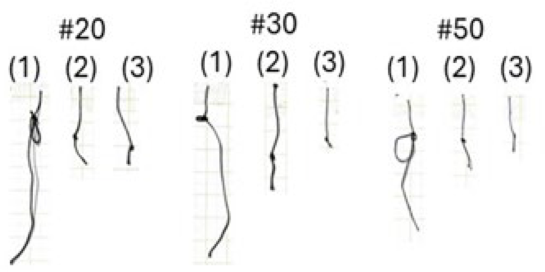
The number of loops, yarn end length, and size of the starting knot are described in terms of the reference conditions and yarn fineness conditions. Figure 1 shows an example of a starting knot made.
Figure 1: Example of made a starting knot ((1) no reference, (2) textbook, (3) video).
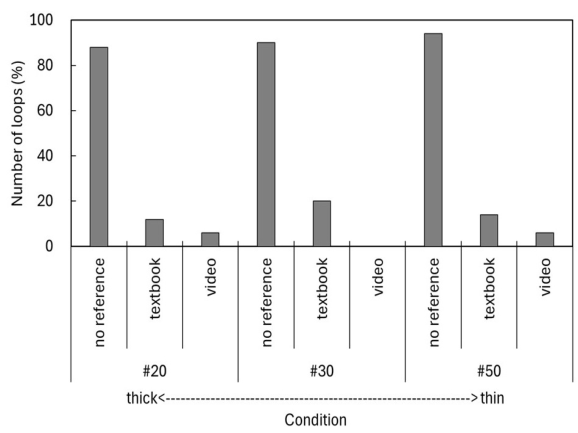
Figure 2 shows the percentage of loops observed in each reference condition (n = 50). Multiple comparisons among the different yarn types showed significant differences between yarns with and without a reference. Additionally, #30 showed a significant difference between the textbooks and videos (P = 0.0012). Furthermore, the results of the Cochran-Armitage test showed a significant decreasing trend for all the fineness values. However,
Sewing Skills for Sustainable Fashion Focusing on the Starting Knot 101
the results of Fisher’s exact probability test for the comparison between the numbers in each material condition showed no significance in any of the cases (P = 0.2468).
Figure 2: Percentage of loop.
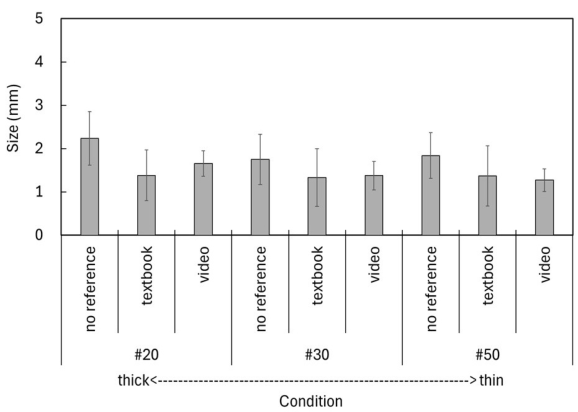
Figure 3 shows the size of the knots for each yarn fineness. There was a significant difference between the presence and absence of a reference, owing to fewer loops. Specifically, #20 showed significant differences between the references (P = 0.030), whereas the other samples showed no significant differences.
Figure 3: Knot size.
102 Morishima and Nakashima
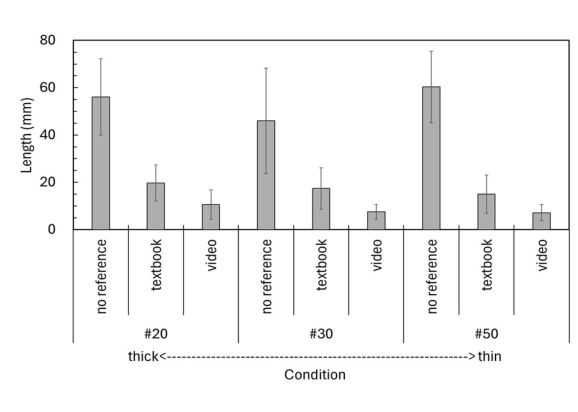
Figure 4 shows the yarn-end lengths. The results of the analysis of variance for length showed that it was significantly shorter in the order of no reference, textbook, and video. The range of standard deviation when viewing the video was confirmed to be within the standard value of 5 mm or less. Comparisons among the yarn types in each reference condition showed that only #30 was significantly shorter in the no-reference condition.
Figure 4: Length from the knot to end.
DISCUSSION
In this study, we evaluated starting knots made with yarn of different fineness under three conditions: previous experience (no reference), followed by a textbook as reference material, and a video. The evaluation indices, number of loops, knot size, and knot-to-yarn end length were statistically compared among the conditions. Through each indicator, it was confirmed that starting knots made based on previous knowledge and experience are easy to untie because of loops, and have longer yarn ends than necessary. It was also suggested that they could be improved by referring to the textbooks and videos. If 30fps (frames per second) were employed in a 30-second video, the viewer would be watching 900 pictures. In the textbook, six images are employed to illustrate the main points. In other words, the video contained 150 times more images than the textbook. This includes holding the end of the yarn, wrapping it around the fingers, shifting the fingers, and pulling the yarn end. While six pictures may be sufficient for a verbal description of the finger action, they may be insufficient for understanding the details. In addition, regarding the difference in yarn fineness, the smaller the longitudinal modulus of elasticity and secondary moment of area, the more easily the yarn is deflected. The short yarn end length of #30 suggests that there is optimum yarn fineness for practices.
Sewing Skills for Sustainable Fashion Focusing on the Starting Knot 103
CONCLUSION
This study aimed to enable individuals to repair their garments for long-term use in a sustainable fashion. As one way to achieve this, a pilot study was conducted to survey the proficiency level of knot tying, which is a basic sewing technique. It was found that an inappropriate knot, such as a loop, was made based on previous knowledge and experience. However, loops were not observed in textbooks and videos.
Subsequently, referring to the videos, the range of the length of the yarn end did not exceed the critical value. It can be inferred that the making of inappropriate knots was due to methods based on previous misconceptions.
In the future, we will increase the number of subjects and clarify the holistic perspective of skilfulness in the fingers and hands for adults and students. In addition, we will consider teaching methods and other methods appropriate for individual skill level, such as devising teaching materials for use in school education in the future.
REFERENCES
Chen, X., Memon, H. A., Wang, Y., Marriam, I. & Tebyetekerwa, M. 2021. Circular Economy and Sustainability of the Clothing and Textile Industry. Materials Circular Economy, 3, 12. Diddi, S. & Yan, R.-N. 2019. Consumer Perceptions Related to Clothing Repair and
Community Mending Events: A Circular Economy Perspective. Sustainability, 11, 5306. Fukui, T., Hayami, T. & Fukui, M. 2021. Creation of a Video on Thread and French Knotting and the Effectiveness as a Teaching Material in Improving Students’ Skills, Based on the Questionnaire Survey for University Students and their Actual Situation of Skills (in Japanese). Curriculum Research and Development on Home Economics Education, 16, 3–10. Harris, F., Roby, H. & Dibb, S. 2015. Sustainable clothing: Challenges, barriers and
interventions for encouraging more sustainable consumer behaviour. International Journal of Consumer Studies, 40, 309–318. Kanda, Y. 2013. Investigation of the freely available easy-to-use software ‘EZR’ for medical statistics. Bone Marrow Transplant, 48, 452–8. Kawabata, H., Nakaya, T., Sofue, Y., Kimura, M. & Tomomitsu, R. 2017. Skills
of Basic Hand Sewing and an Approach to Improve Sewing Studies Using Video Materials in Junior High School (in Japanese). Journal of Integrated Center for Clinical and Educational Practice, 16, 111–116. Klepp, I. G., Laitala, K. & Wiedemann, S. 2020. Clothing Lifespans: What Should Be Measured and How. Sustainability, 12, 6219. Kuroda, H., Fujimoto, T. & Morishima, M. 2024. Skills of Making Thread Knots
of High School Students (in Japanese). Memoirs of the School of Education University of Toyama, 2, 101–106. Ministry of Education, Culture, Sports, Science and Technology 2011. mextchannel. Suzuki, C., Nagata, T. & Fujiwara, N. 2015. Development and Evaluation of the Teacher Education Teaching Materials for Instruction on Making Thread Knots and French Knots in Elementary School Home Economics Classes (in Japanese). The Bulletin of Japanese Curriculum Research and Development, 38, 13–22.
104 Morishima and Nakashima
Takahashi, M., Nishimura, A. & Kawabata, H. 2016. Use of ICT in Sewing Studies Effect of Video Materials in the Teacher Training Faculty. Journal of the Japan Association of Home Economics Education, 59, 135–146. Uchino, N. 2015. Kairyudo Publishing Co., Ltd. Yamada, Y. & Nishimura, K. 2022. The Relationship between the Methods for
Making a Knot by Finger and the Thread Knot (in Japanese). Journal of Life Culture, 59, 29–41. Yates, L. & Evans, D. 2016. Dirtying Linen: Re-evaluating the sustainability of domestic laundry. Environmental Policy and Governance, 26, 101–115.
LISTED IN THE AHFE DIGITAL BOOKSTORE CATALOGUE
Explore the complete digital volume
Social and Occupational Ergonomics
Read this individual research paper free through the original publisher, or explore the full digital proceedings book.
ISBN 978-1-964867-66-3
Explore this ISBN in the AHFE Bookstore ↗Listed in the July 2026 bookstore catalogue; search by ISBN to confirm current availability · Digital book purchase optional