Sylwia Sumińska, Joanna Mazur-Różycka, Patrycja Łach, Łukasz Kapica (2025). The mental burden resulting from the nature of the work performed among Prison Officers. In: Social and Occupational Ergonomics. AHFE Open Access, vol. 190, pp. 91–97. https://doi.org/10.54941/ahfe1006601
The profession of prison officers, along with other uniformed services, is one of the occupations with a higher psychosocial risk (Basińska, 2013). Prison officers are more vulnerable to occupational stress than many other occupational groups (Langan-Fox, Cooper, 2011). The purpose of this study was to assess the psychological burden resulting from the nature of work among prison officers. The study involved 227 prison officers working in the security division, aged between 25 and 56. The questionnaire study included questionnaires on mental workload (including COPSOQ II, NAQ Bullying Measurement Questionnaire, OLBI Occupational Burnout Questionnaire, DASS-21 Depression, Anxiety and Stress Scale, inmate aggression questionnaire) and coping with workload (DERS Emotional Regulation Difficulty Scale, SPP-25 Stress Measurement Scale).A significant relationship between aggression, directed by inmates, and the occurrence of depression in officers has been shown. Officers characterized by better emotion regulation in terms of self-awareness and a sense of meaningfulness of their work cope better (at the emotional level) with inmate aggression. Their sense of meaningfulness in their work provides a buffer against negative consequences from exposure to inmate aggression. In addition, role clarity, i.e., the degree of clarity of responsibilities and the demands and goals placed on officers by management, the support of co-workers and good leadership quality, were shown to be significant predictors of high job satisfaction and low job burnout.
The Polish Prison Service is a hierarchical organization operating under a strict chain of command. The profession of a prison officer, akin to other uniformed services, is characterized by an elevated risk of psychosocial strain, as well as increased exposure to occupational stress and burnout (Basi´nska, 2013; Piotrowski, 2010; Langan-Fox, Cooper, 2011). Furthermore, employment in the penitentiary system entails adverse physical working conditions, which may have a detrimental impact on officers’ health. In Poland, eligibility for this position is restricted to individuals with no criminal record, Polish citizenship, and at least a secondary level of education. Additionally, candidates must meet specific professional qualifications and
demonstrate both psychological resilience and physical fitness required for service in armed formations.
The nature of a correctional officer’s work, constant interaction with inmates, and the necessity of strict adherence to regulations make this profession particularly stressful (Basi´nska, 2013). Officers face daily threats, significant occupational and social pressure, as well as challenging environmental conditions. The heightened risk associated with this profession stems from multiple factors. Key sources of stress in correctional work include (Piotrowski, 2010; Taxman & Gordon, 2009; Lambert et al., 2010):
The occupational stress experienced by correctional officers arises not only from direct interactions with inmates but also from procedural factors (Tewksbury & Higgins, 2006). Both the authoritarian nature of the institution and the requirement for constant availability contribute to significant psychological and physical strain. Correctional officers work in a shift system and are frequently required to report for duty even on their scheduled days off (Piotrowski, 2014). Additional challenges include the strict enforcement of regulations, insufficient substantive support from supervisors, and unclear communication regarding expectations and duties (Pomiankiewicz, 2010; Wells, 2003). The work environment is characterized by rigorous evaluation and a highly critical approach from superiors (Machel, 1997; Przybyli´nski, 2005; Piotrowski, 2014). Correctional officers maintain direct contact with inmates, exposing them to numerous risks, including (Machel, 1997; Ray, 2001):
physical injuries or even loss of life resulting from interventions, firearm- related incidents, or security training exercises,
involvement in extraordinary events involving inmates, such as pursuit operations,
exposure to infectious diseases, including HIV,
witnessing inmate suicides,
witnessing violence among inmates,
witnessing the death or severe injury of a colleague.
Additionally, correctional officers frequently perform their duties in adverse physical conditions, such as extreme temperatures, unfavorable weather conditions, and limited access to natural light (Machel, 1997). The presence of these risk factors makes correctional officers more susceptible than the general population to both physical and mental health deterioration.
The Mental Burden Resulting From the Nature of the Work Performed Among Prison Officers 93
The purpose of this study was to assess the psychological burden resulting from the nature of work among prison officers.
METHODS
Participants The study involved 227 prison officers working in the security division, aged between 25 and 56. All participants had at least five years of experience working as correctional officers. They were employed in penitentiary units across Poland.
Psychological Tests The Copenhagen Psychosocial Questionnaire COPSOQ II (Pejtersen et al., 2010, adapted by Baka, 2019) assesses psychosocial risks in the workplace, including job demands, work organization and content, interpersonal relationships and leadership, human-work interaction, and work-related values.
The Negative Acts Questionnaire (NAQ) (Einarsen & Hoel, 2001, adapted by Warszawska-Makuch, 2007) measures workplace bullying at the organizational level.
The Oldenburg Burnout Inventory (OLBI) (Demerouti & Bakker, 2008, adapted by Baka & Basi´nska, 2016) assesses occupational burnout.
The Depression, Anxiety, and Stress Scale (DASS-21) (Lovibond & Lovibond, 1995) is a screening tool for assessing the severity of anxiety, depressive symptoms, and stress levels over the past week.
The Difficulties in Emotion Regulation Scale (DERS) (Gratz & Roemer, 2004, adapted by Czub, 2012) examines six different types of difficulties in emotion regulation: non-acceptance of emotional responses, difficulties in goal-directed behavior, impulse control difficulties, lack of emotional awareness, limited access to emotion regulation strategies, and lack of emotional clarity.
The Resilience Measurement Scale (SPP-25) (Ogi´nska-Bulik & Juczy´nski, 1998) measures psychological resilience, understood as the ability to cope with challenging life events.
A custom-developed questionnaire on challenging situations related to inmates assesses various forms of aggression displayed by inmates toward correctional officers. The questions address verbal aggression (e.g., insults, shouting, ridicule), non-verbal aggression (e.g., offensive gestures), physical aggression (e.g., pushing, threatening with a knife, property damage), as well as the use of threats.
RESULTS
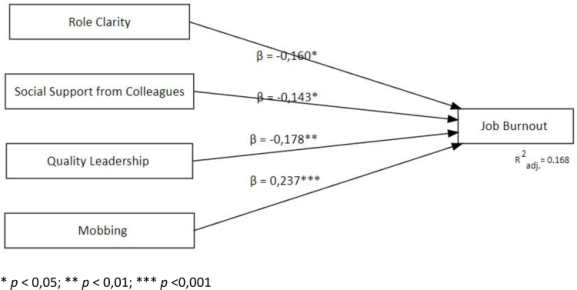
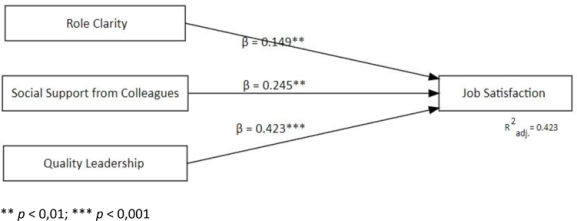
To assess the relationship between psychosocial work conditions, job satisfaction, and occupational burnout, a multiple regression analysis was conducted using the stepwise method. The values of the Variance Inflation Factor (VIF) for the predictors included in the models did not exceed 1.5. The data presented in Figures 1 and 2 indicate that role clarity, i.e., the
94 Sumi ´nska et al.
degree of understanding of the scope of responsibilities, as well as the requirements and goals set by management, support from colleagues, and (good) leadership quality, are significant predictors of high job satisfaction and low occupational burnout. It is worth noting that the relationships between these work resources and job satisfaction are stronger than those with burnout. Furthermore, a significant relationship was found between workplace bullying and occupational burnout (the relationship between bullying and job satisfaction was found to be statistically insignificant: β = −0.015). The presented models explain 42% of the variance in job satisfaction and 17% of the variance in burnout. Additionally, high psychological resilience is associated with higher job satisfaction (r = 0.166, p < 0.05).
Figure 1: Multiple regression model analyzing the relationships between psychosocial work conditions (COPSOQ: role clarity, social support from colleagues, quality leadership) and mobbing (NAQ) with job burnout (OLBI).Figure 2: Multiple regression model analyzing the relationships between psychosocial work conditions (COPSOQ: role clarity, social support from colleagues, quality leadership) and job satisfaction (COPSOQ).
The conducted correlation analysis revealed a relationship between aggression from inmates and depression (DASS) among officers (r = 0.296; p < 0.001). A moderation effect analysis was performed using the PROCESS macro (Hayes, 2018; model 1; bootstrapping with 5000 resamples;
The Mental Burden Resulting From the Nature of the Work Performed Among Prison Officers 95
variables were standardized before being introduced into the model). This analysis verified the role of emotional awareness. The interaction effect between inmate aggression and emotional awareness deficits was statistically significant (B = 0.157; p < 0.05), indicating that among individuals with higher levels of emotional awareness deficits, the relationship between aggression and depression is stronger. The analysis of the conditional effects based on the moderator values showed that for individuals with high and moderate scores on emotional awareness deficits, the relationship between inmate aggression and depression is significant (B = 0.451; p < 0.001 and B = 0.286; p < 0.001, respectively). However, in the group of participants with low scores on emotional awareness deficits (i.e., those with high emotional awareness), the relationship between inmate aggression and depression is not statistically significant (B = 0.121; p = 0.239). This suggests that officers with better emotional regulation in terms of self-awareness are better able to cope with aggression from inmates.
CONCLUSION
In conclusion, correctional officers acknowledge that they often experience both verbal and non-verbal aggression from inmates. The analysis of the results indicates a significant relationship between exposure to aggression and the occurrence of depressive symptoms within this professional group. Officers with better emotional regulation skills, particularly in terms of self- awareness, cope more effectively with the emotional challenges posed by inmate aggression. A key protective factor is also the sense of meaningfulness in their work – individuals who perceive their work as valuable are better equipped to manage difficult situations, helping them minimize the negative effects of stress. The clarity of role, meaning the degree to which officers understand their duties, goals, and the expectations of leadership, is also crucial for job satisfaction and preventing burnout. Additionally, support from colleagues and high-quality leadership contribute to better psychological well-being. The findings of this study could serve as a basis for developing preventive programs aimed at improving the mental health of correctional officers.
ACKNOWLEDGMENT
The authors would like to acknowledge the staff of the Prison Service for their help in the implementation of the study and for their participation in it.
This paper was created on the basis of results of a research task carried out within the scope of the 6th stage of the National Programme “Governmental Programme for Improvement of Safety and Working Conditions”, funded by state services of the Ministry of Family, Labour and Social Policy (under the name of the Ministry of Family and Social Policy prior to December 12th, 2023). task no. 4.ZS.05 entitled “Promoting knowledge about health- promoting behaviors, including strategies for coping with mental and physical strain resulting from the nature of one’s work, among individuals performing jobs of a particularly demanding nature as well as students
96 Sumi ´nska et al.
enrolled in a barracks-based educational system”. The Central Institute for Labour Protection – National Research Institute is the Programme’s main co-ordinator.
REFERENCES
Baka, Ł. (2019). Kopenhaski Kwestionariusz Psychospołeczny COPSOQ II. Podre˛cznik do polskiej wersji narze˛dzia [The Copenhagen Psychosocial Questionnaire COPSOQ II. Manual for the Polish Version of the Tool]. Warszawa: CIOP-PIB. Baka, Ł, Basi´nska, B. A. (2016). Psychometryczne wła´sciwo´sci polskiej wersji oldenburskiego kwestionariusza wypalenia zawodowego (OLBI) [Psychometric properties of the Polish version of the Oldenburg Burnout Inventory (OLBI)]. Medycyna Pracy [Occupational Medicine], 67(1), 29–41. Basi´nska, B. (2013). Emocje w miejscu pracy w zawodach podwy˙zszonego ryzyka psychospołecznego [Emotions in the Workplace in Professions with High Psychosocial Risk]. Polskie Forum Psychologiczne [Polish Psychological Forum], 18(1), 81–92. Czub, T. (2012). Opis Kwestionariusza trudno´sci w regulacji emocji – DERS/
PL [Description of the Difficulties in Emotion Regulation Scale – DERS/PL]. Pozna´n: Instytut Psychologii Uniwersytetu im. Adama Mickiewicza (unpublished manuscript). Demerouti, E., Bakker, A. B. (2008). The oldenburg burnout inventory: a good alternative to measure burnout and engagement. W: Stress and burnout in health care, Halbesleben, J. (eds.), Hauppage: Nova Sciences, 65–78. Einarsen, S, & Hoel, H. (2001). The Negative Acts Questionnaire: Development,
validation and revision of a measure of bullying at work. Paper presented at the 9th European Congress on Work and Organisational Psychology: Globalisation- Opportunities and Threats. Prague. Gratz, K. L, Roemer, L. (2004). Multidimensional assessment of emotion regulation and desregulation: development, factor structure, and initial validation of the Difficulties in Emotion Regulation Scale. Journal of Psychopathology and Behavioral Assessment, 26(1), 41–54. Hayes, A. F. (2018). Introduction to Mediation, Moderation, and Conditional
Process Analysis: A Regression-Based Approach (Methodology in the Social Sciences). New York, NY: The Guilford Press. Lambert, E. G., Hogan, N. L., Altheimer, I. (2010). An exploratory examination of the consequences of burnout in terms of life satisfaction, turnover intent, and absenteeism among private correctional staff. The Prison Journal, 90(1), 94–114. Langan-Fox, J, Cooper, C. (2011). Handbook of Stress in the Occupations.
Cheltenham, UK: Edward Elgar. Lovibond, S. H., Lovibond, P. F. (1995). Manual for the Depression Anxiety Stress Scales, 2nd. ed., Psychology Foundation. Machel, H. (1997). Personel wie˛zienny – zagadnienie kompetencji resocjalizacyjnej
[Prison Staff – The Issue of Resocialization Competence], In: Problem podmiotowo´sci człowieka w pedagogice specjalnej [The Problem of Human Subjectivity in Special Education], Machel, H. (eds), Toru´n: Wydawnictwo Adam Marszałek. Ogi´nska-Bulik, N., Juczy´nski, Z. (2008). Skala Pomiaru Pre˛˙zno´sci (SPP-25) [Resilience Measurement Scale (SPP-25) ]. Nowiny Psychologiczne [Psychological News], 3, 39–56.
The Mental Burden Resulting From the Nature of the Work Performed Among Prison Officers 97
Pejtersen, J. H., Kristensen, T. S., Borg, V., Bjorner, J. B. (2010). The second version of the Copenhagen Psychosocial Questionnaire. Scandinavian Journal of Public Health, 38(3), 8–24. Piotrowski, A. (2010). Stres i wypalenie zawodowe funkcjonariuszy słu˙zby wie˛ziennej [Stress and Burnout Among Correctional Officers]. Warszawa: Difin. Piotrowski, A. (2014). Stres zawodowy a konflikty pomie˛dzy praca˛ a rodzina˛
personelu medycznego Słu˙zby Wie˛ziennej [Professional Stress and Work-Family Conflicts Among the Medical Staff of the Prison Service]. Przegla˛d Naukowo- Metodyczny. Edukacja dla Bezpiecze´nstwa [Scientific and Methodological Review. Education for Security], 2(23), 295–306. Pomiankiewicz, J. (2010). Stres i wypalenie zawodowe funkcjonariuszy Słu˙zby Wie˛ziennej – uwarunkowania, przejawy, konsekwencje – zarys problemu [Stress and Occupational Burnout of Prison Service Officers – Determinants, Manifestations, Consequences – Outline of the Issue]. Przegla˛d Wie˛ziennictwa Polskiego [Polish Prison Review], 67/68, 47–60. Przybyli´nski, S. (2005). Podkultura wie˛zienna – wielowymiarowo´s´c rzeczywisto´sci
penitencjarnej [Prison Subculture – The Multidimensionality of the Penitentiary Reality], Kraków: Impuls. Ray, G. (2001). Emotions the hidden behind a badge. Corrections Today, 98–105. Taxman, F. S., Gordon, J. A. (2009). Do fairness and equity matter? An examination of organizational justice among correctional officers in adult prisons. Criminal Justice Behavior, 36(7), 695–711. Tewksbury, R., Higgins, G. E. (2006). Prison staff and work stress: The role of
organizational and emotional influences. American Journal of criminal justice, 30, 247–266. Warszewska-Makuch, M. (2007). Polska adaptacja kwestionariusza NAQ do pomiaru mobbingu [Polish adaptation of the NAQ questionnaire for measuring mobbing]. Bezpiecze´nstwo Pracy [Occupational Safety], 4(427). Wells, D. T. (2003). Reducing stress for officers and their families. Corrections Today,
24–25.
LISTED IN THE AHFE DIGITAL BOOKSTORE CATALOGUE
Explore the complete digital volume
Social and Occupational Ergonomics
Read this individual research paper free through the original publisher, or explore the full digital proceedings book.
ISBN 978-1-964867-66-3
Explore this ISBN in the AHFE Bookstore ↗Listed in the July 2026 bookstore catalogue; search by ISBN to confirm current availability · Digital book purchase optional