Denisa Charvátová, Juraj Sinay (2026). Occupational Exoskeletons: Overview of Mental Workload Effects and Assessment Methodologies. In: Physical Ergonomics and Human Factors. AHFE Open Access, vol. 223, pp. 28–38. https://doi.org/10.54941/ahfe1007793
This article builds on findings obtained from a study focusing on the use of exoskeletons in real-world automotive manufacturing environments. The results of electromyographic measurements in this study demonstrated a 24.8% reduction in deltoid muscle workload. In contrast, subjective assessments of perceived discomfort measurement sessions showed an average increase of 68.7%. These findings indicate that although exoskeletons can provide substantial reductions in physical workload, their use may simultaneously be associated with an increase in other forms of load that are not captured solely by biomechanical indicators.Attempts to compare these results with existing literature revealed absence of a standardized methodology for assessing mental workload in the context of exoskeleton use. The objective of this article is therefore to present a systematic review of studies addressing mental workload in relation to exoskeleton use, published between 2000 and 2025. A systematic literature search in the Web of Science database identified a total of 40 studies, of which only 13 specifically focused on occupational exoskeletons.The analysis shows that the assessment of mental workload in these studies is inconsistent and methodologically heterogeneous. These methodological differences lead to contradictory conclusions across individual studies. The reliability of the available evidence is further limited by small and gender-imbalanced samples, with a predominance of male participants.The findings of this review highlight the need to develop comprehensive and standardized methodologies for mental workload assessment, enabling a balanced evaluation of both physical benefits and cognitive demands and supporting the safe, effective, and human-centered implementation of exoskeletons in occupational settings.
Musculoskeletal disorders (MSDs) represent one of the most significant global and occupational health challenges of the present time. It is estimated that approximately 1.7 billion people worldwide suffer from some form of musculoskeletal condition (World Health Organization, 2022), with MSDs being among the leading causes of long-term disability. In the occupational context, MSDs have long been identified as the most prevalent work- related health problem across sectors and professions, particularly within
Occupational Exoskeletons: Overview of Mental Workload Effects 29 the European Union (European Agency for Safety and Health at Work [EU-OSHA], 2023). In certain occupational groups, such as healthcare, the prevalence of work-related MSDs reaches very high levels, often exceeding 50% of workers (European Commission, 2020). Employer-reported data from the United States further show that MSDs account for hundreds of thousands of occupational injuries and illnesses each year (U.S. Bureau of Labor Statistics, 2023), frequently resulting in work absence.
In recent years, increasing attention has been directed toward exoskeletons as an effective intervention for reducing the risk of musculoskeletal disorders across various industries (de Looze et al., 2016; Weston et al., 2018). Exoskeletons are defined as wearable assistive devices that, through mechanical interaction with the human body, assist, augment, or support user movement and can be applied in both rehabilitation and occupational contexts (de Looze et al., 2016; Olar et al., 2021).
In occupational settings, exoskeletons are primarily designed to reduce physical and musculoskeletal load, particularly during physically demanding tasks such as overhead work, manual material handling, or repetitive movements (de Looze et al., 2016; Zhu et al., 2021; Flor-Unda et al., 2023). Their use is further supported by numerous studies demonstrating reductions in muscle activity when exoskeletons are applied (Iranzo et al., 2020; Madinei et al., 2020; So et al., 2022; Kong et al., 2023).
Similarly, in our own research conducted under real working conditions in the automotive industry, electromyographic (EMG) results demonstrated a 24.8% reduction in deltoid muscle workload when exoskeletons were used during specific work tasks. In contrast, subjective assessments of perceived discomfort showed an average increase of 68.7%.
Despite the potential of exoskeletons and their experimentally confirmed ability to reduce joint loading, muscle activity, and muscular fatigue, their large-scale adoption in industrial practice remains limited (Crea et al., 2021). Alabdulkarim and Nussbaum (2019) argue that while exoskeletons may reduce loading on specific body regions, they may also lead to unintended consequences, such as increased load or discomfort in other parts of the user’s body.
Another contributing factor may be the insufficient investigation of exoskeleton use from the perspective of mental workload, as well as limited worker trust in these technologies. Currently, there is a lack of sufficient relevant studies examining the effects of exoskeletons on mental workload and their long-term use. For this reason, it is important to summarize the available evidence regarding human–exoskeleton interaction and the associated mental workload.
The aim of this paper is to:
map the individual methods used to assess mental workload in the available studies, and
summarize the main findings reported in these studies, independently of the body regions supported by the exoskeletons or the specific research objectives of the individual studies.
METHODS
This study employed a scoping review methodology to systematically map existing research addressing mental workload and psychological aspects associated with the use of occupational exoskeletons.
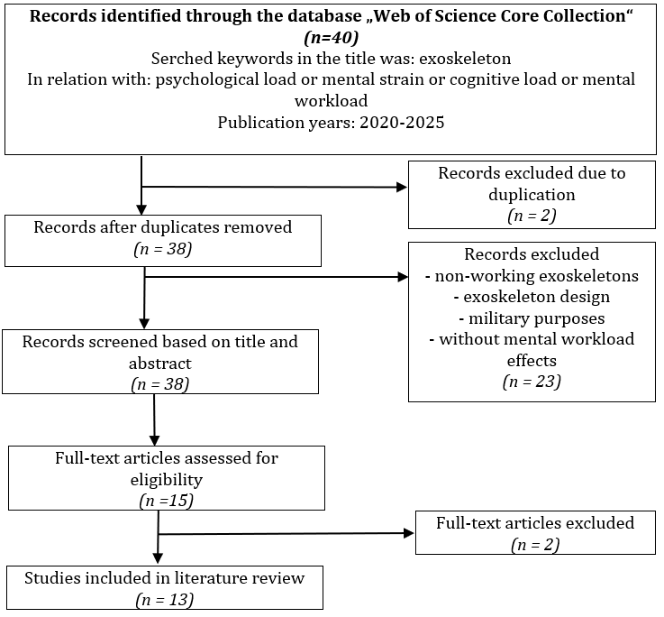
The literature review was conducted through an online search of the Web of Science Core Collection database. The search included peer-reviewed journal articles, review papers, and conference proceedings published in English between January 2020 and November 2025. The search strategy targeted the keyword exoskeleton in the title, combined with the terms mental workload or cognitive load appearing elsewhere in the document. The study selection process is illustrated in Figure 1.
Figure 1: Diagram of literature review and study selection.
To ensure comparability across methodologically heterogeneous studies, a summary table (Table 1) was developed, providing a unified framework for their evaluation.
Mental Workload In this study, mental workload is conceptualized as a multidimensional construct encompassing cognitive load, emotional load, stress, concerns, perceived discomfort, and psychological barriers associated with the use of exoskeletons.
RESULTS
The systematic review identified a total of 40 studies. Of these, 15 studies focused specifically on occupational exoskeletons. One of the identified articles was a review paper, and for one article the full text was not available. Consequently, the present review further analysed 13 studies.
Participants Across all included studies, a total of 224 participants were evaluated. Of these, 129 were male, 63 female, one participant was reported as another gender, and gender was not specified for 31 participants. The weighted mean age of participants was 24.4 years, the average body height was 175.2 cm, and the average body mass was 76.3 kg. Participant characteristics were reported incompletely in three studies. One study included a single participant for whom only gender (male) was specified. Another study involving 10 participants reported gender distribution (5 males and 5 females) and age (25.3 ± 2.5 years), but did not provide anthropometric characteristics. A third study including 17 participants reported only anthropometric data (height: 174 ± 7 cm; body mass: 70.17 ± 11.49 kg), without information on age or gender.
Exoskeletons Across the included studies, a total of 17 exoskeletons of different types were investigated. Of these, nine exoskeletons were active, and eight were passive.
Seven studies investigated back-support exoskeletons, and three studies focused on shoulder exoskeletons. One study examined both back and leg exoskeletons, one investigated leg and shoulder exoskeletons simultaneously and one study evaluated both shoulder and back exoskeletons Study Design (Laboratory or Field Study)
None of the included studies were conducted in a real industrial environment. Eleven studies were performed in laboratory settings simulating work- related tasks (e.g., lifting, carrying, walking). One study was conducted in a controlled immersive virtual reality (VR) environment (Ojha et al., 2025), designed to closely replicate real construction site conditions. One study employed mixed reality (MR) to investigate exoskeleton use (Piol et al., 2024); this experimental environment required participants to perform real manual tasks while the cognitive task was presented through spatially stabilized virtual stimuli using a head-mounted display.
Assessment Methods The assessment of mental workload during exoskeleton use in the included studies was predominantly based on subjective methods focusing on cognitive demands and perceived mental effort. The most frequently used instrument was the NASA Task Load Index (NASA-TLX), which enables a multidimensional evaluation of mental workload and was applied in the majority of studies (Choi, Park & Park, 2025; Govaerts et al., 2023; Leibman
32 Charvátová and Sinay & Choi, 2025a, 2025b; Liu et al., 2024; Ojha et al., 2025; Okunola et al., 2025). Specific aspects of mental workload were also assessed using visual analogue scales (VAS) (Govaerts et al., 2023), particularly for the evaluation of mental fatigue (M-VAS) and boredom (B-VAS). In some studies, the After- Scenario Questionnaire (ASQ) and UMUX questionnaires were used to assess task-related mental demands and immediate user experience (Moreno- Franco et al., 2024). Although primarily intended to evaluate usability, these instruments indirectly reflect the cognitive demands associated with human– exoskeleton interaction. Together, these approaches capture subjectively perceived mental workload across different phases of exoskeleton use and complement objective psychophysiological measurements.
Objective assessment of mental workload during exoskeleton use was primarily based on psychophysiological and performance-based indicators, which allow changes in cognitive and attentional load to be captured independently of participants’ subjective perceptions. The most commonly applied method was electroencephalography (EEG) (Afolabi et al., 2025; Akanmu et al., 2024; Liu et al., 2024; Ojha et al., 2025; Okunola et al., 2025), mainly for the analysis of changes in brain activity and frequency- domain signal characteristics associated with cognitive workload. In addition, electrodermal activity (EDA) was used as an indicator of autonomic nervous system activation and psychological stress (Liu et al., 2024; Ojha et al., 2025).
Objective evaluation of mental workload was further supported by performance-based cognitive tasks, including measures of reaction time, decision accuracy (Govaerts et al., 2023), error rates, and dual-task interference, providing an indirect yet functionally relevant representation of cognitive load during exoskeleton-assisted work.
Study Conclusions Only one study reported clearly positive outcomes (Moreno-Franco et al., 2024). In contrast, several studies consistently point to negative effects of exoskeleton use on mental workload, particularly in situations requiring adaptation, increased attention, or performance under dual-task conditions. Ojha et al. (2023) demonstrated that the use of a powered exoskeleton was associated with increased mental workload. Clear quantitative results were reported by Shayesteh et al. (2022), who observed an average 33% increase in cognitive load during material handling tasks performed with a back- support exoskeleton compared to the no-exoskeleton condition. A negative impact on mental workload was also reported by Liu et al. (2025), where exoskeleton use led to impaired attentional performance and prolonged reaction times; however, these findings primarily suggest increased cognitive demands related to learning and adapting to the device. Similarly, the case study by Akanmu et al. (2021) indicated that working with this technology was associated with increased mental workload, mainly due to the need for continuous adaptation and conscious system control.
The remaining studies do not demonstrate a uniform direction of the effect of exoskeletons on mental (cognitive) workload, with the observed
Occupational Exoskeletons: Overview of Mental Workload Effects 33 outcomes being strongly task-, context-, and method-dependent. While some studies report preserved cognitive performance or more stable attentional allocation without an increase in subjectively perceived mental workload (Maurice et al., 2020; Govaerts et al., 2023; Gräf et al., 2024), others identify changes in cognitive performance or attentional indicators that are not consistently reflected in subjective workload assessments (Leibman & Choi, 2025).
Findings from studies employing cognitive–motor dual-task paradigms suggest that exoskeletons may influence the allocation of cognitive resources rather than the absolute level of mental workload, depending on task characteristics and user experience (Leibman & Choi, 2025; Gräf et al., 2024). An important moderating factor appears to be the cognitive demands of the work environment, particularly the presence of interruptions and additional attentional requirements, which may lead to increased mental workload regardless of exoskeleton use (Maurice et al., 2020). Finally, methodologically oriented studies confirm the potential of EEG-based approaches for objective monitoring of mental workload during exoskeleton use, even though they do not directly assess the direction of workload change (Afolabi et al., 2025).
The findings indicate that most existing research does not address mental workload in its full complexity, but instead focuses primarily on cognitive workload, encompassing demands on attention, working memory, decision- making, visual processing, and motor control.
Table 1: Summary of reviewed studies.
Table available in the original PDF paper.
Results
Source Sample Exoskeleton(s) Conducted Analysis
NEUTRAL
(Afolabi et al., 2025)
Active: back-support 1) Objective: EEG
Total: 8, male: 8 age: 30 years height: 184 cm weight: 79.8kg
NEGATIVE
Active: back-support (Cray X by German Bionic)
1) Objective: EEG + EDA 2) Subjective: NASA - TLX
(Liu et al., 2024) Total: 14 age: 25.1 ± 1.4 years height: ≈ 70.3 kg ± 10.1 weight: ≈ 175 cm ± 7.1 cm
NEUTRAL
1) Subjective: NASA - TLX
(Leibman & Choi, 2025a)
Total: 25, 10 Male 15 female age:19,92 height: 176 cm weight: 95.17 kg
1) Active: back support (BackX by SUITX by Ottobock) 2) Active: leg-based exoskeleton (LegX by SUITX by Ottobock)
(Continued)
Table 1: Continued.
Table available in the original PDF paper.
Results
Source Sample Exoskeleton(s) Conducted Analysis
NEGATIVE
(Okunola et al., 2025)
1) Objective: EEG 2) Subjective: NASA - TLX
Total: 16, male:16 age: 30± 4 years height: 173 ± 5.5 cm weight: 72 ±7.5 kg
1) Active: back support (CrayX by German Bionic) 2) Passive: back support (BackX by SUITX by Ottobock)
NEGATIVE
(Akanmu et al., 2024)
1) Objective: EEG
Active: back support (CrayX by German Bionic)
Total: 16, male: 16 age: 30 ±4 years height: 173± 5.5 cm weight: 72±7.5 kg
NEUTRAL
Passive: shoulder support (AIRFRAME by Levitate)
1) Subjective: NASA -TLX
(Leibman & Choi, 2025b)
Overhead task total: 37, male: 16 female: 20 other: 1 age: 19.61 years height: 173 cm weight:≈75 kg
NEUTRAL
1) Subjective: NASA - TLX
(Leibman & Choi, 2025b)
Passive: leg support (LegX by SUITX by Ottobock)
Squatting task total: 21, male: 10 female: 11 age: 19.86 years height: 174 cm weight: ≈ 71 kg
(Ojha et al., 2025) Total: 18, male:12 female: 6 age: 25.2 ± 4 years height: 179 cm ± 5.5 cm weight:74 ± 6.5 kg
NEUTRAL
Subjective: NASA -TLX
(Choi, Park & Park, 2025)
Passive: back support (Laevo FLEX by Laevo B.V.)
Total: 13, male:13 age:22.7 ± 1.7 years height: 175 ± 3.3 cm weight: 78.1 ± 12.2 kg
NEUTRAL
(Maurice et al., 2020)
Passive: shoulder support (PAEXO by Ottobock)
Total: 12, male: 12 age: 23.2 ± 1.2 years height: 179 cm weight: 72.7 kg
Subjective: Questionnaire based on the Technology Acceptance Model (TAM), NASA-TLX (Continued)
Table 1: Continued.
Table available in the original PDF paper.
Results
Source Sample Exoskeleton(s) Conducted Analysis
NEUTRAL
(Govaerts et al., 2023)
1) Active: back support (CrayX by German Bionic) 2) Passive: shoulder support (PAEXO by Ottobock)
Total: 16, male:10 female: 6 age: 35 ± 13 years height: 173.9 ± 8.1 cm weight: 72.4 ± 9.5 kg
Objective: reaction time, decision accuracy Subjective: NASA-TLX, mental fatigue visual analogue scale, and boredom visual analogue scale
POSITIVE
Active: back support ( XoTrunk by XoLab)
(Moreno- Franco et al., 2024)
Total: 17 height: 174 ± 7 cm weight: 70.17 ± 11.49 kg
Subjective: PURE, ASQ, UMUX, QUEST
NEUTRAL
Passive: shoulder support (Skelex 360 by Skelex)
(Gräf et al., 2024) Total: 10, male: 5 female: 5 age: 25.3 ± 2.5 years
Indirectly – through performance in a cognitive task
NEGATIVE
(Piol et al., 2024) Total: 1 male:1
Passive: Back support (LBE 30 by Wearable Robotics®)
indirectly – through performance in a cognitive task
DISCUSSION
The analysis of the reviewed studies suggests that the integration of exoskeletons into the work process represents a significant psychophysiological challenge that extends beyond purely biomechanical considerations. While the physical assistance provided by exoskeletons has been consistently associated with reductions in muscle fatigue and metabolic cost (Maurice et al., 2020; Toledo Moreira et al., 2025), their impact on workers’ mental capacity remains inconclusive and characterized by several insufficiently explored areas. A key finding is that mental workload is influenced not only by mechanical support but, more importantly, by the nature of human–system interaction. Moreno-Franco et al. (2024) demonstrated that voice-based control was associated with lower perceived cognitive workload compared to visual interfaces; however, this effect was closely linked to the specific interaction modality (HMI) rather than to the physical assistance of the exoskeleton
36 Charvátová and Sinay itself. Therefore, these results cannot be directly generalized to the overall psychological impact of exoskeleton use.
A major methodological limitation of the current body of research is the predominance of controlled laboratory studies. None of the included studies were conducted in real operational settings, where workers are exposed to noise, time pressure, and social interaction with colleagues. Such conditions differ substantially from laboratory-based or simplified tasks, such as pointing tasks (Maurice et al., 2020; Gräf et al., 2024), and represent a significant gap in current knowledge. In real work environments, additional psychological factors may play a role, including the novelty effect (Hawthorne effect), whereby initial enthusiasm for new technology may bias subjective evaluations, as well as technostress associated with a perceived loss of control over one’s body or work performance (Ojha et al., 2025).
Limited experience with exoskeletons during early stages of use appears to be a critical factor contributing to increased mental workload. Users are required to simultaneously adapt their motor behavior to altered biomechanics, monitor device behavior, and adjust their movements in response to the assistance provided (Leibman and Choi, 2025a; Choi et al., 2024). This need for parallel control of movement and technology is repeatedly identified in the literature as one of the main mechanisms underlying increased attentional and cognitive demands, particularly during initial exposure.
Future research should primarily focus on long-term (longitudinal) studies that allow the evolution of mental workload during daily exoskeleton use to be examined. It remains unclear whether increasing experience leads to a reduction of negative effects through habituation, or whether cognitive demands persist over time. The integration of subjective assessment methods with objective biometric indicators and advanced analytical approaches, including machine learning techniques, therefore appears to be a promising direction for future research.
CONCLUSION
This review paper forms part of the authors’ systematic research effort aimed at evaluating the impacts of occupational exoskeleton use. It builds upon a previous empirical study conducted in a real manufacturing environment within the automotive industry, which involved repeated experimental measurements of passive shoulder exoskeleton use. The findings of that study revealed a substantial discrepancy between objectively measured physical workload and subjectively perceived discomfort.
The primary aim of the present review is therefore to establish a foundational framework for subsequent empirical research focused on the long-term and comprehensive assessment of mental workload associated with exoskeleton use in real working conditions.
REFERENCES
Afolabi, A., Yusuf, A.Y. and Akanmu, A. (2025) Predicting mental workload of using exoskeletons for construction work: A deep learning approach. Journal of Information Technology in Construction, 30, pp. 1–21. https://doi.org/10.36680/j. itcon.2025.001 Akanmu, A., Okunola, A., Jebelli, H., Ammar, A. and Afolabi, A. (2024) Cognitive
load assessment of active back-support exoskeletons in construction: A case study on construction framing. Advanced Engineering Informatics, 62(Part D), 102905. https://doi.org/10.1016/j.aei.2024.102905 Alabdulkarim, S. and Nussbaum, M.A. (2019) Influences of different exoskeleton designs and tool mass on physical demands and performance in a simulated overhead drilling task. Applied Ergonomics, 74, pp. 55–66. https://doi. org/10.1016/j.apergo.2018.08.004 Choi, J., Park, J. and Park, C. (2025) Simulated intelligent-system interruptions:
Effects on back-support exoskeleton performance and muscle activation. Actuators, 14, 555. https://doi.org/10.3390/act14110555 Crea, S., Beckerle, P., de Looze, M. et al. (2021) Occupational exoskeletons: A roadmap toward large-scale adoption. Methodology and challenges of bringing exoskeletons to workplaces. Wearable Technologies, 2, e11. https://doi. org/10.1017/wtc.2021.11 De Looze, M.P., Bosch, T., Krause, F., Stadler, K.S. and O’Sullivan, L.W. (2016)
Exoskeletons for industrial application and their potential effects on physical work load. Ergonomics, 59(5), pp. 671–681. https://doi.org/10.1080/00140139 .2015.1081988 European Agency for Safety and Health at Work (EU-OSHA) (2023) Musculoskeletal disorders. Available at: https://osha.europa.eu/en/themes/musculoskeletal- disorders (Accessed: 18 January 2026). European Commission (2020) Work-related musculoskeletal disorders: prevalence,
costs and demographics. Available at: https://op.europa.eu/en/publication-detail/-/ publication/5819be4f-0393-11eb-a511-01aa75ed71a1 (Accessed: 18 January 2026). Flor-Unda, O., Ramirez, A., Valero, E. and Page, A. (2023) Exoskeletons: Contribution to occupational health and safety. Safety Science, 163, 106104. https://doi. org/10.1016/j.ssci.2023.106104 Govaerts, R., Turcksin, T., Vanderborght, B., Roelands, B., Meeusen, R., De Pauw, K.
and De Bock, S. (2023) Evaluating cognitive and physical work performance: A comparative study of an active and passive industrial back-support exoskeleton. Wearable Technologies, 4, e27. https://doi.org/10.1017/wtc.2023.25 Gräf, J., Grospretre, S., Argubi-Wollesen, A. and Wollesen, B. (2024) Impact of a passive upper-body exoskeleton on muscular activity and precision in overhead single and dual tasks: An explorative randomized crossover study. Frontiers in Neurology, 15. https://doi.org/10.3389/fneur.2024.1405473 Iranzo, S., Piedrabuena, A., Iordanov, D., Martinez-Iranzo, U. and Belda-Lois,
J.-M. (2020) Ergonomics assessment of passive upper-limb exoskeletons in an automotive assembly plant. Applied Ergonomics, 87, 103116. https://doi. org/10.1016/j.apergo.2020.103116 Kong, Y.-K., Kim, J.H., Shim, H.-H., Shim, J.-W., Park, S.-S. and Choi, K.-H. (2023) Efficacy of passive upper-limb exoskeletons in reducing musculoskeletal load associated with overhead tasks. Applied Ergonomics, 106, 103878. https://doi. org/10.1016/j.apergo.2022.103878
38 Charvátová and Sinay Leibman, D. and Choi, H. (2025a) Impact of back and leg-support exoskeletons
on novice users’ attention during repetitive lifting task. International Journal of Industrial Ergonomics, 109, 103796. https://doi.org/10.1016/j. ergon.2025.103796 Leibman, D. and Choi, H. (2025b) Going beyond the mean in examining the effects of exoskeleton use on motor and attentional task performance. Applied Ergonomics, 129, 104567. https://doi.org/10.1016/j.apergo.2025.104567 Liu, Y., Gautam, Y., Ojha, A., Shayesteh, S. and Jebelli, H. (2024) Studying the effects
of back-support exoskeletons on workers’ cognitive load during material handling tasks. Proceedings of the ASCE Construction Research Congress, pp. 659–669. https://doi.org/10.1061/9780784485262.067 Madinei, S., Alemi, M.M., Kim, S., Srinivasan, D. and Nussbaum, M.A. (2020) Biomechanical assessment of two back-support exoskeletons in symmetric and asymmetric repetitive lifting with moderate postural demands. Applied Ergonomics, 84, 103021. https://doi.org/10.1016/j.apergo.2019.103021 Maurice, P., et al. (2020) Objective and subjective effects of a passive exoskeleton
on overhead work. IEEE Transactions on Neural Systems and Rehabilitation Engineering, 28(1), pp. 152–164. https://doi.org/10.1109/TNSRE.2019.2945368 Moreno, O.A., Parameswari, R., Di Natali, C., Ortiz, J. and Caldwell, D.G. (2024) Task assessment of XoNLI: A natural language interface for occupational exoskeletons. In: Proceedings of the 10th IEEE RAS/EMBS International Conference for Biomedical Robotics and Biomechatronics (BioRob 2024), Heidelberg, Germany, pp. 634–640. https://doi.org/10.1109/BioRob60516.2024.10719829 Ojha, A., Shayesteh, S., Liu, Y., Jebelli, H. and Akanmu, A. (2025) Psychophysiological
impacts of working with powered exoskeletons on construction sites. Automation in Construction, 177, 106312. https://doi.org/10.1016/j.autcon.2025.106312 Okunola, A., Akanmu, A., Ammar, A., Shojaei, A. and Agee, P. (2025) Comparative analysis of cognitive load associated with passive and active back-support exoskeleton use for construction work. Journal of Safety Research, 94, pp. 473–489. https://doi.org/10.1016/j.jsr.2025.06.034 Olar, M.-L., Leba, M. and Risteiu, M. (2021) Exoskeleton – wearable devices.
Literature review. MATEC Web of Conferences, 342, 05005. https://doi. org/10.1051/matecconf/202134205005 Pamungkas, D.S., Caesarendra, W. and Tjahjowidodo, T. (2019) Overview: Types of lower limb exoskeletons. Electronics, 8(11), 1283. https://doi.org/10.3390/ electronics8111283 Piol, A., et al. (2025) The effects of the use of exoskeletons for manual handling
on cognitive abilities: A mixed reality approach. In: Duffy, V.G. (ed.) HCI International 2024 – Late Breaking Papers. Lecture Notes in Computer Science, vol. 15376. Cham: Springer. https://doi.org/10.1007/978-3-031-76809-5_21 So, B.C.L., Hua, C., Chen, T., Gao, Q. and Man, S.S. (2022) Biomechanical assessment of a passive back-support exoskeleton during repetitive lifting and carrying: Muscle activity, kinematics, and physical capacity. Applied Ergonomics, 99, 103635. https://doi.org/10.1016/j.apergo.2021.103635 Weston, E.B., Alizadeh, M., Knapik, G.G., Wang, X. and Marras, W.S. (2018)
Biomechanical evaluation of exoskeleton use on loading of the lumbar spine. Applied Ergonomics, 68, pp. 101–108. https://doi.org/10.1016/j. apergo.2017.11.006 World Health Organization (2023) Musculoskeletal conditions. Available at: https://www.who.int/news-room/fact-sheets/detail/musculoskeletal-conditions (Accessed: 18 January 2026).
LISTED IN THE AHFE DIGITAL BOOKSTORE CATALOGUE
Explore the complete digital volume
Physical Ergonomics and Human Factors
Read this individual research paper free through the original publisher, or explore the full digital proceedings book.
ISBN 978-1-964867-99-1
Explore this ISBN in the AHFE Bookstore ↗Listed in the July 2026 bookstore catalogue; search by ISBN to confirm current availability · Digital book purchase optional