Ales Bernatik, Vojtech Jankuj, Juraj Sinay (2024). Prevention and risk analysis of Hydrogen refueling station – case study. In: Safety Management and Human Factors. AHFE Open Access, vol. 151, pp. 88–98. https://doi.org/10.54941/ahfe1005305
Hydrogen technology is advancing as a promising solution for a clean energy system and environment. The potential of hydrogen as a clean and promising energy source highlights its advantages in the energy lifecycle, production, storage, transportation, and various applications. National policies and strategies prioritize advancing hydrogen utilization, aiming to drive towards a carbon-neutral society. Among its many applications, hydrogen-powered mobility, particularly through fuel cell electric vehicles generating only water and warm air, stands out. However, there remains an insufficiency in infrastructure and the production of eco-friendly green hydrogen. Recent years have seen the installation of numerous refuelling stations, not limited to the Czech Republic. However, ensuring safety and mitigating potential risks associated with hydrogen applications, for example with hydrogen refuelling stations, is of paramount importance. Especially in the process of introduction and implementation of new technologies, and with hydrogen which is viewed as an explosive gas, steadily increasing societal acceptance is crucial. This necessitates thorough process safety and risk management implementation before installation, aiming to prevent leakage, possible explosions, or major accidents. Considering that absolute safety doesn’t exist, the acceptable risk level aligns with the economic advancement of society, and the greatest source of risks is the human factor (that is people), effective utilization of hydrogen technologies can only be ensured if its manufacturers, users, or even the entire society, are aware of the majority of risks associated with hydrogen as an efficient energy carrier of the future. To ensure a safer environment and acceptance of hydrogen technologies, continuous improvements in safety measures and risk management strategies should be implemented, evolving alongside the advancement and integration of hydrogen–based systems in our energy landscape. This proactive approach will contribute significantly to the safe, efficient, and sustainable utilization of hydrogen technology in the years to come. This study aimed to conduct a quantitative risk assessment of a hydrogen refuelling station, covering its entire lifecycle from production, storage, and distribution, to usage. Focusing on potential hazards associated with hydrogen and scenarios posing environmental risks, the assessment emphasized the critical role of production technology, hydrogen storage, pipelines, and filling stations in ensuring safety. A thorough evaluation of a specific scenario involving continuous hydrogen leakage, dispersion and potential ignition leading to fire or explosion revealed that the risk level at the station is socially acceptable. While safety measures were adequately evaluated, additional precautions such as detachable couplings, detection sensors, or emergency shutdown systems are essential for comprehensive risk management and broader societal acceptance.
Hydrogen, the most abundant in the universe, is gaining attention as a crit- ical pillar in the transition to net-zero emissions. It has diverse applications and can help decarbonize hard-to-abate industries, mobility, and power gen- eration (Qureshi et al., 2023). Hydrogen is a clean, flexible energy carrier which can store and deliver usable energy. However, it does not typically exist by itself in nature and must be produced from compounds that contain it (Abohamzeh et al., 2021). Nowadays, most hydrogen is produced from fossil fuels such as natural gas, nevertheless, hydrogen can also be produced from diverse, local resources including renewable sources such as biomass, geothermal, solar, or wind (Jankuj et al., 2022). These noncarbon sources should be used for hydrogen production instead of fossil fuels, and thus
Prevention and Risk Analysis of Hydrogen Refuelling Station – Case Study 89
hydrogen is going to be a renewable source (Abbasi and Abbasi, 2011). Utilizing renewable energy to conduct water electrolysis, which separates water into hydrogen and oxygen, presents a feasible solution for produc- ing hydrogen in alignment with net-zero requirements (Pasman et al., 2023). Hydrogen is notable for its versatile applications in production, storage, transportation, and end uses (Hjeij, Biçer and Koç, 2022). Hydrogen, being a colourless, odourless, tasteless, and flammable gas, is invisible to the naked eye. Therefore, precise hydrogen detection methods are essential for mea- suring its concentration, especially in cases of unintended release or leakage. These techniques are crucial for safety, as they provide timely alerts (Pasman et al., 2023). Its combustion results in clean water, making it a crucial element in achieving carbon neutrality. However, hydrogen also has certain charac- teristics that make it potentially hazardous. These include a broad range of explosive limits, extremely low ignition energy, and the phenomenon of embrittlement, which can lead to various critical incidents (Ustolin, Paltrinieri and Berto, 2020).
A significant factor pushing hydrogen into the position of a potential alternative energy source is the approval of the so-called “Green Deal for Europe”. This responds to climate change and the deterioration of the envi- ronment, which represents a global existential threat, and thus commits to transforming the European Union and achieving zero-net greenhouse gas emissions by 2050 (European Commission, 2019). The ambitious goal can be achieved by using renewable energy sources, but energy from the sun and wind is intermittent, which can be exaggeratedly referred to as occa- sional energy sources (Capurso et al., 2022). However, this problem could be solved by using hydrogen, which would ensure the storage of large amounts of energy for a long time. This transformation process is referred to as “power to gas” or “power to hydrogen”, where renewable energy sources can be effectively used and the transition to low-carbon energy can be enabled (Ma et al., 2023). As a result, preparations and updates of hydro- gen strategies and maps of individual member states are taking place, which aim to achieve this regulation and adaptation of hydrogen technologies. Individual strategies determine policy and regulatory measures to develop hydrogen technologies, and their implementation, stimulate investment, and also ensure infrastructure for the production, transport, and storage of hydro- gen to create a market. Plans also include opportunities for knowledge exchange and joint research and development initiatives, including interna- tional (cross-border) partnerships and trade. Among the first countries to adopt a hydrogen strategy or hydrogen road maps were Japan, France, and Korea, with a total of more than 35 countries, including the Czech Republic (Bade et al., 2023).
It is a general question and problem, what should come first – refu- elling stations or sufficient infrastructure. Or even the use of hydrogen, i.e., a sufficient number of personal cars, city public transport buses, or even trains with hydrogen propulsion or fuel cells. Then there is the question of the production of renewable hydrogen in sufficient quantities to ensure
potential demand. As per the Czech Hydrogen Strategy, mobility has been identified as a sector where hydrogen usage could soon become sustainable (Ministry of Industry and Trade of the Czech Republic, 2021). To facili- tate this, HRS have been established and continues to be built, with 130 stations opened in 2022 (Statistics - H2Stations.org, 2023). This trend is expected to continue, and similar growth is observed in the Czech Repub- lic. Hydrogen has been utilized in the industry for several decades and when under control, its properties are used to our advantage. However, in the upcoming period, the possibilities of using hydrogen technologies outside the premises of large industrial enterprises and chemical plants are being discussed (Jordan, 2022). In this case, it is necessary to set sufficient rules and regulate risks to the minimum possible extent. Spreading awareness, knowledge, and experience is the best possible solution for future use of hydrogen. The equipment must meet the strictest requirements, such as tightness, resistance to external influences, exclusion of initiation sources leading to fire or explosion, or ensuring against a sudden increase in pressure (Najjar, 2013).
This paper focuses on assessing the potential risk of explosions within the technology involved in producing and dispensing hydrogen for vehicles pow- ered by hydrogen fuel cells, generating electrical energy and risk analysis for a future HRS in Ostrava, Czech Republic, following ATEX Zone classifica- tion (European Committee for Electrotechnical Standardization, 2015) and Act. No. 224/2015 Coll., which pertains to the prevention of major accidents and is subject to the SEVESO Directive III (SEVESO Directive III, 2012). The station will be established to refuel personal cars and buses with hydrogen as an energy source. Since the equipment is specifically designed for producing, storing, and dispensing explosive gas (hydrogen) under high pressure and in significant quantities, there is a need to evaluate the risk of forming an explo- sive atmosphere, considering its volume. This assessment determines whether there is an explosive atmosphere within a hazardous volume, consequently presenting a risk of explosion.
METHODOLOGY
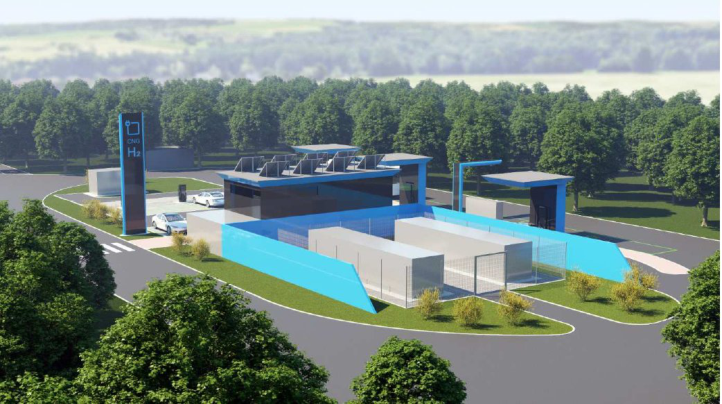
This study focuses on the implementation of Hydrogen Refuelling Stations (HRS) as an alternative energy source for private cars and buses. The strate- gically chosen location for the HRS, in close proximity to the University Campus, Business Centre, and Faculty Hospital, offers significant accessi- bility. Bounded by a suburban forest to the north and west (the nearest building is approximately 300 meters away), the University Campus to the east (100 meters), and the Faculty Hospital to the south (160 meters), the HRS is strategically located for optimal functionality. Refer to Figure 1 for a visualisation of the HRS, including two containers with concrete borders, stands, and a main building for customer services.
Prevention and Risk Analysis of Hydrogen Refuelling Station – Case Study 91
Figure 1: Visualisation of HRS.
The hydrogen production technology employed in the presented HRS com- prises two containers measuring 12.50 × 2.50 meters, spaced 2.62 meters apart. This technology utilizes water and electricity for hydrogen water elec- trolysis production, with a provision for short-term hydrogen storage. The process involves a comprehensive system, including a water treatment plan, a hydrogen generator cleaning mechanism, and subsequent processes for pressurization and storage. The hydrogen, produced through this process, undergoes compression to either low pressure (350 MPa) or high pressure (700 MPa) and is stored in specialized pressure vessel. The entire operational sequence is meticulously controlled from a central control room, which is also integrated with the station’s stands. Additionally, a concrete wall delin- eates the station from them main road and pavements, providing a defined boundary for the facility.
In the HRS area, hydrogen is the sole hazardous substance. The hydrogen- working equipment includes containers with vessels, pipelines, and stands. The estimated quantity of hydrogen is around 450 kilograms. It is evident from this information that the HRS cannot be categorized under the SEVESO DIRECTIVE (SEVESO Directive III, 2012), which stipulates a limit of 5000 kilograms. The potential sources of risk in the HRS are both high-pressure storage (900 – 950 MPa) and low-pressure storage (350 MPa). It is impor- tant to highlight those other installations, including pipelines and stands, pose a lower quantity of hazardous substances when compared to the devices specifically listed for high-pressure and low-pressure storage. This distinction underscores the differential risk levels associated with various components within the HRS Infrastructure.
HRS Technical Specifications In a hydrogen production facility, the container is partitioned into two sec- tions. The first houses the generator and hydrogen processing technology,
while the second accommodates the control system for hydrogen produc- tion and storage, along with a water treatment station. The container’s exterior top side features a cooling unit and fans. The hydrogen generator employs Proton Exchange Membrane (PEM) technology, operating at 40 MPa pressure to ensure a hydrogen flow rate of 68–70 Nm3/hour. The PEM electrolyser decomposes water into hydrogen and oxygen using direct cur- rent. The electrolyser, a pressure type based on Solid Polymer Electrolyte (SPE), generates hydrogen at the anode. Proprietary MOC technology mem- branes separate the anodic and cathodic electrodes, acting as the electrolyte to initiate electrolysis. A digital rectifier converts input alternating current into the direct current power required for the electrolyser. The system main- tains hydrogen pressure at approximately 40 MPa using a control valve. The dosing pump circulates water for gas production and storage tank cooling. Hydrogen and oxygen produced in the electrolyser are directed to their respective separators. Oxygen separators isolate oxygen molecules from water, releasing oxygen into the atmosphere and recirculating water back into the tank. Hydrogen is directed to a two-tower drying system that removes moisture through activated alumina. The container for compression and hydrogen storage comprises low-pressure (350 MPa) and high-pressure (700 MPa) compressors. Dry hydrogen gas is first analysed for trace oxy- gen and dew point. If the gas parameters do not meet the specified criteria, it is vented to the atmosphere. Hydrogen is then directed to a surge vessel for compression. The compression process is automated through a control system within the hydrogen production container. Dispensing stations for public filling typically feature two filling nozzles for filling at nominal pres- sures of 350 MPa and 700 MPa, equipped with a communication receiver. The receiving vehicle is equipped with a communication transmitter.
Risk Analysis In the context of a major accident, the potential consequences were eval- uated by authors (Bernatik et al., 2023) in accordance with the threshold values set by the Areal Locations of Hazardous Atmospheres (ALOHA), a software developed by the US Environmental Protection Agency (EPA). A thermal radiation intensity of 10 kW/m2 was chosen as a representative sce- nario for a fire event. Such a level of thermal radiation can lead to severe health implications, including potential fatality within a span of 60 seconds. For the scenario of a Vapour Cloud Explosion (VCE), an overpressure value of 55 kPa was selected, a level that could result in lethal injuries to individuals. The input parameters for the ALOHA software included an air stability class of D, a southwest wind direction with a speed of 5 metres per second, and an ambient temperature of 20
Celsius. The risk of the HRS operation was evaluated by suitable and available methods. Failure Three Analysis (FTA) was used for the possible causes of malfunctions. On the other hand, Event Three Analysis (ETA) amplify the major accident scenario and define the end accident frequency. The resulting frequency (from FTA) of hydrogen release was used as the input frequency for ETA. The risk assessment is carried out based on the severity and probability of the occurrence of the accident. The
Prevention and Risk Analysis of Hydrogen Refuelling Station – Case Study 93
severity is assessed according to the number of people and the possibility of the affecting their lives and health. The assessment of the social acceptabil- ity of risks was plotted for better clarity using the so-called risk matrix, the boundaries between socially acceptable and unacceptable sources of the risk.
RESULTS
Risk of Hydrogen Gas Leakage HRS are designed with the primary objective of minimizing potential risks to customers, station operations, the technology involved, and the environment. Typically, the facilities of HRS are located outdoors to prevent the danger- ous accumulation of leaked hydrogen in enclosed building structures. Certain components of the HRS, such as those involved in hydrogen production compression, and storage, may be installed in enclosed spaces under the con- ditions stipulated in TPG 304 03 (Czech gas association, 2019). These spaces must be ventilated in accordance with the regulations and conditions speci- fied in these rules. To ensure the automatic shutdown of hydrogen sources in hazardous situations, shut-off valves are installed.
HRS that employ water electrolysis technology comprise several key components:
A hydrogen source (or generator) equipped with a main shut-off valve,
Hydrogen distribution lines, pipelines,
Compressors,
Hydrogen cooling equipment,
High-pressure storage tanks (operating at 900–950 MPa and 350 MPa),
Dispensing stand,
Measurement, control, and safety devices.
Given that the equipment operates with gaseous hydrogen and oxygen under high pressure, there are inherent risks associated with the release of explosive gas in the vicinity of the equipment, leading to the potential creation of an explosive atmosphere around the technology.
Overview of Potential Gas Leakage Risks Within the hydrogen production system, there exist multiple zones sus- ceptible to hydrogen or oxygen leakage. While oxygen is inherently non- flammable, concentrations exceeding 25% vol. can significantly enhance and accelerate the combustion of flammable materials. The hydrogen production container is compartmentalized into several sections, including a hydrogen generator, hydrogen drying technology, a control room, inlet water treat- ment, and venting and safety valves for oxygen and hydrogen. Our analysis indicates that the most significant risks are associated with hydrogen leak- age and the potential formation of an explosive atmosphere. These risks are particularly pronounced in areas such as the hydrogen generation site, the drying technology, and the control room. However, this risk in the control room is contingent upon the presence of an analysis cupboard, which is uti- lized for hydrogen quality management, and potential leaks in the hydrogen
sampling pipeline. The likelihood of leakage or the creation of an explosive atmosphere is particularly high in the vicinity of the venting systems.
The spatial configuration of a hydrogen compression storage container can be bifurcated into two distinct zones: the internal container space and the refrigeration apparatus. The refrigeration component is designed such that it precludes the leakage of hydrogen into the surrounding environment. However, within the confines of the internal container space, potential risks associated with hydrogen leakage may arise. These risks are predominantly attributed to the hinges, seals, and relief valves, which could potentially serve as conduits for hydrogen escape.
Concerning the dispenser, the potential for leakage and the subsequent creation of an explosive atmosphere is linked to the dispenser’s interior, its immediate environment, and the hydrogen-filling nozzle. Leakage can origi- nate from the flanges and safety valves, or in the context of the filling nozzle, from the pipelines when the nozzle is detached from the vehicle tank.
Hazardous Zones Classification According to the above technical rules, the areas around the hydrogen storage and dispensing technology are classified into zones as follows.
Hydrogen Production Container Hydrogen production system and drying technology – Zone 2, an explosion hazardous area, encompasses the entire interior area. Within a distance of 0.2 m around ventilation openings, Zone 2 applies if flammable gas and vapour detection equipment is installed in the hydrogen generator and drying area. And within a distance of 2 m around ventilation openings under the same conditions. The technology area for the control system location and water treatment is a non-hazardous area without risk of explosion. Zone 2 is delin- eated around the venting pipe of safety valves and the functional pressure relief pipe within a distance of 3 meters from the edge of the venting pipe.
Hydrogen Storage The interior of the compressed hydrogen storage container is classified as Zone 2 across the entire space, extending within 0.2 m around ventilation openings if flammable gas and vapour detection equipment are installed in the container space. Zone 2 is designated around the exhaust pipe of safety valves and the pipe of functional reduction, extending within 3 m of the edge of the exhaust pipe.
Dispensing Stand The internal space of the dispenser, specifically the gas section cabinet, is classified within Zone 1. Zone 2 encompasses the area surrounding the dis- penser without requiring additional demonstration, extending up to 0.2 m in all directions up to 1 m above the top of the dispenser. Additionally, a dis- tance of 0.25 m around the filling quick coupling is considered Zone 1 during connection to the mobile device, disconnection from the vehicle and through- out the filling process. Furthermore, Zone 2 is established around the venting
Prevention and Risk Analysis of Hydrogen Refuelling Station – Case Study 95
pipe of the safety valves and the functional reduction pipe, extending within 3 m. of the edge of the exhaust pipe. A Zone 2 classification is applicable within a distance of 0.25 m around the filling coupling during the connec- tion to the vehicle, disconnection from the vehicle, and while the vehicle is being filled.
DISCUSSION
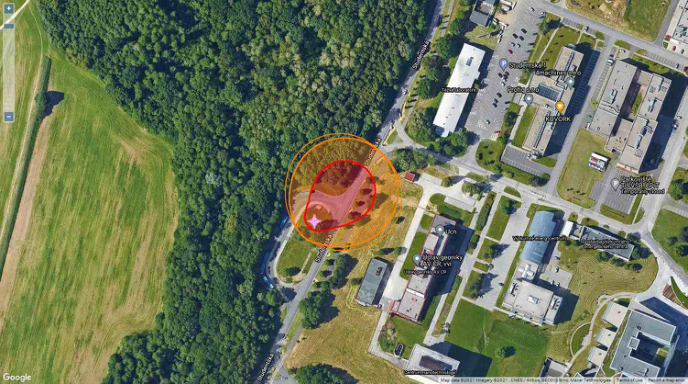
The most severe scenario envisaged for the HRS under discussion involves a hydrogen leak from the high-pressure storage system. The subsequent explosion from such a release could potentially result in fatalities up to an approximate distance of 60 metres, see Figure 2. This scenario is character- ized by the release of hydrogen from the storage system, its dispersion into the surrounding environment, and a delayed ignition leading to the formation of a vapour cloud. In contrast, a Hydrogen Jet fire scenario, which assumes immediate ignition upon hydrogen release, does not yield as significant an impact. The affected area in this case extends up to a distance of 15 metres, considerably less than the previous scenario. This comparison underscores the critical importance of safety measures and timely response strategies in managing hydrogen-based systems.
Figure 2: The most serious hydrogen explosion accident.
The risk assessment is conducted based on two key factors: the severity of a potential accident and the likelihood of its occurrence. The severity is evalu- ated in terms of the number of individuals potentially affected and the extent of impact on their lives and health. The risk associated with the operation of the HRS was assessed using appropriate and accessible methodologies. Consideration was given to both technical and organisational safety mea- sures, including the implementation of automatic valves and hydrogen leak detection systems, among others.
In the most severe scenario, the impact zone is estimated to extend approx- imately 60 metres from the point of incident. In such a case, it is estimated that three individuals (comprising two customers and one station employee) could be within this zone. Consequently, these three individuals would be at risk of fatal injuries in the event of such an incident. This underscores the critical importance of stringent safety measures and emergency response protocols in the operation of hydrogen-based facilities.
Indeed, hydrogen, with its unique properties and vast potential, is ushering in a new era in the fields of energy and transportation. Since its discov- ery, our understanding of hydrogen has continually evolved, leading us to the present day where we grapple with the challenge of safely harnessing hydrogen throughout its lifecycle - from production, storage, and transport to end-use. Hydrogen is not inherently more dangerous than other fuels, pro- vided its safety-related properties are adequately accounted for in the design and operation of the technical systems that handle it. Hydrogen systems can be engineered to be as safe, if not safer, than other systems that use com- bustible fuels, without posing a threat to human health or the environment. A crucial strategy for the safe use of hydrogen systems is the prevention of acci- dents during design, operation, and maintenance. This can be facilitated by disseminating relevant information, adhering to applicable regulations and standards, and through education and training.
CONCLUSION
The risk assessment for the HRS in Ostrava has been evaluated as socially acceptable. This evaluation is based on the adequacy of the implemented safety and security measures, which, according to the risk analysis results, appear to be sufficient.
However, to further mitigate the risk of a major accident or extraordinary event, the following key principles are recommended:
1. Effective Separation of Hazardous Substances: The total amount of hazardous substances in the technology should be divided into smaller parts to minimise the potential leakage of hazardous substances. This recommendation has already been implemented in this HRS, where remote-controlled fittings have been installed to effectively separate the low- and high-pressure parts of the system. 2. Hazardous Substance Leakage Detection: Hydrogen leakage detectors have been designed for this project. In the event of a leakage signal, these detectors will automatically close the remote valves (emergency valve closure). Additionally, a “total stop” button will be installed to disconnect all technologies in case of an emergency. 3. Improving the Safety Management System: It is crucial to systematically raise employee awareness about the source of the risk and train them in emergency scenarios. In the event of an accident, tactical exercises of the integrated rescue system should be carried out to ensure effective intervention.
Prevention and Risk Analysis of Hydrogen Refuelling Station – Case Study 97
These measures not only enhance the safety of the HRS but also con- tribute to its social acceptability by demonstrating a proactive approach to risk management. The global exchange of information and the harmonisa- tion of design, operation, and maintenance requirements will further aid in the development of safe and user-friendly hydrogen systems. The safety of hydrogen technology is an ongoing endeavour that necessitates collaboration, innovation, and continuous improvement. Safety strategies and emergency responses will be particularly needed in relation to the high pressures used in storage and the properties of hydrogen. Hydrogen has the potential to effect positive change on a global scale, and thus, a key driver for future progress is to maximise the safety of technologies that utilise it. This under- scores the importance of a proactive and comprehensive approach to safety in the burgeoning field of hydrogen technology.
REFERENCES
Abbasi, T. and Abbasi, S. A. (2011) ‘“Renewable” hydrogen: Prospects and challenges’, Renewable and Sustainable Energy Reviews, 15, pp. 3034–3040. Available at: https://doi.org/10.1016/j.rser.2011.02.026. Abohamzeh, E., Salehi, F., Sheikholeslami, M., Abbassi, R. and Khan, F. (2021)
‘Review of hydrogen safety during storage, transmission, and applications pro- cesses’, Journal of Loss Prevention in the Process Industries, 72, p. 104569. Available at: https://doi.org/10.1016/J. JLP.2021.104569. Bade, S. O., Tomomewo, O. S., Meenakshisundaram, A., Ferron, P. and Oni, B. A.
(2023) ‘Economic, social, and regulatory challenges of green hydrogen production and utilization in the US: A review’, International Journal of Hydrogen Energy [Preprint]. Available at: https://doi.org/10.1016/J. IJHYDENE.2023.08.157. Bernatik, A., Jankuj, V., Lepik, P. and Sikorova, K. (2023) ‘Process Safety of the Hydrogen Filling Station in the Czech Republic’, in 26th Annual International Symposium, pp. 1–8. Capurso, T., Stefanizzi, M., Torresi, M. and Camporeale, S. M. (2022) ‘Perspective
of the role of hydrogen in the 21st century energy transition’, Energy Conver- sion and Management, 251. Available at: https://doi.org/10.1016/J. ENCON- MAN.2021.114898. Czech gas association (2019) Refuelling compresssed gaseous hydrogen stations for mobile device. European Committee for Electrotechnical Standardization (2015) Explosive atmo-
spheres - Part 10–2: Classification of areas - Combustible dust atmospheres. European Commission (2019) The European Green Deal. Brussel. Hjeij, D., Biçer, Y. and Koç, M. (2022) ‘Hydrogen strategy as an energy transition and economic transformation avenue for natural gas exporting countries: Qatar as a case study’, International Journal of Hydrogen Energy, 47(8), pp. 4977–5009. Available at: https://doi.org/10.1016/J. IJHYDENE.2021.11.151. Jankuj, V., Spitzer, S. H., Krietsch, A., Stroch, P. and Bernatik, A. (2022) ‘Safety of
Alternative Energy Sources: a Review’, Chemical Engineering Transactions, 90. Available at: https://doi.org/10.3303/CET2290020. Jordan, T. (2022) ‘Hydrogen technologies’, Hydrogen Safety for Energy Applications: Engineering Design, Risk Assessment, and Codes and Standards, pp. 25–115. Available at: https://doi.org/10.1016/B978-0-12-820492-4.00005-1. Ma, N., Zhao, W., Wang, W., Li, X. and Zhou, H. (2023) ‘Large scale of
green hydrogen storage: Opportunities and challenges’, International Journal of Hydrogen Energy [Preprint]. Available at: https://doi.org/10.1016/J. IJHY- DENE.2023.09.021.
Ministry of Industry and Trade of the Czech Republic (2021) The Czech Republic’s Hydrogen Strategy. Government of the Czech Republic. Najjar, Y. S. H. (2013) ‘Hydrogen safety: The road toward green technology’.
Available at: https://doi.org/10.1016/j.ijhydene.2013.05.126. Pasman, H., Sripaul, E., Khan, F. and Fabiano, B. (2023) ‘Energy transition technology comes with new process safety challenges and risks’, Pro- cess Safety and Environmental Protection, 177, pp. 765–794. Available at: https://doi.org/10.1016/J. PSEP.2023.07.036. Qureshi, F., Yusuf, M., Khan, M. A., Ibrahim, H., Chukwuemeka Ekeoma, B.,
Kamyab, H., Rahman, M. M., Kumar Nadda, A. and Chelliapan, S. (2023) ‘A State-of-The-Art Review on the Latest trends in Hydrogen production, stor- age, and transportation techniques’, Fuel, 340, p. 127574. Available at: https: //doi.org/10.1016/j.fuel.2023.127574. SEVESO Directive III (2012) Council Directive 2012/18/EU of 4 July 2012 on the control of major-accident hazards involving dangerous substances. Statistics - H2Stations.org (no date). Available at: https://www.h2stations.org/statis
tics/ (Accessed: 25 January 2024). Ustolin, F., Paltrinieri, N. and Berto, F. (2020) ‘Loss of integrity of hydrogen technologies: A critical review’, International Journal of Hydrogen Energy, 45(43), pp. 23809–23840. Available at: https://doi.org/10.1016/J. IJHY- DENE.2020.06.021.
LISTED IN THE AHFE DIGITAL BOOKSTORE CATALOGUE
Explore the complete digital volume
Safety Management and Human Factors
Read this individual research paper free through the original publisher, or explore the full digital proceedings book.
ISBN 978-1-964867-27-4
Explore this ISBN in the AHFE Bookstore ↗Listed in the July 2026 bookstore catalogue; search by ISBN to confirm current availability · Digital book purchase optional