Mika Morishima, Keisei Maki, Fuka Miyamoto, Mai Yoshikawa (2026). Evaluation of Hand Sewing Skills for the Design of a Clothing Repair Education Program: Pilot Study. In: Human Systems Engineering and Design (IHSED2026): Future Trends and Applications. AHFE Open Access, vol. 237, pp. 485–491. https://doi.org/10.54941/ahfe1008188
From a sustainability perspective, individuals who practice appropriate purchasing, proper use and maintenance, and correct disposal of clothing are expected to contribute to reducing environmental impact. In Japan, students learn sewing in school; however, it cannot be said that they acquire sufficient skills. Therefore, this study aimed to develop an ergonomic educational program targeting improved finger dexterity as a long-term goal. As foundational research, it evaluated the current state of sewing skills and identified sewing techniques with potential for improvement. Furthermore, it explored the appropriate training conditions. As a pilot study, we evaluated “basic sewing” projects conducted in high-school home economics classes. Thread fineness was set at #20(n=36), #30(n=36), and #50(n=37), with lower numbers indicating thicker thread. We analyzed stitch length and coefficient of variation by analysis of variance. Additionally, for the knot, the formation of loops was assessed by calculating the proportion and performing a binary logistic regression analysis. The results showed no significant differences in stitch length for each basic stitch between thread finenesses. The proportion of loops in starting knots was 26.9%(#20,n=108), 34.3%(#30,n=108), and 52.3%(#50,n=111), which was higher for finer threads. Additionally, a regression analysis showed no significant differences in the number of strands or observer conditions; however, significant differences were observed only for thread fineness. The adjusted odds ratio for #50 was significantly higher than that for #20(AOR=3.02, 95%CI:1.71–5.34). The influence of the sectional second moment of area may have been inferred. It was suggested that material conditions also need to be considered for training purposes.
Sustainability remains one of our key ongoing priorities. Issues related to clothing include mass production, mass consumption, and mass disposal. What steps should we each take? To reduce environmental impact, we should aim for moderate purchasing, proper use and maintenance, and appropriate disposal(Diddi & Yan, 2019). These efforts help clothing to be worn in good
Received March 19, 2026 Revised June 13, 2026 Accepted June 29, 2026 Available online September 25, 2026
condition for longer periods. Furthermore, they are expected to lead to a reduction in both the volume of discarded items and the volume of new purchases that are not worn. Additionally, maintaining clothing in good condition is expected to contribute to the circular economy(Lieder & Rashid, 2016), which uses discarded garments as raw materials. Repairing clothing is one strategy for maintaining items in good condition. However, the level of sewing skills required for clothing repair remains unclear. In Japan, students learn sewing as part of home economics classes in elementary, junior high, and high school. However, given the current situation, can we really say that they have sufficient skills (Gaul & Issartel, 2016)? Reports indicate that among college students (Morishima & Nakashima, 2025), it is difficult to say that every individual has acquired sufficient sewing skills. Therefore, this study aims to develop an educational program designed to improve manual dexterity from an ergonomic perspective.
As a foundation for this research, to understand the current state of sewing skills among young people, we quantitatively evaluated their sewn works. As a pilot study, we assessed basic stitches sewn using threads of different fineness to identify the impact of material types on training. Additionally, in previous research(Morishima, Kameda, & Ushiro, 2026), we evaluated sewing works created by junior high school students. Taking these results into account, we would like to discuss the need to examine developmental stages.
In this study, we first describe the research methodology, including the sewing procedure, evaluation methods for the works, and statistical analysis methods. Next, in the results and discussion section, we present the measurement results and the findings of the analysis of variance (ANOVA) and regression analysis. Finally, we present the conclusions and future challenges.
METHOD
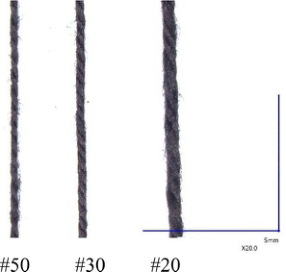
Sewing Process In this pilot study, we evaluated basic hand sewing created by high school students as part of their home economics classes. The materials used were cotton fabric and cotton threads of different finenesses. Although many types of threads are available in the market, #30 cotton thread is an ordinary type used for sewing in classes. Although it is recommended to select the appropriate type of thread (fineness, structure, color, fiber type, etc.) based on the purpose and thickness of the fabric, three types with different finenesses, including #30, were employed in this study. Figure 1 shows a microscopic image of the sample threads employed for hand sewing using a digital microscope (VHX-S660E, KEYENCE). The samples were #20(20/3, 88.6tex), #30(30/3, 59.1tex), and #50(30/2, 39.4tex). They follow the cotton yarn count system, where a higher number indicates a finer thread, as expressed in tex. The number of plies was three, three, and two, respectively. The total length of each stitch on a piece of fabric was approximately 20 cm.
Evaluation of Hand Sewing Skills for the Design of a Clothing Repair Education Program 487 Generally, these basic sewing techniques are taught in elementary and junior high schools. Therefore, the teacher showed the students the URL for the reference video, which was available online. However, they did not provide detailed instructions, leaving it up to the students’ initiative and judgement.
Figure 1: Sample threads.
Measurement Methods The number of evaluated works was 36 (#20), 36 (#30), and 37(#50). It is important to be able to adjust the stitch length, that is, to sew with fine or coarse stitches, depending on the application and conditions. The running stitch, half-backstitch, full backstitch, starting knot, and finishing knot were evaluated by two observers (A, B). The first five stitch lengths of each row were measured using digital calipers. In addition, single or double strands in each stitch type were verified.
In addition, it is crucial that knots do not form loops. This is because a starting knot with a loop can cause the knot to disappear. Therefore, we visually observed the presence of loops in the starting knots to divide the work. In the observed knots, those with a loop were scored as 1, and those without a loop were scored as 0.
It is also important that the finishing knot does not become loose from the edge of the fabric. We assigned 1 to those where the distance between the knot and fabric was 3 mm or more and 0 to those where it was less than 3 mm.
Statistical Analysis of Measurement Data The stitch length and coefficient of variation (a measure of individual variation in each stitch type) were compared among thread types using analysis of variance.
We calculated the adjusted odds ratios (AOR) and 95% confidence intervals (95%CI) for starting and finishing knots by binary logistic regression analysis. The explanatory variables were thread fineness (#20,
#30, #50), observer (A, B), and ply number of the thread (single or double). The reference variable was the first variable. The data was analyzed using statistical software (IBM SPSS Statistics, 30.0.0.0).
RESULT AND DISCUSSION
Measured Values of Stitch Length Standard stitch lengths of approximately 3 mm are recommended for running stitches and approximately 4 mm for backstitches. Additionally, stitches should be straight and consistent with minimal variation.
Table 1 shows the descriptive statistics of the observed stitch length. The mean stitch lengths were at least 1 mm longer than the recommended values. In addition, the backstitches were longer than the running stitches. The coefficient of variation did not vary depending on the type of stitch. As it is unclear whether it can be sewn with short stitches, guidelines regarding stitch length are proposed in further research.
Table 1: Descriptive statistics of observed stitch length.
Table available in the original PDF paper.
N Mean SD Minimum Maximum Running stitch Mean #20 36 4.62 1.77 1.34 9.35
Table 2 presents the results of an analysis of variance conducted to evaluate fineness from the perspective of fineness. No significant differences were observed between the fineness levels in terms of mean values or coefficients of variation.
Table 2: ANOVA of measured stitch length.
Table available in the original PDF paper.
F-Value P-Value
Sum of Squares
df Mean Square Mean Between Groups 5.59 2 2.80 0.67 0.515
Running stitch
443.85 106 4.19
Within Groups/ Error CV Between Groups 0.01 2 0.01 1.81 0.169
0.44 106 0.00
Within Groups/ Error Mean Between Groups 8.13 2 4.06 0.94 0.396
Half backstitch
460.55 106 4.34
Within Groups/ Error CV Between Groups 0.01 2 0.00 0.73 0.484
0.45 106 0.00
Within Groups/ Error Mean Between Groups 4.69 2 2.34 0.39 0.680
Full backstitch
641.82 106 6.05
Within Groups/ Error CV Between Groups 0.00 2 0.00 0.06 0.938
0.56 106 0.01
Within Groups/ Error
Evaluation of the Knots The proportion of loops in starting knots was 26.9% (#20, n = 108), 34.3% (#30, n = 108), and 52.3% (#50, n = 111), which was higher for finer threads. Meanwhile, the proportion of the number of finishing knots distance between the knot and fabric was 3 mm or more was 29.6%(#20, n = 108), 25.0%(#30, n = 108), and 14.4%(#50, n = 111), which was lower for finer threads
Table 3 presents the analysis results for the starting and finishing knots. No significant differences were found in the observer conditions and strands. Among the different thread types, #50 was shown to differ significantly from the other types. The AOR (95%CI) for the starting knot was 3.02(1.71-5.34). The probability of problems forming a loop in thread #50 was significantly higher. It was anticipated that loops would form easily because of the low bending stiffness resulting from the second moment of area.
In previous studies on works created by junior high school students using threads #30 and #20, a significant difference was observed between the two types. However, this study found no significant difference between the two types. This suggests the need to further examine the relationship between developmental stage and manual dexterity (Gaul & Issartel, 2016).
The AOR (95%CI) for the finishing knot was 0.40(0.20-0.78). In other words, it was shown that for thread types other than #50, the probability of occurring the problem of a large distance between the fabric and the finishing knots was significantly higher. We intend to clarify the contributing factors for this through a quantitative evaluation in the future.
Table 3: Analysis results of the binomial logistic model for loop formation of starting knot.
Table available in the original PDF paper.
Starting knot Finishing knot Categories P AOR 95%CI P AOR 95%CI
Observer A - - - - - - B 0.160 0.72 0.45–1.14 0.563 0.86 0.51–1.50
#50 <0.001 3.02 1.71–5.34 0.007 0.40 0.20–0.78 The fact that the stitch length is longer than the recommended value and in appropriate knots are assumed to be due to one of the impacts of the COVID-19 pandemic. When they were in middle school, they were learning online (Goldie, Ironside, & Pirie, 2023). Consequently, this may also be attributed to a lack of hands-on experience. In addition, the fact that sewing is rarely done in daily life may also be a contributing factor.
CONCLUSION
This study aimed to develop an educational program to acquire sewing skills necessary for clothing repairs. As a pilot study for this foundational research, we assessed sewing work. Moreover, the material condition was explored, focusing on thread types with different finenesses.
Longer stitches and improper knots were observed in a certain proportion of cases. These results suggest that, to develop a training program, it is necessary to provide direct learning opportunities, increase the frequency of sewing practice, and carefully select materials in training program.
ACKNOWLEDGMENT
The authors would like to thank all the students who provided their work for this study. We are grateful to Prof. L. Yumoto of Bunka Gakuen University for her guidance in observing the threads.
REFERENCES
Diddi, S., & Yan, R.-N. (2019). Consumer Perceptions Related to Clothing Repair and Community Mending Events: A Circular Economy Perspective. Sustainability, 11(19), 5306. Retrieved from https://www.mdpi.com/2071-1050/11/19/5306 Gaul, D., & Issartel, J. (2016). Fine motor skill proficiency in typically developing
children: On or off the maturation track? Human Movement Science, 46, 78–85. doi:https://doi.org/10.1016/j.humov.2015.12.011 Goldie, K., Ironside, R., & Pirie, E. (2023). “It feels real”: Events management and online experiential learning in COVID-19. Distance Education, 44(2), 230–245. doi:10.1080/01587919.2023.2198490
Evaluation of Hand Sewing Skills for the Design of a Clothing Repair Education Program 491 Lieder, M., & Rashid, A. (2016). Towards circular economy implementation:
A comprehensive review in context of manufacturing industry. Journal of Cleaner Production, 115, 36–51. doi:10.1016/j.jclepro.2015.12.042 Morishima, M., Kameda, M., & Ushiro, M. (2026). Manual dexterity required for clothing repairs: Assessing the influence of thread fineness on evaluation outcomes. AHFE (2026) International Conference, (in press). Morishima, M., & Nakashima, S. (2025). Sewing Skills for Sustainable Fashion
Focusing on the Starting Knot. AHFE (2025) International Conference, 190. doi:http://doi.org/10.54941/ahfe1006602
FIND THE COMPLETE VOLUME IN THE AHFE DIGITAL BOOKSTORE
Explore the complete digital volume
Human Systems Engineering and Design (IHSED2026): Future Trends and Applications
Read this individual research paper free through the original publisher, or explore the full digital proceedings book.