To continuously improve the quality of passenger seat in China’s EMUs, a full-chain innovative design method for EMU passenger seat integrating “challenges identification - design research - design strategy - design scheme verification” is proposed. Firstly, through offline and online surveys, the pain points, travel needs and behavioral characteristics of passengers are clarified. Then, based on the research of functions, ergonomics and dimensions, and key technologies of passenger seats, the basis for innovative design is formed. Design strategies are formulated respectively from the dimensions of spatial layout, functional modules and seat structure. Finally, the strength and safety performance of the design scheme are verified by finite element analysis to form an innovative design product. This method comprehensively covers the entire process of challenges identification, design research, design strategies, and design scheme verification. The case provides a reference method for the innovative design of passenger seats in EMUs.
Electric Multiple Units (EMUs) are a critical mode of public transportation for passenger travel, and their comfort is a key focus in railway vehicle design (Gao and Wang, 2025; Jung et al., 1998). In recent years, China has independently designed and developed a series of advanced EMUs, equipped with facilities such as business-class seats, first-class seats, second-class seats, and horizontal/vertical sleeping berths (Wang et al., 2024; Xiang et al., 2021; Du et al., 2020). To continuously enhance the operational performance and riding comfort of EMUs, the optimal design of passenger seats has become a significant research topic (Gao and Wang, 2025; Cao et al., 2023).
Notably, Wang et al. (2019) proposed a static comfort evaluation method for passenger seats based on human-machine parameters. Jia and Zhan (2017) highlighted key considerations for selecting EMU passenger seat upholstery fabrics in compliance with relevant standards. Jia (2025) presented the lightweight technology applied to passenger seats on China’s Fuxing
Innovative Design Method of Passenger Seat in China’s EMUs 255 high-speed EMUs. Hao et al. (2023) investigated and proposed recommended comfort parameters for EMU passenger seats based on the 95th percentile of Chinese body dimensions. Hang and Wang (2022) explored a conceptual design method for business-class seats on high-speed trains from a user-need perspective. As a key component influencing riding comfort, seats are an essential part of the industrial design of various rail vehicles.
However, existing studies have primarily focused on aspects such as comfort evaluation, parameter determination, lightweight design, fabric application, and conceptual design. There remains a lack of literature systematically elaborating on the overall design and development process of EMU passenger seats in China. Therefore, this paper takes a first-class seat in a China’s new-type EMUs as an example and systematically details its complete design and development process through four stages. This study may provide methodological reference and practical case studies for the innovative development of similar products.
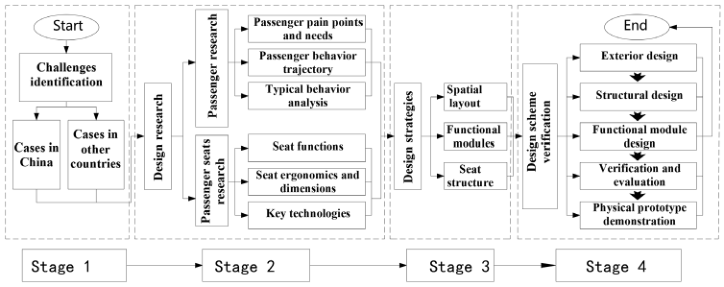
DESIGN PROCEDURE The design procedure, as shown in Figure 1, is divided into four stages as follows:
Stage 1: Challenges Identification. By conducting a comparative analysis of similar domestic and international seat designs and integrating an assessment of China’s national conditions, existing issues in the design of EMU passenger seats are identified.
Stage 2: Design Research on Passengers and Seats. Through research, passenger usage habits and preferences when traveling on EMUs are investigated, and key design points as well as parameters for the seats are defined.
Stage 3: Proposal of Design Strategies. Design strategies are proposed from three aspects: spatial layout, functional configuration, and structural design.
Stage 4: Design Scheme Verification. Taking a seat in an EMU passenger compartment as an example, a design solution is developed in accordance with the design strategies, and its comprehensive performance as well as engineering feasibility is evaluated and verified.
Figure 1: The design procedure.
Challenges
Table 1 presents cases of typical EMU passenger seats from both domestic and international contexts. Analysis reveals that Japan and Europe, as representatives of technologically mature regions, have achieved deep integration of culture, functionality, and materials in seat design at this stage. For instance, seats on the Japanese Shinkansen are based on a simple and elegant aesthetic language. Through systematic application of linked adjustment mechanisms, human-centric functional details, and lightweight materials, they excel in both ride comfort and energy efficiency. In contrast, European passenger seats place greater emphasis on reflecting regional cultural characteristics while also offering a diverse range of seating types, prioritizing spaciousness and convenience for passengers. However, they still exhibit shortcomings in terms of space utilization and privacy (Miu, 2012; Jia, 2025; Yu et al., 2025).
The challenges in the design of passenger seats for China’s EMUs include: a huge passenger volume, relatively long journeys, and diverse carry-on luggage, which necessitate considerations for different spatial zoning and functional modules such as convenient charging interfaces and informational guidance cues. In terms of spatial layout and functional configuration, existing designs still fall short of meeting the actual travel needs of Chinese passengers. Regarding comfort, long-distance travel has raised higher expectations for seating comfort. However, due to insufficient seat pitch and the space occupied by seat rotation and adjustment mechanisms, current EMU passenger seats provide limited legroom, which may adversely affect passengers’ comfort experience.
PASSENGER RESEARCH A mixed-methods approach combining offline and online research was adopted for the passenger-oriented study. The offline component primarily
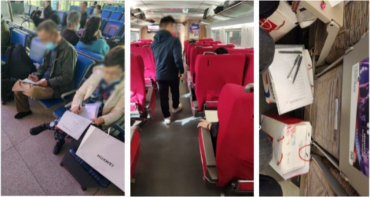
Innovative Design Method of Passenger Seat in China’s EMUs 257 selected high-speed railway waiting areas and first-class compartments as research sites, where the behavioral trajectories of passengers from boarding to alighting were observed and analyzed, with a focus on identifying their needs and pain points during seat usage. The online component involved conducting surveys through online questionnaires to summarize and formulate user need descriptions. Figure 2 presents the keywords of user needs obtained from both offline sampling and online surveys.
a) Research context b) Key words of requirements
Figure 2: The offline and online research sampling diagrams.
Passenger Pain Points and Needs. Based on online surveys and field observations, the following pain points and needs related to seat interaction and surrounding space were identified throughout passengers’ behavioral journey from station entry to departure: (1) Insufficient spatial recognition and guidance. Passengers often struggle to identify seat row numbers when locating or returning to their seats, leading to frequent misidentification. (2) Inadequate storage space design. Small carry-on items often lack dedicated placement areas, and passengers risk taking wrong luggage or leaving belongings behind when leaving their seats. (3) Weak perception of comfort during travel. Hygiene concerns arise due to visual blind spots in seat cushions when passengers sit down; Seat adjustment processes tend to disturb passengers in the rear seats; Lack of privacy during trips affects activities such as work, rest, and entertainment, while resting postures are also perceived as uncomfortable; Further disruption is caused by behaviors such as passengers in rear seats pushing against or stepping on front seats. (4) Poor Information awareness and service support. Passengers face the risk of missing station arrival information due to insufficient notification systems.
Passenger Behavior Trajectory and Typical Behavior Analysis. In the analysis of EMU passenger behavior, the entire process from entering the station to disembarking can be systematically categorized into a series of key typical behaviors: boarding, locating a seat, storing luggage, sitting down, adjusting the seat, temporarily leaving the seat, returning to the seat, leaving the seat, and disembarking. Among these, the core behavior trajectory involving continuous interaction with the seat and the surrounding spatial environment spans from the initiation of seat-locating behavior to the final act of leaving the seat. This process encompasses a range of embodied behaviors, including searching for and confirming the seat location, arranging luggage, adjusting
sitting posture, and operating seat functions. It also involves the cyclical pattern of “temporarily leaving the seat – returning to the seat” triggered by needs such as moving, dining, or using devices during the journey, reflecting passengers’ behavioral patterns and spatial usage characteristics within the confined cabin environment.
PASSENGER SEAT RESEARCH To clarify the principles and technical standards that seat design should follow, the core functions required for seats were first identified based on literature and data research, on-site interviews, and survey results. Secondly, according to ergonomic principles, the static anthropometric measurements and dynamic movement ranges that must be considered in seat dimension design were analyzed. Finally, key technical support requirements for seat design were systematically outlined and proposed in terms of strength, structure, and materials.
Seat Functions. Based on the analysis of EMU passenger seat structures and core components, their functions can be categorized into the following three types: (1) Spatial adaptability function – achieved through foldable tray tables and swivel seats, enabling flexible optimization of personal usage space and social space layout. (2) Seating support function – relying on adjustable footrests, armrests, and seat recline angles to provide dynamically adaptable physical support for passengers’ legs, arms, and torso. (3) Interaction function – reflected in the design of the seat control panel, which must accommodate both visual and tactile perception to enhance the intuitiveness and convenience of adjustment operations.
Seat Ergonomics and Dimensions. The structural design of EMU passenger seats must be based on ergonomics to ensure comfort during long-distance travel and mitigate fatigue. Passenger activities during travel are categorized into three main sitting postures: upright, relaxed, and semi-reclined, with the relaxed posture being the most frequently adopted. Seat design should accommodate the spatial and support needs across these different postures. On one hand, the seat contour should align with the four physiological curves of the human spine (cervical, thoracic, lumbar, and sacral), with particular emphasis on providing appropriate lumbar support to maintain its natural curvature. On the other hand, optimizing the pressure distribution across the seat cushion and backrest helps avoid excessive localized pressure that could impede blood circulation. Structural parameters of the seat—such as seat height, seat depth, backrest height, and width—are designed based on static anthropometric measurements, while also considering dynamic functional dimensions to accommodate passengers’ primary ranges of movement. To ensure the design accommodates the majority of the population, the upper limit is defined using the 95th percentile male body data, and the lower limit using the 5th percentile female body data (Xiang et al., 2019), thereby enhancing the inclusivity of the seat design for diverse passenger body types.
Key Technologies. The key technologies for EMU passenger seats primarily include four aspects: (1) Welding technology. As the fundamental process ensuring structural strength and durability, it must comply with
Innovative Design Method of Passenger Seat in China’s EMUs 259 industry standards such as EN 15085-2. (2) Rotation technology. Through optimized mechanisms and locking devices, seat orientation adjustment is achieved while balancing rigidity, vibration damping, and space efficiency. (3) Linked adjustment technology. Enables coordinated movement of the seat cushion, backrest, and leg rest (e.g., from a 105° sitting posture to a 135° semi-reclined posture, with leg-rest angles ranging from -5° to 45°). It supports multi-posture switching and incorporates an automatic reset function for maintenance convenience. (4) Cushion foaming technology. By regulating the hardness of polyurethane foam (seat cushion: 320-350 N; backrest: 230-250 N), a support surface that conforms to the human body’s contours is shaped, thereby improving pressure distribution and seating comfort.
DESIGN STRATEGY The design strategies for EMU passenger seats are proposed from three aspects: spatial layout, functional modules, and structural design, as detailed below:
Spatial Layout. To address the insufficiency in storage space design for passengers, the internal and surrounding areas of the seat are planned and utilized to meet the needs for storing personal items. Specific measures include: (1) Integrating a multi-functional storage area into the seat back to enable organized storage of small items. (2) Embedding a private storage compartment within the fixed armrest for convenient access to personal small items. (3) Optimizing the space under the seat cushion to accommodate both foot-extension space and temporary storage for small luggage, thereby enhancing the flexibility of the spatial layout. All designs are developed within the constraints of key dimensions such as predetermined seat pitch and aisle width. By carefully coordinating the deployment distance of facilities on the seat back, functional usage and public passage are ensured not to interfere with each other.
Functional Modules. To address passengers’ insufficient spatial recognition and guidance, smart interaction and service interfaces are integrated into the seat structure itself to enhance the convenience of information access and operation. A centralized smart control terminal is installed on the fixed armrest, serving as the core interface between passengers and both the seat and onboard services. It enables intuitive posture adjustment and function settings while providing passengers with real-time key travel information. In addition, USB charging ports are offered as seamless power and data interfaces to meet the battery needs of passengers’ electronic devices.
Seat Structure. To enhance overall riding comfort and experience, the seat structure has been optimized as follows: (1) The sitting posture adaptation system employs a linked mechanism between the seat cushion and backrest, enabling stepless adjustment of the sitting posture. Combined with an adjustable leg rest and a height-adjustable headrest, it provides full-body support from the neck and head down to the legs. (2) Based on key seat parameters determined earlier, the curvature of the seat cushion and backrest has been optimized to improve body pressure distribution, reduce fatigue
from prolonged sitting, and minimize the sense of spatial encroachment on rear rows by refining the backrest angle and thickness. (3) The seat supports a 180° rotation function, unlocked via a foot pedal at the base, allowing passengers to flexibly adjust orientation for social interaction or scenic viewing, thereby enhancing adaptability and self-adjustment in various riding scenarios.
DESIGN SCHEME VERIFICATION Taking a first-class seat in the China’s new-type EMUs as an example, this paper demonstrates the feasibility of the proposed method through its exterior design, structural design, functional module design, verification and evaluation, and physical prototype demonstration.
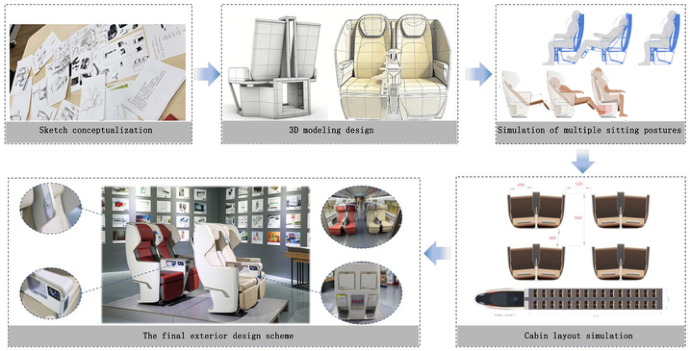
Figure 3: The exterior design process.
Exterior Design. In line with the proposed spatial layout design strategy, the exterior design aims to maximize space utilization by fully leveraging the storage potential beneath the seat cushion. This is primarily achieved through the creation of simplified models and simulations of the actual cabin environment and seating layout, followed by initial ergonomic validation and multiple rounds of iterative optimization. Each iteration advances the design by refining storage compartmentalization (such as multifunctional storage areas on the back of the seat and private storage compartments embedded within the armrests) while ensuring adequate passenger legroom. The goal is to achieve a synergistic balance among efficient space utilization, product feasibility, and riding comfort. As shown in Figure 3, the design process encompasses sketch conceptualization, 3D modeling design, simulation of multiple sitting postures, cabin layout simulation, and ultimately results in the final exterior design scheme through multiple rounds of optimization.
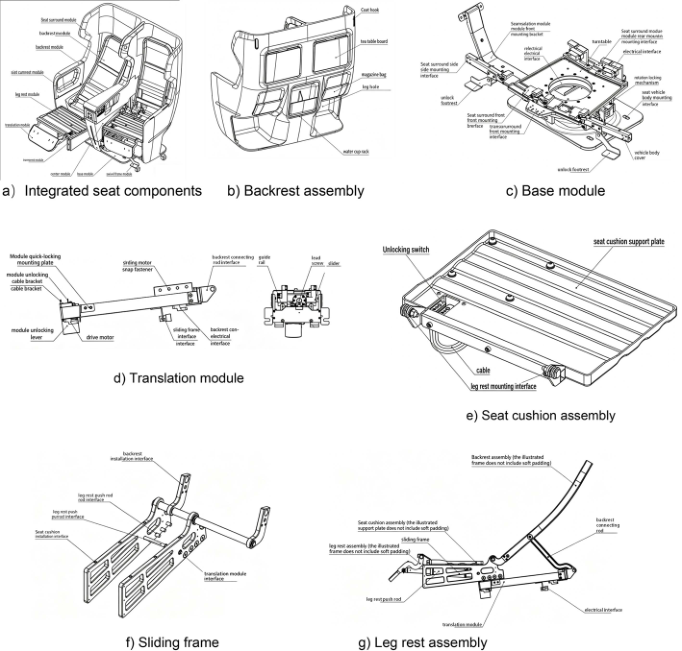
Figure 4: Diagrams of various components of the seat.
Structural Design. The key components of the seat are illustrated in Figure 4. The characteristics of each part are as follows: (1) Integrated seat components. The seat system achieves integrated functional linkage through a translation module, representing a key functional innovation of this solution. (2) Backrest assembly. Connected to the translation module via linkages, the backrest assembly works in coordination with the seat cushion under the module’s actuation to achieve synchronized adjustment, thereby enabling changes in the backrest angle. (3) Base module. As the core component connecting the vehicle body and supporting the upper structure, the base module is designed with targeted reinforcement. It enables rigid fixation of the seat to the vehicle body and facilitates the routing of vehicle cables. It integrates a rotation and locking mechanism, provides mechanical and electrical interfaces for the upper translation module, includes mounting interfaces for the seat surround, and reliably supports the load of all upper components. (4) Translation module. Functioning as the core transmission component, the translation module is responsible for synchronously connecting the mechanical and electrical interfaces of the seat to the base. It also provides mounting interfaces for the sliding frame and the backrest linkage. (5) Seat cushion assembly. This assembly integrates the
cushion support plate and upholstery. Its frame includes mounting interfaces for the leg rest and an unlocking switch, allowing synchronized control of the movement and locking of both the leg rest and the translation module. (6) Sliding frame. Linked to the translation module, the sliding frame features a mounting point for the leg rest actuator at the front and connects to the seat cushion and backrest mounting interfaces at the rear. It serves as the core skeletal structure enabling posture adjustment. (7) Leg rest assembly. Driven by an actuator, the leg rest assembly can perform a flipping motion ranging from -5° to 45°, providing personalized comfort support tailored to the passenger’s leg positioning needs.
Functional Module Design. The seat adopts a modular design approach, decomposed into multiple independent units with standardized interfaces. As shown in Figure 4, the first-class seat of the EMU is divided into nine modules based on functional configuration: base module, rotation frame module, seat cushion module, leg rest module, side armrest module, center armrest module, backrest module, seat surround module, and translation module. Among these, the seat surround module serves as an important carrier integrating multiple functions. Its housing centrally incorporates components such as a water cup holder, leg space, magazine pocket, foldable tabletop, and coat hook to meet passengers’ needs for storing personal items.
Figure 5: The verification and evaluation process of the seat.
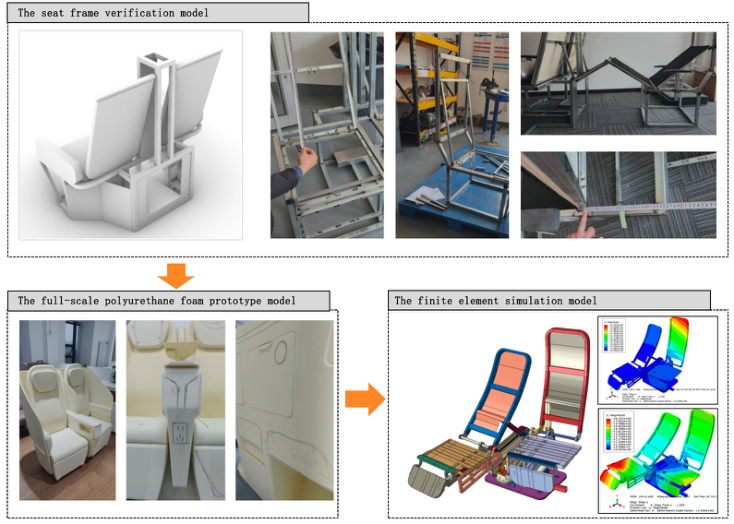
Verification and Evaluation. To ensure the design comprehensively meets technical, spatial, and comfort requirements, a phased systematic verification process was implemented, as illustrated in Figure 5. Initially, the seat frame verification model was produced and tested to validate the rationality of key ergonomic dimensions. Subsequently, the full-scale polyurethane foam
Innovative Design Method of Passenger Seat in China’s EMUs 263 prototype model was further developed to assess spatial layout and seating experience. Finally, structural performance was verified through finite element simulation analysis. The finite element simulation phase included seven typical load cases (namely: left single backrest bearing 1000 N, left single seat cushion bearing 1000 N, right single backrest bearing 1000 N, right single seat cushion bearing 1000 N, two backrests bearing 2000 N, two seat cushions bearing 2000 N, and footrest bearing 490 N). The simulation results showed that the maximum displacement of the seat was 25.41 mm, and the maximum stress was 303.40 MPa, with the safety factor meeting the requirements of the EN 12663 standard.
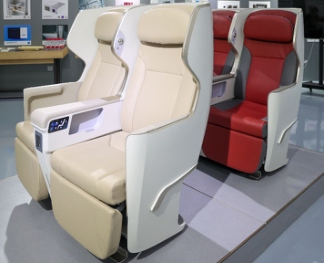
Physical Prototype Demonstration. After the design scheme passed the aforementioned evaluation and verification, and compliance with user requirements and relevant regulations was ensured, a physical prototype was further developed. Small-scale on-vehicle trials of the prototype were conducted to prepare for subsequent product finalization. Figure 6 shows the physical prototype of this case as well as its installation and sampling in the passenger compartment of a new-type EMUs.
a) Seat samples b) On-vehicle installation
Figure 6: The physical prototype seat samples.
CONCLUSION
Conducting innovative design research for passenger seats is an inherent requirement for China to continuously enhance the overall environmental quality within EMUs in the new era, as well as an effective approach to further meet passengers’ diverse travel needs and improve riding comfort. This paper proposes an innovative design framework for EMU passenger seats that integrates “challenges identification - design research - design strategy - design scheme verification” outlines the design procedure, and demonstrates the feasibility of this process using a first-class seat as an example. The proposed innovative design scheme meets specified comprehensive performance criteria and demonstrates strong engineering feasibility, providing a referential methodology for innovative design of passenger seats.
FUNDING This work was supported by the National Key Research and Development Program of China under Grant [2022YFB4301203].
REFERENCES
Cao, L., Hao, X., Fan, H. (2023). Investigation and Analysis of Passenger Seat Comfort of EMU. Railway Energy Saving & Environmental Protection & Occupational Safety and Health, 13(04), 44–47. Du, Y., Zhi, J., Huang, J., et al. (2020). Research on Innovative Design of Longitudinal
Sleeper Car Based on Passenger Satisfaction. Machine Design & Research, 36(03), 161–165. Gao, J., Wang, X. (2025). Research on Coupled Vibration Characteristics of Flexible Carbody-Seat-Body System of High-Speed EMU. China Railway Science, 46(01), 167–181. Hao, X., Cao, L., Fan, H. (2023). Preliminary Study on Optimization of Comfort
Parameters of Passenger Seats in EMU. Railway Energy Saving & Environmental Protection & Occupational Safety and Health, 13(02), 34–37. Huang, C., Chen, G., Huang, S., et al. (2024). Lightweight Design and Analysis of Combined Seat Base Frame for High-Speed Trains Based on SIMP-Style Technology. Chinese Journal of Engineering, 46(06), 1151–1160. Huang, J., Wang, T. (2022). Design of Business Seat for High Speed Train Based on
Fuzzy Kano Model. Packaging Engineering, 43(16), 153–161. Jia, X. (2025). Lightweight Technology for High-speed EMU Passenger Seats. Urban Mass Transit, 28(09), 90–97. Jia, X., Zhan, X. (2017). Study on Seat Masked Cloth for EMU Train. Urban Mass
Transit, 20(02), 82–85. Jung, E.S., Han, S.H., Jung, M., Choe, J. (1998). Coach Design for the Korean Highspeed Train: A Systematic Approach to Passenger Seat Design and Layout. Applied Ergonomics, 29(06), 507–519. Miu, K. (2012). Analysis of Interior Design Features of Chinese and Foreign High-
speed Trains’ Seating Cabins. Packaging Engineering, 33(22), 92–95. Wang, L., Chen, C., Xu H., et al. (2024). Plane Layout and Passenger Interface Design of a New Generation of High-Speed EMU. China Railway, (06), 90–98. Wang, J., Zhi, J., Xiang, Z., et al. (2019). Evaluation Method of Seat Comfort for
High-Speed Trains Based on Seat Ergonomic Parameters. Journal of Southwest Jiaotong University, 54 (06), 1342–1348. Xiang, Z., Zhi, J., Huang, J., et al. (2019). A systematic approach for streamlined head form design and evaluation of Chinese high-speed train. International Journal of Rail Transportation, 7(2), 117–139. Xiang, Z., Zhi, J., Huang, J., et al. (2021). Identifying Factors to Improve the Coach
Design and Service of the New-type EMU Sleeper Train: Findings from Passenger Satisfaction Survey. 2021 5th International Conference on Vision, Image and Signal Processing (ICVISP), Kuala Lumpur, Malaysia, pp. 66–76. Yu, G., Liu, H., Wang, H., et al. (2025). Industrial Design Method of Metro Trains Based on ISM-AHP. Science Technology and Engineering, 25(32), 13744–13752.
LISTED IN THE AHFE DIGITAL BOOKSTORE CATALOGUE
Explore the complete digital volume
Interdisciplinary Practice in Industrial Design
Read this individual research paper free through the original publisher, or explore the full digital proceedings book.
ISBN 978-1-964867-98-4
Explore this ISBN in the AHFE Bookstore ↗Listed in the July 2026 bookstore catalogue; search by ISBN to confirm current availability · Digital book purchase optional