Noriko OKABE (2025). Restoring Job Satisfaction Through Subjective Well-being: Interaction Between Organizational Stress and Subjective Well-being. In: Human Factors in Design, Engineering, and Computing. AHFE Open Access, vol. 199, pp. 1905–1911. https://doi.org/10.54941/ahfe1007001
This study explored the hypothesis that customer service-oriented employees’ positive subjective well-being moderates the decreasing propensity of job satisfaction in circumstances where the organizational stress is perceived. A questionnaire survey was administered to 200 Japanese customer service-oriented employees. The research findings, mean, S.D., Cronbach’s alpha, and correlations for variables used in this study are shown. Then, multiple hierarchical regression is used to test the hypotheses. The results show that positive subjective well-being significantly mediates the decrease in job satisfaction propensity in stressful circumstances where employees perceive role ambiguity and role conflict.
In recent years, researchers have focused on the emotions of service- oriented workers (Ashforth & Humphrey, 1995; Wharton, 2009). In service organizations and companies, corporate missions, sales goals, and marketing strategies are realized through the interactions between individual service workers and customers (Donovan et al., 2004; Bettencourt et al., 2001). This study investigated whether service-oriented workers’ positive emotions, particularly their “subjective well-being,” can mitigate the tendency toward declining job satisfaction and performance in the workplace.
Previous research has demonstrated that service-oriented workers undertake a substantial amount of emotional work when interacting with customers (Hochschild, 1983; Brotheridge & Lee, 2003). Hochschild (1983) referred to this type of work as “emotional labor.” For example, emotional labor involves controlling emotions such as anger or sadness; instead, the service-oriented employees smile and respond nicely to customers (Grandey, 2003). Interpersonal service professions require this kind of “emotion regulation,” implicitly and explicitly. Gross (1998) defined emotion regulation as the process that influences what emotions individuals feel, when, and how they express those emotions. For example, service-oriented
employees sometimes experience stress controlling their emotions to respond to customers and put themself at risk of job burnout (Maslach & Jackson, 1984; Zapf et al., 1999) and mental health issues. Hochschild (1983) identified two types of emotional labor: surface acting and deep acting. Surface acting means altering one’s outward expressions without changing the underlying feelings. Service-oriented employees using surface acting might force themself to smile or suppress frustration to meet workplace expectations. Conversely, deep acting means trying to change one’s internal feeling to align with the expected emotional display. For example, a flight attendant might try to genuinely feel calm and friendly rather than just pretending to be so. Both types of emotional labor require significant emotional regulation and can have various psychological and social consequences.
This study proposes that in today’s rapidly changing and complex work environment, service-oriented employees who perceive stress in their organizations can mitigate declining job satisfaction with positive emotions. Specifically, service-oriented workers can use “subjective well-being (SWB)” to mitigate or recover from a decline in satisfaction and avoid stressful situations in the workplace.
LITERATURE REVIEW AND HYPOTHESES CONSTRUCTION Organizational Stress
There are two leading causes of organizational stress: one is “role conflict” and the other is “role ambiguity (Kahn et al., 1964). Classical organizational theory considered that organizational stress occurs when these two factors, “role conflict” and “role ambiguity”, are violated. Later, the researchers began to include correlations with job satisfaction, job performance, organizational commitment, and other variables.
In role theory, a role is defined as a pattern of behavior that is expected of an individual in a particular social context. “Role conflict” refers to the incompatibility and contradiction of the demands facing the focal person (Rizzo et al., 1970; Ilgen & Hollenback, 1991). For example, there may be conflicts about how a particular employee’s role should be among co- workers, supervisors, and customers. Conversely, “role ambiguity” refers to the level of uncertainty or a lack of clarity and information necessary to perform specific organizational tasks (Kahn et al., 1964). For example, the expected behaviors required in the role may be unclear (Ilgen & Hollenback, 1991).
Job Satisfaction Job satisfaction is understood as an individual’s emotional connection to their job (Rousseau, 1989). It can be overall satisfaction or satisfaction with a specific aspect of their job (e.g., supervisory role). Previous researchers have indicated that job satisfaction is related to organizational citizenship and in-role behavior (Williams & Anderson, 1991). In this study, the author proposes the following hypotheses:
Restoring Job Satisfaction Through Subjective Well-Being 1907
Hypothesis 1: “Role ambiguity” is negatively correlated with “job satisfaction” of service-oriented employees.
Subjective Well-Being (SWB) Previous research has defined subjective well-being as a person’s personal perception and experience of positive or negative emotional responses related to an overall evaluation of their life and emotional experiences, as well as a world-specific cognitive appraisal of life satisfaction (Diener et al., 2002). Subjective well-being is measured from an individual’s perspective (self-report), which distinguishes this field from clinical psychology (Diener et al., 2017). This study proposes the following hypotheses:
Hypothesis 2: Service-oriented employees’ “subjective well-being (SWB)” will mitigate the negative effect of role ambiguity on job satisfaction.
Hypothesis 3: Service-oriented employees’ “subjective well-being (SWB)” will mitigate the negative effect of role conflict on job satisfaction.
METHOD
(1) Survey Methodology This study was administered via an online live app service provided by a global leader in online surveys. The final sample consisted of 200 Japanese customer service-oriented employees (54.5% female). Respondents’ ages ranged from under 20 to over 60, with an average age of 24. Respondents’ reported employment tenure ranged from less than one year to over 30 years, with an average tenure of eight years. The author used IBM SPSS Statistics version 29 and IBM SPSS Amos version 29 for the analysis of this survey.
(2) Questionnaire In this study, the author used a 5-point Likert-type questionnaire ranging from 1 (low) to 5 (high).
“Role Conflict” and “Role Ambiguity” Three role conflict items (α = .82) and three role ambiguity items (α = .76) were adopted from a previous study by Rizzo et al. (1970).
Job Satisfaction Based on a previous study by Robinson & Rousseau (1994), the author used the two-item scales (α = .85) from the perspectives of both employee job satisfaction and organizational role.
RESULTS
To verify the hypotheses, the author first conducted descriptive statistics and correlation analysis (Table 1). The results of the correlation analysis (Table 1) showed a negative correlation between role ambiguity and job satisfaction (r=–0.58, p<.001), supporting Hypothesis 1, which states that “role ambiguity” has a negative correlation with “job satisfaction” among service-oriented workers.
1908 Okabe
Table 1: Descriptive statistics, reliability, and intercorrelation.
Table available in the original PDF paper.
Mean S.D. α4 1 2 3 4 5 6 7 8 9 10
1. Gender1 .54 .50 – 2. Tenure2 2.78 2.05 –.43*** – 3. Age3 2.36 .89 –.36*** .51*** – 4. Job Satisfaction 3.24 1.10 .85 –.03 –.14*** .04 – 5. Job Performance 3.54 .93 .58 –.07 –.30*** –.17 .60*** – 6. Role Conflict 2.81 .88 .76 .03 –.01 –.10 -.06*** -.20*** – 7. Role Ambiguity 2.39 .91 .82 .08 –.35*** .19*** –.58 –.077*** -0.5*** – 8. Surface Acting 3.69 .95 .89 .03 .28*** .13 .57*** –.77*** .23*** .78*** – 9. Deep Acting 3.68 .94 .77 –.10 .28*** –.08 –.58*** .77*** .21*** .74*** .83*** – 10. Subjective Well-Being 3.27 .53 .59 –.04 –.07 –.02 .05 –.10 .26*** –.18*** –.17*** –.22*** – Note. *** p < .001, ** p < .01, * p < .10, N = 200. 1Gender: coded as Male = 0, Female = 1. 2Job tenure: coded as 1 = 0–5 years, 2 = 6–10 years, 3 = 11–15 years, 4 = 16–20 years, 5 = 21–25 years, 6 = 26–30 years, 7 = more than 30 years. 3Age: coded as 1 = less than 20, 2 = 21–30, 3 = 31–40, 4 = 41–50, 5 = 51–60, 6 = more than 60. 4Reliability represents Cronbach’s Alpha coefficients.
Table 2 presents the results of the hierarchical regression analysis. In Study 1, the antecedent is “Role Ambiguity” and the outcome is “ Job Satisfaction”, and in Study 2, the antecedent is “Role Conflict” and the outcome is “Job Satisfaction”.
Table 2: Summary of hierarchical regression analysis: Examining interactions of RA and SWB as well as RC and SWB on job satisfaction.
Table available in the original PDF paper.
Study 1 Predictor: Role Ambiguity(RA) Outcome: Job Satisfaction
Study 2 Predictor: Role Conflict(RC) Outcome: Job Satisfaction (Step 1) (Step 2) (Step 1) (Step 2)
Step 2: Study 1 (Interaction) Role Ambiguity (RA) × SWB F 21.992∗∗∗ 20.047∗∗∗ R2 .425 .434 1R2 .009
–.75∗∗
Step 2: Study 2 (Interaction) Role Conflict (RC) × SWB F 19.274∗∗∗ 16.576∗∗∗
R2 .444 .437 1R2 .007 Standardized regression coefficients are reported. *** p < .001, ** p < .01, * p < .05.
Step 1 of the hierarchical regression analysis involved adding the control variables of gender, years of employment, and age to the regression equation, along with variables related to the organizational stress context: role ambiguity and role conflict, a variable related to organizational goal such
Restoring Job Satisfaction Through Subjective Well-Being 1909
as job performance, as well as emotional and cognitive positive aspect of employees, such as subjective well-being.
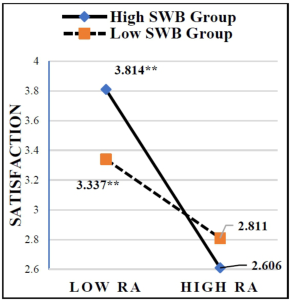
Next, in Step 2 (Study 1), the interaction between “role ambiguity (RA)” and “subjective well-being (SWB)” was added to the regression equation. The interaction (RA × SWB) was significant when added to the regression equation [F(8, 191) = 20.047, p<.001].
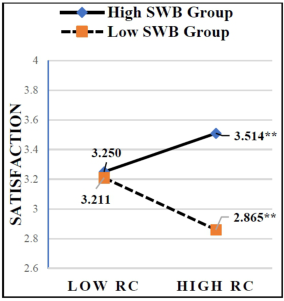
Then, in Step 2 (Study 2), the interaction between “role conflict (RC)” and “subjective well-being (SWB)” was significant when added to the regression equation. The interaction (RC x SWB) was significant when added to the regression equation [F (11, 188) = 16.576, p <.001].
Figure 1 shows the plot graph of the interaction between role ambiguity (RA) and subjective well-being (SWB) significantly predicting higher job satisfaction when the level of role ambiguity is low, supporting partially H2 when role ambiguity is low.
Figure 1: Interaction between RA and SWB.
Figure 2 shows the plot graph of the interaction between role conflict (RC) and subjective well-being (SWB) significantly predicting higher job satisfaction when the level of role conflict is high, supporting partially H3 when role conflict is high.
Figure 2: Interaction between RC and SWB.
1910 Okabe
DISCUSSION AND IMPLICATION In recent years, competition has intensified across a wide range of industries. It is common for automated machines and AI to replace tasks previously performed by employees in business environments. Furthermore, as the workforce shifts, the working environment for customer service-oriented employees changes frequently, making it more likely that modern workers experience stress in their organizations.
It has often been presumed that jobs involving “people work” (e.g., service workers, nurses, teachers) are emotionally taxing (Maslach & Jackson, 1984). However, this problem has seldom been explicitly studied in terms of their emotional and cognitive components. The contribution of this study shows that positive subjective well-being more and less mitigates the decreasing propensity for job satisfaction in stressful circumstances where the employees perceive role ambiguity as well as role conflict.
In conclusion, subjective well-being (SWB) enables employees to cope with today’s stressful work environments and interpersonal relationships, thereby reducing the likelihood of burnout. It is speculated that employees with high emotional and cognitive competence work harmoniously and integrate with their organizations, understand corporate strategies, and work efficiently, thereby enhancing a company’s competitiveness and contributing to its long-term growth.
ACKNOWLEDGMENT
This work is supported by JSPS KAKENHI Grant Number 24K16423.
REFERENCES
Ashforth, B. E., & Humphrey, R. H. (1995). Emotion in the workplace: A reappraisal. Human relations, 48(2), 97–125. Bettencourt, L. A., Gwinner, K. P., & Meuter, M. L. (2001). A comparison of
attitude, personality, and knowledge predictors of service-oriented organizational citizenship behaviors. Journal of Applied Psychology, 86(1), 29. Brotheridge, C. M., & Lee, R. T. (2003). Development and validation of the emotional labour scale. Journal of Occupational and Organizational Psychology, 76(3), 365–379. Diener, E., Heintzelman, S. J., Kushlev, K., Tay, L., Wirtz, D., Lutes, L. D., & Oishi, S. (2017). Findings all psychologists should know from the new science on subjective well-being. Canadian Psychology/Psychologie Canadienne, 58(2), 87. http://dx.doi.org/10.1037/cap0000063. Diener, E., Lucas, R. E., & Oishi, S. (2002). Subjective well-being: The science of
happiness and life satisfaction. In C. R. Snyder & S. J. Lopez (Eds.), Handbook of positive psychology (pp. 63–73). New York: Oxford University Press. https:// doi.org/10.1093/oso/9780195135336.003.0005 Pages 63–73. Donavan, D. T., Brown, T. J., & Mowen, J. C. (2004). Internal benefits of serviceworker customer orientation: Job satisfaction, commitment, and organizational citizenship behaviors. Journal of Marketing, 68(1), 128–146. Grandey, A. A. (2003). When “the show must go on”: Surface acting and deep acting
as determinants of emotional exhaustion and peer-rated service delivery. Academy of Management Journal, 46(1), 86–96.
Restoring Job Satisfaction Through Subjective Well-Being 1911
Gross, J. J. (1998). The emerging field of emotion regulation: An integrative review. Review of General Psychology, 2(3), 271–299. Hochschild, A. (1983). The presentation of Emotion. Sage Publications, 7. Ilgen, D. R., & Hollenbeck, J. R. (1991). Job design and roles. Handbook of
Industrial and Organizational Psychology, 2(1), 165–207. Kahn, R. L., Wolfe, D. M., Quinn, R. P., Snoek, J. D., & Rosenthal, R. A.
(1964). Organizational stress: Studies in role conflict and ambiguity. John Wiley. Maslach, C. (1978). The client role in staff burnout. Journal of Social Issues, 34(4), 111–124. Maslach, C., & Jackson, S. E. (1984). Patterns of burnout among a national sample of
public contact workers. Journal of Health and Human Resources Administration, 189–212. Rizzo, J. R., House, R. J., & Lirtzman, S. I. (1970). Role conflict and ambiguity in complex organizations. Administrative Science Quarterly, 150–163. Robinson, S. L., & Rousseau, D. M. (1994). Violating the psychological contract: Not
the exception but the norm. Journal of Organizational Behavior, 15(3), 245–259. Rousseau, D. M. (1989). Psychological and implied contracts in organizations. Employee Responsibilities and Rights Journal, 2, 121–139. https://doi.org/10.1007/BF01384942. Wharton, A. S. (2009). The sociology of emotional labor. Annual Review of Sociology, 35(1), 147–165. Williams, L. J., & Anderson, S. E. (1991). Job satisfaction and organizational
commitment as predictors of organizational citizenship and in-role behaviors. Journal of Management, 17(3), 601–617. Zapf, D., Vogt, C., Seifert, C., Mertini, H., & Isic, A. (1999). Emotion work as a source of stress: The concept and development of an instrument. European Journal of Work and Organizational Psychology, 8(3), 371–400.
LISTED IN THE AHFE DIGITAL BOOKSTORE CATALOGUE
Explore the complete digital volume
Human Factors in Design, Engineering, and Computing
Read this individual research paper free through the original publisher, or explore the full digital proceedings book.
ISBN 978-1-964867-75-5
Explore this ISBN in the AHFE Bookstore ↗Listed in the July 2026 bookstore catalogue; search by ISBN to confirm current availability · Digital book purchase optional