Jing Yang, Wumin Ouyang (2022). External Human-machine Interface Design for Automated Vehicles Based on Analytic Hierarchy Process. In: Usability and User Experience. AHFE Open Access, vol. 39, pp. 36–43. https://doi.org/10.54941/ahfe1001688
This research provides a theoretical basis and guidance for the design by establishing a demand index system for the external human-machine interface for automated vehicles. First of all, starting from literature research, combined with market product analysis and user interviews, to establish functional demand indicators for the design of external human-machine interface, then collect data through user surveys, and calculate through AHP to obtain the weights of each level and each element. Clarify the preference characteristics of each demand and carry out consistency test to establish an evaluation system to provide a basis for subsequent decision-making and design practice. Finally, combining the research conclusions and design practice, an external human-machine interface for automated vehicles is designed that meets the user's preferences and characteristics, and provides a usable and effective interface for pedestrians.
With the development of technology and economy, the technology of auto- mated vehicles is becoming more and more mature, and its research on perception, decision-making and control theory is advancing in an all-round way, and it is expected to play an important role in the future transporta- tion system (Wu, C. Z. et al., 2018). Automated vehicles can perform driving tasks in road environments that human drivers can handle through the veh- icle’s own software and hardware, and the driver’s attention is diverted to non-driving tasks such as office and entertainment (Tan, H. , and Zhao, Y., 2018). Therefore, automated vehicles need to transmit crucial information to pedestrians through an external human-computer interface, so that pedestri- ans can accurately predict the next behavior of the car and take action. As a bridge of communication, the study of the external human-machine interface for automated vehicles is of great significance.
OVERVIEW OF EXTERNAL HUMAN-MACHINE INTERFACE FOR AUTOMATED VEHICLES Human-computer interaction refers to the process of exchanging informa- tion between people and computers through a certain conversation language
and interaction mode. Faced with the complex human-vehicle interaction environment, the design of the external human-machine interface for auto- mated vehicles is an effective way to establish interaction between vehicles and pedestrians.
Academia and some manufacturers have conducted related research on the design of the external human-machine interface to solve the communication problem between autonomous vehicles and pedestrians. Swedish Semcon uses an anthropomorphic design approach on the radiator grille of the car to pre- sent the ‘smile’ in the external human-machine interface (Snyder J B., 2016). In Baidu-Hongqi L4 automated vehicle, the interface is projected in front of pedestrians through the front projection device. Lagerstrom and his team sho- wed different modes of autonomous vehicles by studying the different states of LED strip (Lagström, T. and Malmsten Lundgren, V., 2016). Automotive intelligence is an inevitable trend, and user demands have also undergone tre- mendous changes with the application of technology. This paper will carry out the design practice from the user’s point of view based on the analytic hierarchy process.
RESEARCH METHOD AND DESIGN PROCESS In order to provide pedestrians with a usable and effective external human- machine interface, it is necessary to conduct user and market demand surveys to clarify the element goals. The AHP is introduced to screen all the element targets. This method mainly calculates the weight value of each element through the weight coefficient, and sorts all elements with the importance as the priority, so as to complete the design decision (Tang, L. et al., 2019).
Overview of Analytic Hierarchy Process AHP is a multi-criteria decision-making method proposed by Profes- sor Thomas L. Saaty in the early 1970s. Analytic Hierarchy Process (AHP) combines qualitative textual expressions with quantitative numeri- cal expressions, takes quantitative analysis as the guide, and uses math- ematical models as tools to comprehensively evaluate limited data sam- ples through quantitative methods, which can effectively avoid the sub- jective one-sidedness of the transformation of demands (Sirisawat, P. and Kiatcharoenpol, T., 2018).
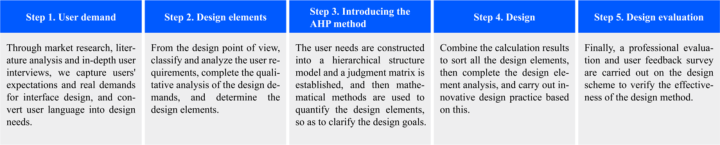
Design Process Analysis of External Human-Machine Interface First, by investigating target users and existing research cases, obtain in- depth user needs and design elements. Then, combine the analytic hie- rarchy process to build a hierarchical structure model, and calculate the target weights of design elements. Finally, the design element objectives are screened, sorted and analyzed, and design practice is carried out. The design of the application process mainly includes the following five steps (see Figure 1).
38 Yang and OuYang
Figure 1: Design process of external human-machine interface.
HIERARCHICAL DEMAND INDEX OF EXTERNAL HUMAN-MACHINE INTERFACE FOR AUTOMATED VEHICLES The selection of the design elements of the external human-machine interface for automated vehicles is a collection of many factors such as multi-level, multi-factor, and multi-indicator design. In the selection of evaluation indi- cators, the elements of evaluation indicators are supplemented and screened through paper reading, case analysis, and collection of opinions from rele- vant experts and design practitioners (Li L. P. and Guo X. Y., 2020). Through the above analysis method, the hierarchical structure of the external human- machine interface is finally determined as follows: 1 target layer, 6 first-level indicators and 24 second-level indicators (see Table 1).
Target layer: The general target of the hierarchical structure model is the hierarchical design requirements of the external human-machine interface.
First-level indicators: Extract B1-Position, B2-Technology, B3-Text, B4- Graphics, B5-Color, B6-Personification, a total of six types of design index elements as criteria-level evaluation elements.
Second-level indicators: According to the design elements of first-level indi- cators, it is divided into details, and a total of 24 second-level evaluation indicators C1-C24 are selected by KJ method to complete the qualitative analysis of structured requirements.
THE WEIGHT OF EACH DESIGN DEMAND ELEMENT IN AHP ANALYSIS HIERARCHY PROCESS After constructing the index system, this research uses the analytic hierarchy process to analyze each indicator of design demands of the external human- machine interface for automated vehicles through questionnaire survey and in-depth interview, calculates the weight value of each index, and completes the consistency test.
Construct Judgment Matrix and Calculate the Weight of Each Index In this study, 50 potential users who participated in the user interview above were selected to participate in the index evaluation, and formed decision makers, including interface designers, related researchers and others. Using the 9-level scaling method in the AHP method as the evaluation scale, it ena- bles users to compare the preferences of each element pairwise and quantify the assignment, which plays an important role in establishing a matrix and finding eigenvector values.
External Human-Machine Interface Design 39
Table 1. Hierarchical function index of External Human-machine Interface.
Table available in the original PDF paper.
Target layer First-level indicators Secondary indicators Design requirements for External Human-machine Interface B1-Position C1-Top of car C2-Windshield C3-Radiator grille C4-Side view of car C5-The surface of the road B2-Technology C6-Projection C7-Display C8-LED light strip B3-Text C9-Please passing C10-No passing C11-About to start C12-Thanks B4-Graphics C13-Pedestrian C14-Wait C15-Welcome C16-Accelerate C17-Pass through B5-Color C18-Traffic color C19-Cyan-blue C20-White C21-blue B6-Personification C22-Eye C23-Smiley C24-Anthropomorphic graphics
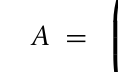
Set judgment matrix A is as follows: [Equation or mathematical symbol available in the original paper PDF][Equation or mathematical symbol available in the original paper PDF]
Equation reproduced from the original PDF.
Equations and mathematical formulas are available in the original paper PDF.
Through the judgment matrix, the weight value of each index is the eige- nvector corresponding to the maximum eigenvalue of the judgment matrix, and the sum-product method is used to calculate the weight value to obtain the comprehensive weight of the hierarchical demand index for the design of the external human-machine interface (see Table 2).
According to the weight value of the first-level indicators, the order of importance of the design of the external human-machine interface is B1- Position, B2-Technology, B5-Color, B4-Graphic, B3-Text, B6-Personification, that means users want to put the location and technology of the inter- face first, followed by factors such as color and graphics. According to the weight value of the secondary indicators, users have higher ratings for C3- Radiator grille, C7-Display, C9-Please passing, C13-Pedestrian, C18-Traffic color, C23-Smiley. At the same time, users have a low degree of recognition of elements such as C1-Top of car and C6-Projection.
40 Yang and OuYang
Table 2. Comprehensive weight of hierarchical function index for External Humanmachine Interface.
Table available in the original PDF paper.
Weight
λ max Secondary indicators Weight
λ max
Target layer First-level indicators value
value
0.260
Design requirements for External Human- machine Interface
B1-Position 0.452 6.509 C1-Top of car 0.035 5.243 C2-Windshield 0.134 C3-Radiator grille 0.503 C4-Side view of car 0.068 C5-The surface of the road B2- Technology 0.246 C6-Projection 0.106 3.039 C7-Display 0.633 C8-LED light strip 0.261 B3-Text 0.047 C9-Please passing 0.416 4.081 C10-No passing 0.312 C11-About to start 0.157 C12-Thanks 0.109 B4- Graphics
Consistency Check In order to avoid subjects being influenced by subjective factors, the data are now checked for consistency. To check the consistency of matrix A, the formula is:
Equation reproduced from the original PDF.
R.I. values can be found online, and the C.I. numerical formula is:
C.I. = (λmax −n)/(n −1)
The C.R. value can be calculated from the above two formulas. When C.R.<0.1, it means that the calculation result of the matrix has passed the consistency test, and the calculated weights are consistent. The calculation results are shown in the table (see Table 3).
External Human-Machine Interface Design 41
Table 3. Consistency test of external human-machine interface .
Table available in the original PDF paper.
C.I. C.R.
C.I. C.R. Secondary
Target layer First-level indicators
indicators
Design requirements for External Human-machine Interface
B1-B6 0.102 0.081 C1-C5 0.061 0.054 C6-C8 0.019 0.037 C9-C12 0.027 0.030 C13-C17 0.037 0.033 C18-C21 0.011 0.013 C22-C24 0.023 0.045 It can be seen from the table that the consistency test of the judgment matrix satisfies C.R.<0.1, and the consistency test is passed.
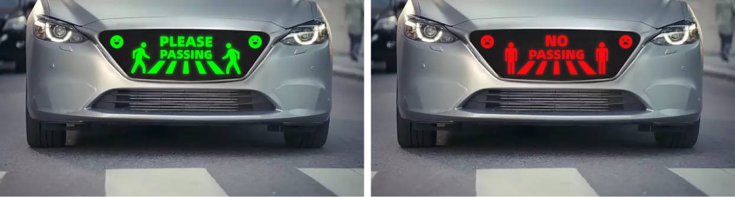
Figure 2: Design of external human-machine interface for automated vehicles.
DESIGN PRACTICE OF EXTERNAL HUMAN-MACHINE INTERFACE Design Practice
According to the weight analysis results of the design elements of the exter- nal human-machine interface for automated vehicles, using the basic process and methods of interface design, combining the research conclusions with practice, a human-machine interface outside the car is designed to provide a usable interface for pedestrians. This study applied the design to the smiling car concept of the Semcon Inc, as shown in the figure (see Figure 2).
In terms of location, the interface is selected at the C3-Radiator grille, which is more convenient for pedestrians to obtain the information to be conveyed by the car. In terms of technology, the interface is displayed in the form of C7-Display, which can realize more possibilities for interaction with pedestrians and realize more diversified information transmission. In terms of color, the interface adopts the standard color of C18-Traffic color, where red means stop and green means go, which is in line with the basic cognition of pedestrians, and enables pedestrians to produce higher accuracy and faster response (Kandil, F. I. et al., 2017). In terms of graphics, the interface adopts the graphics of C13-Pedestrians, combined with the graphics of crosswalks and pedestrians, which can more effectively convey the passable or impas- sable information to pedestrians and avoid confusion. In terms of text, the interface chooses the expression C9-Please passing and C10-No passing, if only a smile is used as an anthropomorphic expression, pedestrians always
42 Yang and OuYang
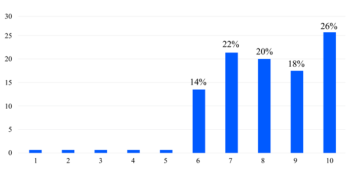
Figure 3: User NPS score results.
do not know whether to cross the road (Deb, S. et al., 2018). The combina- tion of text and graphics can improve the interactive comfort of pedestrians and improve cognitive efficiency.
Design Evaluation In order to improve the interface design of this time, it is necessary to conduct a user feedback test on the degree of achievement of user demand elements. In this test, the 50 members of the expert group mentioned above were invited to conduct a satisfaction test for the degree of achievement of the design demands. Taking the NPS value as the scoring standard, the horizontal axis is the score, and the vertical axis is the number of people (see Figure 3). The total NPS score is 30 after statistics, indicating that this scheme is a successful design practice.
CONCLUSION
Based on the AHP, this paper explores and studies the external human- machine interface for automated vehicles, mainly through the process of case analysis, user research, demand analysis, weight calculation, etc., and finally carries out the design practice with the user needs as the leading factor. This study improves the usability and user satisfaction of the design to a certain extent, and the study method and process provide a certain degree of refere- nce for the field. Due to the subjective evaluation test and the limited number of subjects in this study, there are certain limitations and deficiencies. In the future, we will consider combining advanced technology and more scientific methods to further study the external human-machine interface.
REFERENCES
Deb, S., Strawderman, L. J., & Carruth, D. W. (2018). Investigating pedestrian suggestions for external features on fully autonomous vehicles: A virtual reality experiment. Transportation research part F: traffic psychology and behaviour, 59, 135–149. Kandil, F. I., Olk, B., & Hilgetag, C. C. (2017). Female vs. Male Ampelmännchen-
gender-specific reaction times to male and female traffic light figures. Frontiers in Psychology, 8, 690. Lagström, T., & Malmsten Lundgren, V. (2016). AVIP-Autonomous vehicles’ interaction with pedestrians-An investigation of pedestrian-driver communication and development of a vehicle external interface (Master’s thesis).
External Human-Machine Interface Design 43
Li L. P. , & Guo X. Y. (2020). eHMI Design for Automated Vehicles. Packaging Engineering, 41(2), 8. Sirisawat, P., & Kiatcharoenpol, T. (2018). Fuzzy AHP-TOPSIS approaches to priori-
tizing solutions for reverse logistics barriers. Computers & Industrial Engineering, 117, 303–318. Snyder J B. (Sep 16, 2016) This Self-driving Car Smiles at Pedestrians. The Website: https://www.autoblog.com/2016/09/16/this-self-driving-car-smiles- at-pedestrians/. Tan, H. , & Zhao, Y. .(2018). Peripheral interactive experience in intelligent vehicle.
Packaging Engineering, 2018, 39(16): 1–4. Tang, L. , Chang, Y. , & Wang, Z. R. (2019). Modeling design of the elderly fitness equipment based on qfd and ahp. Packaging Engineering, 40(24): 199–204. Wu, C. Z. , Wu, H. R. , & Lyu, N. C. (2018). Review of control switch and
safety of human-computer driving intelligent vehicle. Journal of Transportation Engineering, 18(6): 135–145.
LISTED IN THE AHFE DIGITAL BOOKSTORE CATALOGUE
Explore the complete digital volume
Usability and User Experience
Read this individual research paper free through the original publisher, or explore the full digital proceedings book.
ISBN 978-1-958651-15-5
Explore this ISBN in the AHFE Bookstore ↗Listed in the July 2026 bookstore catalogue; search by ISBN to confirm current availability · Digital book purchase optional