The main concern in many warehouse management systems is to arrange picking strategies for only time and cost considerations. However, the central operation in warehouse systems is order picking which involves highly physical load due to lifting and handling works. Therefore, load balance should be an integral part of order-picking planning strategies for a successful warehouse management system. This study focuses on determining order picking strategy by assigning orders to the pickers to minimize load imbalance and the total cost of order-picking operations. Ergonomic risk values of picking orders from the shelves are obtained by digital human modeling (DHM) via JACK software. The values for the ergonomic risk of the orders are then used to determine the load of each picker based on the assigned orders. The study is conducted in a warehouse working as a retailer of furniture and home decoration items. The main point of the study is to observe the ergonomic risks in terms of lower back compression force (LBCF) and integrate the results of ergonomic risks into a bi-objective mathematical model to determine an optimal order-picking strategy. The developed bi-objective model solves the order assignment with minimum picking cost and minimum imbalance ergonomic load among pickers. The study evaluates different order assignment strategies such as first come first serve (FCFS), highest ergonomic load order (HELO), lowest ergonomic load order (LELO), longest picking time order (LPTO), and shortest picking time order (SPTO). The results are used to construct a non-dominated set of solution alternatives in order to observe the impact of the order assignment strategy on the objective functions. The developed quantitative approach is used to evaluate the current strategy (FCFS) and compare it with the alternative strategies (HELO, LELO, LPTO, and SPTO). Finally, the suggestions for implementing the real-life numerical case are presented.
Most of the warehouse processes rely on human workers and the manage- ment activities of the human worker related issues. The main driver of the efficiency in a warehouse system is dependent on how to execute order pick- ing processes. Order picking is one of the most energy-demanding tasks among all the others for logistics and warehouse systems. The task is mostly
labour intensive and acquires many awkward lifting postures and heavy loads. The nature of the task is a crucial factor for many work-related muscu- loskeletal disorders which cause managerial issues such as absenteeism, lack of attention, low performance, and longer rest time requirements as well, if not considered in the order-picking planning process.
Order picking processes are categorized as picker–to–part or part–to– picker systems. Picker-to-part systems are more conventional order picking processes and they mostly rely on human effort since pickers travel between shelves to pick items from their locations. Part-to-picker systems are more automated and travelling between shelves to pick the items are handled by automated guided systems to be collected in a common drop point for sort- ing by human workers. Picker-to-part systems are still dominant in industry (Battini, D., et al., 2016). The four order picking planning problems are order batching, picker assignment, batch sequencing, and picker routing in a picker- to-parts system. In common practice of order picking planning, first, the customer orders are combined into batches, next, the batches are assigned to available pickers. Other problems to complete a typical order picking plan are determining the sequence of batches for each picker and defining the sequence of storage locations to visit for each batch to retrieve all orders assigned to a batch (Cao Z., et al., 2023).
Numerous research studies have investigated the relationship between order picking and ergonomic risks. For instance, Kee et al. (2020) showed the evaluation of ergonomic risks using REBA (Rapid Entire Body Assessment) and RULA (Rapid Upper Limb Assessment). RULA is a tool that evaluates the ergonomic risks associated with upper limb tasks, while, REBA is a whole- body ergonomic assessment tool. Both methods are posture-based ergonomic assessment tools. The study revealed that the most significant ergonomic risks during order picking operations were related to manual handling, awkward postures, and repetitive motions. The authors suggested that the implemen- tation of ergonomic interventions could reduce the ergonomic risks and improve workers’ health and well-being. Choobineh et al. (2004) presented a study for the Iranian hand-woven carpet industry in which musculoskeletal symptoms are evaluated, and general guidelines for workstation design are provided. The study showed that prolonged sitting and standing, repetitive movements, and awkward postures were significant ergonomic risks. Weston et al. (2020) stated that psychophysical and physiological measurements to assess postural load are the most common techniques, however, they recom- mended an approach from a biomechanical perspective. This study found that workers experienced high postural loads, particularly during lifting and reaching tasks, and suggested that ergonomic interventions such as optimiz- ing shelf heights and reducing task duration could reduce these loads and improve worker well-being. Lavender et al. (2021) conducted a case study in a distribution center to evaluate ergonomics in order picking. Lavender et al. (2021) showed that the most significant ergonomic risks were related to postures, forces, and repetitive motions, and suggested that ergonomic interventions such as improving storage systems and providing training on proper lifting techniques could reduce these risks and improve worker health and safety.
A Bi-Objective Approach for Determining Optimal Order Picking Planning Strategy 727
This study has a focus on the picker-to-part order picking systems in which it is critical to balance the ergonomic load among the pickers. The physical load in order assignment to the pickers can cause overexertion if it is not bal- anced among the pickers. The pickers who are responsible for collecting the orders in a typical warehouse design are exposed to ergonomic risks due to the highly frequent lifting of heavy and moderate-heavy items with poor cou- plings. Two joint problems as ergonomic risk evaluation using digital human modelling (DHM) and optimal order picking planning for assigning orders to pickers are taken into consideration in this study. Tecnomatix JACK is used to evaluate ergonomic risk in order picking, it is a DHM software developed by Siemens Digital Industries Software. It is used to simulate and analyse human ergonomics and biomechanics in a virtual environment. The JACK software has many ergonomic risk analysis tools and most common one for lifting and material handling tasks is lower back analysis tool. Lower back analy- sis tool measures the risk in terms of lower back compression force (LBCF) value. Ergonomic risk values are obtained by comparing the lower back anal- ysis results of the DHM with the (National Institute for Occupational Safety and Health) NIOSH lifting threshold value for the lower back compression force (LBCF). The values are then fed to the mathematical model to measure ergonomic load of each picker based on the assigned orders. The model devel- oped in this study has bi-objective function of minimizing cost of picking and minimizing ergonomic load imbalance among the pickers.
The rest of the paper is organized as follows; next section describes the methodology and problem, the results for a numerical example of the case problem is provided in another section and finally the study is concluded in the last section.
PROBLEM DEFINITION AND METHODOLGY The order-picking with ergonomic risk evaluation problem refers to the chal- lenge of finding an optimal solution to minimizing cost, time and distance along with providing ergonomic design of work conditions to the pickers. The problem can be varied based on the limitations or specific requirements of the work place and the distribution system.
The order-picking problem can also be complicated by various factors, such as the layout of the warehouse, the availability of inventory, the num- ber and complexity of orders, and the skills and capabilities of the workers. Ergonomic risks associated with order picking can also impact the efficiency and safety of the process. Therefore, optimizing the order-picking process requires a careful consideration of these factors to develop efficient, safe, and cost-effective solutions.
This study specifically addresses a problem in which pickers are assigned with orders in terms of different prioritization strategies and they picked the items from the shelves in a short distance walking span, so there is no particu- lar routing plan is generated for them. Simply the distance of traveling due to the routing is negligible. However, the load of ergonomic risk might be imbal- anced among the pickers due to the difference between components in terms of weight, height of the shelves and the frequency of lifting required. The
728 R. Ozdemir
prioritization strategy employed currently is FCFS (Firs Come First Serve) rule in which the customer order arrived first is assigned to the first available picker and this strategy does not consider the load of ergonomic risk distri- bution among the pickers. In this study, several other strategies are developed as follows:
1. Highest ergonomic load order (HELO) in which the customer orders with the minimum ergonomic load is assigned to the picker with the highest cumulative ergonomic load. 2. Lowest ergonomic load order (LELO) in which the first arrived customer order is assigned to the picker with the lowest cumulative ergonomic load. 3. Longest picking time order (LPTO) in which the customer order with the longest picking time is assigned to the first available picker. 4. Shortest picking time order (SPTO) in which the customer order with the shortest picking time is assigned to the first available picker.
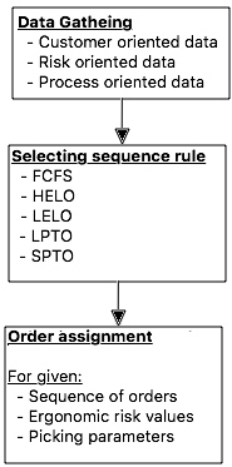
The strategies 1 and 2 are for investigating the ergonomic load balance among the pickers, while last two strategies 3 and 4 are for investigating the effect of time consideration in priority on cost effectiveness. The order picking process is essential for customer satisfaction since the delivery time is mostly dependent of the picking process time. The approach used in this study to incorporate prioritization strategy along with the order assignment is represented in Figure 1.
Figure 1: Flowchart of the order assignment with ergonomic risk evaluation approach.
As seen in the above given figure, after data collection the customer orders are sequenced based on the selected priority rule and then they are fed into the order assignment model to be picked in the given order.
A Bi-Objective Approach for Determining Optimal Order Picking Planning Strategy 729
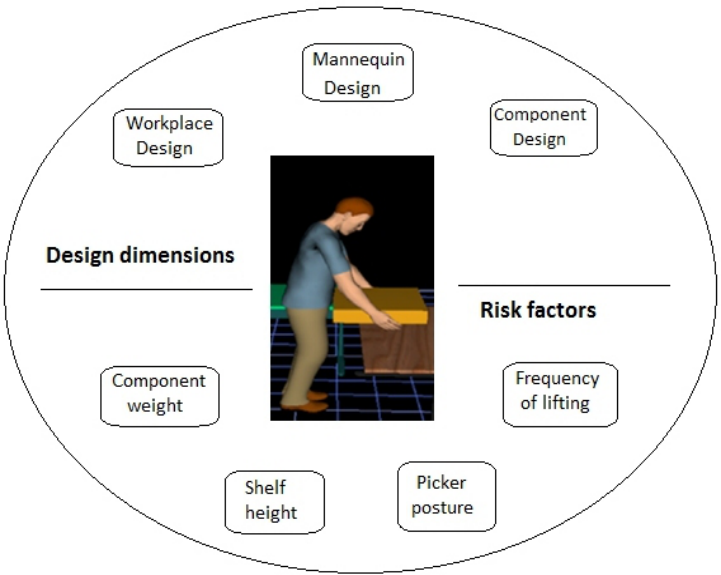
ERGONOMIC RISK EVALUATION USING DHM The proposed approach integrates two joint problems of ergonomic risk eval- uation for manual material handling for order picking process and order assignment to pickers. The problem of ergonomic risk evaluation is modelled by using JACK software which is a well-known DHM software to simulate the musculoskeletal disorder risk virtually for a variety postures, workplace, worker and component designs. The model is developed according to deter- mination of settings for design dimensions and risk factors that affect the ergonomic load analysis results. Lower back analysis is suited most from among the several others in the JACK for the evaluation of ergonomic risk of order picking process. The figure below is for illustrating the model structure for obtaining ergonomic risk values to be incorporated in order assignment model.
Figure 2: The Jack simulation modelling structure for ergonomic risk assessment.
As seen in Figure 2, the Jack simulation modelling requires that a work- place, mannequin, and component design should be constructed based on the system limitations. The structural elements are variable if a different anthro- pometric scale is needed for the picker or a component has a different size or coupling design or the height of the shelf is different for the picking point. The same structure with the work place mannequin and component design is used to simulate the ergonomic risk for all orders. However, the results of the risk analysis are also dependent of the risk factors which vary for every
730 R. Ozdemir
customer order. In each customer order, the items to be picked have differ- ent weights, quantities, locations and positions on the shelves. These features are related to the risk factors of the order picking ergonomics loads for the picker. The location and position on the shelf of the item are associated with the factors of shelf height and picker posture while picking the item. Quan- tity is related to the frequency of the lifting. The JACK simulation software measure the risk in terms of lower back compression values and resulting val- ues are shown in N. However, to incorporate into the mathematical model, these values are converted into risk values without unit by comparing with the NIOSH threshold value. The results are used as parameter for the objec- tive function and the picker ergonomic loads are balanced while minimizing the cost of picking.
Order Assignment Model The model developed in this study has a bi-objective function in which pick- ing cost is minimized and total ergonomic load imbalance is minimized. The model parameters are obtained from direct measurement in the warehouse and using the JACK simulation software. The model developed to solve the order picking assignment problem with ergonomic risk evaluation is given as follows:
Notation through the model is given as j,k picker index i order index ci total cost associated with picking order i co additional premium paid for every overtime introduced ti total time of traveling and material handling for picking order i ervi ergonomic risk value associated with picking order i (this value is obtained by using JACK software at available time in the period OTj overtime required for picker j ERj accumulated lifting risk levels assigned to picker j. ERjk+ positive lifting risk difference between picker j and worker k. ERjk- negative lifting risk difference between picker j and worker k
Equations and mathematical formulas are available in the original paper PDF.
COSTmax z1 of the solution with w1 = 0, w2 = 1, (Upper bound of the picking cost value). COSTmin z1 of the solution with w1 = 1, w2 = 0, (Lower bound of the
picking cost value). ERGOmax z2 of the solution with w1 = 1, w2 = 0, (Upper bound of the ergonomic risk imbalance value). ERGOmin z2 of the solution with w1 = 0, w2 = 1, (Lower bound of the ergonomic risk imbalance value). Objective function is given as
+ w2
z1 −COSTmin COSTmax −COSTmin
z2 −ERGOmin ERGOmax −ERGOmin
A Bi-Objective Approach for Determining Optimal Order Picking Planning Strategy 731
Objective function aims to minimize weighted sum of normalized total picking cost and normalized total imbalanced ergonomic risk value. The actual values of z1 (objective function associated with total picking cost) and z2 (objective function associated with ergonomic risk imbalance among the pickers) are given below.
X
X
X
co OTj
ciXij + i j j
Objective function value of z1 equals to the sum of total cost of picking all orders arrived in the period and total overtime cost for all pickers required if regular available time is not sufficient for picking all orders arrived in the period.
m X
m X
ER+
jk + ER− jk
Objective function value of z2 equals to the sum of positive and nega- tive ergonomic load deviations among the pickers which represents the total ergonomic imbalanced load value in the period. The constraint sets for the model are as given below.
The constraint sets given in the equation above ensures that each order should be assigned to a picker. However, each picker can be assigned more than one order in the period as long as the cumulative picking time for each picker is within the total available picking time of the picker.
The constraint sets given in the equation above ensures that accumulated picking time of all orders assigned to a picker should be less than or equal to the total available time of the picker. Total available time of each picker is sum of regular available time and overtime introduced for the picker.
The constraint sets given in the equation above shows that total available picking time for a picker equals to the regular available time which is constant for all pickers in the period plus the overtime introduced for the picker which causes additional cost.
The constraint sets given in the equation above shows that ergonomic risk value of the orders assigned to a picker are summed to obtain accumulated ergonomic load of the picker.
732 R. Ozdemir
jk, ∀j, k
jk −ER−
The constraint sets given in the equation above shows that the difference of ergonomic load between two pickers should be equal to either positive ergonomic load deviation or negative ergonomic load deviation.
ERj, ER+
jk, ER−
The equations given above define the decision variables of the order picking assignment model.
NUMERICAL RESULTS OF THE CASE PROBLEM The entire approach is implemented in a warehouse working as a retailer of home decoration items, the order picking process is executed for each individual customer with a provided counter queue number. There are four counters and each counter is occupied by a picker one at a time to serve the customer in sequence. Once order is received, the picker is collecting all the items in the list and deliver back to the customer. The storage locations of all items are in an area of 90 m x 30 m, the traveling time and picking time of each order is calculated and input to the model as total picking time of the order. Ergonomic risk value of each order is also calculated based on the JACK software LBCF results. The sample data presented in Table 1 were selected from a one hour time window of customer order processing.
The JACK software is executed for each component and workplace design category to obtain LBCF results then these results are compared to NIOSH threshold value for LBCF (6400 N) to calculate risk values for each item. Risk values are then used in the mathematical model to represent ergonomic load of the pickers. The results of mathematical model for FCFS is represented in Table 2.
A Bi-Objective Approach for Determining Optimal Order Picking Planning Strategy 733
Table 2. Results of the order assignment model for various weight values of objectives.
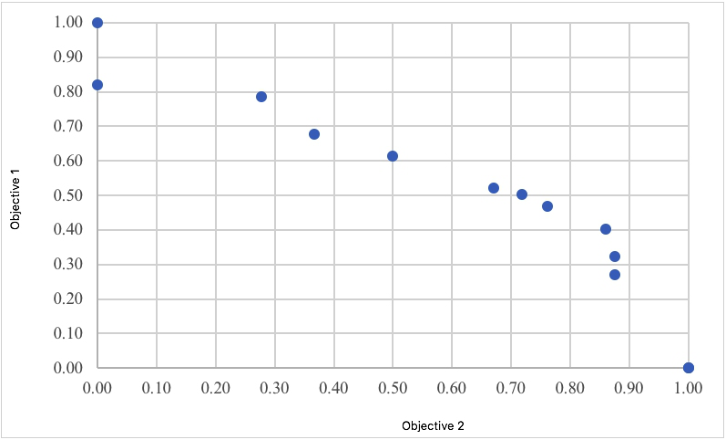
The weight values for objectives are changed to obtain all possible solu- tions and non-dominated set of the solutions are represented in the above given table. These solutions for all weight combinations (w1 and w2) between 0.00 to 1.00 are also illustrated in Figure 3.
Figure 3: Non-dominated solutions set of the bi-objective order assignment model.
The resulting criterion vector Z(x) is said to be non-dominated. The solu- tions are generated by changing the weights of the objective functions with 0.01 increments to evaluate all possible solution alternatives between two subsequent non-dominated solution sets.
734 R. Ozdemir
CONCLUSION
This study has addressed the joint problems of order picking assignment and ergonomic risk evaluation to create a human oriented plan for the ware- house management. The ergonomic risk evaluation is conducted by using JACK software (DHM for lower back analysis) and risk values are deter- mined through a comparison with NIOSH lower back compression force standard value. The results of DHM are then used in a bi-objective mathe- matical model to solve the problems of order assignment with ergonomic risk evaluation optimally for given weights of objectives.
The proposed approach is solved for different order sequences based on priority strategies namely FCFS (first come first serve), HELO (highest ergonomic load order), LELO (lowest ergonomic load order), LPTO (longest picking time order) and SPTO (longest picking time order) developed for the case problem. The developed model is solved for each order sequence to observe the effect of customer orders on the performance of order picking process in terms of cost and ergonomic load imbalance among pickers.
The results showed that the warehouse management can be improved for ergonomic load issues even for current order sequence strategy (FCFS). The work can be improved by considering fuzzy modelling in ergonomic risk evaluation problem since the results are mostly based on imprecise data.
REFERENCES
Battini, D., Glock, C. H., Grosse, E. H., Persona, A., & Sgarbossa, F. (2016).
Human energy expenditure in order picking storage assignment: A bi-objective method. Computers & Industrial Engineering, 94, 147–157. Cao, Z., Zhou, L., Lin, C., & Zhou, M. (2023). Solving an order batching, picker assignment, batch sequencing and picker routing problem via information integration. Journal of Industrial Information Integration, 31, 100414. Choobineh, A., Lahmi, M., Shahnavaz, H., & Jazani, R. K. (2004). Musculoskele-
tal symptoms as related to ergonomic factors in Iranian hand-woven carpet industry and general guidelines for workstation design. International Journal of Occupational Safety and Ergonomics, 10(2), 157–168. Kee, D., Na, S., & Chung, M. K. (2020). Comparison of the Ovako working posture analysis system, rapid upper limb assessment, and rapid entire body assess- ment based on the maximum holding times. International Journal of Industrial Ergonomics, 77, 102943. Lavender, S. A., Sun, C., Xu, Y., & Sommerich, C. M. (2021). Ergonomic con-
siderations when slotting piece-pick operations in distribution centers. Applied ergonomics, 97, 103554. Weston, E. B., Dufour, J. S., Lu, M. L., & Marras, W. S. (2020). Spinal loading and lift style in confined vertical space. Applied Ergonomics, 84, 103021.
Read this individual research paper free through the original publisher, or explore the full digital proceedings book.
ISBN 978-1-958651-87-2
Explore this ISBN in the AHFE Bookstore ↗Listed in the July 2026 bookstore catalogue; search by ISBN to confirm current availability · Digital book purchase optional