Jundong Pei, Yuanming Lv, Can Yang, Pengyu Chen, Huimin Hu, Junmin Du (2026). A Methodological Framework for Upper-Limb Comfort Reachability Modeling Using Biomechanical Simulation and Point-Cloud Representation. In: Physical Ergonomics and Human Factors. AHFE Open Access, vol. 223, pp. 77–84. https://doi.org/10.54941/ahfe1007798
Modeling upper-limb comfort reachability is a fundamental task for ergonomic analysis and human–machine interface layout in transportation systems. Existing approaches often rely on simplified geometric assumptions or static anthropometric rules, limiting their ability to represent the continuous three-dimensional structure of comfort reach space and its variability across individuals. This study proposes a data-driven framework that integrates biomechanical simulation, point-cloud representation, and anthropometric parameterization to construct individualized upper-limb comfort reachability envelopes. An upper-limb musculoskeletal model is established in an open-source simulation platform to represent multi-degree-of-freedom motions of the shoulder, elbow, and wrist. Comfort criteria are defined by constraining joint excursions within specified proportions of physiological ranges. Joint configurations within admissible comfort ranges are sampled, and forward kinematics is applied to compute endpoint positions, generating a three-dimensional point-cloud representation of the comfort reach envelope. The proposed framework enables continuous, scalable, and individualized modeling of comfort reachability, supporting ergonomic assessment and human–machine interface design in transportation systems.
Upper-limb comfort reachability is a fundamental concern in ergonomic analysis and human–machine interface layout for transportation systems, including vehicle interiors, cockpits, and control workstations. Comfort reachability refers to the spatial region within which operators can interact with controls under comfortable joint configurations and postural conditions. Operating outside such configurations has been associated with increased fatigue, reduced task efficiency, and elevated long-term musculoskeletal
risk. Comfort reachability therefore provides an ergonomically meaningful spatial descriptor for evaluating whether controls can be accessed under joint conditions that support stable and sustainable operation.
Early reachability modeling approaches primarily relied on analytical formulations or population-based anthropometric data, and were typically limited to planar sections or simplified geometric boundaries (Alvarez and Miralles, 2015, 2018). While effective for estimating maximum or task- feasible reachability, these approaches are not well suited for representing comfort-oriented reachability, its continuous three-dimensional structure, or its dependence on individual anthropometry. Posture strongly affects upper- limb functional space (Chen et al., 2025), providing a basis for understanding comfort-oriented reachability in ergonomic design. Experimental studies further examined reachability under different postures and task conditions (Clement et al., 2018; McKinnon et al., 2022), but such measurements are typically sparse, difficult to generalize, and rarely formulated explicitly in terms of joint-level comfort constraints.
Recent advances in biomechanical simulation and digital human modeling have highlighted the importance of spatially continuous representations for evaluating reach demands in complex transportation environments (Castro et al., 2019; Geng et al., 2022). Learning-based and spatial data– driven approaches have also been suggested as promising alternatives when anthropometric variability must be considered (Averta et al., 2017; Liu et al., 2023). Nevertheless, a systematic formulation of comfort reachability grounded in joint-level biomechanical constraints and adaptable to individual anthropometry remains limited.
To address these gaps, this study proposes an integrated, data-driven methodological framework for modeling upper-limb comfort reachability by combining biomechanical simulation, joint-level comfort constraints, anthropometric parameterization, and spatial sampling with point-cloud representation. An upper-limb musculoskeletal model is constructed within an open-source biomechanical platform to represent the multi-degree-of- freedom motions of the shoulder, elbow, forearm, and wrist. Comfort criteria are defined by constraining joint excursions within specified proportions of physiological ranges. Discrete joint-angle combinations within admissible comfort ranges are sampled, and forward kinematics is applied to compute endpoint positions, generating a point-cloud representation of the comfort reach envelope. Comfort reachability is explicitly distinguished from maximum functional and maximum physical reachability, and represented as a continuous three-dimensional spatial envelope adaptable to individual anthropometry.
METHODOLOGICAL FRAMEWORK FOR UPPER-LIMB COMFORT REACHABILITY MODELING Framework Overview
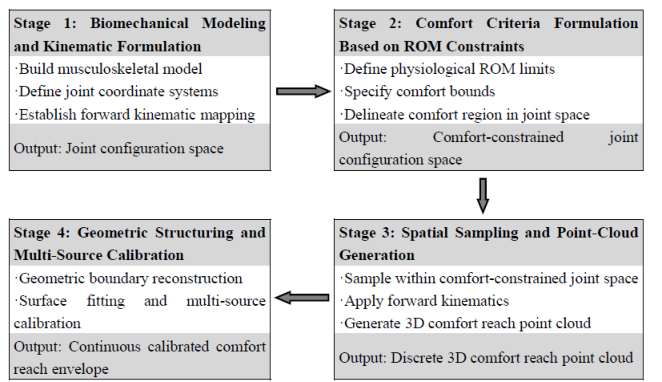
The proposed framework consists of four sequential modules (see Figure 1) : (i) biomechanical definition of upper-limb kinematics, (ii) formulation of comfort criteria using joint range-of-motion (ROM) constraints, (iii) spatial sampling
A Methodological Framework for Upper-Limb Comfort Reachability Modeling 79 and point-cloud generation, and (iv) geometric structuring and multi-source calibration. First, a musculoskeletal model is constructed in a biomechanical platform, establishing forward kinematic mapping from joint to task space. Second, joint-level comfort constraints are defined based on physiological ranges, delineating a comfort region in the joint configuration space. Third, discrete sampling is performed within the comfort-constrained joint space, and forward kinematics is applied to generate a three-dimensional point cloud representing the comfort reach envelope. Finally, geometric structuring and multi-source calibration are performed to convert the sampled point cloud into a continuous and calibrated spatial envelope, ensuring consistency with empirical data while maintaining the underlying biomechanical constraints and interpretability.
Figure 1: Methodological framework for upper-limb comfort reachability modeling.
Biomechanical Definition of Upper-Limb Kinematics The human upper limb exhibits a wide range of motion enabled by the coordinated structure of the pectoral girdle and free limb segments. The pectoral girdle consists of the scapula and clavicle, while the free limb includes the humerus, radius, ulna, wrist, and hand bones. Through the combined action of multiple joints, the upper limb supports both large-amplitude reaching motions and fine manipulation tasks.
Based on these anatomical characteristics, a subject-representative right upper- limb musculoskeletal model was constructed using the OpenSim simulation platform. The model explicitly represents the multi-degree-of-freedom motions of the shoulder, elbow, forearm, and wrist, providing a biomechanically interpretable foundation for subsequent comfort reachability modeling. The model incorporates seven rotational degrees of freedom: three at the shoulder, one at the elbow, one for forearm rotation, and two at the wrist.
A consistent set of joint coordinate systems was defined for all skeletal segments. For this quasi-static analysis, the sternum was selected as the global reference frame. Forward kinematics was formulated using a serial kinematic
chain representation, where each joint connects proximal and distal segments through anatomically defined rotation axes.The three-dimensional position of the hand endpoint was computed by placing a virtual marker at the distal end of the index finger and propagating joint rotations along the kinematic chain. Repeating this computation across all admissible joint configurations yields a set of reachable endpoint positions, which forms the kinematic basis for subsequent steps.
Anthropometric parameters describing upper-limb segment lengths, segment masses, and center-of-mass locations are incorporated into the model to account for inter-individual variability. Specifically, percentile-based anthropometric data of Chinese adults are used to determine segment lengths (e.g., upper arm, forearm, and hand), which are applied to scale the musculoskeletal model in OpenSim using a linear scaling approach based on measured-to-model length ratios. In addition, segment mass distributions and corresponding center-of- mass positions are assigned according to biomechanical statistics, enabling the model to reflect both geometric and inertial differences across individuals of different body sizes and percentiles.
Formulation of Comfort Criteria Using Joint ROM Constraints Comfort reachability is defined here as the subset of upper-limb configurations achievable within joint ranges associated with stable, sustainable, and ergonomically favorable operation. Rather than treating comfort as a purely geometric property in Cartesian space, the proposed framework formulates these comfort criteria explicitly in joint space, where biomechanical admissibility and physiological constraints can be directly represented.
For each degree of freedom, a predefined comfort sub-range is specified within the full physiological ROM. The full ROM is determined according to anatomical references and OpenSim model settings. A selected proportion of this range (e.g., 70%) is then adopted to represent the comfort interval. This proportion can be adjusted depending on operational requirements and design objectives.
For example, shoulder internal–external rotation can be defined within a physiological range (e.g., −60° to 90°), with the sign convention determined by the right-hand rule: internal rotation is positive and external rotation is negative. A reduced proportion of this interval is then selected as the admissible comfort range. Similar proportional bounds are defined for all remaining joint motions.
Comfort constraints are applied independently across all seven degrees of freedom. Shoulder flexion–extension, abduction–adduction, and internal– external rotation are constrained separately. The elbow is constrained in flexion–extension, forearm rotation is bounded at the radioulnar joint, and wrist flexion–extension and radial–ulnar deviation are restricted to zones that maintain proximity to neutral posture. Collectively, these joint-level constraints define a multidimensional comfort region in joint configuration space.
Although functional tasks may involve joint coupling and compensatory patterns, explicit coupling relationships are not imposed in this framework. The objective is to characterize the spatial extent of comfort reachability
A Methodological Framework for Upper-Limb Comfort Reachability Modeling 81 under posture-defined constraints rather than reproduce specific movement trajectories. Joint redundancy is therefore implicitly represented through admissible configuration sampling within the defined comfort region.
Spatial Sampling and Point-Cloud Generation With the biomechanical model and joint-level comfort constraints established, comfort reachability is generated through discrete sampling in joint configuration space and mapping into Cartesian (task) space via forward kinematics, producing an intuitive comfort reachability model for engineering design and ergonomic evaluation.
Discrete sampling is performed independently across all seven degrees of freedom within their defined comfort intervals. All admissible joint- angle combinations are traversed at specified angular increments. For each sampled configuration, the three-dimensional position of the hand endpoint is computed and expressed in a shoulder-centered coordinate system.
The aggregation of all computed endpoint positions forms a three- dimensional point cloud representing the spatial extent of comfort reachability. Because the envelope is generated directly from admissible joint configurations, it inherently excludes ergonomically unfavorable postures while preserving kinematic redundancy. Multiple joint configurations may map to overlapping spatial locations, reflecting the redundancy of the human upper limb.
Anthropometric data directly influences the geometry of the resulting point cloud. Variations in segment length and proportional relationships systematically affect envelope size and spatial distribution, enabling individualized comfort reach modeling within a unified computational structure.
Geometric Representation and Calibration Using Multi-Source Data Following joint-space sampling and point-cloud generation, an additional processing stage is required to transform the discrete spatial representation into a structured envelope suitable for ergonomic evaluation. While the raw point cloud captures admissible comfort configurations, further geometric organization improves interpretability and facilitates practical application.
The first step is to extract the outer boundary of the comfort-reachable region from the sampled endpoint distribution. Surface reconstruction techniques, such as boundary extraction algorithms (e.g., Alpha Shapes), are applied to the point cloud to identify the spatial envelope that encloses the sampled points while preserving potential non-convex characteristics arising from joint-level constraints. Unlike simplified analytical reach models that assume spherical or ellipsoidal boundaries, the reconstructed envelope directly reflects biomechanical feasibility and the resolution of the sampling process.
To enhance realism and reduce potential model bias, a multi-source calibration strategy is introduced. Empirical data—either collected through targeted experiments or obtained from published studies on comfort-based reachability—are used to adjust the reconstructed envelope. These data typically consist of measured reachable positions under comfort-defined
conditions. By comparing model-generated results with such empirical observations, the envelope can be calibrated to improve agreement with real-world behavior. Calibration may involve global scaling adjustments or localized geometric refinements, depending on the availability, density, and distribution of the reference data.
Through geometric structuring and calibration, the comfort reachability representation evolves from a discrete computational output into a continuous, empirically aligned spatial envelope. This final representation supports integration into ergonomic assessment workflows, digital human simulation platforms, and control layout evaluation processes.
Validation Method and Evaluation Criteria To support practical implementation and ensure methodological reliability, the proposed framework can be evaluated using a set of quantitative validation criteria.
First, geometric consistency is assessed by comparing model-generated reach envelopes with reference point sets using point-set discrepancy measures such as the Chamfer distance. This metric evaluates the average bidirectional distance between two point clouds and reflects boundary-level agreement.
Second, spatial agreement is quantified using the root-mean-square (RMS) positional error after rigid or similarity alignment. This measure captures the overall deviation between reconstructed and reference reach envelopes in a common coordinate frame.
Third, for individualized modeling scenarios, scale consistency is examined to evaluate whether the reconstructed envelope preserves subject-specific anthropometric proportions. This can be assessed by comparing characteristic dimensions (e.g., maximum reach extent or segment-based scaling ratios) between the modeled and reference envelopes.
Reference data for validation may be obtained from controlled reachability experiments, published datasets, or implementation-oriented digital human models, where both anthropometric inputs and corresponding reach envelopes are available for direct comparison.
Together, these criteria provide a structured and practical basis for evaluating the accuracy, robustness, and applicability of the proposed framework in ergonomic design contexts.
DISCUSSION
Compared with analytical or percentile-based reach models, the proposed framework establishes a more explicit linkage between biomechanical admissibility and spatial envelope generation. Its primary contribution lies not only in producing a three-dimensional reach boundary, but in formalizing a modeling paradigm in which comfort is first defined in joint configuration space and subsequently mapped into a geometrically interpretable representation in task space.
A Methodological Framework for Upper-Limb Comfort Reachability Modeling 83 Preliminary implementation results further demonstrate the computational feasibility of the framework. In an internal workflow, comfort-reach point clouds were standardized into a unified geometric representation to support comparison and reconstruction. Quantitative evaluation based on geometric discrepancy, alignment-based RMS error, and scale consistency indicates that the framework can achieve stable and interpretable outputs. These findings suggest that the approach can be extended beyond conceptual modeling toward subject-specific prediction and interactive ergonomic assessment applications.
From an application perspective, the framework is particularly relevant to transportation-related scenarios, including cockpit control layout, vehicle interior interface design, and maintenance workstation planning. In cockpit environments, the modeled comfort envelope can help distinguish frequently accessed controls from secondary elements. In vehicle interiors, it supports the placement of touchscreens and manual interfaces for users with varying anthropometric characteristics. In maintenance contexts, it enables identification of regions associated with excessive reach demand, which may contribute to fatigue and reduced operational efficiency.
Despite these advantages, the current framework does not explicitly account for dynamic movement strategies or inter-joint coordination patterns, which may influence reach behavior in real tasks. Future work will focus on integrating motion-dependent constraints and experimental validation to further enhance model fidelity and applicability.
CONCLUSION
This paper proposed a methodological framework for modeling upper-limb comfort reachability by integrating biomechanical simulation, joint-level comfort constraints, spatial sampling, geometric structuring, and calibration. Within this framework, comfort reachability is defined in joint configuration space and subsequently mapped into Cartesian space, resulting in a continuous and calibrated three-dimensional spatial envelope grounded in biomechanical constraints. In addition, a validation perspective is established based on geometric consistency, alignment-based spatial error, and scale recovery, providing a basis for implementation-oriented assessment of the proposed approach. The resulting representation supports transportation- related ergonomic applications, including control layout evaluation, virtual prototyping, and digital human simulation, providing a practical approach for incorporating comfort-oriented reach analysis into human–machine interface design.
ACKNOWLEDGMENT
This research was supported by the National Key Research and Development Program of China (2023YFF0615902), the Science and Technology Plan Program of the State Administration for Market Regulation (2023MK192), and the Fundamental Research Funds for the Central Institutes (522023Y-10381).
REFERENCES
Alvarez, A. and Miralles, D. (2015). Postural analysis and workspace design using an analytically derived inverse kinematics model. Theoretical Issues in Ergonomics Science, 16(2), 187–200. Alvarez, A. and Miralles, D. (2018). Toward a statistical model of the maximum
reach in the sagittal plane in sitting and standing positions: Estimating the 5th percentile reach using anthropometric data. International Journal of Industrial Ergonomics, 67, 210–215. Averta, G., Della Santina, C., Battaglia, E., Felici, F., Bianchi, M. and Bicchi, A.
(2017). Unveiling the principal modes of human upper limb movements through functional analysis. Frontiers in Robotics and AI, 4, 37. Castro, M.N., Rasmussen, J., Bai, S. and Andersen, M.S. (2019). The reachable 3-D workspace volume is a measure of payload and body-mass-index: A quasi-static kinetic assessment. Applied Ergonomics, 75, 108–119. Chen, P., Padun, Y., Yang, C., Hu, H. and Du, J. (2025). Exploring the impact of factors
on upper limb functional space and operational efficiency: A theoretical analysis. Advances in Human Factors of Transportation. AHFE 2025, Vol. 186, 98–106. Clement, J., Raison, M. and Rouleau, D.M. (2018). Reproducibility analysis of upper limbs reachable workspace, and effects of acquisition protocol, sex, and hand dominancy. Journal of Biomechanics, 68, 58–64. Geng, J., Li, Y., Guo, H., Zhang, H. and Lv, C. (2022). Spatial data-based automatic
and quantitative approach in analyzing maintenance reachability. Applied Sciences, 12(24), 12804. Liu, Y., Zhang, W., Cheng, Q. and Ming, D. (2023). Efficient reachable workspace division under concurrent task for human–robot collaboration systems. Applied Sciences, 13(4), 2547. McKinnon, C.D., Sonne, M.W. and Keir, P.J. (2022). Assessment of joint angle and
reach envelope demands using a video-based physical demands description tool. Human Factors, 64(3), 568–578.
LISTED IN THE AHFE DIGITAL BOOKSTORE CATALOGUE
Explore the complete digital volume
Physical Ergonomics and Human Factors
Read this individual research paper free through the original publisher, or explore the full digital proceedings book.
ISBN 978-1-964867-99-1
Explore this ISBN in the AHFE Bookstore ↗Listed in the July 2026 bookstore catalogue; search by ISBN to confirm current availability · Digital book purchase optional