Huimin Hu, Anna Hao, Ling Luo, Wenlei Niu, Jianglan Chen (2023). Analysis of children's sitting posture status and influencing factors. In: Ergonomics In Design. AHFE Open Access, vol. 77, pp. 495–500. https://doi.org/10.54941/ahfe1003409
The in-depth interview method was used to conduct research on target children aged 6~12. In the home environment, the sitting characteristics, common sitting posture types and parents' views on children's sitting posture of different school ages were studied, which provided a reference for the refinement of the influence indicators of children's standard sitting posture in the context of intelligent display devices, which provided reference for the design of sitting posture monitoring products. Studies have found that most children use smart display devices for a single continuous duration of 30~40 minutes, and their correct sitting posture maintenance time is shorter, the frequency of bad sitting posture is higher, and the bad sitting posture is mainly hunched back and head down.
After field surveys and questionnaire studies, it was found that children in China have poor sitting posture and the majority of elementary school chil- dren cannot maintain a healthy sitting posture for long periods of time (Chen, 2015). By tracking school-age children, it was found that children spend increasing amounts of time using electronic devices for online learning in their home environment (Huang, 2022). The studies conducted by Floyd and Ward on schoolchildren showed that 30 to 40% of the total time was occupied by listening and about 30% by writing (D. S. HIRA, 1980).
In a relatively relaxed home environment, children are more likely to have poor sitting posture if parents are unable to monitor and remind them in a timely manner due to their limited concentration and self-control.
Since children’s bones are at a developmental stage with good toughness and high plasticity, if they do not pay attention to proper sitting posture and develop bad sitting habits at this stage, they will cause deformation of bones, hunchback, scoliosis, and also myopia, which is not conducive to children’s healthy growth (Qin, 2015).
Research on sitting health dates back to the 1950s and 1960s and focused on spinal morphology and spinal pressure, with more of a bias toward the
cervical and lumbar spine. With the later emergence of spinal measurement tools, scholars began to quantify the morphology of the spine. However, there is no clear unified official data on spine morphology that can be directly referenced by science. In addition, scholars prefer to consider the posture that conforms to the natural shape of the spine to be the healthiest posture.
The central illustration, where the subject is sitting erect comfortably, sup- ported by the backrest and with the trunk slightly rounded, but in other respects in a posture similar to the first illustration, shows almost minimum activity in all 4 pairs of muscles (FLOYD, 1969). Vital JM showed from bio- mechanical and epidemiological studies that the tension of the cervical spine during sitting posture seems to be related to forward head tilt (Vital JM, 1986). Cervical flexion has been studied by many researchers and has been investigated by Dvorak. Loss of cervical pronation occurs in flexion, which can lead to increased disc pressure and increased electromyographic readings of cervical spine muscle tissue (Dvorak, 1991).
IN-DEPTH INTERVIEWS In-depth interviews were conducted with target children aged 6 to 12. In the home environment, interviews were conducted on the typical learning task types and durations, sitting postures and scenarios of children in the context of smart display devices to investigate the sitting posture characteri- stics of children of different school ages, common types of sitting postures, and parents’ views on children’s sitting postures, to provide guidance for the design of typical experimental test scenarios, and to provide a reference basis for the refinement of the impact indicators of children’s standard sitting postures in the context of smart display devices. This will provide guidance for the design of typical test scenarios and provide a reference for the refine- ment of standard sitting posture indicators for children in the use of smart display devices.
A total of 12 child subjects with experience in using smart display devices were recruited for this study, and the specific information is shown in Table 1. parents of each child also participated in the interviews simultaneously.
Among the 12 children who participated in the in-depth interviews, the male to female ratio was 1:1, the age range was 7 to 12 years old, the height range was 1200 mm to 1540 mm, and the school age covered all gra- des of elementary school. The subjects were in good health, with normal vision or corrected vision, no spinal health problems, no physical injuries or defects, etc.
Learning Scenario Factors The subjects and their parents indicated that the smart devices were most often used for online classes, and all 12 subjects had learning tasks for online classes. Five subjects use the device to watch learning videos, three subjects need to do homework, test questions, etc. on the device, and in addition, two subjects use the device to look up information. It is evident that online courses are a typical learning task for children using smart devices.
Analysis of Children’s Sitting Posture Status and Influencing Factors 497
Table 1. Participants information.
Table available in the original PDF paper.
Subject number Gender Age Grade Learning devices 1 Female 7 2 Pad 2 male 7 1 Pad 3 Female 8 2 Pad 4 Female 10 4 Pad 5 male 9 3 Pad 6 male 10 5 Laptop 7 male 9 3 Pad 8 male 11 6 Pad 9 Female 8 3 Pad 10 male 12 4 Pad 11 male 11 6 Pad 12 Female 11 5 Laptop
From the interviews, we found that most of the subjects had online courses of 2 hours and less than 2 hours in length, with 40 minutes per class and 5 minutes to 10 minutes break between classes. There were 4 subjects with online courses of 1 hour and less, 5 subjects with online courses of 1 hour to 2 hours, 2 subjects with online courses of 2 hours to 3 hours, and 1 subject with online courses of 3 hours to 4 hours.
Besides, 8 subjects had learning tasks such as watching learning videos, doing homework and testing using smart display devices, and the length of the tasks was mostly less than 30 minutes. Among them, 2 subjects had other tasks of 10 minutes or less, 1 subject had other tasks of 10 minutes to 20 minutes, 3 subjects had other tasks of 20 minutes to 30 minutes, and 2 subjects had other tasks of 30 minutes to 60 minutes. Eleven subjects used extra lights when studying, while one subject studied with natural light. The parent said, “The child finishes his homework before dark, so the natural light is enough and there is no need to turn on the light. It can be seen that most of the children studied need additional auxiliary lights when using smart display devices.
Children Sitting Posture The study of sitting posture mainly investigates the size of the table and chair under the sitting posture of the child when using the smart display device for learning, the sitting posture of the child such as the duration of maintenance, the frequency of bad sitting posture and the habit of bad sitting posture.
From the results of objective data analysis, the table and chair of 12 subje- cts were high in height from the standard recommended size, which did not match with their height. However, from the subjective point of view, only one subject and his parents thought that the table and chair height was inappro- priate, and the remaining 11 subjects and parents thought that the table and chair height was appropriate. It can be seen that the subjective and objective evaluations of table and chair size appropriateness are not consistent. This result may be due to: there is a certain error in the measurement; the value
Table 2. Table and chair size of 12 subjects at home.
Table available in the original PDF paper.
Subject number Height(mm) Table Height(mm) Chair Height(mm)
given by the standard is the recommended value of a certain height range, which cannot be fully matched with individual height; there is a cognitive error between the subjects and parents on the suitability of children’s table and chair height dimensions and height. It can be seen that the matching size of the table and chair should be based on a reasonable sitting situation and given according to different height dimensions.
The duration of correct sitting posture maintenance is the single continu- ous duration of children maintaining correct sitting posture, which provides a reference for setting the duration of the experimental task.
During the interviews, it was found that all 12 child subjects were sit- ting upright when they first started using the smart device, and they would change their sitting posture by adjusting their bodies after using the device for a period of time, and then resume the correct sitting posture. The interval between sitting changes was less than 30 minutes.
Five subjects changed their sitting posture after using the device for 5–10 minutes, three subjects changed their sitting posture after using the device for less than 5 minutes and 10–20 minutes, respectively, while only one subject changed his sitting posture only after using the device for 20–30 minutes.
It can be seen that the majority of the child subjects (91.67%) changed their sitting position at intervals of less than 20 minutes.
The majority of child subjects (91.67%) develop poor sitting posture within 30 minutes. Among them, 4 subjects had bad sitting posture in 10 minutes to 20 minutes, while 2 subjects each had bad sitting posture in 5 minutes to 10 minutes and 20 minutes to 30 minutes. In addition, three sub- jects had bad sitting posture within 5 minutes, and some parents even said that “their children have bad sitting posture when they write”.
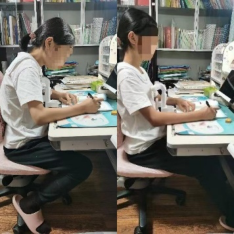
The most occurring poor sitting posture among the 12 subjects in their habitual sitting posture was hunchback with 83.33%, followed by head down too far. In addition, head tilting and body tilting were also the poor sitting postures that occurred in 16.67% of the subjects’ feedback (see Figure 1).
Analysis of Children’s Sitting Posture Status and Influencing Factors 499
Figure 1: Sample of subjects’ habitual sitting posture (left) and healthy sitting posture (right).
The most frequently mentioned perception of healthy sitting posture for children was “straight back” (100% mentioned). This was followed by “feet naturally flat on the floor” (83.33% mentioned) and “eye distance is appro- priate” (33.33% mentioned). In addition, a few parents mentioned “thighs and calves at 90
”.
CONCLUSION
The following conclusions can be drawn from the study of 12 children:
1. Internet courses are typical learning tasks for children using smart display devices. 2. The majority of children use smart display devices for a single continuous duration of 30 to 40 minutes or less. From the above task duration pro- file, it can be concluded that most of the subjects used the smart display device for a single continuous duration of 40 minutes or less. 3. Most children need additional auxiliary lighting when using smart devices. 4. The matching size of the table and chair should be based on a reasonable sitting posture and given according to different height dimensions. 5. The correct sitting posture is maintained for a short period of time and the bad sitting posture appears more frequently. 6. Bad sitting posture is mainly hunchback and head down.
ACKNOWLEDGMENT
This research was supported by Project of the President’s Fund for China National Institute of Standardization for 2022 and 2023 (522022Y-9405; Construction and validation of a model for the representation of children’s healthy sitting posture under learning scenarios).
REFERENCES
Chen K J. (2015). Design and implementation of adaptive children’s learning chair based on Kinect interaction technology[D]. Zhejiang University of Technology.
D. S. HIRA, (1980). An ergonomic appraisal of educational desks. Ergonomics.
vol. 23, no. 3. London. Dvorak J, Panjabi MM. (1991). Novotny JE, Antinnes JA. In vivo flexion/extension of the normal cervical spine. J Orthop Res 1991;9: 828–34. Floyd, W. F., and WARD, J. S. (1969). Anthropometric and physiological consi-
derations in school, office and factory sealing. Ergonomics, Vol. 12, No. 2, 132-139. Huang J M. (2022). Research on the design of myopia prevention table and chair for 11–12 years old school children. Donghua University. Qin X, Shen L Q, Xiao Y H. (2015). Based on the idea of product system design--
discussing the design of study table that can correct children’s sitting posture[J]. Furniture. DOI: 10.16610/j.cnki.jiaju.2015.05.015. Vital JM, Senegas J. (1986). Anatomical bases of the study of the constraints to which the cervical spine is subject in the sagittal plane. A study of the center of gravity of the head. Surg Radiol Anat.
LISTED IN THE AHFE DIGITAL BOOKSTORE CATALOGUE
Explore the complete digital volume
Ergonomics In Design
Read this individual research paper free through the original publisher, or explore the full digital proceedings book.
ISBN 978-1-958651-53-7
Explore this ISBN in the AHFE Bookstore ↗Listed in the July 2026 bookstore catalogue; search by ISBN to confirm current availability · Digital book purchase optional