Yu-pin Weng, I-jui Lee (2024). Preliminary exploration of tripartite social pain games: Expressions of feelings among three players and game mechanism design. In: Human Factors and Systems Interaction. AHFE Open Access, vol. 154, pp. 333–341. https://doi.org/10.54941/ahfe1005381
This study aimed to explore the social pain issues that school-age children may encounter when facing social challenges such as misunderstandings, exclusion, and bullying. To simulate social pain scenarios, we designed a three-player game mechanism to assist school-age children in building coping abilities through experiential learning and understanding. In the game design phase, we created game mechanisms involving misunderstandings, exclusion, and bullying, using a three-player ball-passing game to create corresponding situational atmospheres that simulated the experience of social pain. To avoid potential negative impacts on children through direct experimentation, we initially used adults as the experimental subjects. They participated in a three-player social pain game experience to gain preliminary insights into reactions in social pain situations. In the experiment, one participant and two informed players familiar with the game rules engaged in a ball-passing game, completing specific tasks to elicit social pain responses. Assessment tools included a social pain perception questionnaire and stress detection through Garmin wristbands to understand the participants’ physiological responses. Through recording and evaluation, we preliminarily explored the participants’ reactions, experiences, and empathy expressions when facing social pain. The results indicated that these three social pain mechanisms successfully elicited social pain experiences in the three-player game, while also stimulating participants’ empathy. This study provided preliminary research references for future applications of social pain games targeting children.
Social Pain Social pain refers to the negative, distressing, or saddening emotional experi- ences that may arise in interpersonal interactions (Eisenberger et al., 2003). This type of pain, which often stems from social setbacks, misunderstandings, exclusion, and bullying, can impact an individual’s psychological well-being and emotional state.
For children, social pain may manifest as unfriendly treatment, isola- tion, or being ignored during interactions with peers or at school, subse- quently affecting their self-esteem and emotional health (Palermo, 2000). In essence, social pain emphasizes the psychological discomfort generated in social situations, presenting a social issue that requires understanding and management.
When children are unable to appropriately handle such social pain, they may face emotional distress, behavioral changes, and potential long-term impacts on their psychological well-being and social functioning (Forgeron et al., 2010).
Social Pain Games Effectively assisting children in understanding the social pain triggered by var- ious social challenges, such as setbacks, misunderstandings, exclusion, and bullying, is a necessary and urgently needed skill. Utilizing gamification to help children comprehend the feelings, situations, and atmospheres associ- ated with social pain can be a pathway to reduce their psychological stress when facing actual social pain situations (Kosa and Uysal, 2020).
Through games, children can experience, interact, and feel this particular negative emotion in a more relaxed manner, subsequently developing appro- priate channels for emotional release and emotional regulation methods (Herndon et al., 2012).
Therefore, we conducted a study aimed at developing a set of game con- tents covering the theme of social pain. Through simple and engaging game formats, we aimed to assist children in personally experiencing feelings of social pain and effectively engaging in emotional relief. As social pain games represent a relatively underdeveloped psychological experience for players, clever game mechanism designs could effectively aid children in simulating the experience of social pain.
Considering the potential negative impact of directly conducting game experiments with children, we initially chose adults as the game participants. We used a three-player ball-passing game as the basis for the experiment, simulating social challenges such as misunderstandings, exclusion, and bul- lying through different rules and scenarios within the game. The partici- pants underwent emotional experiences through interacting during the game, and after the game concluded, we collected relevant data through psycho- logical perception questionnaires and stress index measurements to assess whether such game mechanisms could effectively simulate and trigger social pain. The results provided a preliminary research foundation for a deeper understanding of the effectiveness of social pain games.
DESIGN AND IMPLEMENTATION This study aimed to evoke social pain experiences through game mechanisms and then, after testing and evaluation, develop game strategies suitable for children. The goal of these game strategies was to assist children in building appropriate coping and resolution abilities in the face of social pain. Through
Preliminary Exploration of Tripartite Social Pain Games 335
this approach, we hoped to enhance children’s coping skills in social situa- tions, especially when dealing with challenges such as misunderstandings, exclusion, and bullying, thereby enabling them to handle interactions with others more effectively.
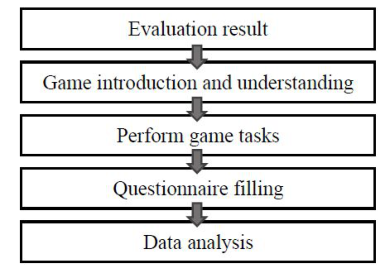
Figure 1: Design method flow chart.
Figure available in the original PDF paper.
This research not only contributed to a deeper understanding of the psy- chological mechanisms of social pain but also held potential value in its application to education and children’s mental health. The specific process of the study followed the methods outlined below (Figure 1).
Game Design The inspiration for the game design in this study came from the virtual ball- passing game mechanism proposed by Rubo and Munsch in 2024 (Rubo and Munsch, 2024), which focuses on creating situations that induce social pressure. Building upon this foundation, we developed a new set of game mechanisms that aimed to simulate and explore different scenarios of social pain, including elements of misunderstandings, exclusion, and bullying.
The primary objective of the game was to gain initial insights into the behavioral responses and psychological experiences of the participants when confronted with these social pain scenarios. We observed their feelings, cop- ing strategies, and changes in stress levels throughout different stages of social pain.
In the game, three players formed a group consisting of one participant and two informed individuals familiar with the game rules. They engaged in a ball-passing game, with each player receiving tasks at specific stages to guide their behavior in the game. Importantly, the participant was unaware of the tasks assigned to the other two players, creating an authentic scenario for experiencing social pain. This design facilitated a deeper observation and analysis of the psychological and behavioral responses of the participants when facing these social challenges.
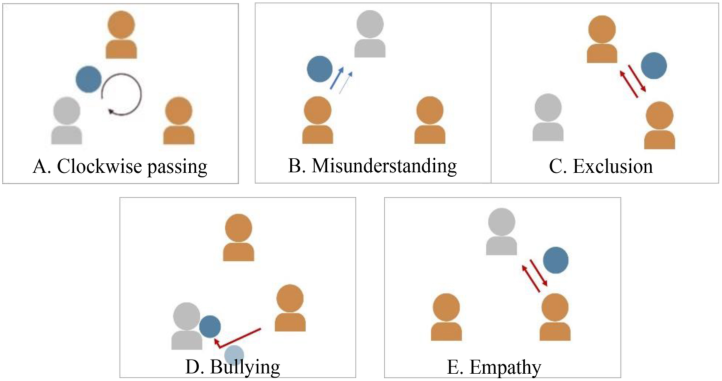
The social pain game experiment comprised five stages, including mis- understanding, exclusion, bullying, empathy, and awareness. Before enter- ing the game stages, the players familiarized themselves with each other through clockwise ball passing, allowing for conversation but prohibiting the disclosure of secret tasks to the participant (Figure 2A).
The first three stages required the players to perform specific tasks that were cleverly designed to simulate scenarios of misunderstanding, exclusion, and bullying.
Stage 1 was misunderstanding, in which the participant needed to inform the other players about the passing rule of the ball in advance, but the
336 Weng and Lee
informed players intentionally provided incorrect information, creating a situation of misunderstanding (Figure 2B).
Stage 2 was exclusion, in which the two informed players only passed the ball to each other, deliberately excluding the participant and creating a scenario of exclusion (Figure 2C).
Stage 3 was bullying, in which the participant was deliberately targeted by the other players and continuously hit by the ball, thereby simulating a bullying situation (Figure 2D).
Stage 4 was empathy, in which the participant collaborated with one informed player to exclude the other player, aiming to observe whether the participant demonstrated empathy and experienced social pain (Figure 2E).
In Stage 5 was awareness, we informed all players of the experimental objectives to make them aware of the actual game purpose and continu- ously monitored their psychological stress levels and experiences. During this stage, we observed how the participant experienced the ball-passing game with social pain again, under the knowledge that the scenarios had been intentionally designed. We examined whether there were differences in the participants’ stress and social pain responses.
In the experiment, each participant underwent an adaptation period before entering the next stage. This time was designed to allow the participants to adjust their emotions and wait for stress levels to decrease before entering the next social interaction stage. The purpose of this arrangement was to observe the psychological and physiological responses of the participants when fac- ing different social scenarios after relaxation and emotional adjustment. This adaptation period was meant to simulate changes in real-life social situa- tions more comprehensively and understand the impact of social pain on individuals in a more holistic manner.
Figure 2: Game design flowchart (The gray player is the test subject; the other two are the informed game manipulators).
Preliminary Exploration of Tripartite Social Pain Games 337
Experimental Design In this study, to avoid potential negative impacts that may arise from directly using children as experimental subjects, we initially selected ten adults, with an average age of approximately 25 years, as the participants. The partici- pants engaged in a three-player social pain game experience to preliminarily explore their reactions to social pain.
Before the start of the experiment, the players were only informed that they would participate in an experimental ball-passing game. They were instructed to follow the tasks while wearing Garmin wristbands to measure their heart rate and stress level. Specific information related to the game and social pain was not disclosed, to ensure the participants would exhibit natural reactions during the game. Additionally, the participants were unaware of the tasks assigned to the other players, thus enhancing the authenticity and objectivity of the experiment.
After each stage of the game, participants filled out questionnaires. Through observing and assessing participants’ behavioral responses at each stage, the study aims to gain a deeper understanding of the behavioral and emotional responses of participants under the game mechanism. The detailed operational procedures, mechanisms, and steps of the social pain game experiment are illustrated in Figure 3.
Figure 3: Game design flowchart (Gray player as the test subject, the other two are informed game manipulators).
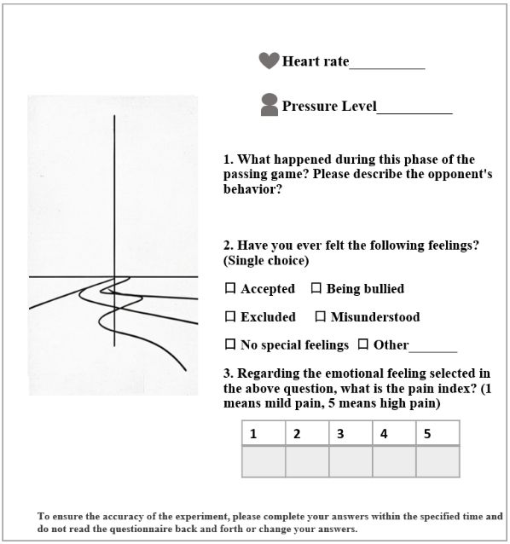
Evaluation Tools Self-Assessment-Questionnaire-Social-Pain-Index After completing each stage of the game, the participants were asked to fill out a questionnaire (Figure 4) to assess their responses to different social pain game scenarios and obtain a social pain index. We analyzed and evaluated the impact of the game outcomes on the participants’ emotional states through their responses and self-assessment content. This aided in gaining a deeper understanding of the participants’ emotional and behavioral responses when exposed to different social pain game scenarios. This analytical approach
338 Weng and Lee
helped reveal the impact of the game mechanisms on the participants’ psy- chological and emotional aspects, as well as the subsequent assessment of their perception of social pain.
Figure 4: Self-assessment questionnaire.
Participant-Stress-Levels This study utilized the Garmin vivosmart 5 health and fitness tracker to mon- itor the stress levels of participants. The stress detection feature in the tracker was based on the measurement principle of heart rate variability (HRV). To obtain accurate data, after the completion of each game stage, the par- ticipants were asked to read the values on their wristbands and record the readings at that specific moment.
Additionally, to comprehensively document and analyze the participants’ behavior throughout the game, we recorded video of the entire game pro- cess. This approach allowed for a deeper understanding of the participants’ response patterns and behavioral characteristics during the game.
RESULTS
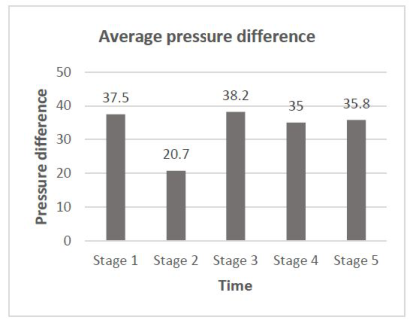
Before the game began, baseline measurements were taken to determine the participants’ stress levels before the game started. To observe changes in the stress indices, the average stress values for each stage were subtracted from the initial stage to obtain the stress change for each stage. Figure 5 presents the results obtained by subtracting the measured stress values from the initial stress values (Figure 5).
Preliminary Exploration of Tripartite Social Pain Games 339
Figure 5: Average pressure difference.
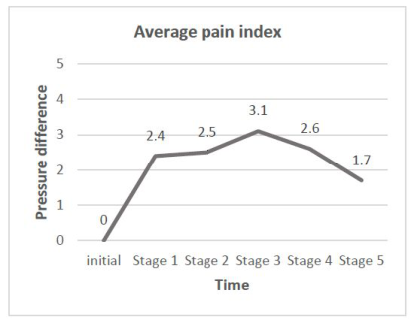
The participants were also asked to write down their social pain indices for each stage based on their current feelings. Figure 6 shows the average social pain indices for the participants at each stage (Figure 6).
Firstly, in the misunderstanding stage (Stage 1), the participants’ stress indices significantly increased (a difference of 37.5 from the initial value), and their social pain indices also showed a notable increase (an increase of 2.4). This suggested that the participants experienced higher levels of stress and social pain when facing misunderstandings in social situations, as they found the behavior of others confusing and difficult to predict.
Figure 6: Average pain index.
As the game entered the exclusion stage (Stage 2), although the increasing trend in the stress indices slowed down slightly (a difference of 20.7 from the initial value), the psychological perception of social pain continued to rise (an increase of 2.5). This reflected that in the exclusion scenarios, the participants began adjusting their emotional responses, seeking alternative ways to shift attention in coping with social challenges.
340 Weng and Lee
After entering the bullying stage (Stage 3), the increase in stress levels was most significant (a difference of 38.2 from the initial value), and at the same time, the participants’ social pain indices sharply rose (an increase of 3.1). In this stage, the participants faced more challenging social pain, especially when experiencing intentional bullying. Some participants wrote in the ques- tionnaire about feeling scared and unpleasant when the ball was intentionally thrown at them.
Subsequently, the empathy stage (Stage 4) presented an interesting phe- nomenon. While stress levels remained relatively high (a difference of 38.2 from the initial value), the participants’ social pain indices decreased (an increase of 2.6). This indicated that the participants felt less social pain, since they were not a target of bullying. However, they still experienced a certain level of stress due to empathizing with others’ situations (a difference of 35 from the initial value).
In Stage 5, when the scenario was revealed to be false, although stress levels remained elevated (a difference of 35.8 from the initial value), the participants’ social pain indices significantly diminished (an increase of only 1.7). This suggested the participants were still tense about the ball-passing game mechanism but had realized the social interactions were orchestrated, resulting in a reduction of their social pain indices to some extent.
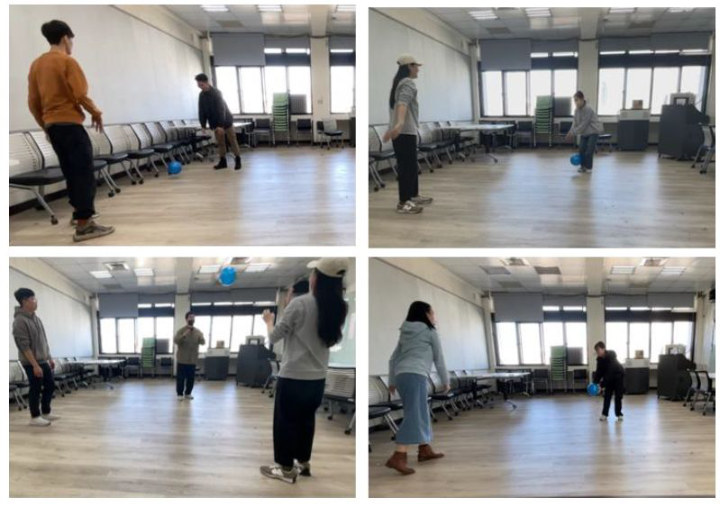
Overall, all three game mechanisms generated social pain responses, espe- cially in the bullying scenario, but there was a weakened social pain response when empathizing with others. The social pain became less apparent when the participants knew the game was staged. Figure 7 illustrates the process of the game (Figure 7).
Figure 7: Game process.
Preliminary Exploration of Tripartite Social Pain Games 341
CONCLUSION AND FUTURE RECOMMENDATIONS This study successfully revealed the potential for generating social pain expe- riences through a simple three-player game mechanism designed to include social pain elements such as misunderstandings, exclusion, and bullying. The results clearly demonstrated the effectiveness of game design in simulat- ing social interactions. Furthermore, we found that these mechanisms could trigger the participants’ empathy, allowing them to experience social pain and stress through perspective-taking. Additionally, when the participants learned that the game was fictional, the perception of social pain diminished, indicating the significance of cognitive factors in social interactions.
The findings of this study could provide valuable insights for future devel- opments in social pain game applications for children. Although long-term tracking of these effects and experiments specifically targeting children have yet to be conducted, these preliminary findings offer a promising foundation for future research with appropriately designed interventions.
ACKNOWLEDGMENT
We would like to express our sincere gratitude to the National Science and Technology Council for their generous funding support under project Nos. NSTC 111-2221-E-027 -059 -MY2. Additionally, we extend our heartfelt appreciation to all the participants for their invaluable contributions to this study.
REFERENCES
Eisenberger, N. I., Lieberman, M. D., & Williams, K. D. (2003). Does rejection hurt?
An fMRI study of social exclusion. Science, 302(5643), 290–292. Forgeron, P. A., King, S., Stinson, J. N., McGrath, P. J., MacDonald, A. J., & Chambers, C. T. (2010). Social functioning and peer relationships in children and adolescents with chronic pain: A systematic review. Pain Research and Management, 15, 27–41. Herndon, K. J., Bailey, C. S., Shewark, E. A., Denham, S. A., & Bassett, H. H.
(2013). Preschoolers’ emotion expression and regulation: Relations with school adjustment. The Journal of genetic psychology, 174(6), 642–663. Kosa, M., & Uysal, A. (2020). Four pillars of healthy escapism in games: Emotion regulation, mood management, coping, and recovery. Game user experience and player-centered design, 63–76. Palermo, T. M. (2000). Impact of recurrent and chronic pain on child and family
daily functioning: A critical review of the literature. Journal of Developmental & Behavioral Pediatrics, 21(1), 58–69. Rubo, M., & Munsch, S. (2024). Social stress in an interaction with artificial agents in virtual reality: Effects of ostracism and underlying psychopathology. Computers in Human Behavior, 153, 107915.
LISTED IN THE AHFE DIGITAL BOOKSTORE CATALOGUE
Explore the complete digital volume
Human Factors and Systems Interaction
Read this individual research paper free through the original publisher, or explore the full digital proceedings book.
ISBN 978-1-964867-30-4
Explore this ISBN in the AHFE Bookstore ↗Listed in the July 2026 bookstore catalogue; search by ISBN to confirm current availability · Digital book purchase optional