Cheng Yao, Pinhao Wang, Zhengke Li, Jing Li, Xinyi Li, Jun Hu, Barakova Emilia, Fangtian Ying, Wenjie Xu (2023). StressButton: Using Connectivity of Everyday Objects for Children to Coping Learning Stress. In: Affective and Pleasurable Design. AHFE Open Access, vol. 71, pp. 179–187. https://doi.org/10.54941/ahfe1003257
The highly competitive education system is an unavoidable problem for primary school students in China, and excessive learning stress among children is a problem that cannot be ignored in current primary education. In the family environment, parents tend to ignore the stress of children in the learning process and lack encouragement. This paper proposes a theory of connectivity and presents the interaction design and implementation of StressButton to help build a bond between parents and children in coping with stress through the intelligent connection of everyday objects. We conduct a study to verify the connectivity and effectiveness of StressButton. The results show that using the connectivity of IoT to improve the connectedness of family members is a better approach to coping with stress and helping build a relaxed home environment.
Stress management supported by the interactive system has become an impor- tant area of concern in HCI (Bhardwaj, 2020). Despite the considerable efforts invested in Children’s emotion regulation and social stress (Oana & Daniel, 2022), much of the previous work has neglected the relationship between children’s stress and their parents. Also, there is a lack of effe- ctive ways to make parents aware of their children’s learning stress and help them relieve it. To better establish a parent-child bond, help parents partici- pate in managing children’s stress and reduce children’s learning stress; we hypothesized that including parental interventions when children are stres- sed during task performance would be beneficial. Because in the traditional social ecological model, the stakeholders that affect children’s stress include children, siblings, parents, peers, school teachers, and others. The parent- child bond has been widely explored to promote children’s mental health, and many studies have confirmed the effectiveness of breathing exercises for stress intervention (Miri, 2022).
With the development of IoT and wearable devices, there has been a lot of previous work on stress detection and intervention systems (Welch, 2022).
For example, Hannah made an auto-inflating wearable device to reduce anxiety (Brown, 2021). However, few studies have focused on the help of parent-child connectedness for stress relief in children. Extreme psychologi- cal stress adversely affects the growth of children. The amount of homework assigned at school, tests, and parents’ high expectations of their children are the main factors leading primary school students to high academic stress levels. In the family environment, parents tend to ignore the stress of chil- dren in the learning process, and a lack of encouragement, criticism, and scolding often occur. Children are developing cognitive strategies for con- structive stress management between the ages of 6-12. Cognitive flexibility is essential in coping with stress in daily life (Xue, 2021). We believe encourage- ment should be the focus of research, and the underlying psychological causes of stress are likely to be intrinsic rather than targeted to stress symptom relief.
This paper proposes a theory of connectivity, which helps to establish the bond between parents and children through the intelligent connection of daily necessities. Through the social-ecological model, parents are invo- lved in the children’s stress intervention and jointly cope with the learning stress generated during the period. This paper presents a system and descri- bes the interactive design, collaborative strategy, and implementation of the stress button: a health tracker to detect children’s stress, an airbag belt to provide feedback for stress intervention, and a stress button for parents. The main contributions of our work are:
We proposed a method for visualizing stress values to improve parents’ understanding of their children’s learning stress profile.
We proposed a strategy for parents and children to cope with learning stress together based on the theory of connectivity. Stress is high; the stress button is elevated, and vice versa. The parent chooses to press the stress button to trigger breathing training feedback, and the child understands that the parent provides this relief.
We conducted user experiments and quantitative and qualitative analyses to verify system effectiveness and acceptance.
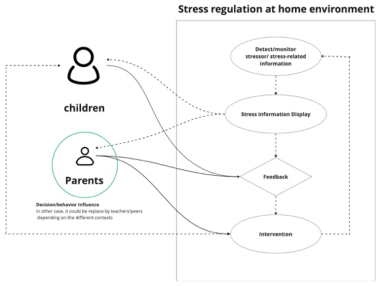
Developing Connectivity Theory as a Supportive Framework for Design and Modelling The social ecological model (SEM) was proposed by Bronfenbrenner for the study of various influences on children’s development and growth in educational psychology. Human behaviour is influenced by both internal and external environmental factors (Bronfenbrenner, 1977). Parents play an important role in the developmental process of children and it has been demonstrated that parental involvement in general therapy contributes to the social stress of children (Theofanopoulou & Slovak, 2022). Therefore, we develop a theory of connectivity, a supportive framework of parent-child- connected objects, and a tangible interactive system to help primary school children manage stress during the learning process. In contrast to design inte- rventions that work directly with children, our system incorporates parents into the design intervention process, leveraging the connectivity of the IoT to provide parental awareness of their child’s stress and access to intervention.
Using Connectivity of Everyday Objects for Children to Coping Learning Stress 181
Figure 1: Supportive framework of parent-child-connected objects for children stress regulation.
In this paper, we focus on the learning stress of normal Chinese elemen- tary school children in their home environment and develop and test the corresponding system.
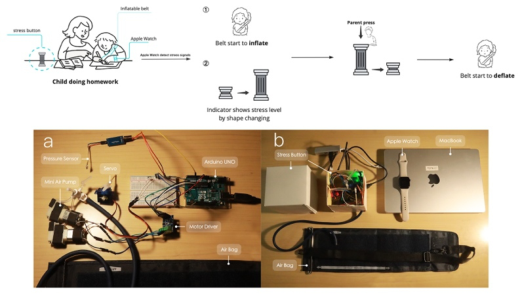
Interactive System Design In our prior research with children, we found that children have a weak concept of stress and can not quite understand it or describe it accurately in words, but they can have a general sense of their own stress state under the guidance of researchers. Therefore, we decided to enhance the system’s accuracy in detecting children’s stress using device detection plus children’s subjective scoring. At the same time, with the consent of parents and children, we expanded the learning stress for a short period by introducing error cues to facilitate a more accurate measurement of stress changes by the detection device. We propose the concept and interaction design of the stress button, collaborative strategy, implementation and application to user experiments. The system consists of a health tracker to detect the stress of children, an airbag belt to provide feedback for stress intervention, and a stress button for parents. When stress is detected, the stress button rises as an indicator of stress information, meaning the child’s stress is presented to the parents through the stress button. It helps parents understand the child’s internal state. This is one of the advantages of the system. Pressing the stress button by the parent triggers the airbag belt to begin inflation and deflation simu- lating breathing relaxation, which many studies have shown to help children relieve current stress.
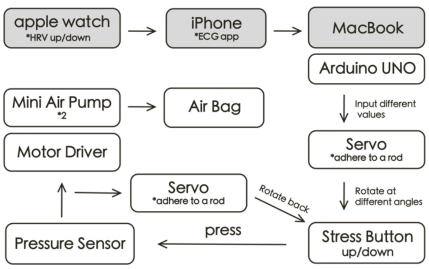
The specific system workflow is as follows: The child’s real-time heart rate variability (HRV) is detected by an apple watch worn on the child’s hand, and the data is transmitted to the researcher. We use the ECG HRV application from the iOS apple store. When a change in HRV is detected, the researcher translates the change in HRV value to the corresponding stress change value and then to the specific change in servo angle in the Arduino. The value of the servo angle change is then translated into the Arduino ide code, and the servo drives the front rod up and down to push the button shell, thus changing
Figure 2: Stressbutton system: (a) Stressbutton components. (b) How stressbutton works.Figure 3: Technology schematic of stressbutton.
the height of the button. The more the heart rate variability decreases, the greater the stress increases, the greater the value of the servo angle changes in the vertical direction, the more the servo front end rod raises upward, and the more the button shell raises.
After the button is raised, the parent notices the change of the button and actively presses the button. The thin film resistance pressure sensor on the top of the button feels the pressure and drives the servo to rotate 180 degrees in the vertical direction to drive the button down, and it descends to the lowest position. At the same time, the motor driver in the button drives the air pump to start deflating, and the gas generated by the air pump is transmitted to the airbag on the child through the pipe, and the airbag starts to inflate. After a certain time of inflation, the airbag reaches a fuller state. Then the air pump starts to suck air and the airbag on the child is deflated. The Arduino ide code controls the approximate required inflation and deflation time to achieve the proper bulging and contraction according to the airbag size. The airbag is made of a more comfortable, flexible material, which makes it easy to sense the airbag inflation and deflation state, and is also suitable for use in child belts.
Using Connectivity of Everyday Objects for Children to Coping Learning Stress 183
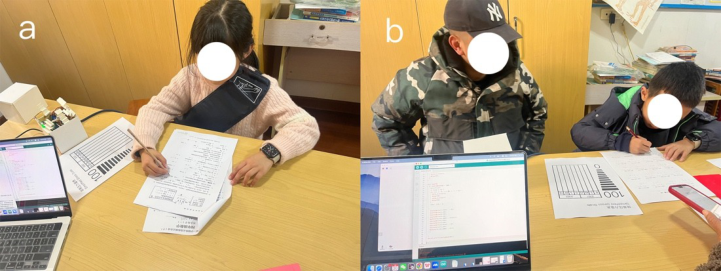
Figure 4: User studies: (a) Child 3 finish the task with auto-feedback in test 1. (b) Child 5 finish the task with parent intervention through stressbutton in test 2.
User Study and Experiment We conducted a study to verify the system’s effectiveness and to find out whether it was more beneficial for children to realize that their parents were helping them cope with the stress by comparing it with automatic feedback provided by breathing relaxation product. We explored children’s stress chan- ges during the learning process, the effects of the two interventions, and their experiences. We recruited 6 children (3F, 3M, mean age = 8, SD = 1.26) from a neighbourhood school. Children aged 6–9 years old, between first and third grade. Consent was obtained from parents and children to com- plete the experiment in the company of parents. Parents signed an informed consent form.
Experimental Design and Procedure The value of HRV is detected by Apple Watch and the data is transmitted to the hardware system via cell phone and Bluetooth to control the airbag belt and stress button. The experiment is divided into two parts: system automa- tic intervention feedback and parental participation intervention feedback through the stress button. Children were given 15 minutes to complete the math calculation questions and were prompted with an error if they answe- red incorrectly. The stress button rises and falls based on the child’s average stress over time. The experiment was completed according to the designed experimental procedure.
1. The researcher introduces the experiment process and the prototype’s use to the child’s parents and jointly explains it to the child. 2. Parents sign the consent form for the experiment and obtain verbal consent from the child. 3. The prototype system is installed, the airbag and health detection device are placed on the child’s body, and the math calculation questions to be completed are printed and given to the child. Incorrect answers will be indicated by a researcher placing a red card as an error. 4. The device detects the initial stress level and uses a simplified stress scale to allow the child to self-measure stress as an aid to assessment. The
simplified stress scale is designed specifically for children and is easy to understand. The rectangular box from bottom to top corresponds to the self-perception of stress from 0-100, and the child checks a box at a cer- tain position in the rectangle. The experiment started when the child was relaxed after communicating with the child. 5. The first part of the experiment: the system provides intervention feed- back based on the detected stress during the child’s learning process, which lasts 15 minutes. Every 5 minutes, children were asked to assess their current stress state using a simplified stress scale. 6. The second part of the experiment: After a break, the experiment started when the children were relaxed. The children were informed before the experiment that the inflation and deflation of the airbag were achieved with the help of the parents. The detected pressure values were visually reflected on the stress button during the child’s learning process. The parents assessed the current situation by pressing the button to initiate the intervention feedback, which lasted for 15 minutes. A simplified stress scale was used every 5 minutes to allow children to assess their current stress state. 7. At the end of the experiment, parents were interviewed semi-structured and communicated with the children to understand their thoughts during the process. Children’s errors during the two experiments were recorded and quantitative stress-related experimental data were collected. 8. Interview and provide experimental gifts.
Interview The interviews were completed by 2 researchers, and the purpose of the inte- rview was explained to the interviewees before the interview began. Prior consent was obtained from all interviewers, and the entire interview was recorded without any personal information. A semi-structured interview was adopted, and the children’s questions would be more simplified.
Results
The results showed that the children realized that encouragement and help from their parents could achieve this better than traditional ways of designing interventions to relieve stress. The children said the most desired form of reward for learning was praise from their parents, which largely released their psychological stress, made them feel more relaxed, and felt more connected to their parents. We take the data of two of the children as an example.
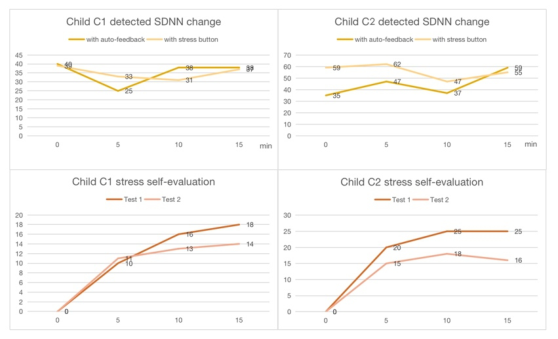
The first child got a total of 5 questions wrong. In the first test, the heart rate variability SDNN varied over 15 minutes: 40ms-25ms-38ms-38ms. In the second test, the heart rate variability SDNN varied over 15 minutes: 39ms-33ms-31ms-37ms. The second child got a total of 2 questions wrong. In the first test, the heart rate variability SDNN:35ms-47ms-37ms-59ms. in the second test, the heart rate variability SDNN changed in 15 minutes: 59ms-62ms-47ms-55ms. As Figure (5) shows the variation of SDNN over 15 minutes for the two children. Figure (6) shows a graph of the change in self-evaluation stress
Using Connectivity of Everyday Objects for Children to Coping Learning Stress 185
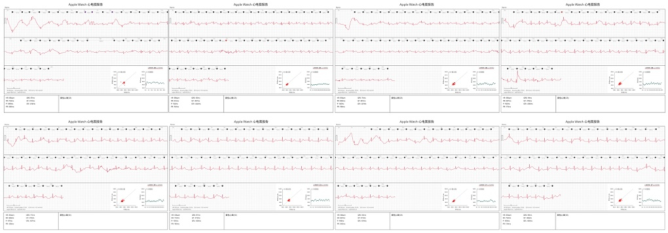
Figure 5: C1 ECG report in two tests. Above is test 1. Below is test 2.Figure 6: Child C1 and C2 detected SDNN and self-evaluation in two tests.
values over 15 minutes for the two children. The initial relaxation heart rate variability (HRV) data varied considerably from child to child. Overall, the children generally performed better in the second test than the first one, completing the test with less stress.
In the interview, P1 felt that the child’s self-regulation ability was okay and would choose to play Lego to relax when stressed in his study. During the learning process, when the child is emotionally restless, he will ask if he has encountered any problems and help him solve them together. For him, having a system by itself will be much easier. P3 indicates that the child relaxes by playing with toys and making small videos.
P5 indicates that the child will want to get up after a while to do a little pull-up to relax. Parents generally wanted to be involved in the process of regulating their child’s learning stress and also thought this approach would be better, with one parent mentioning that they might not have as much time to spend with their child. P6 mentioned the need to help their child in a stressful time but usually did not quite understand how to help them. Overall, the parents felt that our system was positive and helpful in relieving their child’s learning stress and in feeling better connected to their child.
C1 felt that the airbag would help make things easier, C2 and C4 wanted mom and dad to be there to encourage them to solve problems together, C3 and C5 said the airbag and buttons were fun, and C6 felt more at ease with mom and dad around. Overall, the children had a positive attitude toward the system.
CONCLUSION
Introducing a social ecological model in the home learning environment, we propose to help children manage learning stress by constructing a theory of connectivity. This led to the design of the StressButton system, which introdu- ces parents into children’s learning process to jointly cope with the learning stress that arises during the period. A user study was conducted to compare the help of intelligent hardware automatically giving relaxation feedback and parental involvement in co-helping regulation of children’s learning stress relief. The results were positive. We believe that using the connectivity of IoT to improve the connectedness of family members is a better approach to coping with stress and helping build a relaxed home environment. We will explore further along this line in the future.
ACKNOWLEDGMENT
We appreciate all user study participants and the joint effort of Zhejiang University and Eindhoven University of Technology.
REFERENCES
Bronfenbrenner (1977) Toward an experimental ecology of human development, American Psychological Association. American Psychological Association. Avai- lable at: https://psycnet.apa.org/record/1978-06857-001 (Accessed: February 2, 2023). David, O. A. and David, D. (2022) How can we best use technology to teach children
to regulate emotions? Efficacy of the cognitive reappraisal strategy based on robot versus cartoons versus written statements in regulating test anxiety. Hannah Brown, Emily Shannon and Naomi T. Fitter (2021) Design and Preliminary Evaluation of the AID Vest: An Automatic Inflatable Wearable Device for Anxiety Reduction. 2021 IEEE World Haptics Conference (WHC). Nikki Theofanopoulou and Petr Slovak (2022) Exploring Technology-Mediated
Parental Socialization of Emotion: Leveraging an Embodied, In-situ Intervention for Child Emotion Regulation Napat Chaowadee, Phuwanate Lertsiriyothin and Thanaphat Phuangkhemkhao Thanaphat Phuangkhemkhao (2021) Reinforced Learning in Children through a Stress Warning Unit. Purav Bhardwaj National Institute of Design et al. (2020) Juno: An interactive
storytelling robot for early constructive childhood intervention. Psychology, P. M. D. of et al. (2022) Far: End-to-end vibrotactile distributed system designed to facilitate affect regulation in children diagnosed with autism spectrum disorder through slow breathing. Smakman, M. H. J. et al. (2022) A trustworthy robot buddy for primary school
children, MDPI. Multidisciplinary Digital Publishing Institute. Available at: https: //www.mdpi.com/2414-4088/6/4/29 (Accessed: February 2, 2023).
Using Connectivity of Everyday Objects for Children to Coping Learning Stress 187
University, K. V. K. S. et al. (2019) A wearable therapy and technology garment for kids: Proceedings of the 2019 ACM international symposium on wearable computers, ACM Conferences. Uratani Hiroki, O. M. (2018) Relaxation effect of a respiration-leading stuffed toy,
CiNii Research. Victoria Welch et al. (2021) Use of Mobile and Wearable Artificial Intelligence in Child and Adolescent Psychiatry: Scoping Review. (Accessed: February 2, 2023). XueWen et al. (2021) Momentary and longitudinal relationships of mindfulness
to stress and anxiety among Chinese elementary school students: Mediations of cognitive flexibility, self-awareness, and Social Environment, Journal of Affective Disorders.
LISTED IN THE AHFE DIGITAL BOOKSTORE CATALOGUE
Explore the complete digital volume
Affective and Pleasurable Design
Read this individual research paper free through the original publisher, or explore the full digital proceedings book.
ISBN 978-1-958651-47-6
Explore this ISBN in the AHFE Bookstore ↗Listed in the July 2026 bookstore catalogue; search by ISBN to confirm current availability · Digital book purchase optional