Zhenyu Liu, Cheng Yao, Fangtian Ying (2024). Effects of Digital Art Emotional Expression Therapy on the Rehabilitation of Children with Autism Spectrum Disorder. In: Human Interaction and Emerging Technologies (IHIET-AI 2024): Artificial Intelligence and Future Applications. AHFE Open Access, vol. 120, pp. 63–70. https://doi.org/10.54941/ahfe1004556
Evaluating the Effectiveness of Digital Art Emotional Expression Therapy in Combination with Conventional Rehabilitation to Relieve Autism in Children. Methods: Thirty Children with Autism were selected and randomly divided into the Experimental and the Control Groups, with fifteen children in each group. In the Control Group, the children with Autism Spectrum Disorder were given regular Psychological Rehabilitation Training; in the Experimental Group, they were given eight weeks of Digital Art Emotional Expression Therapy in addition to the regular Psychological Rehabilitation Training. In the Experimental Part, the Autism Treatment Assessment Scale and the Childhood Autism Rating Scale were used to score and compare the thirty children to verify their validity. Conclusion: The result showed that Digital Art Emotional Expression Therapy combined with conventional Psychological Rehabilitation Training could enhance the Rehabilitation Effect of children with Autism, alleviate their Autistic Symptoms, and improve their ability to interact with others and their language expression.
Autism spectrum disorder (ASD) is a neurodevelopmental disorder character- ized by impaired reciprocal communication, social interaction, and repetitive, stereotyped interests and behaviors (American Psychiatric Association & American Psychiatric Association, 2013). Children with autism spectrum dis- order have language difficulties, social interaction difficulties, stereotypical behavior, and, in some cases, mental retardation (Cibralic et al., 2019).
Expressive arts therapy is unique in that it has the advantage of being non-verbal and communicative, not limited by age, type of work, or level of education (Van Lith et al., 2017). Digital art, as one of the methods of expres- sive art therapy, has been used in recent years to achieve significant results in treating autism in children (Bitonte & De Santo, 2014). Through the inter- vention of digital art, emotional expression therapy regulates psychological states and heals mental illnesses while enjoying the beauty of art. In this study, digital art expression is used in combination with conventional psychological
rehabilitation training for children with autism who have deficits in self-care, language, and motor skills, with positive results.
RELATED WORK
Characteristics of Children With Autism Cognitive deficits: Many children will display varying degrees of cognitive underachievement with autism. The specifics of this are reflected in the fol- lowing areas: firstly, there is a significant lag in cognitive ability. Children with autism lack comfort with new things and can be indifferent to exter- nal happenings (Berkovits et al., 2017). Secondly, children with autism grow up interested in particular things, like to repeatedly touch the surface of things, and develop a specific dependence on objects but not on their relatives. Thirdly, children with autism have a relatively low level of awareness. Most children with autism have a high level of mechanical cognitive ability, such as remembering numbers, train times, and calendar dates. However, they lack a strong memory for related things and a certain level of imagination (Day et al., 2022). Fourthly, there is a temporal deficit in the developmental per- ception of children with autism. Some parents of children with autism lack a particular educational philosophy, and as a result, children grow up without a systematic understanding of abstract issues and lack cognitive skills (Mayes et al., 2020).
Delayed and abnormal language development: There is a specific variabil- ity in the language skills of children with autism, with approximately 50% of children with autism suffering from aphasia, which is reflected in the fol- lowing aspects: firstly, the variability of language development. In the course of research, it can be found that 50% of autistic children can use language to communicate to an eventual extent. However, their communication skills could be better during their daily life, and it is difficult for them to express their wishes in the communication process. Secondly, autistic children are characterized by mechanical and repetitive language. Finally, the language form needs a certain rhythm. Children with autism often have problems with the intonation and speed of their speech, which is most often characterized by repetitive intonation and uncontrolled volume (Chandler et al., 2016).
Social interaction difficulties. Due to a lack of social interest, children with autism express indifference towards familiar or unfamiliar people resulting in a lack of regular interaction with others as they grow up (McVey et al., 2018). In addition, due to their lack of non-verbal skills, children with autism are less able to meet each other’s eyes when communicating, do not look into each other’s eyes when speaking, and may avoid eye contact. They lack a certain amount of emotional variation and have difficulty understanding the facial expressions of others, so they are unable to form interpersonal relationships with others.
The Diagnostic Function of Digital Art in Psychological Counseling and Therapy Red indicates violent, passionate, aggressive, and angry emotions; yellow for positive and optimistic; and brown for a timid mind. However, counseling
Effect of Digital Art Emotional Expression Therapy on the Rehabilitation of Children 65
and therapy are more concerned with the correspondence between specific psychological problems and colors. Research shows that people suffering from severe domestic violence and depression often use only one or two specific colors to express inner pain, sadness, fear, and loneliness. Children with autism usually only use two or three colors to express their emotional state, primarily black, white, and occasionally red (Bartram et al., 2017). In contrast, those with depression usually use darker colors (such as grey) to express their inner feelings. Research in art therapy for children with autism has shown that children’s psychological states can be analyzed by observing their color preferences in art drawings and paintings from around three years of age (Tielsch & Allen, 2005).
The trauma children with autism inflict on themselves can be partially healed as they grow up. However, some traumas are challenging to alleviate through conventional psychological rehabilitation, thus affecting the forma- tion and development of personality and interpersonal relationships (Piergies et al., 2022). Children with autism strongly desire to participate and com- municate in digital art expression therapy, inconsistent with the self-centered autistic traits displayed in real life (Munley, 2002). The appreciation of digital artworks can screen information about the child’s thinking and emotions and change cognition by adapting elements of the digital artworks (Roth et al., 2021).
The Therapeutic Function of Digital Art for Children With Autism Through digital art emotional expression therapy, children with autism are guided to transform passive awareness into active awareness and gain rich perceptual experiences(Nissimov-Nahum, 2009). They are encouraged to promote the development of perceptual skills through activities such as appreciation of digital artworks, painting, and scrapbooking; and to expand the range of perception. Consciously allow children with autism to access information by coordinating various sensory organs.
Children with autism can use symbols, lines, colors, and objects to express their emotions, wishes, etc. For children with autism who are emotionally disturbed and impulsive, we can vent and gradually integrate emotions by tearing paper and doodling. With the help of digital artwork appreciation and drawing to understand the inner world of autistic children better, we can better communicate with them verbally and promote healthy emotional development through careful observation and analysis of the artwork.
STUDIES Study Subjects
Thirty children with autism admitted to a Women and Children’s Medical Centre in Guangzhou from 2020 to the present were selected and randomly assigned according to the Control and Experimental groups of fifteen chil- dren each. In the Control group, children aged from 2 to 7 years old, with an average age of (4.23±1.43); In the Experimental group, children aged from 3 to 8 years old, with an average age of (4.12±1.53). There was no significant
difference in age, gender, and duration of illness between the children in the control group and the experimental group, P > 0.05, which was compara- ble(Mahan & Matson, 2011). Consent was obtained from the children with autism, the parents of the children with autism, the children’s school, and the medical center before the formal conduct of the experiment. All children participating in the experiment volunteered and signed the informed consent form.
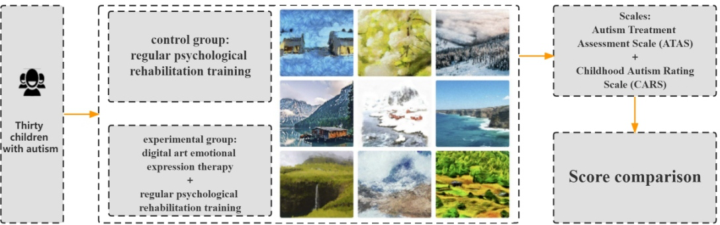
Figure 1: Study process.
Research Methods In the control group, regular rehabilitation training was conducted, with the training focusing on improving the autistic children’s self-care, language, and motor skills, in addition to helping them improve their emotional-cognitive and verbal communication skills through various forms of outdoor games and small teamwork tasks; the therapist also helped them improve their diet, allocate a reasonable amount of time for exercise, and work with their parents to encourage the children to come out of autism.
In the experimental group, thirty children with autism will be treated for eight weeks, once a week for 1.5 hours, based on regular rehabilitation training combined with digital art emotional expression therapy.
During the first four weeks of digital art therapy, children with autism are connected through visual art therapy through the appreciation of digital artwork. The therapist will ask the child to choose 7–8 of the 100 paintings that they find most appealing and encourage them to share their choices with the therapist and other children with autism in the room. Through this art appreciation and sharing, children with autism are allowed to express their emotions.
During the second four weeks of digital art therapy, children with autism are given a specific theme to paint and after they have finished their painting, it is scanned into the computer for digital art processing. The theme of the painting revolves around nature, allowing the children to paint their picture of the sky, woods, lakes, etc. in the form of a brush. In addition, clip art will be provided for children with autism to combine their favourite elements in the form of a collage of images, mainly of natural landscapes and animals (Liszio et al., 2020).
Effect of Digital Art Emotional Expression Therapy on the Rehabilitation of Children 67
Scale Selection and Statistical Methods The Autism Treatment Assessment Scale (ATAS) and the Childhood Autism Rating Scale (CARS) were used. The indicators covered by the CARS are self-care, language, motor, communication, and sensory abilities.
The data were analyzed using SPSS software. The measurement data were expressed as (¯x±s) and t-test for comparison between groups. The difference was considered statistically significant at P < 0.05.
RESULTS
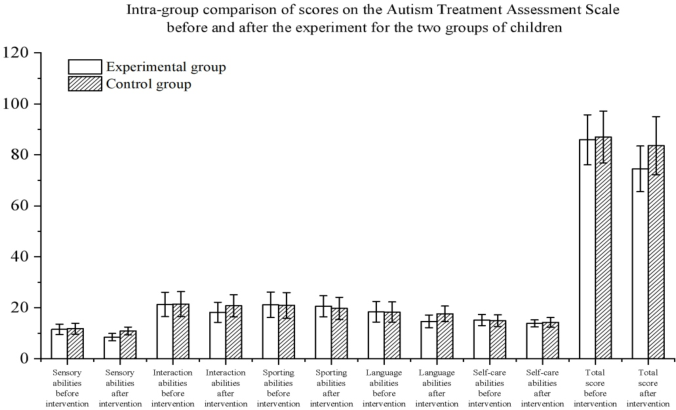
Comparison of the Scores of the Autism Treatment Assessment Scale Before and After the Experiment Between the Two Groups of Children With Autism As shown in Figure 2, it can be concluded from the experiment that the scores of the four indicators of language ability, communicative ability, sensory abil- ity, and total score decreased significantly, and the difference was statistically significant at P < 0.05. In contrast, there was no significant change in the self-care and motor ability scores, with P > 0.05.
Figure 2: Intra-group comparison of scores on the autism treatment assessment scale before and after the experiment for the two groups of children.
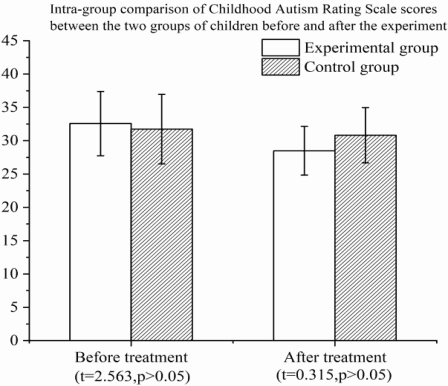
Comparison of the Scores of the Childhood Autism Rating Scale Before and After the Experiment Between the Two Groups of Children With Autism As shown in Figure 3, there was no significant difference between the scores of the two groups of children before and after the experiment, P > 0.05.
Figure 3: Intra-group comparison of childhood autism rating scale scores between the two groups of children before and after the experiment.
DISCUSSION
Digital art expression therapy is playing an increasingly important role in supporting the rehabilitation of children with autism. In this study, by using digital art expression therapy in combination with conventional rehabilita- tion training, after treating them for a period of eight weeks, we found that it could improve the symptoms of children with autism and develop their ability to communicate with others and express themselves verbally.
Improve the Speech and Language Skills of Children With Autism As children with autism have difficulties in communicating, interventions for children with autism through digital art emotional expression therapy guide children to share their feelings through language. Through digital art, chil- dren with autism are able to have simple conversations with teachers and classmates around them, but are still less motivated to communicate with strangers (Zantinge et al., 2017). Children with autism maintain a desire to communicate with them despite their difficulties in doing so.
Improve the Emotional, and Cognitive Skills of Children With Autism The eight-week digital art expression therapy effectively improved the emo- tional and cognitive skills of children with autism (p < 0.05). When others appreciated their work during the drawing phase, it gave them a sense of satisfaction and increased their engagement.
Digital Art Expression Therapy provides insight into the inner world of children with autism and helps to improve the rehabilitation outcome and develop their verbal and emotional cognitive skills (Gev et al., 2021).
Effect of Digital Art Emotional Expression Therapy on the Rehabilitation of Children 69
CONCLUSION AND FUTURE WORK In this paper, based on the characteristics of children with autism, including cognitive deficits, delayed language development, social interaction diffi- culties, and abnormalities, we have tried to use digital artistic expression therapy combined with conventional psychological rehabilitation training and achieved specific results.
This study mainly adopts the visual aspect to help children with autism in their rehabilitation training. In future work, we will explore how to help children with autism return to everyday life through auditory and olfactory approaches.
ACKNOWLEDGMENT
We thank all the participants of our study for generously dedicating their time.
REFERENCES
American Psychiatric Association, & American Psychiatric Association (Eds.).
(2013). Diagnostic and statistical manual of mental disorders: DSM-5 (5th ed). American Psychiatric Association. Berkovits, L., Eisenhower, A., & Blacher, J. (2017). Emotion Regulation in Young Children with Autism Spectrum Disorders. Journal of Autism and Developmental Disorders, 47(1), 68–79. https://doi.org/10.1007/s10803-016-2922-2 Bitonte, R. A., & De Santo, M. (2014). Art therapy: An underutilized, yet effective
tool. Mental Illness, 6(1). https://doi.org/10.4081/mi.2014.5354 Chandler, S., Howlin, P., Simonoff, E., O’Sullivan, T., Tseng, E., Kennedy, J., Charman, T., & Baird, G. (2016). Emotional and behavioural problems in young children with autism spectrum disorder. Developmental Medicine & Child Neurology, 58(2), 202–208. https://doi.org/10.1111/dmcn.12830 Cibralic, S., Kohlhoff, J., Wallace, N., McMahon, C., & Eapen, V. (2019). A sys-
tematic review of emotion regulation in children with Autism Spectrum Disorder. Research in Autism Spectrum Disorders, 68, 101422. https://doi.org/10.1016/j.ra sd.2019.101422 Day, T. N., Mazefsky, C. A., & Wetherby, A. M. (2022). Characterizing difficulties with emotion regulation in toddlers with autism spectrum disorder. Research in Autism Spectrum Disorders, 96, 101992. https://doi.org/10.1016/j.rasd.2022. 101992 Gev, T., Avital, H., Rosenan, R., Oliver Aronson, L., & Golan, O. (2021). Socio
emotional competence in young children with ASD during interaction with their typically developing peers. Research in Autism Spectrum Disorders, 86, 101818. https://doi.org/10.1016/j.rasd.2021.101818 Liszio, S., Basu, O., & Masuch, M. (2020). A Universe Inside the MRI Scanner: An In- Bore Virtual Reality Game for Children to Reduce Anxiety and Stress. Proceedings of the Annual Symposium on Computer-Human Interaction in Play, 46–57. https: //doi.org/10.1145/3410404.3414263 Mahan, S., & Matson, J. L. (2011). Children and adolescents with autism spectrum
disorders compared to typically developing controls on the Behavioral Assessment System for Children, Second Edition (BASC-2). Research in Autism Spectrum Disorders, 5(1), 119–125. https://doi.org/10.1016/j.rasd.2010.02.007
Mayes, S. D., Calhoun, S. L., & Waschbusch, D. A. (2020). Sluggish cognitive tempo in autism, ADHD, and neurotypical child samples. Research in Autism Spectrum Disorders, 79, 101678. https://doi.org/10.1016/j.rasd.2020.101678 McVey, A. J., Schiltz, H. K., Haendel, A. D., Dolan, B. K., Willar, K. S., Pleiss, S. S.,
Karst, J. S., Carlson, M., Krueger, W., Murphy, C. C., Casnar, C. L., Yund, B., & Van Hecke, A. V. (2018). Social difficulties in youth with autism with and without anxiety and ADHD symptoms: Mcvey et al./Anxiety, ADHD, and social difficulties in autism. Autism Research, 11(12), 1679–1689. https://doi.org/10. 1002/aur.2039 Munley, M. (2002). Comparing the PPAT Drawings of Boys with AD/HD and Agematched Controls Using the Formal Elements Art Therapy Scale. Art Therapy, 19(2), 69–76. https://doi.org/10.1080/07421656.2002.10129340 Nissimov-Nahum, E. (2009). Use of a drawing task to study art therapists’ per-
sonal experiences in treating aggressive children. The Arts in Psychotherapy, 36(3), 140–147. https://doi.org/10.1016/j.aip.2008.12.001 Piergies, A. M. H., Hirota, T., Monden, R., & Zheng, S. (2022). Subgrouping school-aged children on the autism spectrum based on co-occurring psychiatric symptoms. Research in Autism Spectrum Disorders, 95, 101983. https://doi.org/ 10.1016/j.rasd.2022.101983 Roth, A., Broder, D. G., Levy, M., Ishai, R., & Bat Or, M. (2021). Associations
Between Form, Content and Narrative in Person Picking an Apple from a Tree Drawings of Preschool Children. The Arts in Psychotherapy, 72, 101727. https: //doi.org/10.1016/j.aip.2020.101727 Tielsch, A. H., & Allen, P. J. (2005). Listen to them draw: Screening children in primary care through the use of human figure drawings. Pediatric Nursing, 31(4), 320–327. Van Lith, T., Stallings, J. W., & Harris, C. E. (2017). Discovering good practice for
art therapy with children who have Autism Spectrum Disorder: The results of a small scale survey. The Arts in Psychotherapy, 54, 78–84. https://doi.org/10.1016/ j.aip.2017.01.002 Zantinge, G., van Rijn, S., Stockmann, L., & Swaab, H. (2017). Physiological Arousal and Emotion Regulation Strategies in Young Children with Autism Spectrum Disorders. Journal of Autism and Developmental Disorders, 47(9), 2648–2657. https://doi.org/10.1007/s10803-017-3181-6
LISTED IN THE AHFE DIGITAL BOOKSTORE CATALOGUE
Explore the complete digital volume
Human Interaction and Emerging Technologies (IHIET-AI 2024): Artificial Intelligence and Future Applications
Read this individual research paper free through the original publisher, or explore the full digital proceedings book.
ISBN 978-1-958651-96-4
Explore this ISBN in the AHFE Bookstore ↗Listed in the July 2026 bookstore catalogue; search by ISBN to confirm current availability · Digital book purchase optional