Under the epidemic situation of Covid-19, many companies are promoting telecommuting to protect employees' health. At the same time, telecommuting created an additional communication barrier for people to communicate with their colleagues or express their feelings. Stress can lead to health problems and burnout. In this paper, we propose AffectiveTree, a dynamic painting that can visualize collective stress among Chinese telecommuters in an abstract way. According to the stress level and duration of the Chinese telecommuters, the shape and color of the trees in the painting will be morphed. We used participatory design to involve the user in the design of the AffectiveTree and to verify its effectiveness and usability. The result showed that this dynamic painting could visualize the stress level of Chinese telecommuters through dynamic abstract art, and it can relieve their stress.
The Coronavirus Disease 2019 (COVID-19) pandemic was declared a “Pub- lic Health Emergency of International Concern” by the World Health Orga- nization (WHO) on 30 January 2020. WHO indicated that in the first year of the epidemic, the global prevalence of anxiety and depression increased by 25%. Isolation periods, mandatory lockdowns, social distancing policies, loss of jobs, and future confusion combined affect the mental health of work- ers and citizens (Giorgi et al., 2020). The pandemic has changed the work systems and management. In particular, telecommuting has been promoted globally as a countermeasure against COVID-19 infection.
Telecommuting can eliminate the potential risk of infection at the work- place and enhance a sense of security among telecommuters. However, telecommuting also has a few drawbacks that cause emotional distress to telecommuters(Gajendran & Harrison, 2007). For example, telecommuting reduces face-to-face interactions and communication between telecommuters and offline colleagues. In this case, telecommuters may weaken their inter- personal bonds with their supervisors or colleagues. Besides, due to the separations in physical space, offline colleagues can not see telecommuters’
AffectiveTree: Visualizing Collective Stress Amongst Chinese Telecommuters 459
efforts and contributions. Some telecommuters may experience anxiety that working alone at home will jeopardize their job prospects (Lansisalmi et al., 2000). Dynamic paintings effectively relieve stress by bringing an enjoyable expe- rience through artistic paintings to lower people’s cortisol levels (Kaimal et al., 2016). Inspired by this, we propose dynamic paintings which can help Chinese telecommuters unobtrusively reduce their stress and help them to relax without disturbing their ongoing work.
The main contributions of our work are:
1. Through dynamic painting, to visualize the stress of Chinese telecom- muters, to help them relieve their stress, keep them in a healthy working and lifestyle, and enhance social interaction. 2. Building a new digital art social media.
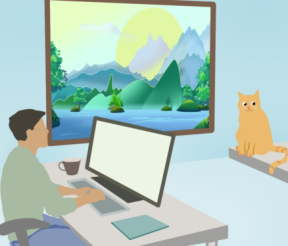
Figure 1: AffectiveTree showed as an animation. A home-based telecommuter using AffectiveTree.
RELATED WORK
HCI Design for Stress Expression There has been increasing interest in studying Stress Visualization from the HCI community. In visual expression, the user’s body of water collected stress-related data with a 3D camera and then visualized the user’s heart rate as water in a specific display. As the user’s stress rose, the water sur- face generated more waves; when the stress dropped, the water got calmer (Jones et al., 2018). ClockViz is an augmented reality installation with static or dynamic projection to visualize three extents of collective stress on a clock (Xue et al., 2017). StressTree is a tree-shaped metaphorical visualization of heart rate variability (HRV) biofeedback system for stress management (Yu et al., 2017).
In addition to expressing emotions through visuals, some HCI research also visualizes stress through sounds. Heart Waves, an experimental ambient feedback system that tracks a user’s heart rate and uses falling water sound to offer feedback in a stressful work environment; the flow rate of water changes according to the heart rate (Ettehadi et al., 2020). EmotiSphere is an interactive sensor-based musical instrument that generates music based on a user’s stress level (Chuang et al., 2015).
Animation for Visualization While animation has long been used as a mass medium that reaches global audiences, researchers and practitioners have just begun exploring its bene- fits (Martin et al., 2018). As a form of visual expression, animation, images, and other visual ways of expression fit in with the human cognitive system and are easier to convey information quickly than textual descriptions(Davis & Landay, 2005). Animation creates a combined audio-visual sensory expe- rience based on static images, conveying information while providing the fun and creativity of audio-visual interaction, enabling more precise, more intuitive delivery of information and enhancing memory and understanding. Animation that combines elements of photography, theatre, music, literature, and other disciplines into a unified whole can be considered a new form of collective stress visualization (Chin et al., 1980).
Animation constitutes active, meaningful, dynamic interventions involving self-discovery, self-awareness, and self-expression. Creative animation pro- duction might be efficacious in treating loneliness, stress, hopelessness, and other symptoms of depression (Tosone et al., 2005).
DESIGN PROCESS Participatory Design
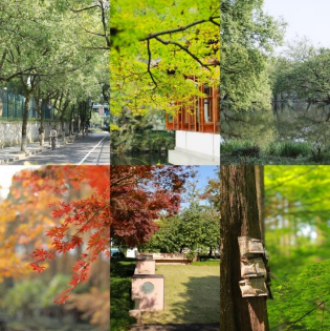
A dynamic art painting was designed to metaphorically present the collec- tive stress of telecommuters without revealing a specific person’s stress and health status. The painting, AffectiveTree, was created through a participa- tory design study with eight participants. The study aimed to understand user preferences for color, shape, and visual style elements. Four sets of pictures with different themes were provided, and participants preferred the plant- themed pictures. They were then asked to sort the plant pictures according to stress and relaxation, and they tended to classify plants with lush leaves as no stress, light yellow plants with few leaves as some stress, and red plants with few leaves as more stress.
The participants’ thoughts on the AffectiveTree animations were also collected, and one participant suggested that slow-moving screen elements would show relaxation while fast-moving screen elements would show stress. Another participant noted that the plant’s shape also impacted the classifica- tion, with smooth outlines indicating relaxation and sharp edges indicating stress.
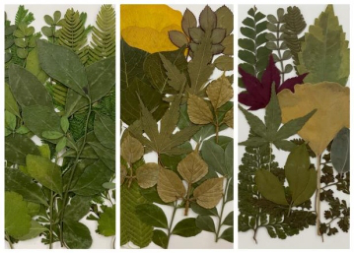
A Dynamic Painting In the second study, eight participants created visualizations for a relaxed and stressed ambiance. We provided participants with several species of plant specimens, which vary in shape and color, to be emailed to these eight telecommuters due to the epidemic. After receiving the specimens of plants, they created them according to the ambiance of stress and relaxation. Based on the artwork created by the eight telecommuters, we animated their work through Adobe XD into a dynamic painting that the telecommuters could see by placing a screen in the working environment or their laptops.
AffectiveTree: Visualizing Collective Stress Amongst Chinese Telecommuters 461
Figure 2: A group of plant-themed pictures for sorting.
Based on the artworks created by the participants, it can be seen that they preferred green to express the non-stress, dry yellow leaves to express the presence of some stress, and red and yellow leaves to express the presence of more stress.
Figure 3: The participants created ArtWorks. It was increasing stress levels from left to right.
Final Design The final design, called AffectiveTree, is a dynamic painting displayed on a screen or laptop, which visualizes the collective stress of telecommuters based on changes in tree shape, color, and the number of leaves, besides visualizing the level of stress according to the speed of change of the painting. Affec- tiveTree does not visualize the stress of a specific telecommuter; it visualizes the average collective stress level. AffectiveTree contains three scenarios, the first showing telecommuters without stress (where the trees are primarily soft green with more leaves), the second showing some telecommuters feel stress (where the trees are primarily dark green or yellowish with fewer leaves), and the third showing all telecommuters with stress (where the trees are primarily red with fewer leaves) (Khut, 2016).
In the AffectiveTree design, we used a combination of trees to visualize collective stress, and research has shown that the combination of multiple data is compelling. Telecommuters do not know the stress status of other colleagues, which avoids exposing privacy. Inspired by participatory design research, this study shows that the shape, color, and number of leaves of a tree change in response to stress levels, with a soft color (light green, which shows vitality and also represents a relaxed state of the telecommuters), changing from a soft light green to a brighter yellow or red as the stress level of the user increases (Bartram et al., 2017). In addition, the duration of stress is also essential. This study reflects the duration of stress in telecommuters through changes in the number of leaves, as this can be dangerous when a person feels stressed for a long time. It is important to note that AffectiveTree is in a hypo- thetical setting and does not use any wearable device to collect physiological data from the user.
Based on the preferences of the eight participants in the participatory design, we made a static design of the AffectiveTree. We then animate the AffectiveTree on Adobe XD.
Figure 4: Scenario 1, telecommuters without stress.Figure 5: Scenario 2, some telecommuters feel stress.
AffectiveTree: Visualizing Collective Stress Amongst Chinese Telecommuters 463
Figure 6: Scenario 3, all telecommuters with stress.
STUDIES Eighty participants were recruited from a Guangzhou-based Internet technol- ogy company that had to telecommute due to the pandemic. The Research and Development department and Operations department were chosen, each with 40 participants. The telecommuters selected were under stress and had consented to participate in the study. Additionally, they had telecommuted for at least one month and had similar job content, workload, and working hours. Personal information was collected from the participants, and they were informed of the study’s entire process.
Employees were recruited according to the criteria mentioned above, and these 80 employees were divided into two groups according to different departments, Group 1 and Group 2 (every 40 employees). In Group 1, the number of female employees was 22. The number of male employees was 18, aged 23 to 40 (32.83±3.41) years, with a duration of stress generation of 1 to 4 (2.63±0.77) months; in Group 2, the number of female employees was 21, and the number of male employees was 19, aged 25 to 40 (32.10±3.66) years, with a duration of stress generation of 1 to 5 (2.50±0.99) months. The differences between the two groups regarding gender, age, and dura- tion of stress were not statistically significant (p > 0.05) and were, therefore, comparable.
Study Materials In this study, we used the following materials: Plant pictures (Sorting cards according to whether they feel stressed or relaxed); Different species of plant specimens (create artwork); A screen or a laptop to show AffectiveTree; Informed consent forms (Each participant need to read and sign); Three scales completed online; Adobe XD: for animation conversion.
Stress Measurement In this study, we measured the stress levels of telecommuters using the PANAS and Perceived Stress scales rather than physiological data. The PANAS includes positive and negative emotions and measures group stress. The Per- ceived Stress Scale measures an individual’s general levels of daily stress in their life (Medvedev et al., 2019). Both scales were administered twice to
the 80 telecommuters - before and after two weeks of AffectiveTree use. The PANAS evaluates energy, concentration, cheerfulness, sadness, apathy, and lethargy, while the Perceived Stress Scale does not ask about specific stress triggers (Watson et al., 1988).
Stress Relief Measurement The WHOQOL-100 scale was used in this study to assess the Affective- Tree for stress relief for telecommuters (Power et al., 1999). According to the World Health Organization, health-related quality of life is defined as the experience of individuals from different cultures and value systems with their goals, expectations, standards, and concerns. Based on this definition, the WHO has developed the WHOQOL-100 scale, which contains 100 ques- tions covering six domains and 24 aspects of quality of life. Similarly, eighty telecommuters will be asked to take the AffectiveTree before and two weeks after using the AffectiveTree.
Data Processing Data were analyzed, and information was measured using SPSS 22.0. t-test for paired samples was used for intra-group comparisons. n(%) was used for numerical calculations, and P<0.05 for comparison between groups.
RESULTS
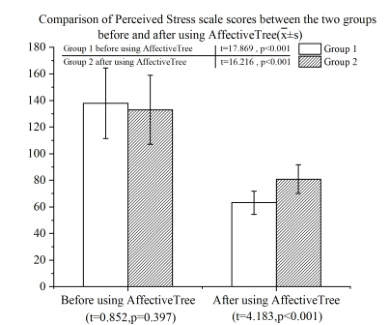
Stress-Related Data Assessment Before using AffectiveTree, the difference in Perceived Stress Scale scores between Group 1 and Group 2 was not statistically significant. After two weeks of using the AffectiveTree, the scores of the Group 1 and Group 2 decreased compared to the pre-using period, with the two groups after using AffectiveTree showing a higher degree of decrease than the pre-using period, with all differences being statistically significant.
Figure 7: Comparison of Perceived Stress scale scores between the two groups before and after using AffectiveTree.
AffectiveTree: Visualizing Collective Stress Amongst Chinese Telecommuters 465
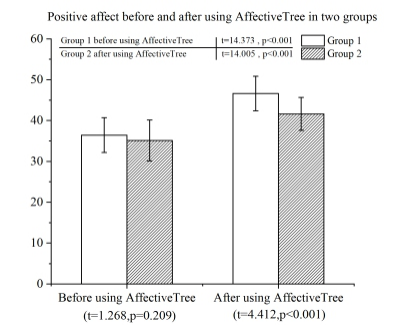
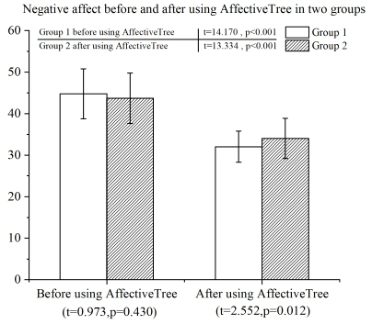
Before using AffectiveTree, there was no statistically significant difference between the two groups on the PANAS scale of positive emotions. After two weeks of telecommuters using AffectiveTree, both Group 1 and Group 2 scored higher than before using AffectiveTree, with the after-using period scoring higher than the pre-using period, and the differences were statistically significant. Before using AffectiveTree, there was no statistically significant difference between the two groups on the PANAS scale of negative emotions. After two weeks of use, the scores of both two groups decreased com- pared to the pre-using period scores, and the differences were all statistically significant.
Figure 8: Positive affect before and after using AffectiveTree in two groups.Figure 9: Negative affect before and after using AffectiveTree in two groups.
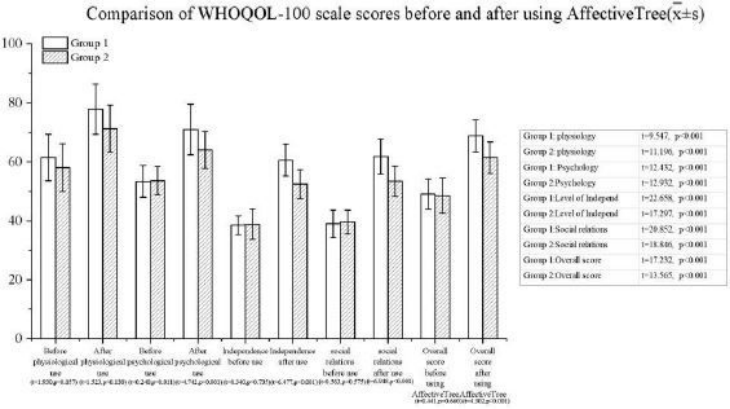
Stress Relief-Related Data Assessment Before using AffectiveTree, there was no statistically significant difference between Group 1 and Group 2 in the WHOQOL-100 scale scores for
physical, psychological, independence, and social relationships. After two weeks of using the AffectiveTree, all four scores increased in two groups, with all differences being statistically significant. There were no statistically significant differences in the physiological indicator evaluation items.
Figure 10: Comparison of WHOQOL-100 scale scores.
DISCUSSION AND CONCLUSION In this study, we propose AffectiveTree, a dynamic painting that visualizes the collective stress of telecommuters. AffectiveTree visualizes collective stress according to the tree’s shape, color, and number of leaves without disturbing the work of the telecommuters. It includes three scenarios, depending on the stress level: telecommuters without stress, some who feel stress, and all who are with stress. The Perceived Stress Scale and PANAS scale were used for the stress-related data assessment, and the WHOQOL-100 scale was used for the stress relief-related data assessment; the results showed that two groups performed better after using AffectiveTree than before using AffectiveTree.
There are also some limitations: 1) For stress measurement, the scale method is used, and due to the epidemic, we do not collect physiological data from users to measure their stress (Giannakakis et al., 2022). 2) The Affec- tiveTree was designed for telecommuters in this study and was not validated for stress relief in other scenarios.
We intend to apply AffectiveTree to more places, such as nursing homes, hospitals, and museums(Ghadim & Daugherty, 2021). Music can have a pos- itive effect on stress relief. Some psychotherapists introduce music therapy (MT) to help patients relieve stress and anxiety to restore, maintain and pro- mote physical and mental health (Yu et al., 2018). Some studies have shown the possibility of using essential oils such as citrus fragrances or rose scents to relieve stress and pain (Amores et al., 2018). Therefore, We plan to add music and scents to AffectiveTree to enrich the application scenario.
AffectiveTree: Visualizing Collective Stress Amongst Chinese Telecommuters 467
ACKNOWLEDGMENT
This research was supported by the Engineering Research Center of Com- puter Aided Product Innovation Design, Ministry of Education, Fundamental Research Funds for the Central Universities 226-2022-00065, National Nat- ural Science Foundation of China (Grant No. 52075478), and National Social Science Foundation of China (Grant No. 21AZD056).
REFERENCES
Amores, J., Hernandez, J., Dementyev, A., Wang, X., & Maes, P. (2018). BioEssence: A Wearable Olfactory Display that Monitors Cardio-respiratory Information to Support Mental Wellbeing. 2018 40th Annual International Conference of the IEEE Engineering in Medicine and Biology Society (EMBC), 5131–5134. https: //doi.org/10.1109/EMBC.2018.8513221 Bartram, L., Patra, A., & Stone, M. (2017). Affective Color in Visualization. Pro-
ceedings of the 2017 CHI Conference on Human Factors in Computing Systems, 1364–1374. https://doi.org/10.1145/3025453.3026041 Chuang, G., Wang, S., Burns, S., & Shaer, O. (2015). EmotiSphere: From Emotion to Music. Proceedings of the Ninth International Conference on Tangi- ble, Embedded, and Embodied Interaction, 599–602. https://doi.org/10.1145/ 2677199.2688809 Davis, R. C., & Landay, J. A. (2005). Forms of Expression for Designing Visual
Languages for Animation. 2005 IEEE Symposium on Visual Languages and Human-Centric Computing (VL/HCC’05), 327–328. https://doi.org/10.1109/VL HCC.2005.39 Ettehadi, O., Jones, L., & Hartman, K. (2020). Heart Waves: A Heart Rate Feedback System Using Water Sounds. Proceedings of the Fourteenth International Conference on Tangible, Embedded, and Embodied Interaction, 527–532. https: //doi.org/10.1145/3374920.3374982 Gajendran, R. S., & Harrison, D. A. (2007). The good, the bad, and the unknown
about telecommuting: Meta-analysis of psychological mediators and individual consequences. Journal of Applied Psychology, 92(6), 1524–1541. https://doi.org/ 10.1037/0021-9010.92.6.1524 Ghadim, M. R., & Daugherty, L. (2021). Museum-based Art Therapy: A Collaborative Effort with Access, Education, and Public Programs (1st ed.). Routledge. https://doi.org/10.4324/9781003014386 Giannakakis, G., Grigoriadis, D., Giannakaki, K., Simantiraki, O., Roniotis, A., &
Tsiknakis, M. (2022). Review on Psychological Stress Detection Using Biosignals. IEEE Transactions on Affective Computing, 13(1), 440–460. https://doi.org/10. 1109/taffc.2019.2927337 Giorgi, G., Lecca, L. I., Alessio, F., Finstad, G. L., Bondanini, G., Lulli, L. G., Arcangeli, G., & Mucci, N. (2020). COVID-19-Related Mental Health Effects in the Workplace: A Narrative Review. International Journal of Environmental Research and Public Health, 17(21), 7857. https://doi.org/10.3390/ijerph17217857 Jones, L., Gardner, P., & Puckett, N. (2018). Your Body of Water: A Display
that Visualizes Aesthetic Heart Rate Data from a 3D Camera. Proceedings of the Twelfth International Conference on Tangible, Embedded, and Embodied Interaction, 286–291. https://doi.org/10.1145/3173225.3173284 Kaimal, G., Ray, K., & Muniz, J. (2016). Reduction of Cortisol Levels and Participants’ Responses Following Art Making. Art Therapy, 33(2), 74–80. https: //doi.org/10.1080/07421656.2016.1166832
Khut, G. (Poonkhin). (2016). Designing Biofeedback Artworks for Relaxation. Proceedings of the 2016 CHI Conference Extended Abstracts on Human Factors in Computing Systems, 3859–3862. https://doi.org/10.1145/2851581.2891089 Lansisalmi, H., Peiro, J. M., & Kivimaki, M. (2000). Collective stress and coping in
the context of organizational culture. European Journal of Work and Organiza- tional Psychology, 9(4), 527–559. https://doi.org/10.1080/13594320050203120 Martin, L., Oepen, R., Bauer, K., Nottensteiner, A., Mergheim, K., Gruber, H., & Koch, S. (2018). Creative Arts Interventions for Stress Management and Prevention—A Systematic Review. Behavioral Sciences, 8(2), 28. https://doi.org/ 10.3390/bs8020028 Medvedev, O. N., Krägeloh, C. U., Hill, E. M., Billington, R., Siegert, R. J., Webster,
C. S., Booth, R. J., & Henning, M. A. (2019). Rasch analysis of the Perceived Stress Scale: Transformation from an ordinal to a linear measure. Journal of Health Psychology, 24(8), 1070–1081. https://doi.org/10.1177/1359105316689603 Power, M., Bullinger, M., Harper, A., & The World Health Organization Quality of Life Group. (1999). The World Health Organization WHOQOL-100: Tests of the universality of quality of life in 15 different cultural groups worldwide. Health Psychology, 18(5), 495–505. https://doi.org/10.1037/0278-6133.18.5.495 Tosone, C., Gelman, C. R., & McVeigh, L. (2005). Through Their Own Eyes: A
Media-Based Group Approach to Adolescent Trauma. International Journal of Group Psychotherapy, 55(3), 415–432. https://doi.org/10.1521/ijgp.2005.55.3. 415 Watson, D., Clark, L. A., & Tellegen, A. (1988). Development and validation of brief measures of positive and negative affect: The PANAS scales. Journal of Personality and Social Psychology, 54(6), 1063–1070. https://doi.org/10.1037/0022-3514.54. 6.1063 Xue, M., Liang, R.-H., Hu, J., & Feijs, L. (2017). ClockViz: Designing Public
Visualization for Coping with Collective Stress in Teamwork. In M. B. Alonso & E. Ozcan (Eds.), Proceedings of the Conference on Design and Semantics of Form and Movement—Sense and Sensitivity, DeSForM 2017. InTech. https: //doi.org/10.5772/intechopen.71220 Yu, B., Funk, M., Hu, J., & Feijs, L. (2017). StressTree: A Metaphorical Visualization for Biofeedback-assisted Stress Management. Proceedings of the 2017 Conference on Designing Interactive Systems, 333–337. https://doi.org/10.1145/ 3064663.3064729 Yu, B., Funk, M., Hu, J., & Feijs, L. (2018). Unwind: A musical biofeedback
for relaxation assistance. Behaviour & Information Technology, 37(8), 800–814. https://doi.org/10.1080/0144929x.2018.1484515
Read this individual research paper free through the original publisher, or explore the full digital proceedings book.
ISBN 978-1-958651-87-2
Explore this ISBN in the AHFE Bookstore ↗Listed in the July 2026 bookstore catalogue; search by ISBN to confirm current availability · Digital book purchase optional