Lori Basham, Barry Shender, Bethany Shivers, Andrew Koch, Kenneth Ritchey (2025). Digital Human Modeling for Naval Aviation: Past, Present, and Future. In: Accessibility, Assistive Technology and Digital Environments. AHFE Open Access, vol. 162, pp. 222–232. https://doi.org/10.54941/ahfe1006029
Digital Human Modeling (DHM) has been used to inform U.S. Navy (USN) aircraft acquisition programs such as F-35, CH-53K, and others for decades. Historically, the primary focus of Naval Air Warfare Center Aircraft Division’s (NAWCAD) DHM efforts has been anthropometric accommodation (reach, vision, clearances) for aircrew and aircraft maintainers. A variety DHM applications (e.g., SAFEWORK/Delmia/Envision, RAMSIS, Jack/Process Simulate Human, Santos) have been used by Department of Defense (DoD) subject matter experts and/or aircraft manufacturers. DoD contributions to DHM capabilities have included software development, validation, and the development of multivariate use cases for inclusion in requirements specifications and related modeling efforts. Use of DHM is essential for evaluation of design early in the acquisition lifecycle to reduce cost and development time, however, there are a number of limitations that can impact modeling fidelity that must acknowledged. Examples include a lack of representative anthropometric data and manikins, users with no previous Human Factors and Ergonomics exposure/expertise, users with little understanding of aircrew and maintainer operations and environment, and modeling evaluations relying on guesswork regarding positioning and posture of manikins without accurately representing factors like cushion compression, flesh compression, aircrew clothing and equipment, postural variation, and restraint systems. Although acute injury risk due to crash or ejection has been successfully modeled for many years, recent Fleet requirements indicate the need to predict the risk of chronic musculoskeletal pain/injury as well. A variety of efforts to develop biomechanical modeling applications and assessments of ergonomics tools in commercially available DHM applications are currently underway to support ongoing initiatives. An architectural framework supporting integration of current and future human modeling software is in development. A collaborative U.S. Air Force and USN project to collect empirical data on fully equipped personnel in a variety of aircraft seating to develop posture models, support DHM tool development, and improve modeling fidelity is also underway. Proposed future efforts include development of a variety of publicly available modeling tools to include: parametric accommodation models, head and hand models, shape models, and poseable parametric finite element human models that use USN/USMC aircrew, aviator, and general population databases and 3D scan data to allow accurate representation of distinct populations. This presentation will document the DHM journey for Naval Aviation, highlighting past, present, and future efforts of NAWCAD and their collaborators.
Digital Human modeling (DHM) is an essential tool for the evaluation of design alternatives early and iteratively in the acquisition lifecycle, significantly reducing cost and development time. DHM has been in use on U.S. Naval (USN) and other Department of Defense (DoD) aircraft acquisition programs for over 25 years. This paper will explore historical use, limitations and lessons learned, current efforts to improve capabilities/fidelity, and discuss proposed future fidelity improvement efforts.
HISTORICAL USE OF DHM FOR DOD AIRCRAFT ACQUISITION PROGRAMS DHM has been used extensively for aircrew anthropometric accommodation evaluations (reach, vision, clearances) for several USN aircraft applications, such as F-35B/C, CH-53K, T-6A/B, and MH-60R NexGen Gunner Seat. DHM was also used to evaluate maintenance tasks on F-35 and CH-53K.
Digital Human Modeling for Naval Aviation: Past, Present, and Future 223
Commercially available software used included Safework/Delmia and Envision. The U.S. Air Force (USAF) also relied on DHM analysis for the F-35A, T-6A, and F-16 cockpit accommodation. F-16 maintenance tasking was also modeled (Abshire and Barron, 1998). Modeling analysis has been typically performed by aircraft manufacturers and reviewed by DoD subject matter experts (SMEs), but not in all cases. The U.S. Army (USA) developed in-house DHM capability and expertise using Jack and has supported numerous Program Offices (Hicks et al., 2010). The Australian Defence Science and Technology Organisation’s Air Operations Division published a detailed review of Jack that includes an interesting historical overview of the evolution of DHM tools through 2010 as well as examples of modeling applications and validation efforts by military SMEs (Blanchonette, 2010).
LIMITATIONS OF DHM FOR DOD AIRCRAFT ACQUISITION PROGRAMS AND EFFORTS TO MITIGATE LIMITATIONS DHM User Areas of Concern
DHM tools are not known for their usability. They can be difficult to navigate and have a steep learning curve. Setting up the modeling effort can be extremely time-consuming, especially for a complicated dynamic task requiring multiple digital manikins such as an aircraft engine removal. Using DHM requires the ability to work well in 3D space, which can present challenges. DHM is not recommended for the casual or infrequent user. In many cases, there is a shortage of DHM expertise, with just one SME modeling for a variety of efforts. This is risky. A good job offer or onset of a health issue for a lone DHM SME can kill an organization’s modeling capability and bring it right back to ground zero.
Another important consideration is that DHM users are often engineers with little or no human factors and ergonomics education or expertise. This can lead to a variety of modeling missteps. It is also uncommon for industry DHM users to have a good understanding of military flight or maintenance operations, which can impact modeling fidelity. A very simple example is that industry modelers will often place manikin feet on aircraft rudder pedals in a non-operational position. Another example is positioning the manikin in a helicopter reaching for the cyclic stick with the arm hanging in mid-air. Helicopter pilots do not fly this way. They fly with their forearm resting on their thigh. DHM users without human factors expertise simply don’t know what they don’t know, and this can lead to serious modeling blunders. This illustrates the importance of having DoD modeling SMEs and end-users (aircrew, maintainers) involved in modeling efforts.
Anthropometry Pitfalls DHM users are subject to a wide variety of anthropometric errors, whether due to limitations of the modeling tool or user lack of expertise. One issue is the use of manikins that do not represent the intended population. Using manikins representing the civilian population for the general military population is inappropriate. Many commercially available DHMs do have
the USA Anthropometric Survey (Gordon et al., 2012) included, but even that should not be applied to every military application. The U.S. Marine Corps (USMC) is a different population anthropometrically than the USA. USN/USMC pilots are a very different population from the USN/USMC general population. Why the differences? The majority of anthropometric variation is explained by age, sex, and race/ethnicity (Bradtmiller et al., 1995; ISO, 2012). If the demographic characteristics of populations are different, the anthropometric characteristics will be as well. And yes, the demographics are different between the services, between enlisted and officers, and between different occupations. One special case is USN/USMC aviators and naval flight officers (NFOs). They are required to anthropometrically qualify by fitting within anthropometric restriction codes (ARCs) that are established to ensure safety of flight. Student aviators and NFOs must meet the ARCs for their eventual assigned aircraft model, as well as all aircraft in their training pipeline. This means that not only are these two populations different from other military officers, but they are also different across each aircraft model. It is important the DHM users know what their target population is, and ensure the manikins they use represent that target population.
Another consideration is that the anthropometric measurements included and/or adjustable in some DHM tools may not be the ones needed for some applications or ones that align with DoD standardized anthropometric measurements (Gordon et al., 2012) and cited in MIL-STD-1472H (Department of Defense, 2020).
Sometimes the measurements of most importance to an evaluation are overlooked. A common example is when a manikin is pulled from the software library without the user fully understanding its anthropometric breakdown. A manikin with a 5th percentile female stature or 95th percentile male stature may be used to evaluate a seated workstation where stature is irrelevant. In this case, what is essential for evaluating shin clearance is buttock-knee length, because evaluation of overhead clearance sitting height matters, and for assessing ability to reach design eye point, sitting eye height matters. Stature does not. There has been a movement since the mid-1990s to move away from a percentiles-based or univariate approach to anthropometrics and more towards a multivariate approach. A method to create multivariate use cases via principal components analysis (PCA) was developed (Zehner et al., 1993) and the JPATS (Joint Primary Aircraft Training System) cases 1–7 were a result. These cases, or an update to them have been used as requirements for T-6, F-35, and CH- 53K, and some DHM software libraries include manikins using these multivariate cases. The JPATS cases are only meant to represent pilots, which prompted the F-35 program to develop multivariate use cases for aircraft maintainers as well. These cases have been used on the CH-53K program to construct appropriate DHM manikins. The use of PCA or boundary cases, as they are also referred to, as DHM manikins was also corroborated by Hogberg and Case (2007), who suggested that predefined manikin families be provided to make it “easier to do it correctly” for users. More recent studies comparing univariate to multivariate methods
Digital Human Modeling for Naval Aviation: Past, Present, and Future 225
also confirm the benefits of multivariate accommodation (DaSilva et al., 2020). Unfortunately, change has been slow and percentiles continue to make their way into many requirements specifications and DHM tools. This needs to change. The Human Factors and Ergonomics Society released their Guidelines for Using Anthropometric Data in Product Design (HFES, 2004) detailing the issues with percentiles and providing a variety of anthropometric guidance. MIL-STD-1472H (Department of Defense, 2020) included significant changes to the anthropometry section to ensure use of multivariate accommodation and clarify the need to consider male and female populations separately, not combined (Table 1).
Table 1: Human engineering anthropometry standards (Department of Defense, 2020).
Table available in the original PDF paper.
Paragraph Anthropometric Accommodation Standard 5.8.3.1 General Unless otherwise specified (see 6.2), the design of DoD
Unless otherwise specified (see 6.2), for systems and
systems, equipment, and facilities shall accommodate the multivariate central 90 percent (95 percent preferred) of suitably clothed and equipped males of the target user population and the multivariate central 90 percent (95 percent preferred) of the suitably clothed and equipped females of the target user population using dimensions applicable to the tasks (see 3.2.10). 5.8.3.2 Life-critical systems and equipment
equipment that are life-critical (e.g., accessibility of safety interlocks, clearances for ejection seats, fit of gas masks), the design for all physical factors (size, shape, weight, reach, strength, and endurance) shall accommodate the multivariate central 99 percent of suitably clothed and equipped males of the target user population and the multivariate central 99 percent of suitably clothed and equipped females of the target user population using dimensions applicable to the tasks (see 3.2.10).
DHM Fidelity and Validation DHM fidelity, or the ability of the model to accurately represent the real world has been and continues to be a topic of concern. While the Computer Aided Design (CAD) of the aircraft may be accurate (assuming adequate configuration control of the CAD), can we be confident that other aspects of the model are really representative? At this time, DoD Aircrew Accommodation and DHM SMEs are not confident enough in DHM to rely on it for requirements verification or source selection purposes, especially with anthropometric accommodation a critical requirement to determine safety of flight. Instead, mock-ups are built and evaluated as soon as preliminary design allows with iterative physical evaluations as design changes occur. The USAF has made efforts to validate DHM software (Hudson and Zehner, 1998; Hudson et al., 2000; Oudenhuijzen et al., 2002), a small validation trial was conducted by the USA as part of their RAH-66
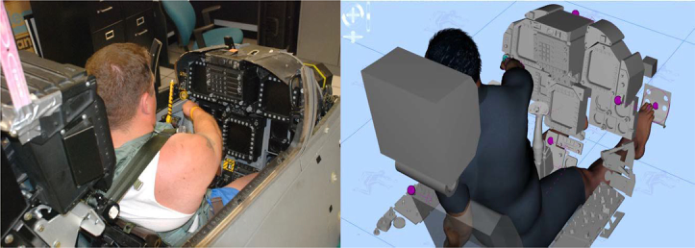
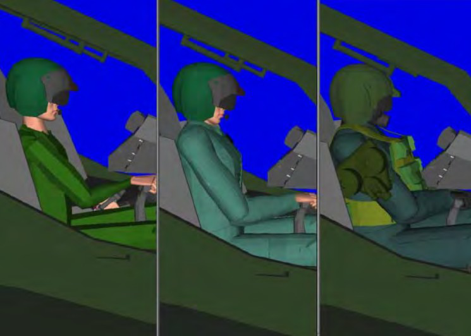
program (Kozycki and Gordon, 2002), and the USN assessed fidelity of reach prediction in Santos using participant custom manikins (Figure 1). These efforts yielded mixed results and full validation of any DHM modeling tools for military aviation applications has not been completed to date. Modeling fidelity is a challenge since it is difficult for DHM to accurately account for posture variation, cushion compression, flesh compression, restraint system properties and their impact on reach, and the effect of the substantial amount of clothing and flight equipment worn by military aircrew. In the absence of empirical data, posture models, or software libraries containing representative clothing and flight equipment, DHM users must rely on guesswork to position/posture manikins. Figure 2 illustrates differences in DHM modeling when representative clothing and equipment are added to the model.
Figure 1: USN DHM reach prediction validation effort.Figure 2: Jack manikin seated in AH-64 with various equipment ensembles (Hicks et al., 2010).
Currently, NAWCAD is collaborating with the USAF Airmen Accommodation Lab (AAL) to support their efforts to collect quantitative data to create a seat specific posture model (SSPM) for pilots. The AAL is collecting the position and postural data of the ejection seat mock-up,
Digital Human Modeling for Naval Aviation: Past, Present, and Future 227
while NAWCAD will assess various helicopter seats. Each of the mock- ups will include adjustable seats and control locations. The SSPM can be applied to DHM software (RAMSIS) and can generate statistical models and accommodation modeling tools for CAD. DHM fidelity profiles are being created by using non-pilot test participants of specific body sizes. These profiles will help to better understand the impacts of tissue and seat deformation, realistic initial posture/positioning, encumbering gear, and restraint systems. The fidelity profiles will include postural data in the form of joint angles, positional data, and reach performance to controls. The reach data is being collected under several conditions divided into three zones, including pointing with shoulder fixed, hard reach against locked inertia reel, and reach while pulling out inertia reel restraints. A second population of aviator participants are also being assessed for their preferred pilot posture seat position which will be used to help model for future aircraft acquisitions.
DHM Interoperability Current DHM efforts have been primarily used discrete software packages or applications, each focused on specific DHM modeling domains. For instance, RAMSIS for ergonomics and LS-DYNA for dynamic modeling and crash analysis. Many of these software tools do not have robust interoperability, limiting the ability to conduct a streamlined, whole lifecycle analysis. When conducting an analysis of an aircraft, the anthropometric and ergonomic workflow is completely separated from the assessment of crash dynamics. In many cases, there is a loss of fidelity with this separation. Advanced anthropometric analysis cannot easily be leveraged by the dynamic modeling and crash software, which instead defaults to 50% manikins.
The DoD is currently exploring methods of enhancing interoperability between the existing, well developed DHM tools. Currently, the N201- 009 SBIR (Small Business Innovation Research) project (with BioMojo as the performing company) has shown promise by demonstrating the ability to create multiparametric, simulated digital humans that incorporate anthropometric, biomechanical, and physiological into a user-friendly tool and integrate that data with existing COTS software (e.g., RAMSIS, OpenSim).
Current and future efforts are expected to continue, as interoperability is expected to reduce the barrier to entry for DHM, consolidate scattered modeling efforts throughout the Naval Aviation Enterprise, and reduce the cost of providing robust and accurate verification and validation of Program Office products.
DHM Applications for Chronic Musculoskeletal Pain and Injury Risk Dynamic modeling with anthropomorphic test dummies (ATDs) has been used very successfully to assess risk of acute injury due for crashworthiness and ejection applications. More comprehensive ergonomic or biomechanical modeling assessments have not been the norm, but in response to Fleet feedback and demand for intervention for musculoskeletal pain and injury,
there has been significant focus on modeling of aircrew chronic pain and injury risk and mitigations.
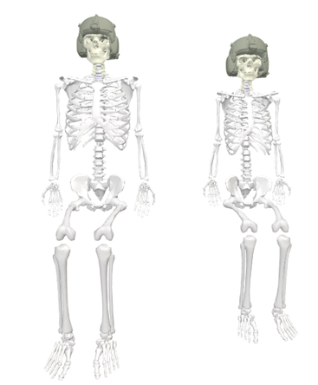
A state-of-the-art computational modeling framework to predict acute exertional muscle pain and pre-endplate failure chronic pain path was developed by CFD Research Corporation (CFDRC) for the USN from 2021-23. Military pilot acute and chronic neck pain characteristics were established to reveal pain generating structures, and defined neck pain by location, character, severity, neck stiffness, onset, duration, and relief measures. The pain causing structures and mechanisms were identified along with pain/damage criteria. Based on this work, design requirements were determined for a neck model and assessment tool with predictive methodologies for acute and chronic pain onset. In 2023-25, the initial OpenSim integration was expanded to include the finalized cervical model integrated into whole-body male and female models. The whole-body model was evaluated for ability to predict the response of human subjects in a variety of operationally significant scenarios including using previously recorded experiments that involve head and neck motions while wearing a head-supported mass.
Figure 3: Side-by-side size comparison of the CFDRC large male (left) and small female (right) wearing head-supported mass.
Additionally, using published reports, the review of operational neck pain, and USN medical subject matter expert input, an operational neck pain index (ONPI) was developed to facilitate the documentation, tracking, treatment, and modeling for engineering development, pilot rotation, and mission planning which will facilitate pain tracking by pain-evoking flight events, location, character, severity, neck stiffness, motion effect, onset, duration, and pain relief method (Whitley et al., 2025).
From 2020–2025, NAWCAD has worked with the Office of Naval Research to fund development of the Incapacitation Prediction for Readiness in Expeditionary Domains — an Integrated Computational Tool (I-PREDICT) as a Future Naval Capability. I-PREDICT is a biofidelic
Digital Human Modeling for Naval Aviation: Past, Present, and Future 229
predictive computational model of biomechanical response and risk of injury/trauma and functional incapacitation due to exposure to multi- dimensional hazards — acute and chronic — encountered in military operations. I-PREDICT will enable prediction of injury from: l) low-level repetitive loading, 2) accelerative/blunt loading (e.g., high G-forces), and 3) vibrational loading (such as those experienced by helicopter aircrew). The computational model will be constructed using experimentally derived characterizations of the human body at tissue, organ, regional, and whole- body levels subject to loading conditions representative of those experienced during military operations and validated using data from operationally relevant regional or whole-body injuries. The I-PREDICT tool will help close the gap for materiel and non-materiel solutions to address Warfighter acute and chronic injury through rapid design iteration of aircrew seating and Personal Protective Equipment that optimizes acute/traumatic protection while minimizing factors associated with chronic injury e.g. mass, mass- offset, poor fit, etc.
Another NAWCAD initiative is evaluating Delmia’s ergonomic assessment tools (RULA, REBA, NIOSH equation, Snook and Ciriello, etc.) for aircrew and maintainer posture and task injury risk assessments. Empirical data (posture scan, photographs, interview, anthropometry) are being collected for pilot and maintainer postures/tasks and the ergonomic methods will be applied using traditional techniques and digitally for comparison. Comparisons of manikin postures when placed by user estimation vs. when empirical data (photographs, 3D posture scans) are applied will also be made.
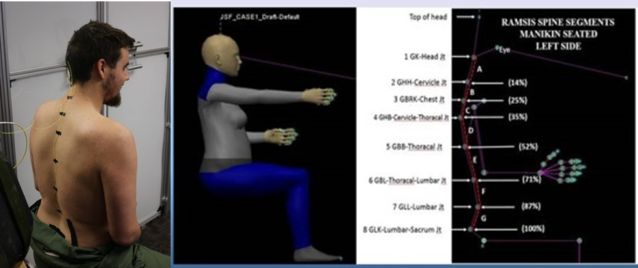
FUTURE USN AVIATION DHM What might the future of USN Aviation DHM look like? There are a variety of innovative technologies and methods that are being explored for their potential to move DHM capabilities forward. There may be opportunities to collect in-flight empirical posture data via fiber optic sensor (Whitestone et al., 2018; Figure 4) or with action cameras and computer vision biomechanics or pose estimation applications (Tambwekar et al., 2024). This data can be used to inform DHM and improve fidelity. New aviator and aircrew databases are in development and will be available soon. Preliminary work is underway to create aircraft specific aviator databases to characterize the population differences resulting from aircraft anthropometric restriction codes (ARCs). There are a variety of parametric head, hand, foot, and body shape models that can incorporate USN aviator and aircrew anthropometry and 3D scans and improve size design, fit prediction, and tariffing outcomes (Park et al., 2021; Lee et al., 2020; Godil, 2009; Goto et al., 2019; Reed et al., 2014). These models can better quantify percent accommodated than multivariate use cases alone. They go beyond traditional linear anthropometric measurements and consider 3D shape, and in some cases, can even account for tissue compression. There is the potential to use 3D and 4D scanning technologies to develop dynamic fit models for clothing and equipment and allow consideration of functional fit required for the user, which is frequently neglected (Griffen
et al., 2019). In addition to 3D shape models, parametric and posable finite element human models based on USN aircrew can be generated to support a variety of modeling applications. Accommodation models that have been developed for USA ground vehicles (Figure 5) could be leveraged to create aircraft specific versions based on USN aircrew anthropometric data and the posture models being developed for the SSPM project (Reed and Ebert, 2020; Reed and Parkinson, 2008; Park et al., 2015). These models provide an option for DHM and anthropometry non-experts to apply the right data on the right population as well as representative postures that consider clothing/equipment, cushion/flesh compression, restraint systems, and posture variation. These accommodation models can be imported into commercially available CAD packages and do not require DHM software at all.
Figure 4: Fiber optic sensor data applied to the RAMSIS DHM (Whitestone et al., 2018).Figure 5: US army ground vehicle systems center accommodation model.
CONCLUSION
There is much ongoing work to complete and future efforts that should be considered to improve current capability limitations. It is also important that the DoD make databases, use cases, DHM manikins, parametric models, and accommodation models publicly available and provide guidance on how to appropriately apply the data and tools. Considering the necessity of incorporating DHM in product design, investments to address current
Digital Human Modeling for Naval Aviation: Past, Present, and Future 231
capability limitations is will result in measurable program cost and time savings.
ACKNOWLEDGMENT
The authors would like to acknowledge all the referenced contributors and/or collaborators from DoD, industry, and academia. Improving DHM is truly a team effort, and we appreciate all your hard work, contributions, and comradery.
REFERENCES
Abshire, K. J., Barron, M. K. (1998). Virtual maintenance real-world applications within virtual environments, in: Annual Reliability and Maintainability Symposium. 1998 Proceedings. International Symposium on Product Quality and Integrity, pp. 132–137. Blanchonette, P. (2010). Jack Human Modelling Tool: A Review. Bradtmiller B, Ratnaparkhi J, Tebbetts I. (1985). Demographic and anthropometric
assessment of the US Army anthropometric data base. Technical Report NATICK/ TR-86/004 (AD A164 647). US Army Natick Research Development and Engineering Center, Natick, MA. Da Silva, G. V., Zehner, G. F. and Hudson, J. A. (2020). ‘Comparison of univariate and multivariate anthropometric design requirements methods for flight deck design application’, Ergonomics, 63(9), pp. 1133–1149. Department of Defense. (2020). MIL-STD-1472H, “Design Criteria Standard:
Human Engineering”. Godil, A. (2009). Facial Shape Analysis and Sizing System, in: Duffy, V. G. (Ed.), Digital Human Modeling, Lecture Notes in Computer Science. Springer Berlin Heidelberg, Berlin, Heidelberg, pp. 29–35. Goto, L., Huysmans, T., Lee, W., Molenbroek, J. F. M., Goossens, R. H. M.
(2019). A Comparison Between Representative 3D Faces Based on Bi- and Multi- variate and Shape Based Analysis, in: Proceedings of the 20th Congress of the International Ergonomics Association (IEA 2018). Gordon, C. C., Blackwell, C. L., Bradtmiller, B., Parham, J. L., Barrientos, P., Paquette, S. P., Corner, B. D., Carson, J. M., Venezia, J. C., Rockwell, B. M., Mucher, M., Kristensen, S. (2012). 2012 Anthropometric Survey of U.S. Army Personnel: Methods and Summary Statistics. Griffin, L., Kim, N., Carufel, R., Sokolowski, S., Lee, H., Seifert, E. (2019).
Dimensions of the Dynamic Hand: Implications for Glove Design, Fit, and Sizing. In: Chung, W., Shin, C. (eds) Advances in Interdisciplinary Practice in Industrial Design. AHFE 2018. HFES. (2004). Guidelines for Using Anthropometric Data in Product Design. Human Factors and Ergonomics Society. Hicks, J. S., Durbin, D. B., Kozycki, R. W. (2010). An Overview of Human Figure
Modeling for Army Aviation Systems: Defense Technical Information Center, Fort Belvoir, VA. Högberg, D., Case, K. (2007). Predefined Manikins to Support Consideration of Anthropometric Diversity by Product Designers, in: Duffy, V. G. (Ed.), Digital Human Modeling. Springer, Berlin, Heidelberg, pp. 110–119. Hudson, J. A. and Zehner, G. F. (1998), “Development of human model validation methods for cockpit accommodation evaluation”, in Proceedings of SAFE Association Annual Symposium, 36th, Phoenix, AZ, 14–16 September, pp. 245–249.
Hudson, J. A., Oudenhuijzen, A., Zehner, G. F. (2000). Digital Human Modelling Systems: A Procedure for Verification and Validation Using the F-16 Crew Station. Proceedings of the Human Factors and Ergonomics Society Annual Meeting 44, 723–726. ISO 15535:2012, (2012). General requirements for establishing anthropometric
databases. International Organization for Standardization, Geneva. Kozycki, R. and C. C. Gordon. (2002). Applying human figure modeling tools to the RAH-66 Comanche crewstation design. in Digital Human Modeling Conference. 2002. Munich, Germany: SAE International. Lee, W., Kim, J.-G., Molenbroek, J. M. F., Goossens, R. H. M., You, H. (2020).
Estimation of Facial Contact Pressure Based on Finite Element Analysis, in: Di Nicolantonio, M., Rossi, E., Alexander, T. (Eds.), Advances in Additive Manufacturing, Modeling Systems and 3D Prototyping. Springer International Publishing, Cham, pp. 657–667. OudenhuijzenA.J.K.,Zehner G.F.,Hudson J.A.(2002).Verification and Validation of Human. Modeling Systems (Report TNO-TM-02-A007). Park, J., Ebert, S., Reed, M., & Hallman, J. (2015). Statistical Models for Predicting
Automobile Driving Postures for Men and Women Including Effects of Age. Human Factors, 58. Park, B.-K. D., Corner, B. D., Hudson, J. A., Whitestone, J., Mullenger, C. R., Reed, M. P. (2021). A three-dimensional parametric adult head model with representation of scalp shape variability under hair. Applied Ergonomics 90, 103239. Reed, M., Parkinson, M., (2008). Modeling Variability in Torso Shape for Chair and
Seat Design, Proceedings of the ASME Design Engineering Technical Conference. Reed, M. P., Raschke, U., Tirumali, R., and Parkinson, M. B. (2014). Developing and implementing parametric human body shape models in ergonomics software. Proc. 3rd International Digital Human Modeling Conference. Tokyo, Japan. Reed, M. P., & Ebert, S. M. (2020). Development of Driver Posture Prediction and
Accommodation Models for Military Vehicles: Fixed-Eye-Point, Out-of-Hatch, and Highly Reclined Driver Configurations [Technical Report]. University of Michigan, Ann Arbor, Transportation Research Institute. Tambwekar, A., Park, B.-K. D., Kusari, A., & Sun, W. (2024). Three-Dimensional Posture Estimation of Vehicle Occupants Using Depth and Infrared Images. Sensors (Basel, Switzerland), 24(17), 5530. Whitestone, J., Hudson, J. A., Rife, B. (2018). Determining Spinal Posture for
Encumbered Airmen in Crewstations Using the Luna Positioning Sensor. Defense Technical Information Center, Fort Belvoir, VA. Whitley PE, Shender BS, Shivers BL. (2025). Initial Evaluation of the Operational Neck Pain Index. Aerosp Med Hum Perform, 96(5), in press. Zehner, G., Meindl, R., Hudson, J. (1993). A Multivariate Anthropometric Method
for Crew Station Design. Defense Technical Information Center, Fort Belvoir, VA.
LISTED IN THE AHFE DIGITAL BOOKSTORE CATALOGUE
Explore the complete digital volume
Accessibility, Assistive Technology and Digital Environments
Read this individual research paper free through the original publisher, or explore the full digital proceedings book.
ISBN 978-1-964867-38-0
Explore this ISBN in the AHFE Bookstore ↗Listed in the July 2026 bookstore catalogue; search by ISBN to confirm current availability · Digital book purchase optional