1 Intelligent and Interactive Systems Laboratory, Universidad de Las Américas, Quito, Ecuador; Facultad de Tecnologías de Información,Universidad Latina de Costa Rica, San José, Costa Rica; Facultad de Ingeniería y Ciencias Aplicadas, Universidad de Las Américas, Quito, Ecuador ↗
2 Departamento de Informática y Ciencias de la Computación, Escuela Politécnica Nacional, Quito, Ecuador ↗
3 Facultad de Medicina, Pontificia Universidad Católica del Ecuador, Quito, Ecuador ↗
4 Facultad de Psicología, Pontificia Universidad Católica del Ecuador, Quito, Ecuador ↗
5 Centro de Investigación en Ciencias Humanas y de la Educación - CICHE, Universidad Tecnológica Indoamérica, Quito, Ecuador ↗
6 One Health Research Group, Universidad de las Américas, Quito, Ecuador ↗
7 Intelligent and Interactive Systems Laboratory, Universidad de Las Américas, Quito, Ecuador; Facultad de Enfermería, Pontificia Universidad Católica del Ecuador, Quito, Ecuador ↗
8 Facultad de Enfermería, Pontificia Universidad Católica del Ecuador, Quito, Ecuador ↗
9 Facultad de Comunicacion y Artes Visuales, Universidad de Las Américas, Quito, Ecuador ↗
Ensuring accessibility to educational resources on respiratory therapies is crucial for patients and healthcare professionals to access accurate and up-to-date information. However, not all websites and resources meet accessibility standards, making it difficult for those with disabilities to access them. Multimedia resources, especially videos, pose unique challenges in terms of accessibility, but it is essential to develop methods and tools to assess and improve accessibility. This research applied a manual review method to evaluate video content with WCAG 2.1 guidelines. The results revealed that while the most complied with is the "perceptible" principle, with a compliance rate of 34.1%, the AA level, which is the appropriate level according to WCAG 2.1, is not reached. These findings emphasize the need for further efforts to improve the accessibility of educational resources, especially multimedia resources. This research can contribute to future studies and computer applications and help reduce the digital divide. The development of accessible educational resources is vital for promoting equal opportunities for all individuals to access and benefit from such resources, regardless of their physical or cognitive abilities. The findings of this study highlight the importance of continuous efforts to improve the accessibility of multimedia resources, which will ultimately lead to a more inclusive and accessible society.
Accessibility to educational resources for respiratory therapies is a topic of great interest in the healthcare community. The study (Song et al., 2020) pointed out that access to information and resources is essential for patients, carers, and healthcare professionals to provide optimal care and manage. Moreover, a study (Gilmutdinova et al., 2021) about the COVID-19 pande- mic has highlighted the importance of providing accessible information on respiratory therapies, especially for post-COVID-19 patients.
Digital tools and technology can help improve the accessibility of educa- tional resources in respiratory therapy (Sleurs et al., 2019) argue that digital health technologies, including mobile apps and telemedicine, can improve patient engagement, self-management, and adherence to therapy. However, not all digital resources meet accessibility standards; the article (Patricia Acosta-Vargas et al., 2022) argues that most digital health tools have limi- ted or no accessibility features, which may limit their usefulness for people with disabilities. Therefore, it is essential to develop methods and tools to assess and improve the accessibility of digital resources, especially multime- dia content such as videos, which are widely used in therapeutic education. The research (Acosta et al., 2020) mentions that the accessibility of educati- onal videos is crucial to guarantee that all users, regardless of their physical and sensory abilities, can access the information contained in these resources.
The Web Content Accessibility Guidelines (WCAG) 2.1 (World Wide Web Consortium, 2018), proposed by the World Wide Web Consortium, provide a comprehensive set of guidelines for creating accessible digital content. The WCAG 2.1 guidelines cover a wide range of aspects related to accessibility, including visual, auditory, and cognitive accessibility.
These guidelines, combined with a manual review that includes a video accessibility checklist, can help assess the accessibility of multimedia resou- rces (P. Acosta-Vargas et al., 2019) and identify areas for improvement.
In conclusion, ensuring accessibility to educational resources in respira- tory therapy is essential to provide optimal care and managing respiratory conditions. Developing and implementing methods and tools to assess and improve the accessibility of digital resources, especially multimedia content, is a crucial step to reducing the digital divide and promoting inclusive health practices.
The manuscript is structured as follows: Section two presents the back- ground knowledge and related works. Section three describes the method and the case study. The outcomes and analysis are presented in section four. Finally, section five includes the conclusions, limitations, and future work.
BACKGROUND KNOWLEDGE AND RELATED WORKS The article (Zdravkova et al., 2022) analyzes the impact of the COVID-19 pandemic on face-to-face education, particularly for students with disabi- lities. The results indicate that students who switched to distance education experienced a significant decrease in learning outcomes, hindering their active participation in education. However, distance education also allows for modernizing traditional education, which has become the new normal. The
Towards Accessibility in Educational Resources for Respiratory Therapies 451
research examined the accessibility of learning management systems, audio and video teleconferencing applications, and massive open online courses, crucial for transitioning from face-to-face to online education.
The study (Kosova, 2021) applied to a sample of 182 students with a que- stionnaire containing 64 revealed that many respondents have health disor- ders and require easy access to online courses. Respondents also indicated a need for web accessibility features such as closed captioning and transcripts on video lectures, audio descriptions, and customizable web pages. The study highlights the urgent need for specialized learning conditions and e-learning resources that are WCAG 2.1 compliant.
The study (Molanes-Lopez et al., 2021) examines multimedia accessibility, a complex, and time-cask that goes beyond checking for audio descripti- ons and subtitles. The study enlisted novice evaluators who had completed a MOOC on digital content accessibility and divided accessibility evalua- tion into criteria. Two groups of evaluators evaluated two similar videos with different accessibility barriers. Each evaluator rated statements based on WCAG 2.1 criteria, generic information on video accessibility, quality perception, and personal preference. Results showed novice evaluators could identify accessibility issues using specific statements. The study emphasi- zed the importance of certain success criteria and the need for improving accessibility training for novice evaluators.
The study (Acosta et al., 2020) evaluates the accessibility of educatio- nal videos published on YouTube by top-tier universities worldwide. Due to the rapid increase in video consumption on the Internet, it is essential to ensure that everyone, including people with disabilities, has access to education and information. Access to education and information is a fun- damental human right recognized in various international conventions and most countries’ constitutions. However, despite efforts to improve accessi- bility, millions of people are still left out due to the absence of features like subtitles, sign language, and audio descriptions. The study evaluated 91,421 videos from 113 universities for compliance with WCAG 2.1, revealing low levels of accessibility that urgently need improvement.
The research (Salvador-Ullauri et al., 2020) proposes a method to moti- vate the development of computer applications that can reinforce the learning process of students with cognitive problems. The objective is to improve lear- ning new concepts by using accessible video games that comply with the Accessibility Guidelines for Web Content 2.1.
These guidelines include barriers for users with cognitive disabilities, such as those with limited ability to process information, memorize, make decisi- ons, or learn. The proposed method is designed to assess accessibility in video games and can be replicated for users with other types of disabilities. The approach suggests that the review cycle be applied during game development to ensure the final product is more inclusive and accessible.
The authors propose applying a manual review methodology on respi- ratory therapy videos to ensure they comply with the appropriate level of accessibility, which is AA according to WCAG 2.1. To achieve this, we propose a manual review method conducted by experts based on the
Website Accessibility Conformance Evaluation Methodology (WCAG-EM) 1.0, detailed in the following section.
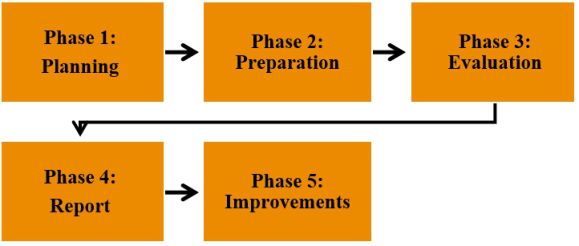
METHOD AND THE CASE STUDY The applied method is a modification of the Website Accessibility Confor- mance Evaluation Methodology (WCAG-EM) 1.0, applied to a sample of the YouTube videos that deal with post covid-19 respiratory therapies “post covid 19 respiratory therapies” that correspond to the videos from February 26 to March 26, 2023, without a duration limit and with greater relevance. The filter issued six thoroughly analyzed videos; this allows us to check if the most recent videos comply with WCAG 2.1. The manual evaluation method includes five phases described in Figure 1.
Phase 1: Planning; in this phase, the video accessibility objectives were defined, as well as the selection of a sample of videos to review, detailed in Table 1; containing the video ID, link, subject, and duration; in addition, an accessibility expert review team and their roles were established.
Figure 1: Method for manual evaluation of videos.Table 1. List of videos to evaluate applying the WCAG 2.1.
Table available in the original PDF paper.
ID Link Theme Duration 0:00:29 V1 https://www.youtube.com/watch? v=iW5IwGZFF0o How BREINEX breathing trainer benefits regular Smokers?
0:00:47
Equation reproduced from the original PDF.
What is Vital Capacity? || #Shorts || Infinity Learn NEET 1:06:40
Equation reproduced from the original PDF.
How can we improve delivery room resuscitation of very sick newborn babies 1:04:00
Equation reproduced from the original PDF.
[Panel Discussion] Your Healthcare Scholarships Experience 0:50:40
Towards Accessibility in Educational Resources for Respiratory Therapies 453
Table 2. Items to validate accessibility in videos.
Table available in the original PDF paper.
Verification Principle Guideline Techniques Accessibility Element
Perceivable 1.1 Text alternatives
Text alternatives for videos
Does the video have captions, transcripts, or audio descriptions?
G94: Providing a short text alternative for non-text content that serves the same purpose and presents the same information as the non-text content
1.4 Contrast (minimum)
Text contrast
Does the text in the video have sufficient contrast with the background?
G183: Using a contrast ratio of 3:1 with surrounding text and providing additional visual cues on focus for user interface components Video descriptions
Does the video have audio descriptions?
1.2.1 Audio-only and Video-only (Prerecorded)
G78: Providing a second, user-selectable audio track that includes audio descriptions of the video content
Operable 2.1 Keyboard accessibility
Video controls
Are the video controls accessible with the keyboard?
G21: Ensuring that users are not trapped in content, functionality, or user interface elements that are operable through a keyboard interface
2.2 Enough time
Video speed Can the video be played at different speeds?
G133: Providing a mechanism for the user to pause, stop, or hide any moving, blinking, scrolling, or auto-updating content Video labeling Understandable 3.1 Readable G141: Organizing a page so that it is consistent and predictable
Does the video have clear and descriptive labels?
3.3 Input assistance
User interface
G162: Positioning labels to maximize the predictability of relationships
Is the user interface of the video player accessible?
Platform accessibility
Robust 4.1.1 Parsing G134: Validating that there are no duplicate ids in forms or that they are otherwise unique on a page
Is the YouTube platform in which the video is being embedded accessible?
4.3.1 Status messages
G58: Placing the interactive elements in an order that follows sequences and relationships within the content
User testing Has user testing been conducted with people with disabilities to validate the accessibility of the video?
Phase 2: Preparation; in this phase, the critical characteristics of the videos were identified, and a set of review criteria based on WCAG 2.1 were defined and detailed in Table 2; which contains the principle, guideline, technique (W3C, 2022), accessible element, and verification according to WCAG 2.1.
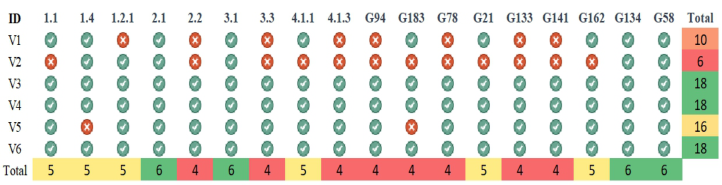
Phase 3: Evaluation; in this phase, a manual review of the selected videos was performed based on the criteria set out in Table 2, and the data was
Figure 2: Review of compliance with accessibility guidelines and techniques.
also recorded in a spreadsheet; accessibility issues were identified and docu- mented. Figure 2 shows the data record and the rest of the information. The data analysis is available in the Mendeley repository (Patricia Acosta-Vargas, 2023) with open access to reproduce this research. Phase 4: Report; in this phase, the evaluation results were summarized using dynamic tables and graphs that showed the errors that are frequently repeated. These can be improved, and a better level of accessibility in the videos can be achieved. The results are discussed in more detail in outcomes and analysis.
Phase 5: Improvements and follow-up; in this phase, it is suggested to apply a follow-up of the recommendations to improve accessibility. We also recommend periodic reviews to ensure the videos comply with accessibility standards.
By applying the WCAG-EM 1.0 methodology of WCAG 2.1, detailed evaluation processes can be followed to ensure that YouTube videos are accessible to all users. This method focuses on identifying accessibility issues and recommending actions needed to improve the accessibility of any video, including educational resources.
OUTCOMES AND ANALYSIS This section presents the results obtained from a manual analysis of videos in which different accessibility guidelines and techniques were applied. The results of this analysis are summarized in Table 3, which includes detailed information on compliance with the four accessibility principles, guideli- nes, success criteria, levels, techniques, and total accessibility compliance of the evaluated videos. This information has been assessed according to the information contained in Tables 1 and 2, detailed in the method section.
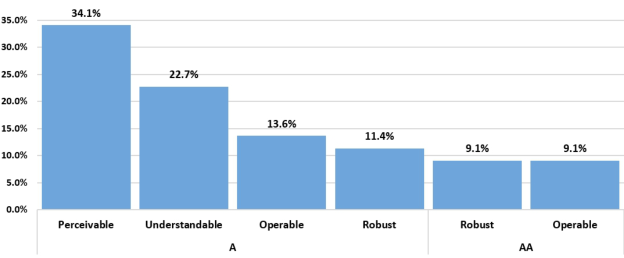
Figure 3 presents the analysis of YouTube videos evaluated according to the guidelines established by WCAG 2.1, revealing that most videos (81.8%) meet only level A for accessibility.
This study indicates that much work is needed to improve the accessibility of these videos and make them accessible to all people. Furthermore, the fact that only 18.2% of the videos meet level AA for accessibility suggests that there is still much room to improve the accessibility of the videos and make them more accessible to a broader audience.
Towards Accessibility in Educational Resources for Respiratory Therapies 455
Table 3. Principios, guidelines, and techniques.
Table available in the original PDF paper.
Principles Guidelines Success Criterion Level Techniques Total A G94 5 Perceivable 1.1 Text Alternatives 1.1.1 Non-text Content
A G78 5
Perceivable 1.4 Distinguishable 1.4.1 Use of Color A G183 5 Perceivable 1.2 Time-based Media 1.2.1 Audio-only and Video-only (Prerecorded) AA G133 4 Operable 2.1 Keyboard Accessible 2.1.1 Keyboard A G21 6 Operable 2.2 Enough Time 2.2.1 Timing Adjustable
A G141 6
Understandable 3.1 Readable 3.1.2 Language of Parts
A G162 4
Understandable 3.3 Input Assistance 3.3.2 Labels or Instructions
AA G58 4
Robust 4.1 Compatible 4.1.1 Parsing A G134 5 Robust 4.1 Compatible 4.1.3 Status Messages
Figure 3: Principles and levels of accessibility according to WCAG 2.1.
The accessibility principle that is most fulfilled is perceivable, with 34.1%, followed by operable, with 22.7%, while the understandable principle has a similar percentage, also with 22.7%. The least fulfilled principle is robust, with 20.5%.
To improve and achieve level AA, it is suggested to provide captions, and audio transcripts, which help people with hearing disabilities understand the video content more clearly. YouTube offers a feature to add captions to videos, which makes the task much more accessible. Ensuring that captions are accurate and synced correctly with the audio is essential.
Provide audio descriptions, which help people with visual impairments understand what is happening in the video. Audio descriptions provide a detailed description of what is happening in the video rather than simply reading the text on the screen.
Use appropriate colors and contrast; this strategy of using colors that have sufficient contrast allows them to be readable by everyone. The contrast between the text and the background should be strong enough to read it effortlessly.
Ensure accessibility of the video player so that all people can control and use the video. Video controls should be accessible through the keyboard or assistive devices. (5) design the user interface clearly and concisely to make it easy to use and understand. Buttons and navigation should be clearly labeled and organized so users can easily navigate the video.
CONCLUSIONS, LIMITATIONS, AND FUTURE WORK The evaluation of YouTube’s accessibility, based on WCAG 2.1, has reve- aled the need for significant improvements to ensure accessibility for all users, including those with disabilities. The results indicate that most videos (81.8%) only meet the minimum level A for accessibility, highlighting the importance of addressing the accessibility gaps and making videos available to everyone.
This study has certain limitations. It focused on evaluating specific aspe- cts of accessibility in YouTube videos, such as captions, audio descriptions, colors and contrast, video player accessibility, and user interface. However, it did not assess other critical aspects, such as the overall content and navigation of the YouTube website. Additionally, the sample size was limited to a speci- fic timeframe, which may not represent the videos available on YouTube. It is important to note that this study represents the initial phase of our resea- rch project on platforms with accessible educational content for respiratory therapies.
In future research, we plan to conduct a more comprehensive evaluation of YouTube videos, primarily focusing on educational materials related to respi- ratory therapies and other platforms and websites. This broader evaluation will encompass various aspects of accessibility, including website navigation and overall structure, and will involve a more extensive and diverse sample of videos. Furthermore, we will continue to strive towards enhancing the accessibility of YouTube videos by leveraging new technologies and adopting strategies to ensure efficient and effective access to online content for all users.
ACKNOWLEDGMENT
The authors would like to thank the Corporación Ecuatoriana para el Desar- rollo de la Investigación y Academia - CEDIA for the support of this research work, through the I+D+I-XVII-2022-27 program, especially for the funding of the project: “Plataforma digital para educación terapéutica accesible hacia las necesidades de rehabilitación respiratoria”.
REFERENCES
Acosta-Vargas, P., Esparza, W., Rybarczyk, Y., González, M., Villarreal, S., Jadán, J., Guevara, C., Sanchez-Gordon, S., Calle-Jimenez, T., Baldeon, J., & Nunes, I. L. (2019). Educational resources accessible on the tele-rehabilitation platform. In Advances in Intelligent Systems and Computing (Vol. 781). https://doi.org/10. 1007/978-3-319-94334-3_22 Acosta-Vargas, Patricia. (2023). (Dataset) Accessibility in educational resources for
Towards Accessibility in Educational Resources for Respiratory Therapies 457
Acosta-Vargas, Patricia, Novillo-Villegas, S., Salvador-Acosta, B., Calvopina, M., Kyriakidis, N., Ortiz-Prado, E., & Salvador-Ullauri, L. (2022). Accessibility Analysis of Worldwide COVID-19-Related Information Portals. International Journal of Environmental Research and Public Health 2022, Vol. 19, Page 12102, 19(19), 12102. https://doi.org/10.3390/IJERPH191912102 Acosta, T., Acosta-Vargas, P., Zambrano-Miranda, J., & Lujan-Mora, S. (2020).
Web Accessibility Evaluation of Videos Published on YouTube by Worldwide Top- Ranking Universities. IEEE Access, 8, 110994–111011. https://doi.org/10.1109/ ACCESS.2020.3002175 Gilmutdinova, I. R., Kolyshenkov, V. A. Lapickaya, K. A., Trepova, A. S., Vasileva, V. A. Prosvirnin, A. N., & Reverchuk, I. V. (2021). Telemedicine platform COVI- DREHAB for remote rehabilitation of patients after COVID-19. European Journal of Translational Myology. https://doi.org/10.4081/ejtm.2021.9783 Kosova, Y. A. (2021). Assessment of the Need in ICT-Based Accommo- dations for Higher Education Students. CEUR Workshop Proceedings, 3057, 112–121. https://www.scopus.com/inward/record.uri?eid=2-s2.0– 85122825173&partnerID=40&md5=aec2d1760c0486c7ad32b3db866e1f76 Molanes-Lopez, E. M., Rodriguez-Ascaso, A., Leton, E., & Perez-Martin, J. (2021).
Assessment of Video Accessibility by Students of a MOOC on Digital Materials for All. IEEE Access, 9, 72357–72367. https://doi.org/10.1109/ACCESS.2021. 3079199 Salvador-Ullauri, L., Acosta-Vargas, P., & Luján-Mora, S. (2020). Accessibility Evaluation of Video Games for Users with Cognitive Disabilities. International Conference on Intelligent Human Systems Integration, 853–859. https://doi.org/ 10.1007/978-3-319-94277-3_43 Sleurs, K., Seys, S. F., Bousquet, J., Fokkens, W. J., Gorris, S., Pugin, B., & Hellings, P.
W. (2019). Mobile health tools for the management of chronic respiratory diseases. Allergy, 74(7), 1292–1306. https://doi.org/10.1111/all.13720 Song, J. W., Ogura, T., Inoue, Y., Xu, Z., Quaresma, M., Stowasser, S., Stansen, W., & Crestani, B. (2020). Long-term treatment with nintedanib in Asian patients with idiopathic pulmonary fibrosis: Results from INPULSIS®-ON. Respirology, 25(4), 410–416. https://doi.org/10.1111/resp.13647 W3C. (2022). Techniques for WCAG 2.1. https://www.w3.org/WAI/WCAG21/Tech
niques/ World Wide Web Consortium. (2018). Web Content Accessibility Guidelines (WCAG) 2.1. https://www.w3.org/TR/WCAG21/ Zdravkova, K., Dalipi, F., & Krasniqi, V. (2022). Remote Education Trajectories for
Learners with Special Needs During the Covid-19 Outbreak. International Journal of Emerging Technologies in Learning, 17(21), 89–121. https://doi.org/10.3991/ ijet.v17i21.32401
Read this individual research paper free through the original publisher, or explore the full digital proceedings book.
ISBN 978-1-958651-87-2
Explore this ISBN in the AHFE Bookstore ↗Listed in the July 2026 bookstore catalogue; search by ISBN to confirm current availability · Digital book purchase optional