Patricia Acosta-Vargas, Carlos Freire Vergara, Ricardo Plaza Mendizabal, Michelle Abigail Rodriguez, Manuel Calvopina, Nikolaos C Kyriakidis, Belén Salvador-Acosta, Esteban Ortiz Prado (2022). Challenges in achieving accessibility on official COVID-19 websites. In: Human Factors and Systems Interaction. AHFE Open Access, vol. 52, pp. 305–312. https://doi.org/10.54941/ahfe1002170
During the COVID-19 pandemic, powerful health promotion messages and reliable communication from local, regional, or worldwide health authorities stumbled. The World Health Organization (WHO) pointed this problem out, issuing the message “health for all,” incentivizing health leaders to use ac-accessible and inclusive technologies, plain language, and diverse content to increase accessibility. This article presents the accessibility evaluation of a random sample of 21 websites from various health ministries and government agencies worldwide. We found that most of the websites tested did not meet the minimum AA accessibility level set by WCAG 2.1. Moreover, indicate that 29.9% violate the perceivable principle related to contrast errors. Our research reveals that web designers and developers should be aware of accessibility requirements and guidelines to comply with universal access during web designing.
According to World Bank figures and World Health Organization (WHO) data reports, at least 15% of the world’s population have some degree of special need or disability (World Health Organization (WHO), 2011). The prevalence of disability is significantly higher among developing countries (Gorgenyi-Hegyes et al., 2021). As COVID-19 has a large-scale impact worl- dwide [3], it is vital to note that those populations struggling with some disability issues are particularly accessing proper health services, inclusive schooling, transportation, and information.
Vulnerable populations, such as those with disabilities and physical limita- tions, are especially vulnerable to COVID-19-related complications. In that sense, all information related to COVID-19 prevention, protection and mana- gement actions must be easily accessible and available on the various official websites of national and international health agencies. However, not all offi- cial websites are inclusive and offer the minimum requirements for such
populations (Acosta-Vargas et al., 2020a). These conditions are available within the guidelines suggested by the World Wide Web Consortium (W3C), which establishes the minimum requirements for public-use sites to have an adequate level of accessibility (World Wide Web Consortium, 2018). For this reason, in this study, we applied an accessibility analysis on a random sample of official websites that provides information on COVID-19 (Daniel, 2020).
This research applies a modification to the accessibility evaluation method (Acosta-Vargas et al., 2017) centered on the Website Accessibility Conforma- nce Evaluation Methodology (WCAG-EM) 1.0. Also, to accomplish adequ- ate access, we utilized the Web Content Accessibility Guidelines (WCAG) 2.1(World Wide Web Consortium, 2018), particularly for communities with incapacities.
The WCAG 2.1 includes the four principles (World Wide Web Consor- tium, 2018) related to accessibility 1) Perceivable to identify information and interface elements. 2) Operable the operator interface and the web of interacting and navigating. 3) Understandable the knowledge and procedu- res users operate with the web application. 4) Robust to be compatible with the technologies used by users, including assistive technologies.
The websites for this study were taken from the Geneva Foundation for Medical Education and Research (Sultana et al., 2018), which shares mate- rial to improve health education and research, that includes 195 websites containing official COVID-19 information.
To achieve an adequate level of web accessibility, we applied an automa- tic review method based on WCAG-EM 1.0, which consists of six stages. This research can promote 1) Future research associated with accessibility for other websites. 2) Designing a software application that includes arti- ficial intelligence to help web experts and developers assess accessibility in websites with WCAG 2.1. 3) Applying the evaluation of sites with official COVID-19 information with end-users with disabilities.
The rest of the manuscript is constructed as follows: section two pre- sents the background knowledge and related works; section three shows the method and the case study; section four contains the outcomes and analysis; and ultimately, section five includes the conclusions, limitations, and future work.
LITERATURE REVIEW AND RELATED WORK During the COVID-19 pandemic, citizens turned to the public for informa- tion to assist them in comprehending the coronavirus crisis. This condition has highlighted the requirement to guarantee that everybody has access to official information. Organizations’ scientific literature and guidelines have focused on proposing solutions; however, the same efforts are not making information accessible.
The authors (Alcaraz-Martínez and Ribera-Turró, 2020) argue that acces- sibility in statistical graphics on COVID-19 for people with low vision includes several accessibility issues, such as 1) The few text alternatives in both images and SVG graphics. 2) The absence of customization options. 3) The lack of a printed version for operators who use screen readers.
Challenges in Achieving Accessibility on Official COVID-19 Websites 307
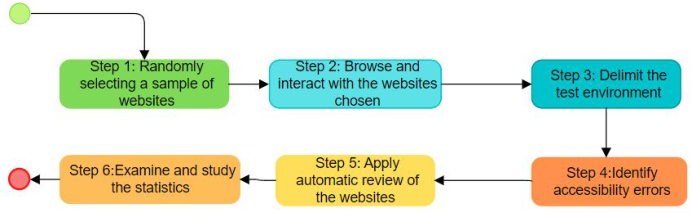
Figure 1: Evaluation of the accessibility.
Article (Acosta-Vargas et al., 2020b) argues that there are several webs, but not all of them are accessible, so it is required to create websites that comply with WCAG 2.1. The website is the one that has modernized the best with technical improvement and the pandemic; what was originally a scientific communication approach currently is the source of fundamental, instant, and financial information.
The opportunities for users regarding information are limitless; therefore, the web has become a brand new essential design tool for health specialists. The outcomes appear that the websites that offer information associated with COVID-19 require alternative text, empty links, form labels, and contrast errors. The websites examined in this research with WAVE (WebAIM, 2021) violated web accessibility requirements under WCAG 2.1 (World Wide Web Consortium, 2018).
Methodology and Case Study We started from a total sample of 198 websites taken from the official site of the Geneva Foundation for Medical Education and Research. The sample was then divided into three groups of 66 websites, and seven websites were taken randomly by applying the Excel function “RANDOM.BETWEEN(1;66)” from each group; finally, we obtained a total of 21 websites. The unit of analysis is each website that meets the sample parameters and therefore is part of the population and the sample. In assessing accessibility, we applied an automatic review method based on WCAG-EM 1.0; the applied method is described in the six steps (see Figure 1).
Step 1: We randomly selected 21 websites and applied them as case studies.Table 1 contains the 21 websites evaluated, including the country, website domain and URL.
Step 2: We explored each of the websites selected in the stage; we navigated and interacted on the first pages of each website.
Step 3: We identify the functions performed on each designated website; the accessibility level applied was AA (World Wide Web Consortium, 2018).
Step 4: We listed accessibility barriers and related them to WCAG 2.1. Step 5: We applied for automatic review with the WAVE tool (WebAIM, 2021) that includes the plugin component for Google Chrome, version 95.0.4638.69; three web accessibility experts participated in this stage. WAVE is a film set of assessment tools that helps developers make web
Table 1. Evaluated websites.
Table available in the original PDF paper.
# Country Domain URL 1 Argentina ar https://www.argentina.gob.ar/salud/coronavirus- COVID-19 2 Australia au https://www.health.gov.au/ 3 Azerbaijan az http://www.health.gov.az/ 4 Belgium be https://www.health.belgium.be/fr 5 Burkina Faso bf http://www.sante.gov.bf/ 6 Canada ca https://www.hc-sc.gc.ca/ 7 Cuba cu https://salud.msp.gob.cu/ 8 Kuwait kw https://twitter.com/kuwait_moh 9 Lesotho ls http://www.gov.ls/ministry-of-health/ 10 Malawi mw https://www.facebook.com/malawimoh 11 Monaco mc https://en.gouv.mc/Government-Institutions/ 12 Netherlands nl https://www.government.nl/ministries/ 13 Norway no https://www.regjeringen.no/en/dep/hod/id421/ 14 Mexico mx https://www.gob.mx/salud 15 Portugal pt https://www.dgs.pt/ 16 Puerto Rico pr http://www.salud.gov.pr/ 17 Qatar qa https://www.moph.gov.qa/ 18 Dominican Republic do http://digepisalud.gob.do/ 19 Sint Maarten sx http://www.sintmaartengov.org/government/ 20 Saint Vincent vc http://health.gov.vc/health/index.php/c 21 Saint Lucia lc https://www.covid19response.lc/
satisfaction more than accessible to persons with disabilities. WAVE helps recognize various accessibility errors by applying WCAG 2.1 and assists human assessment of web content.
Step 6: We recorded the dataset (Freire, Carlos; Rodriguez, Michelle- Abigail; Plaza Mendizabal, Ricardo; Acosta-Vargas, 2022) in an open access repository to explore and share the outcomes and find possible advancements.
Outcomes and Discussion
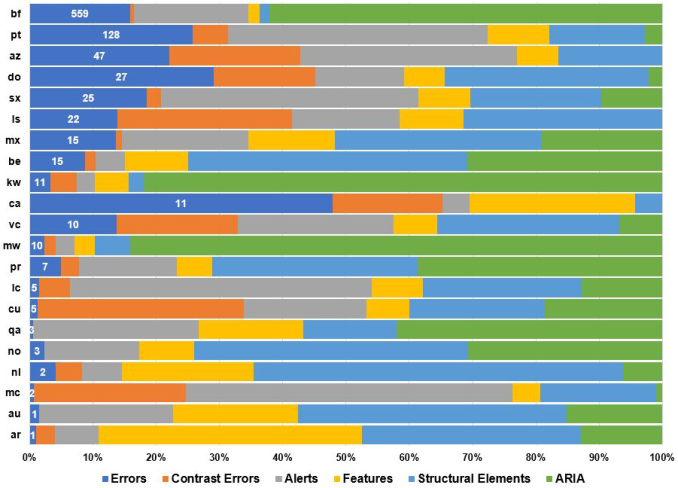
Table 2 includes the evaluation outcomes of the 21 websites assessed with the WAVE tool.
The most severe bugs need to be corrected urgently to help make the Web sites more accessible (see Figure 2).
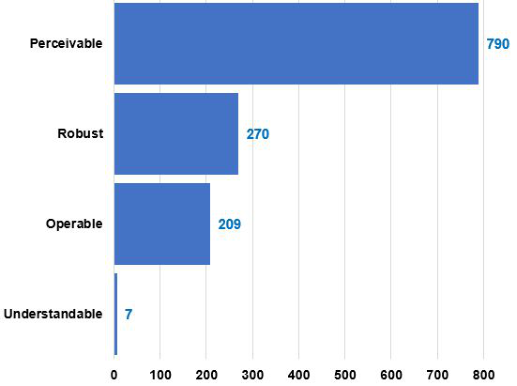
The accessibility problems are related to the Errors and Contrast Errors variables, corresponding to the websites of Burkina Faso, Portugal, Azerbai- jan, the Dominican Republic, and Sint Maarten (see Figure 3) reveals that the principle with the most barriers is perceivable with 790 barriers, equivalent to 61.9%; followed by robust with 270, which is 21.2%; then the operable with 209, is 16.4%; finally, the understandable principle with seven barriers and represents 0.5%.
Challenges in Achieving Accessibility on Official COVID-19 Websites 309
Table 2. Assessment of the accessibility of the 21 websites.
Table 3 includes the guidelines, success criteria, levels of WCAG 2.1, and the total barriers identified on websites that provide official information on COVID-19.
Figure 3: Accessibility principles.Table 3. Guidelines of WCAG 2.1.
Table available in the original PDF paper.
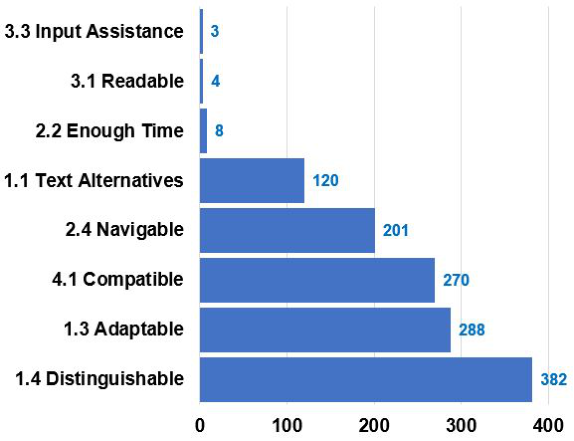
Guideline Success Criteria Level Total 1.1 Text Alternatives 1.1.1 Missing alternative text A 120 1.3 Adaptable 1.3.1 Info and Relationships A 288 1.4 Distinguishable 1.4.3 Contrast (Minimum) AA 382 2.2 Enough Time 2.2.2 Pause, Stop, Hide A 2 2.2 Enough Time 2.2.1 Timing Adjustable A 6 2.4 Navigable 2.4.4 Link Purpose (In Context) A 191 2.4 Navigable 2.4.6 Headings and Labels AA 10 3.1 Readable 3.1.1 Language of Page A 4 3.3 Input Assistance 3.3.2 Labels or Instructions A 3 4.1 Compatible 4.1.2 Name, Role, Value A 270
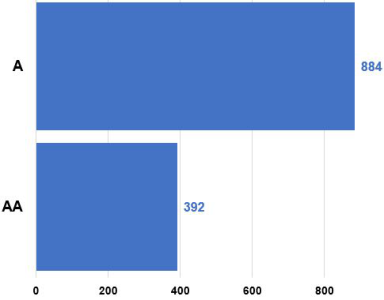
Concerning level A accessibility, there are 814 barriers, equivalent to 69.3%, followed by level AA with 392, representing 30.7% (see Figure 4). The results of the visual analysis show that the “success criterion” with the highest number of accessibility barriers belong to 1.4.3 associated with con- trast with a total of 382 barriers, representing 29.9%; followed by criterion 1.3.1 related to information problems totaling 288 barriers, corresponding to 22.6%; then 4. 1.2 with name, role, value problems total 270, representing 21.2%; then 2.4.4 associated with link purpose problems with 191 barriers, corresponding to 15%; finally, the rest of the criteria present values lower than 10% (see Figure 5).
Challenges in Achieving Accessibility on Official COVID-19 Websites 311
Figure 4: Levels of WCAG 2.1.Figure 5: Success criteria.
CONCLUSION
According to the results obtained, it is considered that the evaluated sites violate the accessibility principles agreeing to WCAG 2.1. Among the fur- thermost distinguished errors are focused on the principles of perceivable and robust, which confirmations that they are essential variable quantity of communication since they are straight associated to contrast, textual alter- natives, and compatibility with assistive technologies, especially for visually impaired users who use screen readers. Therefore, one of the characteristics urgently required to be enhanced is directly associated with these two princi- ples. Regarding the limitations, it is worth mentioning that the study could be accomplished by evaluating a more significant number of websites with a combined (Salvador-Ullauri et al., 2020) or heuristic method (Acosta-Vargas et al., 2019) that would include both manual and automatic verification. As
for future work is recommended to consider the barriers found in evalua- ting accessibility in mobile applications. Our investigation can contribute to upcoming analyses associated with accessibility to apply digital ramps open to many users with disabilities. Design a software tool that includes artificial intelligence to support the development of more accessible websites.
ACKNOWLEDGMENT
The authors thank CEDIA and Universidad de Las Américas-Ecuador, an internal research project INI.PAV.20.01.
REFERENCES Acosta-Vargas, P., Antonio Salvador-Ullauri, L., Lujan-Mora, S., 2019. A Heuristic Method to Evaluate Web Accessibility for Users with Low Vision. IEEE Access 7, 125634–125648. https://doi.org/10.1109/ACCESS.2019.2939068 Acosta-Vargas, P., González, M., Luján-Mora, S., 2020a. Dataset for evaluating the
accessibility of the websites of selected Latin American universities. Data Br. 28. https://doi.org/10.1016/j.dib.2019.105013 Acosta-Vargas, P., Hidalgo, P., Acosta-Vargas, G., Gonzalez, M., Guaña-Moya, J., Salvador-Acosta, B., 2020b. Challenges and improvements in website accessi- bility for health services, in: Advances in Intelligent Systems and Computing. pp. 875–881. https://doi.org/10.1007/978-3-030-39512-4_134 Acosta-Vargas, P., Luján-Moras, S., Salvador-Ullauri, L., 2017. Web Accessibility
Policies of Higher Education Institutions, in: Conference on Information Tech- nology Based Higher Education and Training. pp. 1–7. https://doi.org/10.1109/IT HET.2017.8067808 Alcaraz-Martínez, R., Ribera-Turró, M., 2020. An evaluation of accessibility of Covid-19 statistical charts of governments and health organisations for people with low vision. El Prof. la Inf. 29. Daniel, J., 2020. Education and the COVID-19 pandemic. Prospects 49, 91–96. https:
//doi.org/10.1007/s11125-020-09464-3 Freire, Carlos; Rodriguez, Michelle-Abigail; Plaza Mendizabal, Ricardo; Acosta- Vargas, P., 2022. (Dataset) Challenges in achieving accessibility on official COVID-19 websites. Mendeley Data V1. https://doi.org/10.17632/jk7tkhr8rx.1 Gorgenyi-Hegyes, E., Nathan, R.J., Fekete-Farkas, M., 2021. Workplace Health
Promotion, Employee Wellbeing and Loyalty during Covid-19 Pandemic—Large Scale Empirical Evidence from Hungary. Economies 9, 55. https://doi.org/10. 3390/economies9020055 Salvador-Ullauri, L., Acosta-Vargas, P., Gonzalez, M., Luján-Mora, S., 2020. Combined method for evaluating accessibility in serious games. Appl. Sci. 10. https: //doi.org/10.3390/APP10186324 Sultana, S., Methe, F.Z., Muhammad, F., Chowdhury, A.A., 2018. Knowledge
and practice regarding prevention of puerperal sepsis among postpartum women attending a private hospital in Bangladesh. Int. J. Res. Med. Sci. 6, 3264. WebAIM, 2021. WAVE Web Accessibility Evaluation Tool [WWW Document]. URL https://wave.webaim.org/ (accessed 1.26.22). World Health Organization (WHO), 2011. World report on disability 2011, Ameri-
can journal of physical medicine rehabilitation Association of Academic Physia- trists. https://doi.org/10.1136/ip.2007.018143 World Wide Web Consortium, 2018. Web Content Accessibility Guidelines (WCAG) 2.1 [WWW Document]. URL https://www.w3.org/TR/WCAG21/ (accessed 1.26.22)
LISTED IN THE AHFE DIGITAL BOOKSTORE CATALOGUE
Explore the complete digital volume
Human Factors and Systems Interaction
Read this individual research paper free through the original publisher, or explore the full digital proceedings book.
ISBN 978-1-958651-28-5
Explore this ISBN in the AHFE Bookstore ↗Listed in the July 2026 bookstore catalogue; search by ISBN to confirm current availability · Digital book purchase optional