Verónica-Gabriela Maldonado-Garcés, Elking Araujo, Mayra Carrión, Marco Santórum, Patricia Acosta-Vargas, Diana López, Mahatma Quijano, Luis Llanganate (2022). Designing a Serious Game to enhancement of musical skills of children using iPlus methodology. In: Human Factors in Virtual Environments and Game Design. AHFE Open Access, vol. 50, pp. 165–172. https://doi.org/10.54941/ahfe1002074
Serious Games have become a popular tool for knowledge transfer, behavioral, perceptual, or cognitive change, and valuable for developing or improving a specific area. The use of serious games for educational purposes can have a very positive effect; in our case, this area is related to the educational or psychological field, and its purpose is to strengthen the psychoeducational processes, allowing the achievement of an optimal and motivating learning process in the different stages of development of the human being. The current research focuses on constructing a serious game for the enhancement of musical skills of children using iPlus methodology. This game is aimed at children from 8 to 12 years old; however, it is not ruled out to be applied to adolescents, middle-aged, and elderly adults. The game is suitable for practicing and improving musical abilities such as memory, attention, and spatial perception by recognizing notes on the staff. The possibility of strengthening two essential psychological processes is also offered, not only for the acquisition of learning but also to solve life problems.
The evolution of education has taken a radical step from teacher-centered pedagogy to one in which the student is responsible for their learning. In this context, the educational task permanently requires active methodologies that allow the student to arouse interest and motivation to achieve meaning- ful learning. Incorporating ICTs into the teaching-learning process provides endless possibilities for innovation for both teachers and students. The con- stant evolution of technology allows education to renew the possibilities of acquiring knowledge, skills, and abilities. Beyond theoretical proposals, the
technology allows students and teachers to open new paths in their need to learn.
This range of possibilities also implies an improvement in the learning scenario. With technology, knowledge acquisition is no longer limited to the classroom space. The experience can be lived from multiple scenarios breaking the old barriers to which educational actors were once subjected. From this situation, the teacher and the student’s role is rethought. Similarly, learning and self-learning acquire other advantages and challenges.
Thanks to perception, we interpret external stimuli through our senses. For its part, memory is fundamental; without the acquisition and development of this process, the development of other functions such as language and reasoning would not be possible. Serious games have become a proposal that constitutes an essential tool for learning adapted to the current context. It is a challenge, not directly related to education but to political management, to ensure that all students, regardless of their socio-economic status, can access as many technological means as possibly linked to learning.
This paper presents a conceptual framework, describes the iPlus methodo- logy and the construction of a serious game to the enhancement of musical skills of children, the result of the implementation and evaluation section and finally, the conclusions developed because of the investigation are presented.
RELATED WORKS Currently, the study of serious games and their relationship with teaching and learning processes is relevant. In this way, we can mention the work done by (Juca Maldonado, F., García Saltos, M. B., & Burgo Bencomo, 2017) where it is mentioned that serious games are learning tools with didactic, autonomous, self-sufficient, and reusable pedagogical purposes, which allow players to obtain a set of knowledge and competences predominantly practical. For this to be a reality, serious games must be designed to justify their use. In the case of our work, the application has been created to allow the user to learn to recognize the notes of the staff, which also implies the possibility of improving psychological processes such as perception, attention, and memory; in short, strengthening integral learning.
The study (Leyva Regalón and Mayol Céspedes, 2019) researched serious games in training and cognitive rehabilitation, stating that the application of strategies and techniques in cognitive rehabilitation has been supported by using technologies (p.140). In addition, they conclude that, depending on the specific needs of a person, the technologies are applied in various ways, from alarms to remind individuals about their planning of medicines to the use of assistants, robotic, interactive, this strengthens the justification of our proposed research, it also offers a range of possibilities related to the age and conditions of the users. The proposed serious game could be included as part of intervention programs for people with cognitive deficits or in the application of preventive programs to avoid the progressive loss of cognitive processes, as is the case for older adults. However, as (Leyva Regalón and Mayol Céspedes, 2019) conclude, this is a field in constant development that requires many studies.
Designing a Serious Game to Enhancement of Musical Skills of Children 167
The intervention of psychological processes through serious games, as psychoeducational resources, allows learning to be improved through a meth- odology that arouses interest and motivation in the user, who is the builder of his learning with the support of technology built with training purposes. In this case, musical stimulation is added to the playful activity, which is intrinsi- cally attractive to users. The artistic reinforcement thus converts the resource into a promising path for improving the indicated areas.
The development of a serious game must be designed using an appropriate methodology. The player must feel that he is playing a game where the lear- ning is a consequence of the playing actions. The lack of a correct design of the SGs can cause those games to lose both their attraction and their game essence.
Previous studies by the authors (Carrión et al., 2020) argue that applying the user-centered design approach of the iPlus methodology was critical to the development of cognitive skills through temporal sequence resolution and vocabulary review.
Additionally, the authors (Salvador-Ullauri et al., 2020b) argue that serious games have been incorporated into teaching and learning. Due to the increase in their use, the need arises to comprehensively ensure their accessibility to include people with disabilities in educational environments. The results sug- gest that accessibility should be included in developing serious games based on Web Content Accessibility Guidelines (WCAG) 2.1 (World Wide Web Consortium, 2018) like in the study (Salvador-Ullauri et al., 2020a).
DESIGNING A SERIOUS GAME USING iPLUS METHODOLOGY A Serious Game to the Enhancement of Musical Skills of Children
Serious games have shown that it is possible to learn while you play. This tea- ching method is known as game-based learning; in our case, we use a serious game in the teaching and learning processes regarding music and instruments.
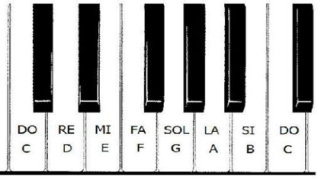
According to (Vargas and María, 2010), the raw material of music is sound, a physiological phenomenon that originates in the inner ear, and its material base is sound vibration. A musical sound has at least four proper- ties: duration, intensity, pitch, and timbre. Musical hearing encompasses at least 3 characteristic domains: sensory, affective and mental hearing. There- fore, training a student in music means stimulating their auditory capacities within the three characteristic domains of musical hearing. For the current project, the iPlus methodology has been used to correctly manage the develo- pment of the serious game called “Mozart’s musical adventure,” which aims to improve the musical recognition of notes by stimulating auditory memory through a scenario composed of musicals blocks. These blocks are based on Anglo-Saxon and Spanish-American musical scale notation (see Figure 1).
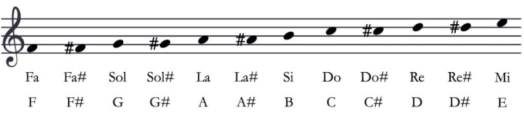
On the other hand, The project aims to enable the student to recognize the notes of a staff. These notes are related to the basic and sharp scale explained above. In this way, the student can improve his auditory memory and learn the representation of musical notes on the staff. (see Figure 2).
In this document, we explain in a general way the process carried out with the iPlus methodology for the implementation of this serious game, ranging
Figure 1: A major Piano scale.Figure 2: Pentagram in treble clef.
from the identification of initial purposes through interviews with interested users and the creation of user stories that are inputs for the implementation of the game in the Unity game engine.
iPlus Methodology iPlus (Carrión-Toro et al., 2020) is a user-centered methodology for SG design that presents a participatory approach, offering a phase to ascertain consensual requirements through the participation of various experts.
Phase 1. Identification: Resultant artifacts: Here, the general problem is defined by the interested party, and, depending on the situation, participants in the methodology are identified. Description: A serious game is required for the enhancement of musical skills. This study case involves an expert in pedagogy, responsible for defining pedagogical objectives, the product owner, a music specialist teacher, a video game designer, the software developer, and end-users.
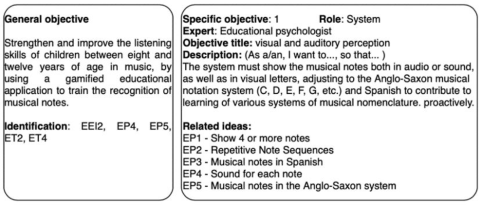
Phase 2. Pedagogical Objectives: Resultant artifacts: In this phase, the general and specific objectives are defined as participatory and agreed upon under the pedagogical expert’s guidance. Description: We interviewed an expert in educational psychology, a child educator and two experts on the subject to better understand how the expert understands the users’ needs. An affinity diagram defines the objectives (see Figure 3).
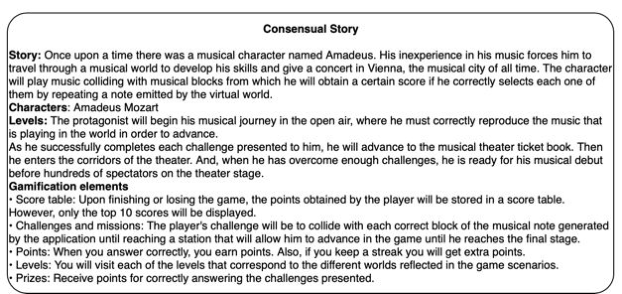
Phase 3. Ludic Game Script: Resultant artifacts: This phase aims to create the “Game Design Document” (GDD) based on the Product Owner’s needs or requirements. Then, with the selected ideas, the participants and the sub- ject expert create the game script that contains the narrative, characters, and gamification elements such as badges, points, prizes, among others, which can be implemented in the SG. Description: The result of this phase is the game script format or consensual story. In this serious game, it was based on showing how Amadeus (first name of the composer, pianist, conductor, and teacher Wolfgang Amadeus Mozart) seeks to get to give concerts in Vienna
Designing a Serious Game to Enhancement of Musical Skills of Children 169
Figure 3: General objective and specific objective.Figure 4: Game script for the serious game.Figure 5: GamePlay card.
through a series of worlds and levels. The following (see Figure 4) summari- zes the aspects that allow the reader to have a complete idea of the serious game.
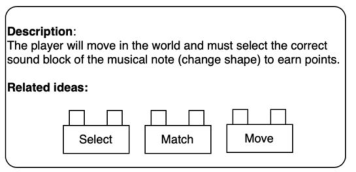
Phase 4. GamePlay: Resultant artifacts: Here, experts define the GamePlay blocks. They are used to describe the functionalities that are part of the game. Additionally, the genre of the game is identified. Description: The Gameplay blocks are related to hold, move, position, and points such as “A player wins points when holding, positioning or moving an object. An example of the proposed Gameplay blocks is shown (see Figure 5). Additionally, Stakehol- ders define the game genre as reasoning because it involves problem-solving skills.
Phase 5. Refine Resultant artifacts: After going through the ideation pro- cess, GamePlays need to be filtered to eliminate repetitive or impossible
Figure 6: Resultant user story.Figure 7: Game screens.
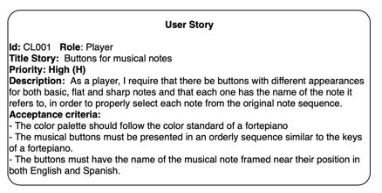
aspects to create from the pool of ideas. Description: User stories that repre- sent a short description of characteristics of the game expressed as user needs (see Figure 6).
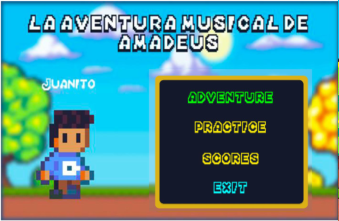
The Game Implementation As mentioned above, our case study deals with teaching and learning proces- ses regarding music and instruments, stimulating auditory memory through a scenario composed of musical blocks. The serious game was developed using the Unity cross-platform game engine. The serious game’s different interfa- ces (modules) were implemented. The first consists of the player starting a session by typing a name or alias. Once the player has pressed the enter button, it displays its initial menu. Here, the player can choose between opti- ons according to his preferences (see Figure 7 on the left). The first option, “Adventure,” allows entering the primary mode of the serious game where the player must pass each level, avoiding mistakes until reaching the end (see Figure 7 right). The “Practice” option allows the player to interact with the different blocks on the screen to practice his ear and remember each mar- ked note’s sounds. There is the “Scores” screen where the player can see a board that indicates the names or aliases of the ten players with the high- est score obtained so far. In this way, practice is encouraged through healthy competition.
OUTCOMES AND DISCUSSION We applied a manual review method of accessibility evaluation based on the four accessibility principles of the Web Content Accessibility Guidelines
Designing a Serious Game to Enhancement of Musical Skills of Children 171
Table 1. Accessibility barriers.
Table available in the original PDF paper.
Id Barrier Principle Success Level Compliance criteria G1 Easy-to-read font Perceivable 1.1.1 A 1 G2 Text alternatives Perceivable 1.1.1 A 1 G3 Closed captioning Perceivable 1.2.4 AA 0 G4 Adjusting display settings Perceivable 1.3.4 AA 0 G5 Use of color Perceivable 1.4.1 A 1 G6 Well-spaced elements Perceivable 1.4.12 A 1 G7 Good audio techniques Perceivable 1.4.2 A 1 G8 Images as sharp as possible Perceivable 1.4.5 AA 1 G9 Visual presentation Perceivable 1.4.8 AAA 1 G10 Accessible keypad Operable 2.1.1 A 1 G11 Luminance flash Operable 2.3.1 A 0 G12 Animation of interactions Operable 2.3.3 AAA 1 G13 Help Understandable 3.3.5 AAA 1 G14 Consistent navigation Robust 4.1.3 AA 1
100.0%
63.6%
50.0%
18.2% 9.1% 9.1% 0.0%
AAA AA Perceivable Operable Understandable Robust
Figure 8: Accessibility principles.
Figure available in the original PDF paper.
(WCAG) 2.1; Table 1 presents the identifier, accessibility barriers, principle, success criteria, level and compliance. The number (1) is applied when it complies with the analyzed barrier, (0) if it does not comply.
From the results, we observe that the accessibility principle that is most complied with is perceivable (63.6%), followed by operable (18.2%), under- standable and robust (9.1). Levels A and AA add up to 73.7%, so the application can be considered moderately accessible (see Figure 6). Corre- ctions to the identified barriers will be applied to achieve an accessible and inclusive product in future work.
CONCLUSION
We suggest applying iPlus methodology, a user-centered methodology for designing Serious Games. It incorporates a participatory, flexible and user- centered approach, adaptable to users with non-standard knowledge. The construction of the Serious Game to improve children’s musical skills with iPlus offers a phase for determining consensual requirements through the participation of several experts. The iPlus methodology allows generating more accessible software products so that software development experts can obtain and use user stories as the input to any software methodology.
It should be noted that this application meets most of the guidelines for visually impaired people, including easy-to-read letters, text alternatives, adequate contrast, well-spaced elements, good audio techniques.
We suggest an accessibility evaluation throughout the application develo- pment cycle to create usable, accessible, and inclusive applications for future research.
We suggest socializing the iPlus methodology with the software developer community to generate applications that guarantee user satisfaction and start researching new user-centered methodologies.
ACKNOWLEDGMENT
The authors would like to thank PUCE for funding this publication.
REFERENCES
Carrión-Toro, M., Santorum, M., Acosta-Vargas, P., Aguilar, J., Pérez, M., 2020.
iPlus a user-centered methodology for serious games design. Appl. Sci. 10, 9007. Carrión, M., Santórum, M., Sampredro, C., Paredes, A., Ortiz, Y., Samaniego- Santillán, P., Pérez-Medina, J.-L., Acosta-Vargas, P., Corrales-Gaitero, C., Maldonado-Garcés, V., 2020. Designing a serious game for labor inclusion of people with intellectual disabilities using iplus methodology. https://doi.org/10. 1007/978-3-030-51828-8_79 Juca Maldonado, F., García Saltos, M. B., & Burgo Bencomo, O., 2017. Serious
games and their influence on responsible energy use and environmental care. Rev. Univ. y Soc. 9, 129–136. Leyva Regalón, J.A., Mayol Céspedes, I., 2019. Serious games in cognitive training and rehabilitation. Rev. Cuba. Informática Médica 11, 140–157. Salvador-Ullauri, L., Acosta-Vargas, P., Gonzalez, M., Luján-Mora, S., 2020a.
Combined method for evaluating accessibility in serious games. Appl. Sci. 10. https://doi.org/10.3390/APP10186324 Salvador-Ullauri, L., Acosta-Vargas, P., Luján-Mora, S., 2020b. Web-based serious games and accessibility: A systematic literature review. Appl. Sci. 10, 1–25. https: //doi.org/10.3390/app10217859 Vargas, K.M.R., María, K., 2010. Music education and its impact on development.
Rev. Educ. y Desarro. 53–60. World Wide Web Consortium, 2018. Web Content Accessibility Guidelines (WCAG) 2.1 [WWW Document]. URL https://www.w3.org/TR/WCAG21/ (accessed 1.26.22).
LISTED IN THE AHFE DIGITAL BOOKSTORE CATALOGUE
Explore the complete digital volume
Human Factors in Virtual Environments and Game Design
Read this individual research paper free through the original publisher, or explore the full digital proceedings book.
ISBN 978-1-958651-26-1
Explore this ISBN in the AHFE Bookstore ↗Listed in the July 2026 bookstore catalogue; search by ISBN to confirm current availability · Digital book purchase optional