Verónica Maldonado-garcés, Elking Araujo, Mayra Carrión Toro, Erick Mayorga, Cristhian Muñoz, Ariel Pillajo, Marco Santórum (2023). Design of a serious game for the improvement of reading comprehension through the IPLUS methodology. In: Intelligent Human Systems Integration (IHSI 2023): Integrating People and Intelligent Systems. AHFE Open Access, vol. 69, pp. 524–532. https://doi.org/10.54941/ahfe1002873
Reading understanding is an indispensable ability for the educational training of every citizen. Designates a higher level than the mere fact of reading (decoding lingülistic signs). While reading already implies a great cognitive advance for anyone, reading comprehension requires more skills. Understanding a text always requires three previous areas. Two of them refer to basic functions: memory and attention. The other to training: is the knowledge of the world.However, even if there are these three elements, if there is not sufficient motivation and training approach to various types of texts, the degree of reading comprehension will be poor.In Ecuador, reading comprehension levels are still low. The standardized tests that the Ecuadorian State has applied to students for admission to public universities for 10 years are evidence of the serious delay in this skill. This situation would also explain the low levels of performance in other subjects, as well as the little cultural and educational development of the general population.The causes that contribute to this low reading comprehension of the Ecuadorian student population are multiple. They range from the high cost of the book, low access to technology, the absence of a network of public libraries throughout the country, an educational system with reluctant teachers to apply innovative methodologies for reading stimulation, etc.The insufficient application of innovative methodologies for reading stimulation has built the myth that reading is boring. Young people do not read because nothing in the social environment invites them to do so demonstrating that it is an authentically attractive and useful activity. In this context, this research set out to build a gamified application for the development of students reading students from 12 to 16 years of age.For the creation of this application, the IPLUS methodology and the Videujeos Roblox Studio Development tool were used. This video game allows to train students reading skills, through the use of exercises resolution in multiple choice questions and the Cloze test. Both modalities are based on understanding a text and selecting the correct answer from a set of options. While multiple choice questions are based on the text, for the Cloze test the words omitted systematically in a written text that contain empty spaces must be located. This anima was implemented in a 3D world in Roblox so that the student can strengthen his ability to reading his reading comprehension.Iplus is a methodology created for the design of serious games for educational purposes. This methodology uses a participatory approach focused on the user where requirements are taken with experts in pedagogy and the subject. The main phases of this methodology are identification, pedagogical objectives, game script, gameplay, and refinement.Regarding the implementation of the serious game, the gamified application contains challenges to strengthen reading comprehension in the player in different themes or missions: Costa, Sierra, and East, the three regions that make up the Ecuadorian territory. Each of the scenarios contains instruction signs, a Start button, a blackboard to enter the correct answer, and response options.This gamified application in Roblox is aimed at being a tool for learning and strengthening reading comprehension in school students close to paying the transform exam, the standardized access test to public universities. This can be done independently by students or being a support tool for teachers and their students since reading comprehension skills are applicable for a lifetime.With this work, the IPLUS methodology and the Roblox Studio software create a thematic environment where reading comprehension becomes a skill resulting from the player's enjoyment has been used. Stimulation and reading shake hands thanks to this application.The results obtained suggest that the gameplay can be improved to offer greater feedback to the user about the search for the correct answer to be such an extensive scenario. Finally, this application can expand its scope by using its playability dynamics to other areas of knowledge such as mathematics, natural sciences, and social sciences.Regardless of the extension of the readings, in the design, the extension of the texts can be adapted as well as their complexity so that the reading skill can be graduated. The application works very well with short texts such as those required by the Cloze test.
Reading comprehension can be defined as a competence for life, indispensa- ble for learning and thinking. It is considered one of the generic competencies for education, which is why it is appreciated as an area of evaluation in the admission processes of educational institutions at all levels (Andrade and Utria, 2020).
The level of reading comprehension is the degree of development reached by the reader in obtaining, processing, evaluating, and applying the informa- tion contained in the text. It includes the independence, originality, and crea- tivity with which the reader evaluates the information (Cervantes et al. 2017).
Design of a Serious Game for the Improvement of Reading Comprehension 525
For some authors (Cervantes et al. 2017), reading is a fundamental tool in the development of personality, but it is also a tool for socialization as an essential element for living together in democracy and developing in soci- ety. Reading not only provides information (instruction), but also forms (educates), creating habits of reflection, analysis, effort, and concentration.
On the other hand, the process of reading comprehension can be under- stood as an operation in which two types of activities are involved: some basic and others at a higher level. Basic activities comprise the decoding of the text that, at a higher level of reading development, a person executes automati- cally (Araujo et al. 2022). In this sense, from the initial processes of reading and writing acquisition, teachers work to ensure that a student understands what he or she reads and therefore can internalize what is learned through reading. However, this achievement of understanding what we read is not an acquired process in all people. And in high percentages, it is the triggering fact of diagnoses related to a learning difficulty at all educational levels. In addition, it can be the cause of poor performance in the workplace.
It is important to analyze what happens with reading comprehension levels in university students. Let us remember that, at the higher level, reading constitutes an unavoidable requirement for access to autonomous learning knowledge (Araujo et al. 2022). However, reading processes are not uni- que: they are based on other skills that must be appropriately developed. These skills include attention, knowledge of the language, and knowledge of the world (Bruning et al. 2005). Training before higher education should ensure that these skills are sufficiently developed in young people so that they can learn the levels and genres of reading that the professional environment demands.
In Latin America, several studies have found that 70% of students entering higher education have reading comprehension failures. Likewise, these stu- dies have shown, in addition to low performance, inadequate use of strategies to facilitate comprehension (Andrade and Utria, 2020). These researchers, after conducting research related to the level of reading comprehension, where 1,125 students of the first level of a Colombian university were eva- luated, define that the results obtained are consistent with other studies that affirm that in general university students present low levels of literacy, which does not contribute in a positive way to their formative process or gra- dual incorporation into the scientific and professional community of their discipline of study.
In another research conducted by (Cervantes et al. 2017), in a Mexican educational institution of the Upper Middle level that is part of the National System of Technological Education, researchers state that students present serious difficulties concerning reading comprehension. One of them consists of insufficient lexical and semantic knowledge, which must be remedied for students to perceive and decode the text in its entirety.
In Ecuador, the research “Evaluation of reading comprehension in recent university students in Ecuador” by (Araujo et al. 2022) concludes that 61.17% of the students evaluated in reading comprehension present pro- blems in inferring the structure of a written text. The inference process depends to a large extent on the subject having the necessary prior knowledge
related to what he/she is reading. Presenting difficulties in inferring the stru- cture of the text will cause an inefficient comprehension of what is read and, therefore, meaningful learning will not take place.
Low reading skills may be due to multiple personal factors (attention problems, lack of previous knowledge, low lexical acquisition) and social factors (difficult access to books, non-reading family environment, unsti- mulating educational level, etc.). In the scope of our research, we propose a technological resource that helps to remedy the personal causes of low reading levels, i.e., attention, knowledge of the world, and lexical acquisition.
Therefore, this research group worked on the creation of a serious game to improve reading comprehension levels using the iPlus methodology. This product is a collaborative work between professionals in the areas of Educational Psychology, Linguistics, and Computer Engineering.
Through Serious Games, students- and the general public- can exercise, strengthen, and improve their reading skills in the three areas noted (Carrion et al. 2019). The playful nature of the resource ensures user motivation, a fact directly related to attention. The challenging activities that users must overcome contribute to the gradual acquisition of lexical and general know- ledge that will subsequently improve performance in written texts of different levels.
The serious game is designed for young students between the ages of 12 and 17 years old who are studying at the basic higher education and high school levels in schools in Ecuador. We intend the game to be, in addition, a prepa- ration for university entrance exams since all of them include the evaluation of reading comprehension and areas related to reading and writing.
METODOLOGY Reading is one of the most critical components of any language and it is an essential tool for lifelong learning. For many reading-disabled students, reading comprehension is a significant problem, someone can read fluen- tly and still have poor comprehension. It happens when a child’s decoding skills are more developed than their ability to understand a text. Here we propose a game that aims at strengthening underlying cognitive skills, inclu- ding processing speed, short-term memory, working memory, and logical thinking.
iPLUS Methodology iPlus (Carrión-Toro et al. 2020) is a user-centered methodology for SG design that presents a participatory approach. The iPlus design approach is flexi- ble, can be used to design any serious educational game, and offers a design approach integrated with other agile methods. The design process begins by defining the problem according to its specific needs and defining the expe- cted learning outcomes. The story design and the pedagogical objectives are essential, together with the conception of a delightful and playful setting. iPlus aims to take advantage of motivational factors designed through game mechanics to offer interactive learning.
Design of a Serious Game for the Improvement of Reading Comprehension 527
iPlus comprises a series of ordered steps organized into five phases. Phase 1. Identification: Here, the general problem is defined by the intere- sted party, and, depending on the situation, participants in the methodology are identified.
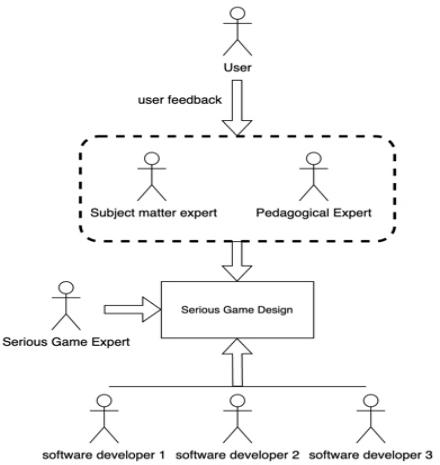
Result of this phase: A serious game is required to strengthen underlying cognitive skills, including processing speed, short-term memory, working memory, and logical thinking. The specification of the stakeholder needs phase involves a subject matter expert, a subject matter expert, and a game designer. In addition, the methodology facilitator and the software developers and end-users are involved (see Figure 1).
Figure 1: Identification phase: experts and users.
Phase 2. Pedagogical Objectives: In this phase, the general and specific objectives are defined as participatory and agreed upon under the pedagogical expert’s guidance.
Result of this phase: The objective defines what the game wants to achieve “To train reading comprehension skills for the development of aca- demic activities and a better performance in the college entrance exam” (see Table 1).
Phase 3. Ludic Game Script: This phase aims to create the “Game Design Document” (GDD) based on the Product Owner’s needs or requirements. Then, with the selected ideas, the participants and the subject expert cre- ate the game script that contains the narrative, characters, and gamification elements such as badges, points, and prizes, among others, which can be implemented in the SG.
Table 1. Pedagogical objectives description.
Table available in the original PDF paper.
General objectives Specific objectives “To train reading comprehension skills for the development of academic activities and a better performance in the college entrance exam” Number: 5 Priority: High Role: Pedagogical expert Role in the game: Player Objective title: Strengthening player reading comprehension Description: The player will be able to navigate through different scenarios by activating different gameplay mechanics that will capture his attention and generate the enjoyment of activities to stimulate his memory and allow him to reflect and inspect the meaning of what he reads. Atmosphere (temperature, pressure, humidity, quality, etc.)
Related ideas (orange post it notes): ID: 5 The player will be able to navigate through different scenarios by activating different gameplay mechanics that will capture his attention and generate the enjoyment of activities to stimulate his memory. ID: 5.1 Multiple choice questions ID: 5.2 Cloze test questions ID: 5.3 Attention and memory activation ID: 5.4 Exercises for students between 16 and 18 years of age
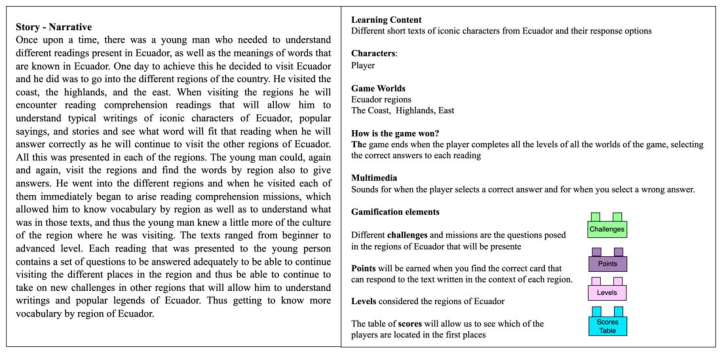
Figure 2: Consensual game script.
Result of this phase: The result of this phase is the game script format or consensual story. The game consists of touring Ecuador, exploring its regi- ons, and appreciating its diversity, such as the “Reventador” volcano, the “Amazonas” river, alpacas, and shrimp boats. The player must understand a text and select the correct answer from a set of multiple-choice questions. Also, we implemented the Cloze test (Sukarni, 2021), where players must locate the omitted words systematically in a written text containing gaps. Figure 2 summarizes the aspects that allow the reader to have a complete idea of the serious game.
Design of a Serious Game for the Improvement of Reading Comprehension 529
Phase 4. GamePlay: Here, experts define the GamePlay blocks. They are used to describe the functionalities that are part of the game. Additionally, the genre of the game is identified.
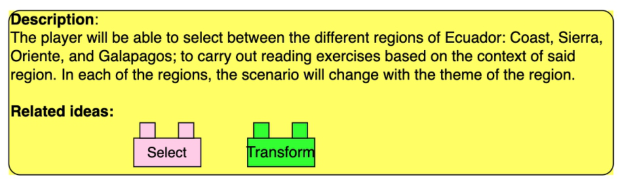
Result of this phase: The Gameplay blocks are related to holding, moving, position, and points such as “The player will be able to select among the different regions of Ecuador: Coast, Highlands, East, and Galapagos to per- form reading exercises based on the context of that region (see Figure 3). In each of the regions, the scenario will change with the theme of the region”. Additionally, stakeholders define the game genre as reasoning and adventure because the player assumes the role of a protagonist and the game involves problem-solving skills.
Figure 3: GamePlay cards.
Phase 5. Refine Resultant artifacts: After going through the ideation pro- cess, GamePlays need to be filtered to eliminate repetitive or impossible aspects to create from the pool of ideas. The requirements ideas are filte- red by means of a refinement matrix, which evaluates a list of criteria (Clear and unambiguous, Feasible, Correct, Appropriate, Verifiable, Completeness, Necessary, Unique, conforms to these standards, Consistent, Modifiable, Traceable) that define whether a requirement is a good or not.
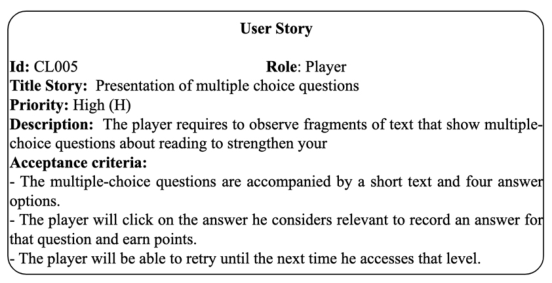
Result of this phase: User stories that represent a short description of cha- racteristics of the game expressed as user needs. Table 2 shows the result of the evaluation of the purposes or ideas obtained in the phase of pedago- gical objectives and the evaluation of the GamePlay cards, obtained in the GamePlay phase. These are evaluated according to the required properties and are considered by those who pass the evaluation with the mandatory properties. In other words, if your calculation is greater than seven, that need is considered for the design of the game. Figure 4 shows a resultant User Story.
Figure 4: Resultant user story.Table 2. Evaluation of the purposes and GamePlay obtained.
THE SERIOUS GAME IMPLEMENTATION As mentioned above, our case study deals with reading comprehension, sti- mulating reading skills through a game that consists of going through the regions of Ecuador while facing some reading comprehension challenges from beginner to advanced level. Each reading will contain a set of questions rela- ted to it, which the player will have to answer. Once the player succeeds, he/she will be able to take on new challenges in the other regions that will allow him/her to understand typical writings of iconic Ecuadorian characters, popular sayings, stories, and legends. and legends.
What is valuable about the serious game presented in this publication is that it has been designed in an interdisciplinary manner and is based on the needs and interests of students who need to improve their reading comprehen- sion levels to gain admission to universities and achieve an adequate student trajectory with a view to their inclusion in the labor market.
Design of a Serious Game for the Improvement of Reading Comprehension 531
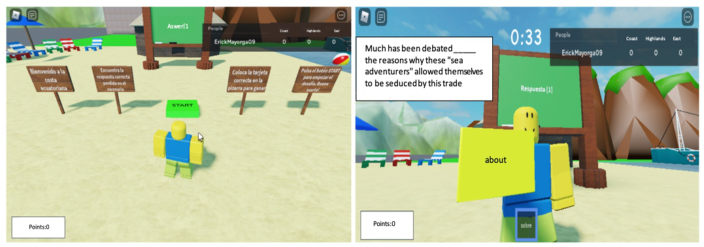
The serious game contains challenges to strengthen the player’s reading comprehension in different themes or missions: “The coast”, “The high- lands”, and “the east”. Each of the scenarios contains instruction signs, a start button, a board to enter the correct answer, and answer option cards.
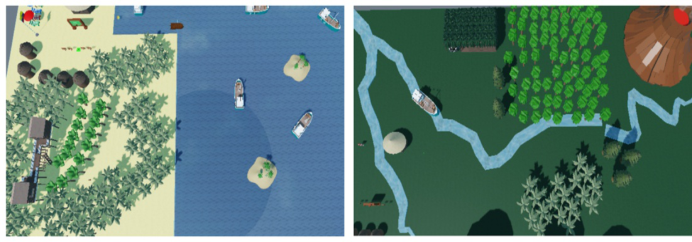
Figure 5 shows the coast and Amazonia scenarios of Ecuador. Ecuadorian coast where elements such as houses and wooden huts in the style of the coa- stal communities are detailed. Additionally, animals common to the region such as the shrimps are placed on the stage along with fishing boats in an aquatic setting. The East of Ecuador or Amazonia where part of the Ama- zon River and an emblematic volcano such as the “Reventador” can be seen. Ecuadorian Sierra is represented by mountains and green areas with typical animals of the region such as Alpacas.
Figure 5: Game screens.
When running the game, the player must choose one of the worlds or sce- narios. The player must click on the Start button, which will start the quiz game with a maximum response time of five minutes for the player to find the cards with the correct answer. To win the challenge, the player places the correct answer card on a blackboard in the scenario and it will display the message “Correct answer”, otherwise the message “Wrong answer” is displayed. Figure 6 shows the game scenario.
Figure 6: Cloze test questions game.
When all questions are answered correctly, the leaderboard is updated, showing on the right side of the screen the highest scores as a function of time. This illustrates the inclusion of Gamification game mechanics.
CONCLUSION
Games for improving reading comprehension can be valuable tools to help people refine their reading comprehension. Instead of taking a traditional approach to teaching, games can engage learners more interactively. Our serious game helps to remedy the personal causes of low reading levels, i.e., attention, knowledge of the world, and lexical acquisition.
The construction of the Serious Game to improve reading comprehen- sion skills with iPlus offers a phase for determining consensual requirements through the participation of several experts. iPlus methodology allows gene- rating more accessible software products so that software development experts can obtain and use user stories as input to any software methodology. We suggest applying the iPlus methodology, a user-centered methodology for designing Serious Games. It incorporates a participatory, flexible, and user-centered approach, adaptable to users with non-standard knowledge.
ACKNOWLEDGMENT
The authors would like to acknowledge the financial contribution of PUCE and the support of research of LudoLab – EPN.
REFERENCES
Andrade, L., & Utria, L. (2020). Niveles de comprensión lectora en estudiantes universitarios. Revista Palobra, 80–95. Araujo, E., Maldonado, V., & Sevilla, M. (2022). Evaluación de la comprensión
lectora en estudiantes de reciente ingreso de una carrera universitaria en el ecuador. revista Campo Abierto de la Universidad de Extremadura., 13–33. Bruning, R., Schraw, G., Norby, M., & Ronning, R. (2005). Psicología cognitiva y de la instrucción. Madrid: Pearson. Cervantes, R. D., Pérez, J. A., & Alanís, M. (2017). Niveles de comprensión lectora.
Sistema CONAPEL. Revista Internacional de Ciencias Sociales y Humanidades SOCIOTAM, 73–114. Carrion, M., Santórum, M., Flores, H., Aguilar, J., & Perez, M. (2019, November). Serious game, gamified applications, educational software: a comparative study. In 2019 International Conference on Information Systems and Software Technologies (ICI2ST) (pp. 55–62). IEEE. Carrión-Toro, M., Santorum, M., Acosta-Vargas, P., Aguilar, J., & Pérez, M. (2020).
iPlus a user-centered methodology for serious games design. Applied Sciences, 10(24), 9007. Sukarni, S. (2021). The Use of Cloze Test To Test Reading Comprehension of Non- English Department Students. Jo-ELT (Journal of English Language Teaching) Fakultas Pendidikan Bahasa & Seni Prodi Pendidikan Bahasa Inggris IKIP, 8(1), 74–82.
LISTED IN THE AHFE DIGITAL BOOKSTORE CATALOGUE
Explore the complete digital volume
Intelligent Human Systems Integration (IHSI 2023): Integrating People and Intelligent Systems
Read this individual research paper free through the original publisher, or explore the full digital proceedings book.
ISBN 978-1-958651-45-2
Explore this ISBN in the AHFE Bookstore ↗Listed in the July 2026 bookstore catalogue; search by ISBN to confirm current availability · Digital book purchase optional